

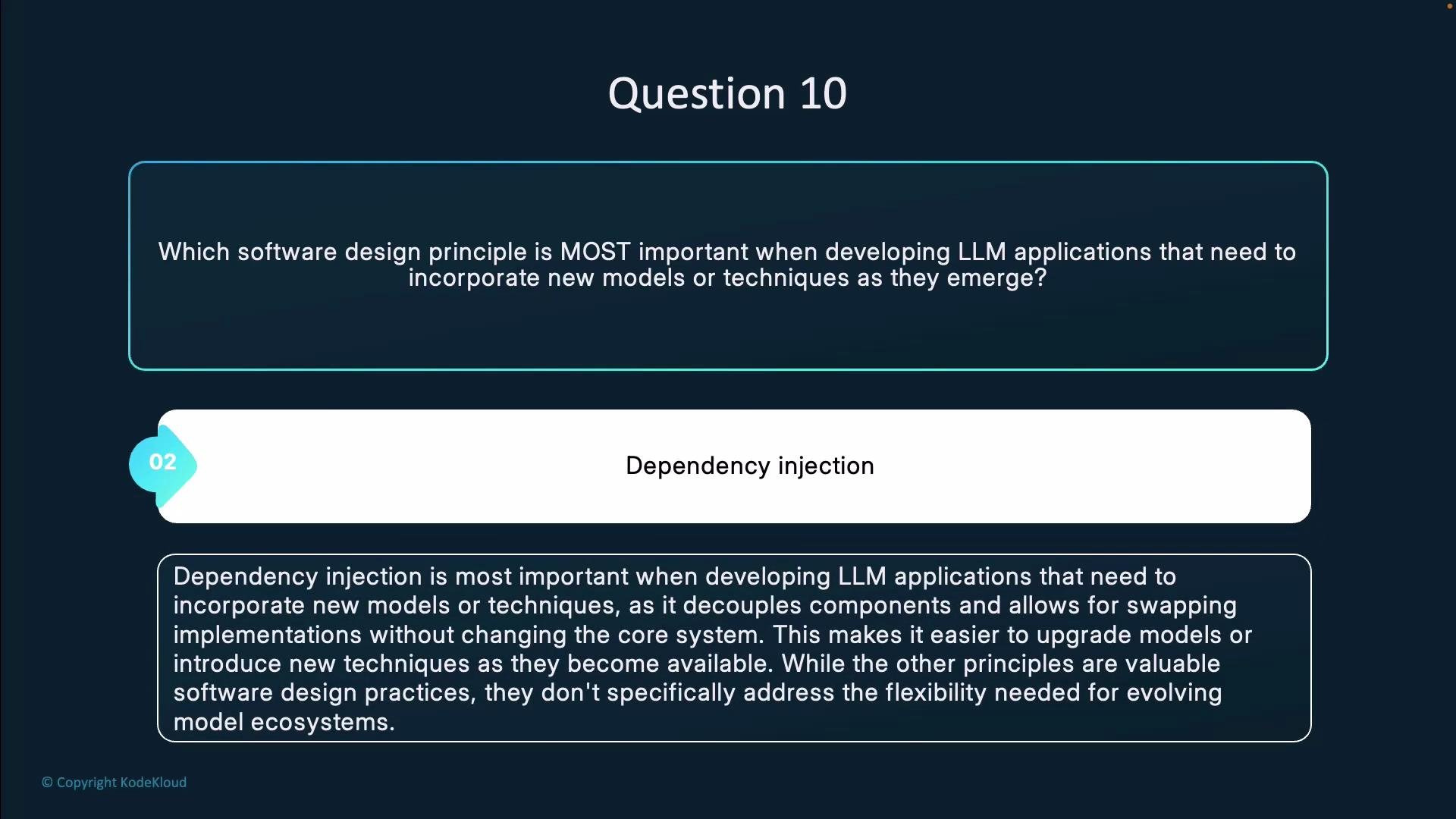
- Decoupling: Keep model selection, loading, and runtime invocation separate from business logic so the core pipeline remains stable when models change.
- Testability: Inject mock or stub model implementations for unit and integration tests without altering application code.
- Configurability: Select models, providers, or strategies through configuration, dependency injection containers, or plugin registries at runtime.
- Extensibility: Add new model adapters (e.g., local runtime, cloud API, experimental prototype) by implementing a defined interface and registering it with the DI system.
- Define clear interfaces for: model inference, tokenization, input validation, and output postprocessing.
- Use factories or a DI container to bind concrete implementations (e.g., local model adapter, remote API client, or experimental adapter).
- Keep wiring and configuration separate from business logic so feature teams can swap implementations via config changes or environment variables.
- Combine DI with feature flags or strategy patterns for safe rollouts and A/B testing of new models or techniques.
When designing an LLM system, define interfaces for inference, tokenization, and data pipelines. Use factories or a DI container to wire concrete implementations (local models, cloud APIs, or experimental prototypes) so switching or testing them requires minimal changes.
Best practice summary
- Prioritize DI to enable model/provider swapping, runtime selection, and easier testing.
- Apply SRP to keep components small and focused so DI bindings are simple and predictable.
- Use immutability where appropriate (e.g., for request payloads) to reduce side effects in concurrent systems.
- Employ the command pattern or strategy pattern for complex orchestration, but wire those patterns through DI so their implementations remain replaceable.
- Dependency Injection (Martin Fowler)
- Design Patterns: Strategy and Factory
- Best practices for ML system design