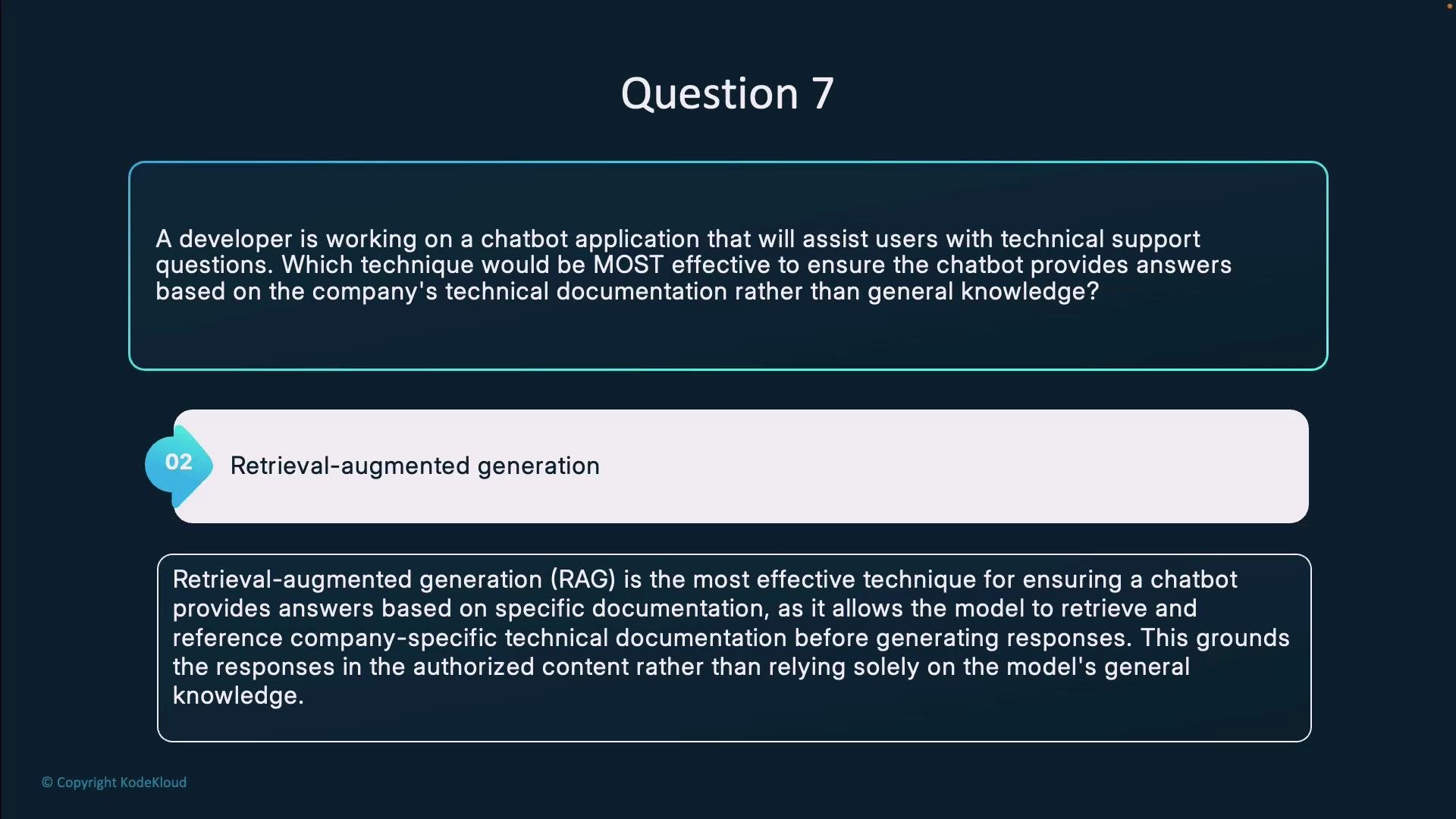
- Grounding: RAG conditions the LLM’s output on retrieved documents so responses are tied to the company documentation rather than only the model’s pretraining.
- Freshness and scope control: You can update the indexed documents independently of the generative model, keeping answers aligned with the latest documentation.
- Traceability: Retrieval enables returning source passages or citations alongside answers, aiding verification and compliance.
- Practical architecture: RAG maps well to a production stack that includes embeddings, a vector database, and a generative LLM that fuses retrieved context into final answers.
- Preprocess and index company documentation (chunking, embedding, and storing vectors in a vector database).
- At query time, embed the user query and retrieve the top-k most relevant passages using vector search.
- Provide the retrieved passages as context to the generative model (often prepended to the prompt or used in a dedicated fusion module).
- Return the model’s response along with source citations or links to the retrieved documentation.
- Reinforcement learning from human feedback (RLHF): Useful for aligning behavior and improving conversational quality, but does not guarantee grounding in external documents by itself.
- Adversarial training: Improves robustness to tricky or malicious inputs, but does not provide document grounding.
- Self-supervised learning: Enhances general representations and knowledge from unlabeled data, but does not constrain responses to a specific documentation corpus.
- Use a high-quality embedding model that captures semantic similarity for your domain.
- Chunk documents into reasonably sized passages (e.g., 200–1,000 tokens) with overlap to preserve context.
- Store embeddings in a production-ready vector database (e.g., Pinecone, Milvus, Weaviate, or an open-source alternative).
- Implement reranking and filtering to reduce noisy or out-of-scope retrievals before conditioning the LLM.
- Always surface source citations and, when possible, links to the original documentation for verification.
Use a RAG pipeline with a reliable embedding model and a vector database for retrieval. Return retrieved sources with each response so users and auditors can verify the information against the company documentation.
- [Vector databases and semantic search] (https://www.pinecone.io/learn/semantic-search/)
- [Retrieval-augmented generation (RAG) overview] (https://www.research.microsoft.com/en-us/people/angus/2020_rag/)
- [Best practices for chunking and embedding documents] (https://www.huggingface.co/blog/semantic-search)