

- Comparing the fine-tuned model to a larger, more advanced model
- Comparing the fine-tuned model to the same base model before fine-tuning
- Comparing the fine-tuned model to a completely different architecture
- Comparing the fine-tuned model only on the training dataset
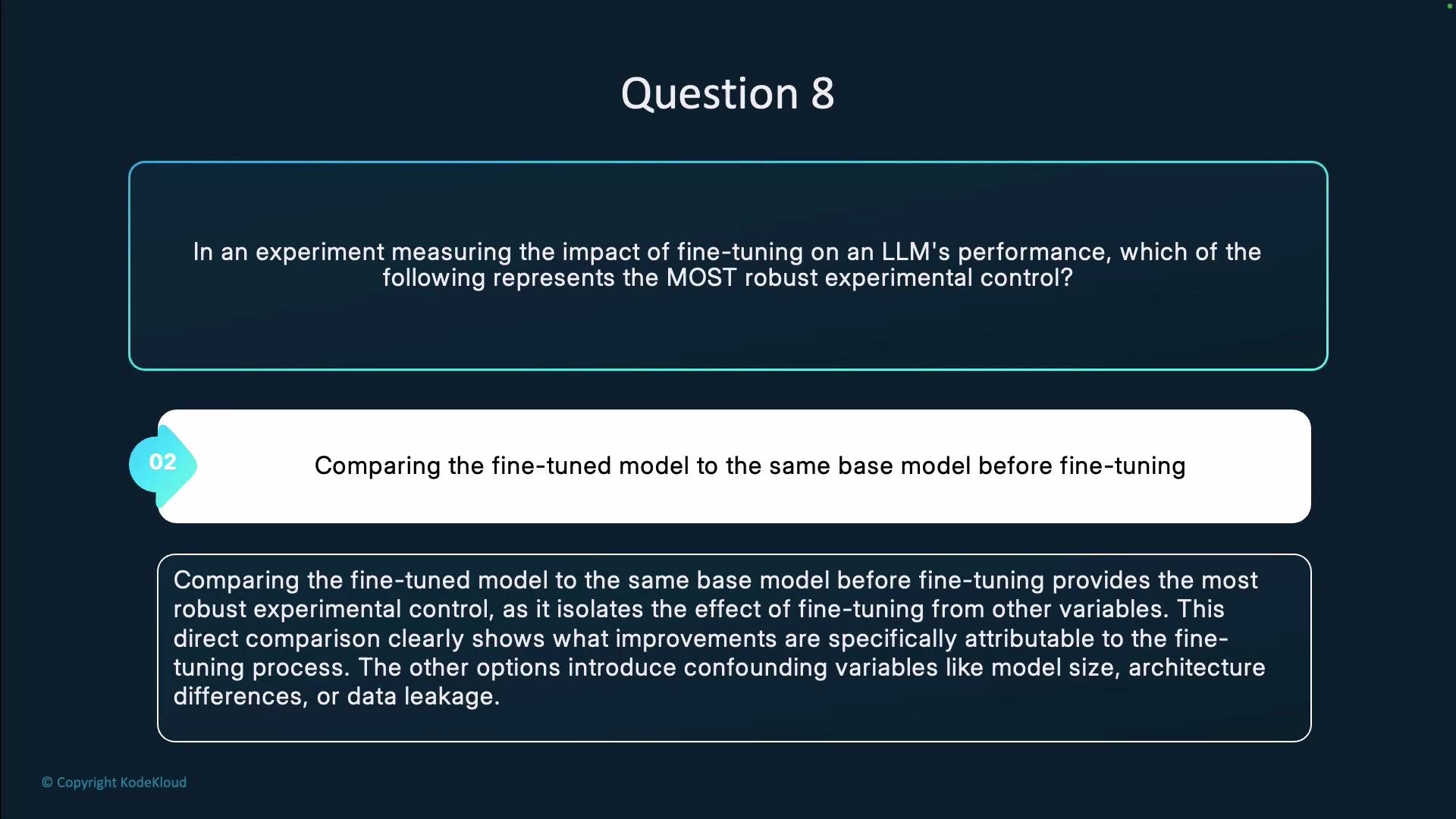
- Direct attribution: Using the same base model before and after fine-tuning ensures that observed performance differences are attributable to the fine-tuning procedure rather than differences in architecture, capacity, or pretraining data.
- Reduced confounders: Other comparisons (larger models, different architectures) introduce confounding variables such as increased parameters, different inductive biases, or varied optimization dynamics.
- Generalization check: Measuring on held-out test sets (not just the training data) verifies that improvements reflect generalization rather than memorization.
Best practices for measuring fine-tuning impact
- Use the same pre-fine-tuned base model as the control (pre/post comparison).
- Evaluate on held-out test sets representative of the target use cases to measure generalization.
- Report multiple metrics (accuracy, F1, calibration, fairness) and confidence intervals.
- Run repeated trials or cross-validation to quantify variance from random seeds and data shuffles.
- Consider ablation studies to separate contributions from dataset size, hyperparameters, and training strategy. See more on ablation methodology: Ablation study.
- Monitor for overfitting and memorization; review examples where the model changed predictions after fine-tuning. Learn about overfitting: Overfitting (Wikipedia).
For robust evaluation, compare the fine-tuned model to its own pre-fine-tuning baseline and measure performance on held-out test sets that reflect intended production use cases. Include repeated runs and clear reporting of metrics to support reproducible, interpretable conclusions.