

CountVectorizer, TfidfVectorizer), pipeline composition, feature selection, and a wide range of classical classifiers (e.g., LogisticRegression, MultinomialNB, SGDClassifier). Its consistent API and lightweight dependencies make it ideal for small- to medium-scale problems and rapid prototyping.
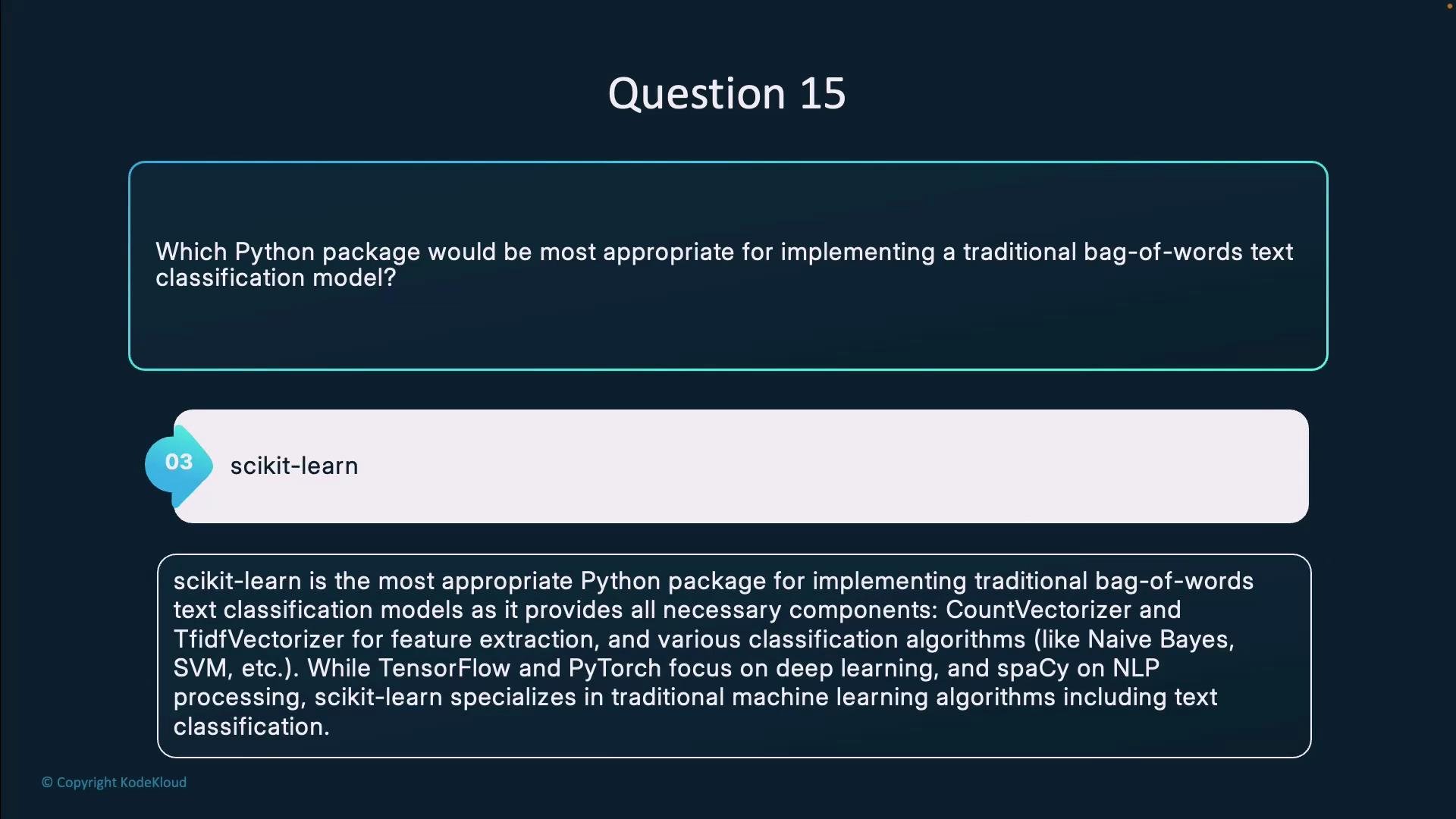
Use scikit-learn to quickly prototype bag-of-words pipelines. Migrate to deep-learning frameworks only when you need learned embeddings, complex sequence modeling, or GPU-accelerated training for large datasets.
Example — minimal scikit-learn pipeline using TF-IDF and logistic regression:
- Choose scikit-learn for traditional bag-of-words workflows: vectorizers + classical classifiers with fast, interpretable results.
- Use PyTorch or TensorFlow when you require neural-network models, learned representations (embeddings/transformers), or GPU-accelerated training.
- Combine spaCy for preprocessing with scikit-learn for modeling when you want robust tokenization and a lightweight modeling stack.
- Scikit-learn — Official Documentation
- PyTorch — Official Documentation
- TensorFlow — Official Documentation
- spaCy — Official Documentation