

- Structured, consistent schemas → SQL is usually a better fit.
- Unstructured or highly variable records → NoSQL often works better.
Why choose SQL (relational databases)?
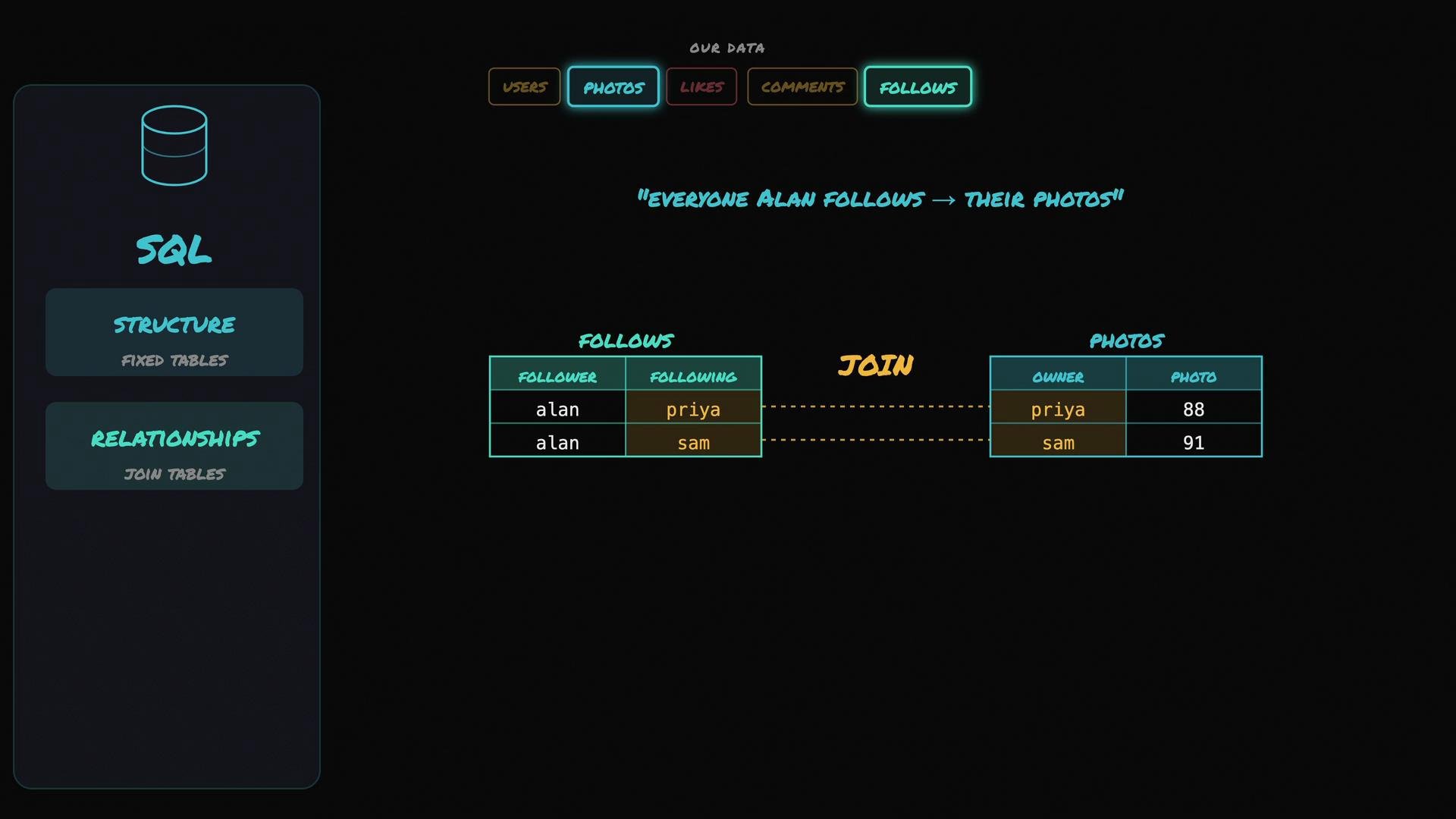
SQL databases enforce a fixed schema and store data in tables (rows and columns). This strong structure makes it easy to model entities and relationships, for example: users, photos, likes, and follows. Modern relational systems like Postgres and MySQL also support semi-structured data (JSON/JSONB columns), adding flexibility where needed. SQL makes relational queries straightforward. For example, to show all photos posted by people Alan follows, you join thefollows table to the photos table and filter by the relevant user:
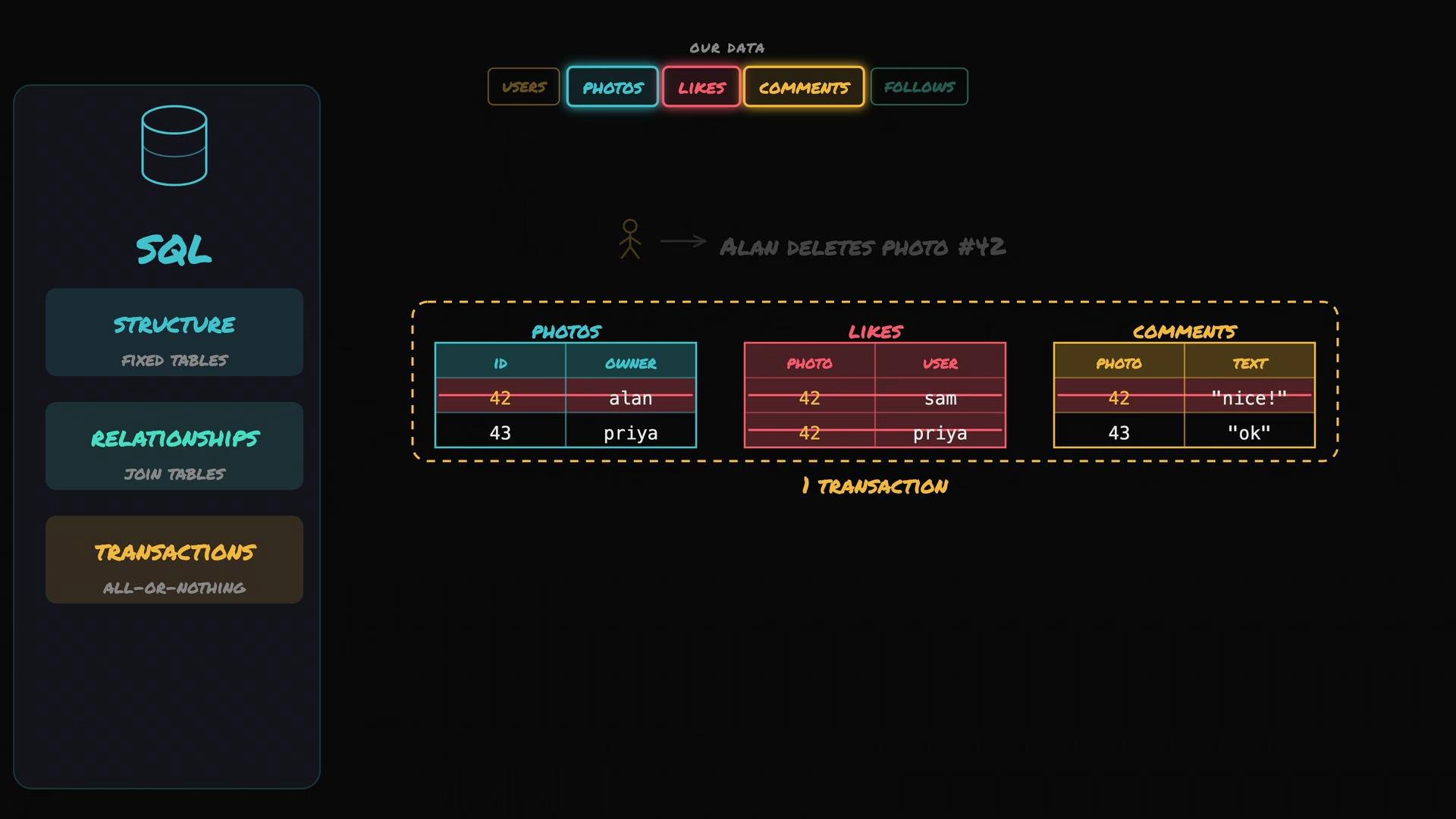
ACID stands for Atomicity, Consistency, Isolation, and Durability — properties that help ensure reliable transactions in relational databases.
- Postgres (postgresql.org)
- MySQL (mysql.com)
- Strongly relational data (users, orders, relationships)
- Complex joins and transactional workflows
- Data that benefits from enforced schema and constraints
Why choose NoSQL?
NoSQL databases relax the fixed schema requirement. Each record (document) can have a different shape, which makes NoSQL a natural fit for heterogeneous or rapidly evolving data models such as event logs, analytics events, or user preferences. NoSQL systems are often designed for horizontal scalability and high throughput across many machines. Common NoSQL examples:- MongoDB (mongodb.com) — document store
- DynamoDB (aws.amazon.com/dynamodb/) — managed key-value/document store
- Elasticsearch (elastic.co) — search and analytics engine, often used as a document store for search use cases
Example: deciding for a photo-sharing app
In our photo app, most data is structured and relational: photos, users, likes, follows. That clearly points toward a relational database for the core domain — for example, Postgres. Conceptual example of thephotos table:
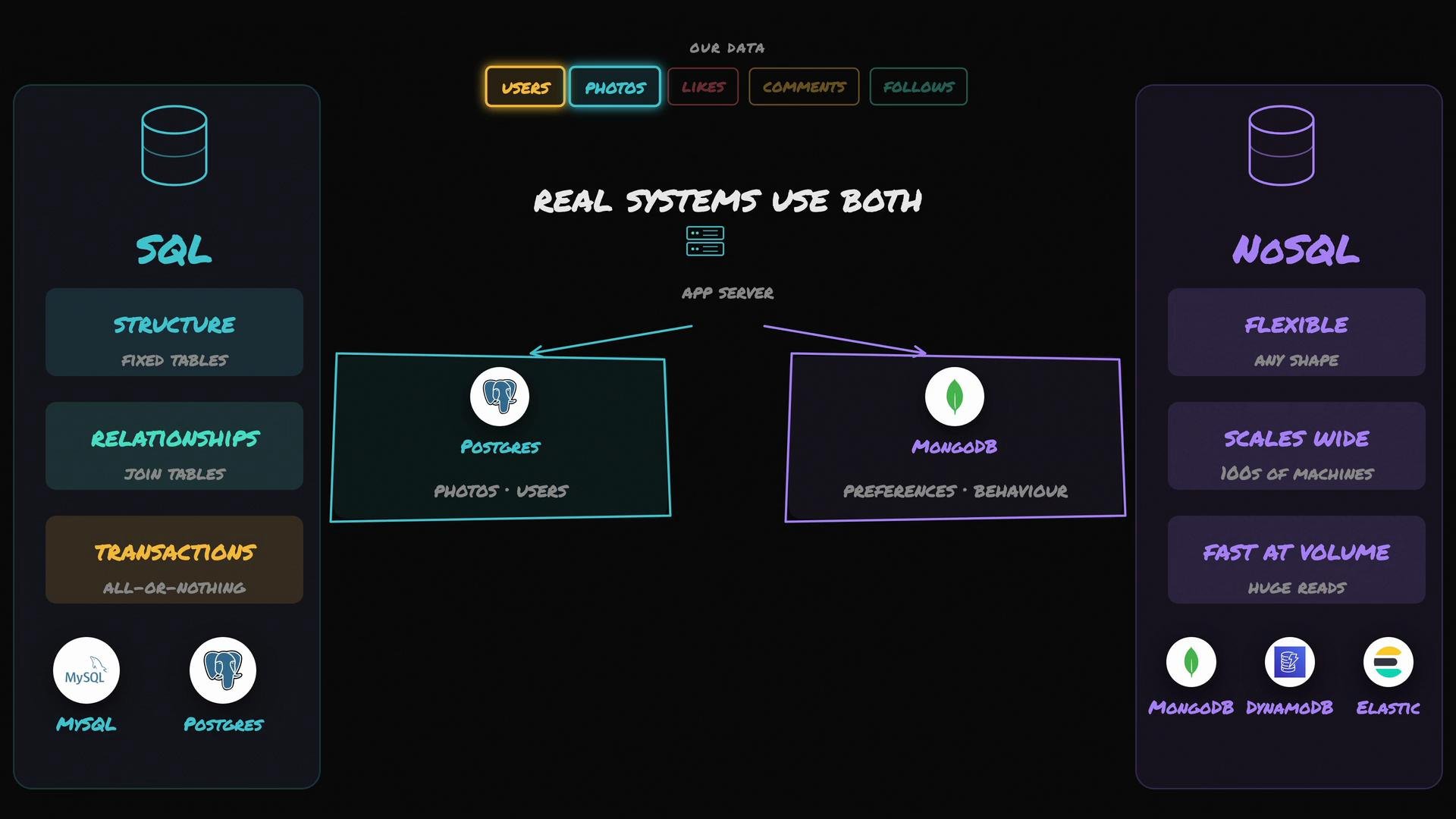
- SQL (e.g., Postgres) for structured, relational data: users, photos, likes, follows, orders.
- NoSQL (e.g., MongoDB, DynamoDB) for flexible or high-volume data: preferences, clickstreams, event logs, search indexes.
Quick comparison (SQL vs NoSQL)
Practical guidance: when to use which
- If your domain model has many relationships and requires consistency: start with SQL.
- If your data is highly varied or you need to ingest massive volumes of log-like events: NoSQL is often better.
- If you’re unsure: starting with SQL is a safe choice for most business applications because it covers a wide range of cases and makes it easier to reason about correctness.
- For production-scale systems, consider polyglot persistence: use the best tool for each data type and access pattern.
- Build a user feed with relational joins and index-backed queries → query Postgres.
- Load per-user preferences or feature flags stored as flexible JSON → query MongoDB or DynamoDB.
- Full-text search or analytics over large text fields → use Elasticsearch or a search-optimized store.