When answering an estimation question in a system-design interview, always tie your numbers back to the architecture you propose. Speak your assumptions and rounding out loud so the interviewer can follow and validate your trade-offs. Walk through one concrete example and announce each rounding as you go. Step-by-step example (announce each assumption and rounding):
  1. State the core user assumptions:
    • Total users: 100,000,000
    • Daily active rate: 20% (0.20)
    • Feed opens per active user per day: 20
    Calculate reads per day:
  2. Convert reads per day to reads per second.
    • Say aloud: “I’ll call a day one hundred thousand seconds” (a convenient mental rounding; actual day = 86,400s).
  3. Account for traffic peaks with a peak factor (common practice: 3–5×).
    • Announce: “I’ll round peak traffic to about 3–5×; let’s call it 15,000 reads/s for planning.”
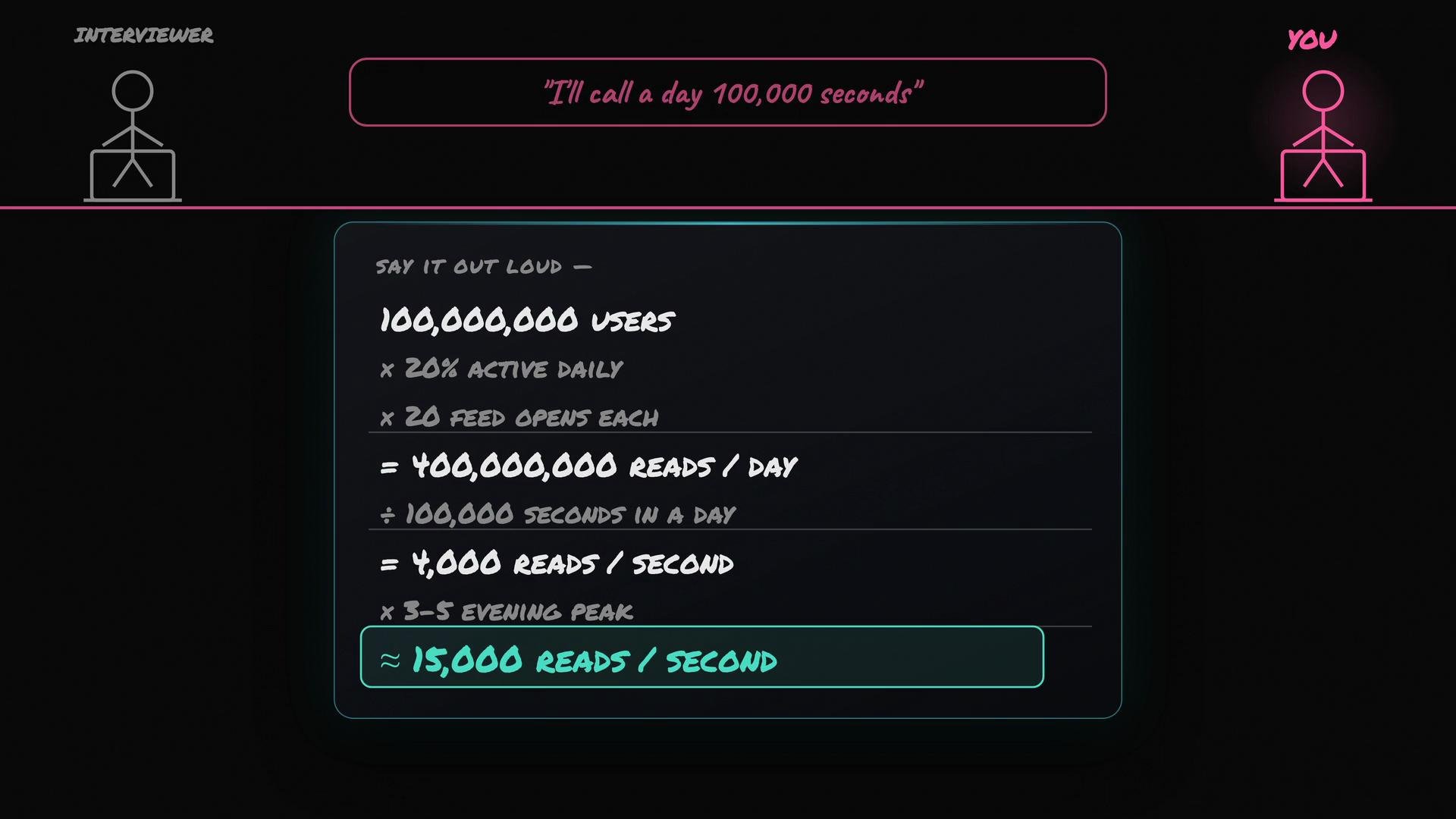
Use these verbal signals during the interview: “I’ll call a day one hundred thousand seconds” and “I’ll round peak traffic to about 3–5×, so let’s call it 15,000 reads/s.” Interviewers are evaluating your assumptions, reasoning, and trade-offs—not just the arithmetic.
The image features a calculation of application reads, using a hypothetical scenario of 100 million users with 20% active daily, leading to approximately 15,000 reads per second during peak times. Two stick figures are labeled as "Interviewer" and "You."
Say your assumptions and rounding aloud. Those are the signals interviewers use to grade your reasoning.
Quick reference constants to memorize How to use these numbers in design decisions
  • Use the final reads/s to size front-end load balancers, web server pods, and API capacity.
  • Multiply by average request cost (CPU, DB reads, cache hit rate) to size back-end services and databases.
  • Convert reads/sec to IOPS, network bandwidth, and cache memory needs as you pick components (CDN, Redis, read replicas, etc.).
Further reading and references Memorize these two handy mental constants and always narrate your rounding choices — that clarity is often worth more than perfect arithmetic during interviews.

Watch Video

Practice Lab