

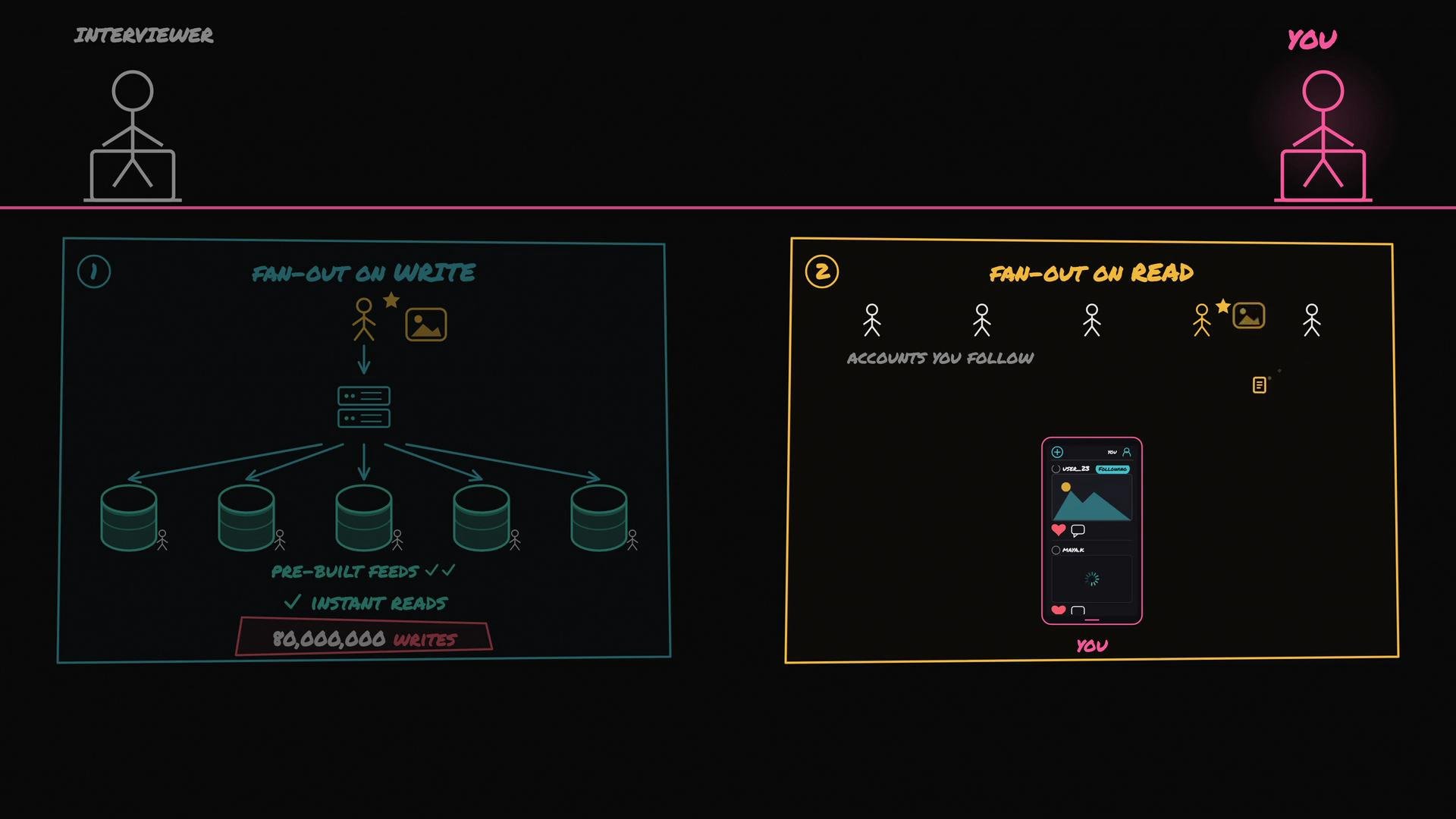
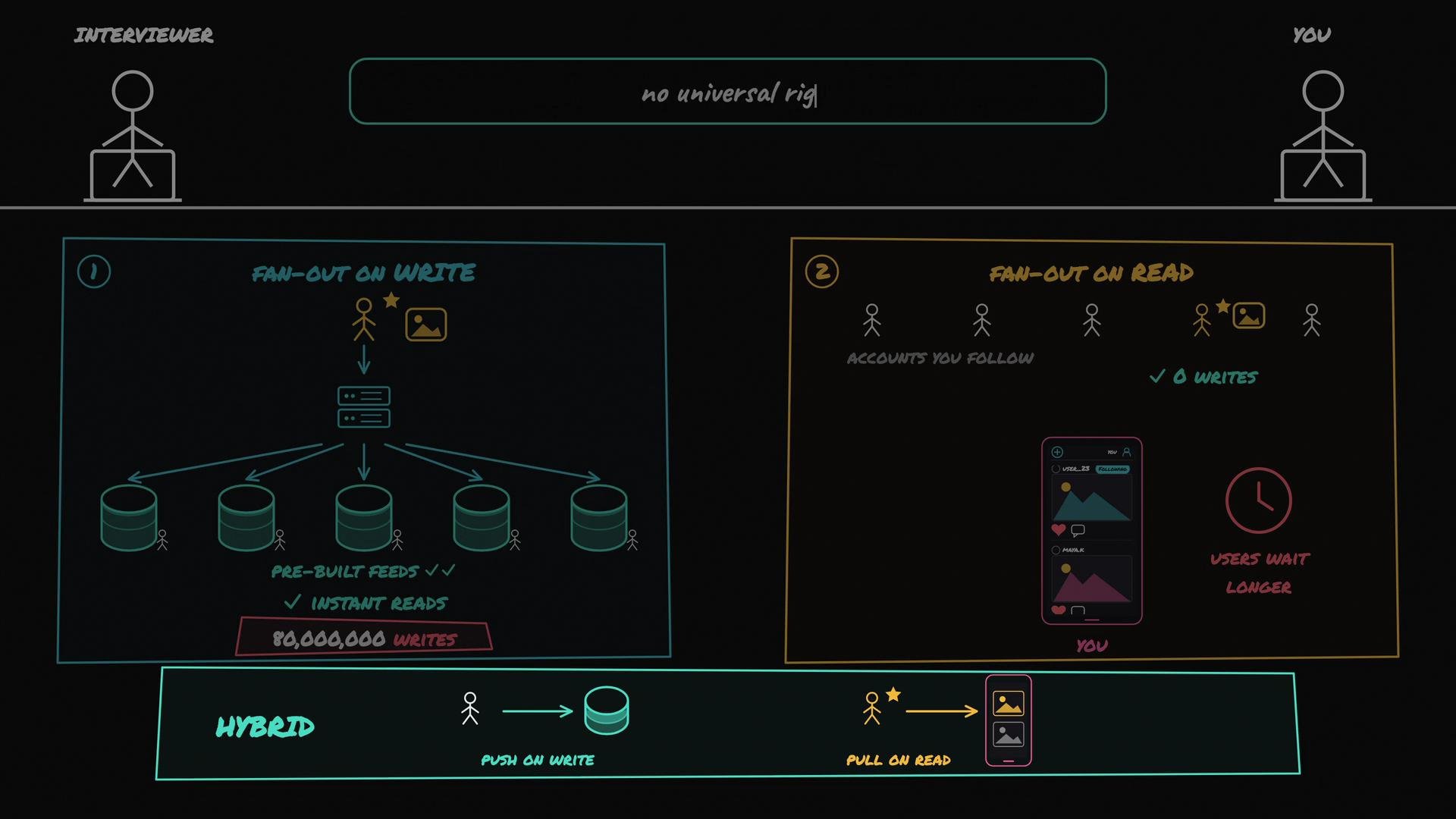
- Fan‑out on write (push): update followers’ timelines at post time.
- Fan‑out on read (pull): build the timeline when a user opens the app.
- Hybrid: combine push for normal users and pull for celebrities.
Fan‑out on write (push at post time)
At post time, the system pushes a reference (or a copy) of the new photo into each follower’s prebuilt feed/timeline. Benefits- Extremely fast reads — timelines are precomputed and ready to serve.
- Simplified read path: minimal merging and ranking on fetch.
- Write amplification: a celebrity post can produce millions of writes.
- Storage duplication: storing references or cached copies across many timelines.
- Backpressure on write pipelines, requiring robust queuing, batching, retries, and idempotency.
- Need for storage strategies that tolerate high write fan‑out (sharding, compaction, TTL).
- Batch writes and aggregate fan‑outs into worker jobs.
- Use message queues (Kafka, Pub/Sub) and backpressure controls.
- Write only references (IDs) instead of full payloads to reduce storage.
- Incremental rebuilds and background reconciliation for consistency.
- Rate limiting or throttling for extreme fan‑outs (celebrity posts).
Fan‑out on read (pull at fetch time)
When a user opens the app, the system fetches recent posts from followed accounts, merges and ranks them, and returns a timeline. Benefits- Writes are localized to the author’s activity store; posting does not trigger massive downstream writes.
- Freshness: reads can reflect the latest state without replaying many writes.
- Reads are heavier: each request triggers many fetches, merges, and ranking operations.
- Higher latency and CPU/I/O per read, which can hurt user experience without caching or aggressive optimization.
- Increased complexity in optimizing and parallelizing reads across services and caches.
- Caching hot accounts’ recent posts.
- Parallel fetching and efficient merging/ranking pipelines.
- Read replicas and CDN caches for media content.
- Partial precomputation (e.g., cache top results for frequent followers).
Hybrid approach (practical at scale)
Most large systems use a hybrid:- Push to followers for typical (low‑fanout) users so reads are fast for the common case.
- Pull for a small set of high‑fanout accounts (celebrities) to avoid massive write storms and storage duplication.
- Balances read latency and write throughput.
- Controls storage costs by avoiding full duplication for extreme fan‑outs.
- Lets you tune thresholds (e.g., account follower count) to decide push vs pull.
Quick comparison
Key considerations to discuss in an interview
- Latency: precomputed timelines minimize read latency; on‑read increases user‑perceived wait.
- Throughput & durability: large fan‑outs demand scalable, idempotent write pipelines and durable queues.
- Storage vs compute: push duplicates data (more storage); pull increases per‑read compute.
- Operational complexity: batching, queue management, backpressure controls, and incremental rebuilds help but add system complexity.
- Consistency & freshness: push gives faster visibility to followers; pull can show the absolute latest state without heavy replay.
Interview tip: Describe both strategies and their trade‑offs (latency, cost, complexity). Recommend a hybrid solution and mention implementation details such as batching, message queues, rate limiting, and thresholds for offloading celebrity accounts to a pull model.
- [System Design: Fan‑out patterns and tradeoffs] — discuss push vs pull strategies and mitigation options.
- [Designing data pipelines at scale] — guides on queues, batching, and idempotency for high‑fanout systems.