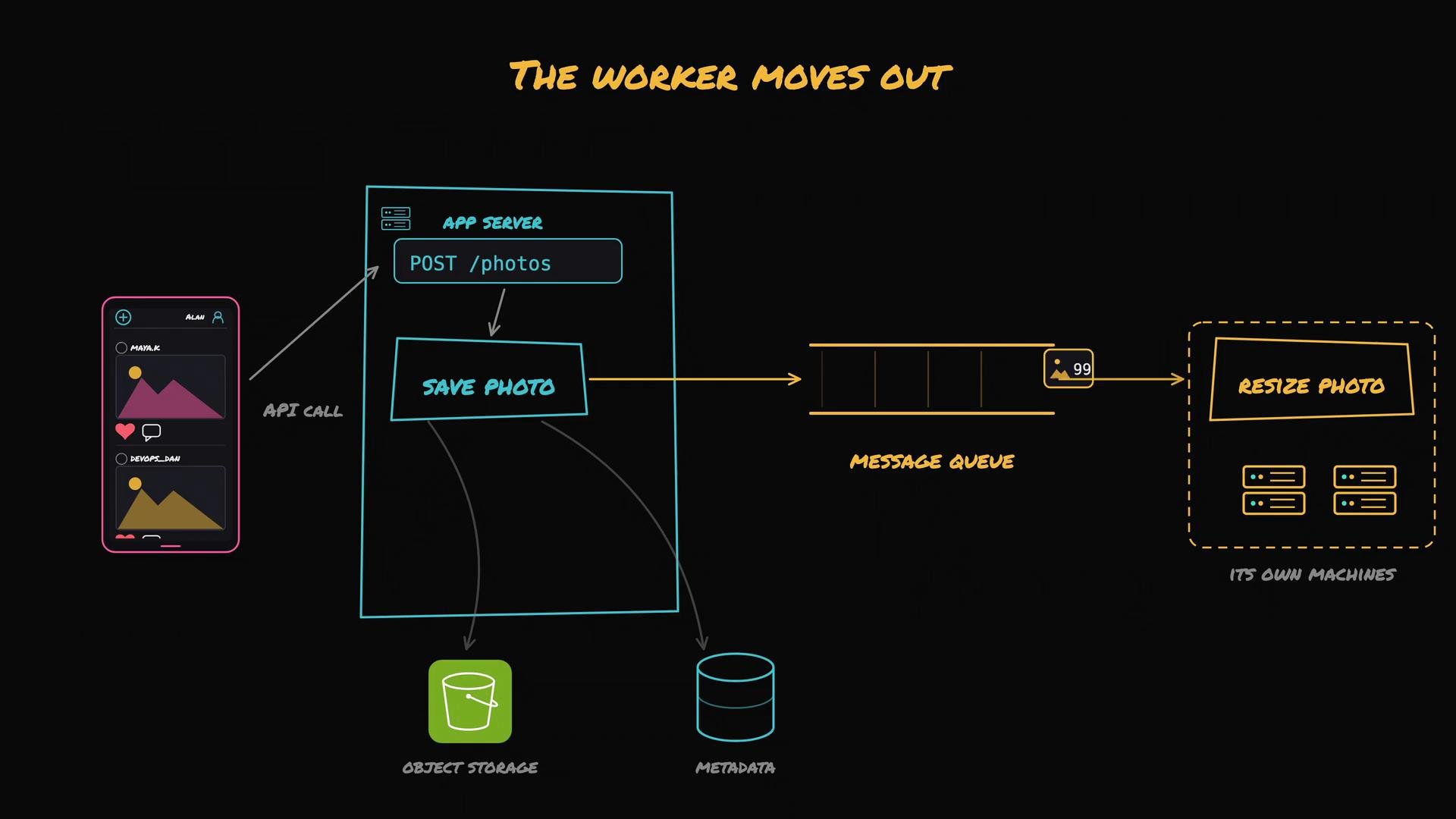
In this lesson we cover message queues: what they are, why they matter, and how they enable resilient, decoupled systems for handling background work and traffic spikes. A concrete motivating example is a photo-upload flow in a typical photo app. We don’t want to serve full-size images to users, so we generate smaller thumbnails. Thumbnail generation can be slow, so doing it synchronously would make users wait. Instead, we offload this work to a background system. When a user uploads a photo, the client calls an API such as POST /photos. The server-side handler (for example, savePhoto) validates the image, stores the original file in object storage (e.g., S3), writes metadata to the database, and triggers thumbnail creation.
The image is a flowchart illustrating how an app server processes a photo upload request from a mobile app. It depicts steps such as API call, validation, saving the photo, and storage in object storage and metadata.
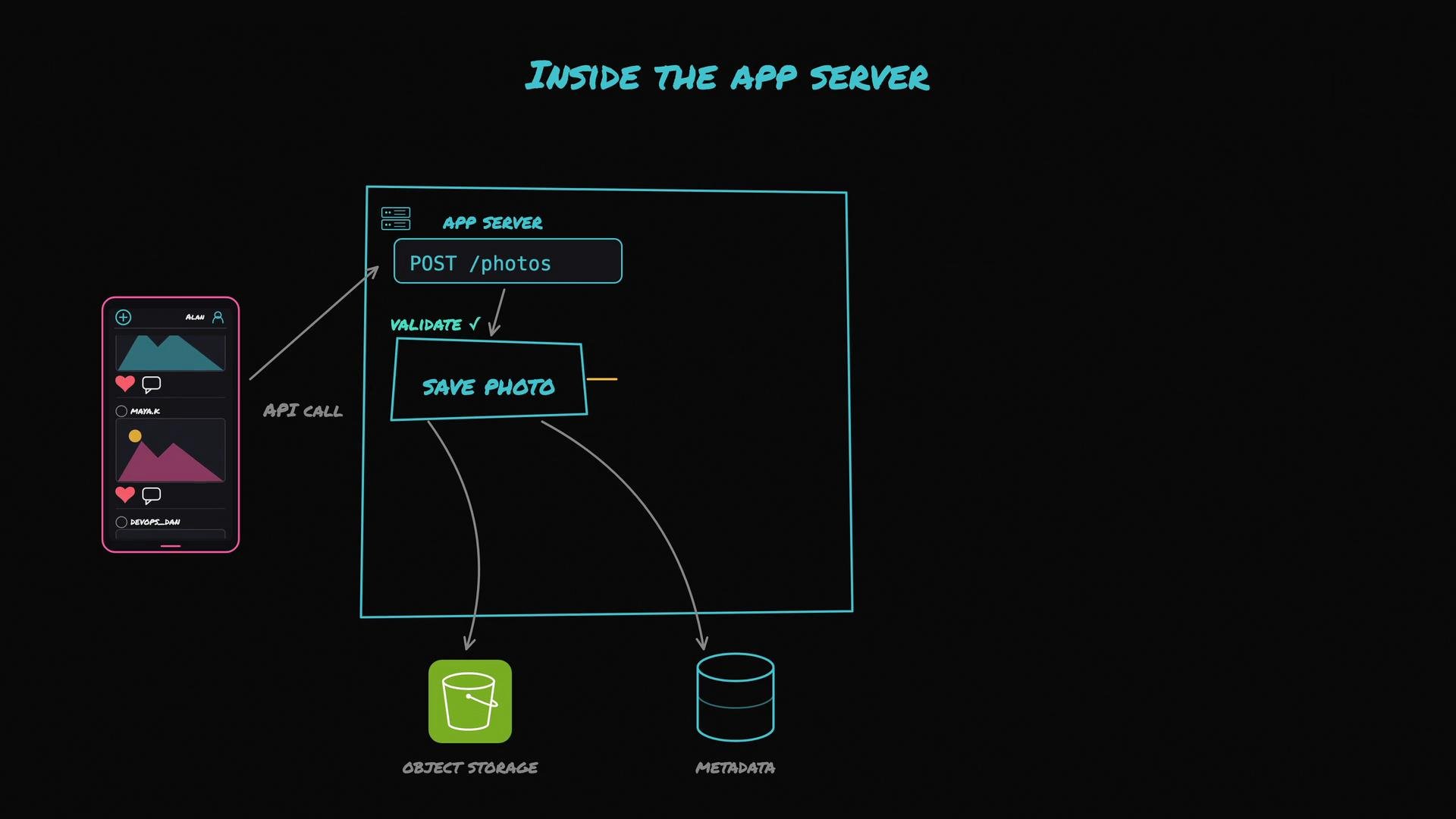
A naive (and inefficient) approach is to call the thumbnail generator (resizePhoto) synchronously from savePhoto. In this design, the upload handler performs the resize before returning success to the client. If the resize is slow or gets stuck, the user experiences long waits or timeouts.
The image depicts a flowchart illustrating a process for handling photo uploads, showing interactions between a mobile device, an app server, and storage solutions, with the message "Don't make the user wait."
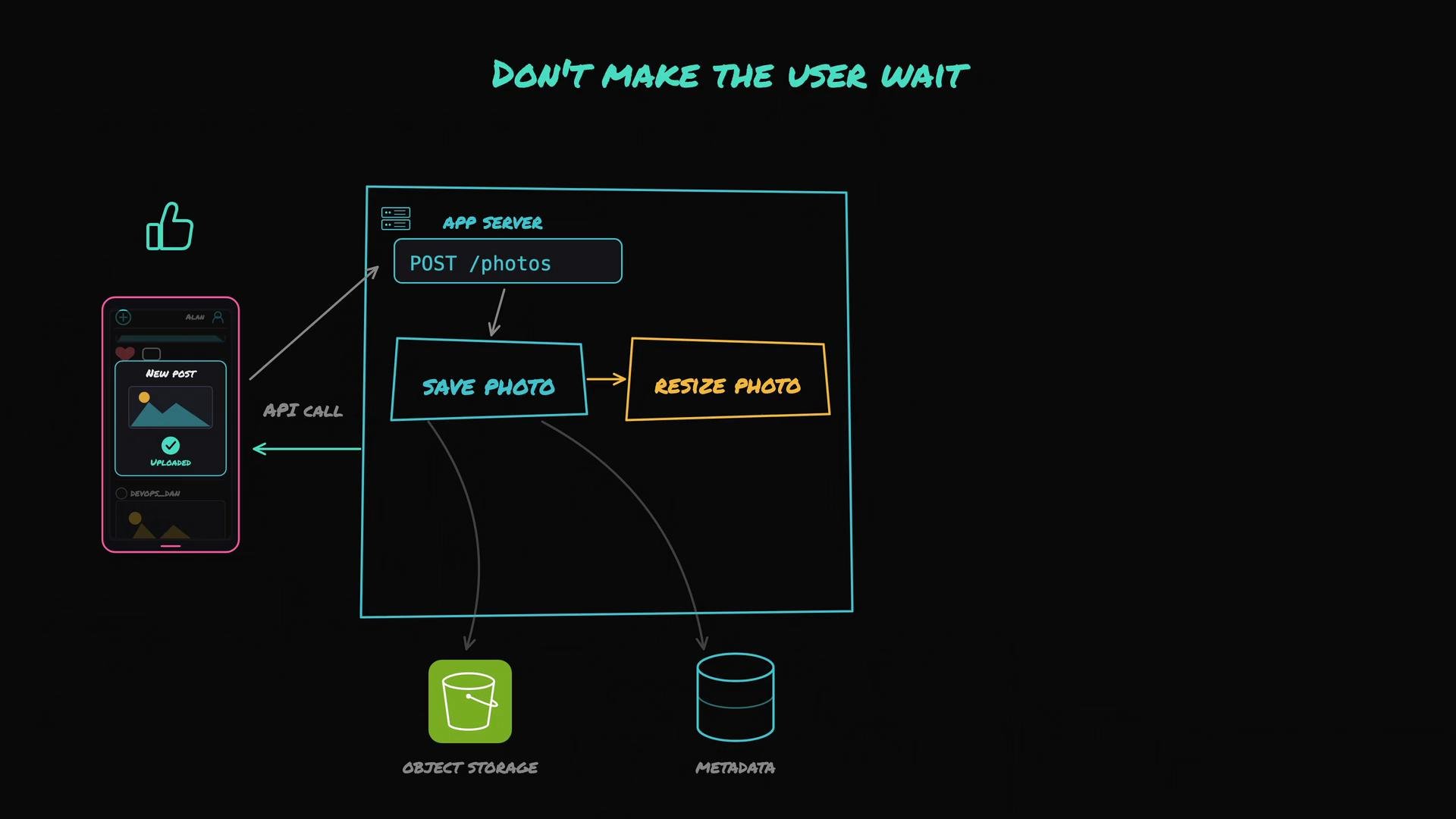
A better design is to make the resize task asynchronous. After saving the original photo and metadata, the server returns success to the user immediately and hands the slow work to a background system. The question becomes: how do we hand off the job safely so it won’t be lost if the server crashes? The safe solution is a message queue. Instead of calling resizePhoto directly, savePhoto writes a small message to a queue (for example, a resize-photo queue) describing the job. Then savePhoto returns success to the client.
The image is a flowchart depicting a photo upload process using an app server and message queue system. It shows steps from making an API call to saving, resizing the photo, and storing metadata and the object.
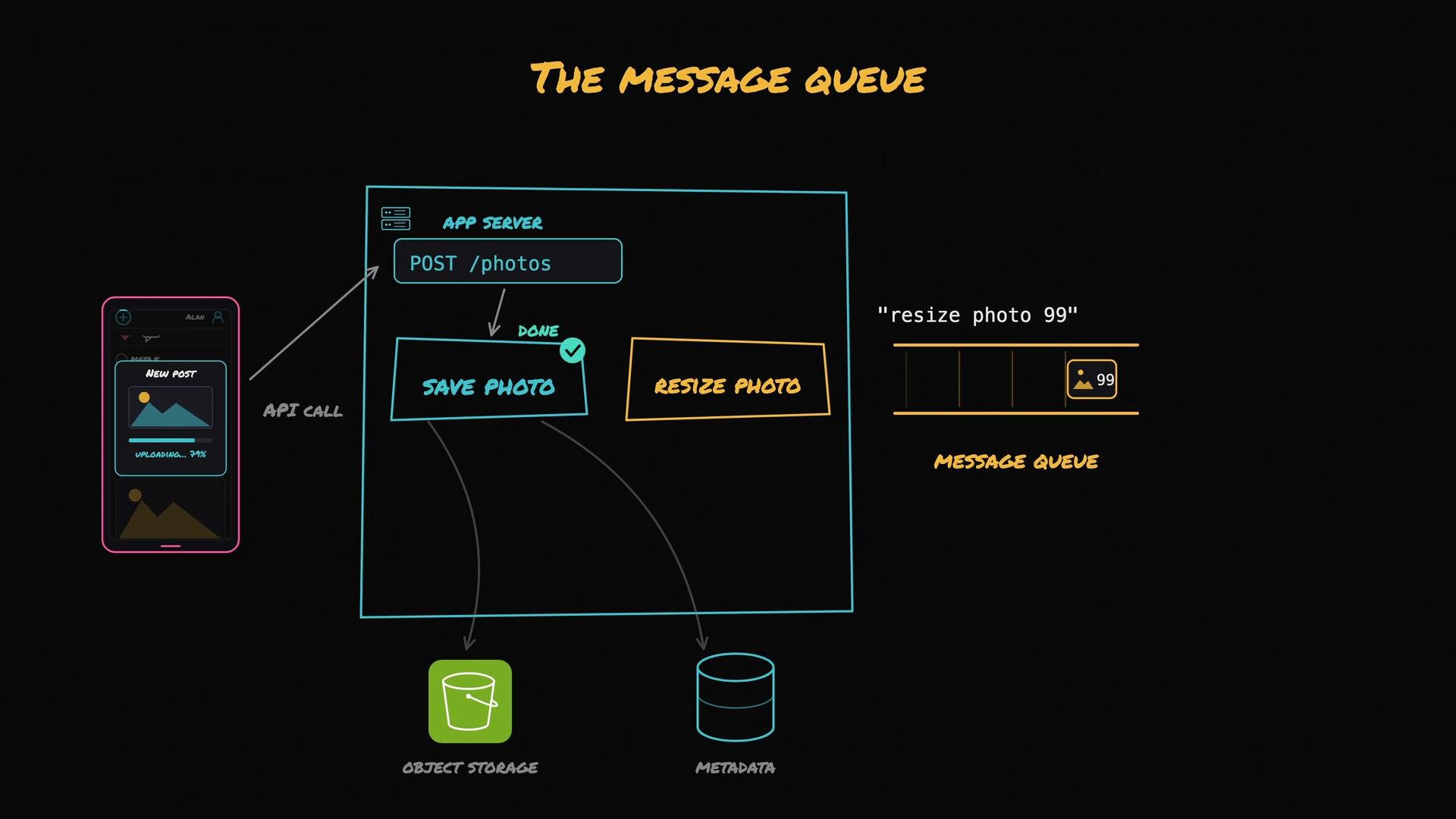
The message persists in the queue until a worker (consumer) picks it up. Thumbnail generation no longer runs inside the main app server; instead, independent worker processes or services poll the queue, process messages, and acknowledge completion.
The image illustrates a workflow diagram for photo processing, showing an app server handling a POST request to save a photo, storing it, and then using a message queue to resize the photo on separate machines.
Key terms Why this decoupling helps
  • Producers and consumers are independent: they do not need to know each other’s implementation or location.
  • Producers return quickly and do not block on slow work.
  • The queue acts as a buffer: it absorbs traffic spikes and stores work until consumers are ready.
  • Workers can be scaled independently to increase processing throughput.
  • If a worker crashes, the message remains in the queue until processed—improving fault tolerance.
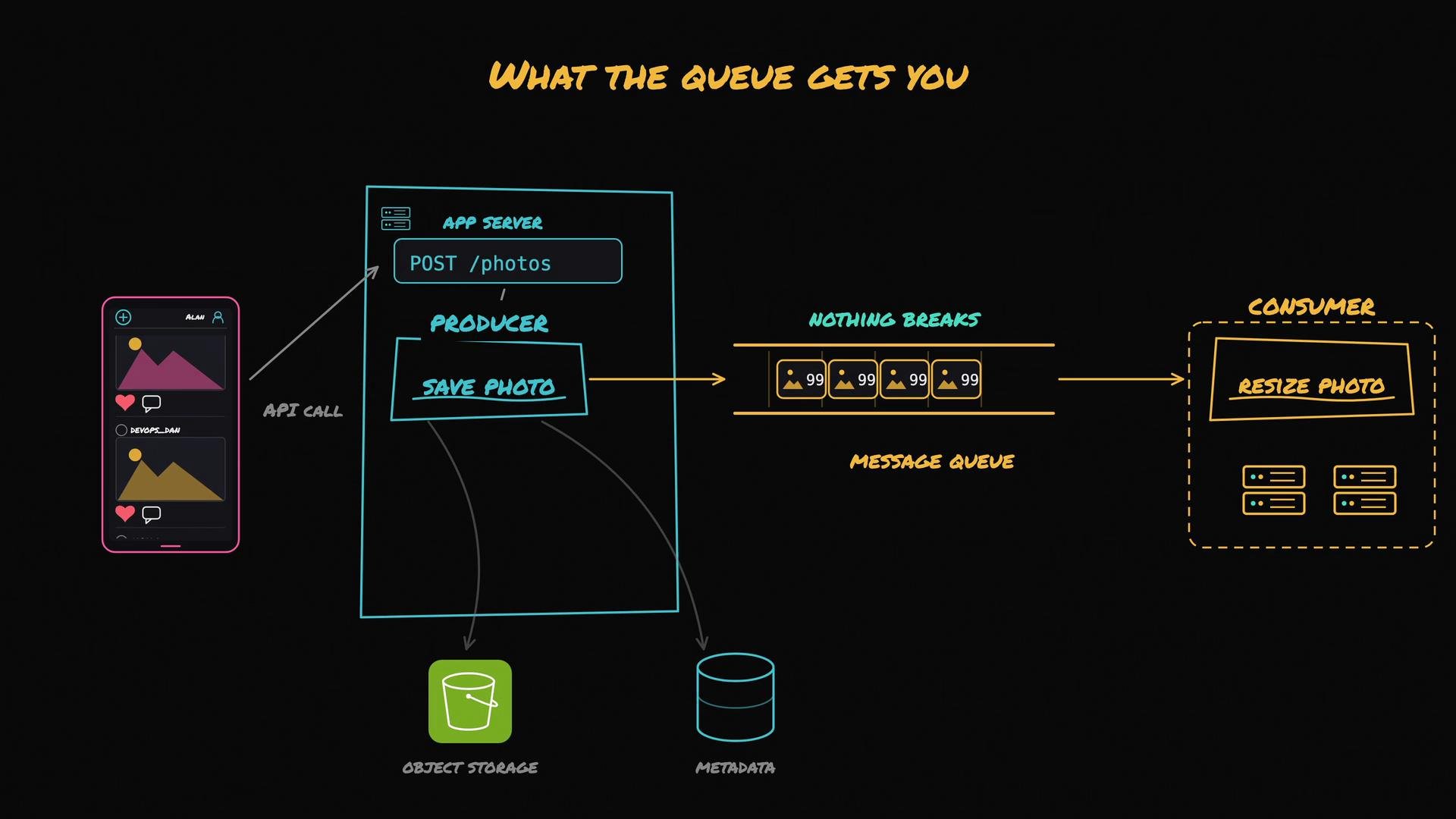
The image is a flowchart illustrating a photo processing system where an app server saves photos through an API call, stores them in object storage and metadata, sends them to a message queue, and then a consumer resizes the photos.
Important nuance: delivery semantics and idempotency Many queues provide at-least-once delivery. That means a message can sometimes be delivered more than once. Example: a worker receives a message, completes the resize, but crashes before acknowledging the queue; the queue will eventually redeliver the message. Resizing twice is usually harmless, but duplicate effects (such as charging a customer) can be catastrophic. Design consumers to tolerate duplicate deliveries:
  • Make operations idempotent (safe to repeat).
  • Or check whether work is already done before acting (e.g., a processed flag in the database or checking object existence).
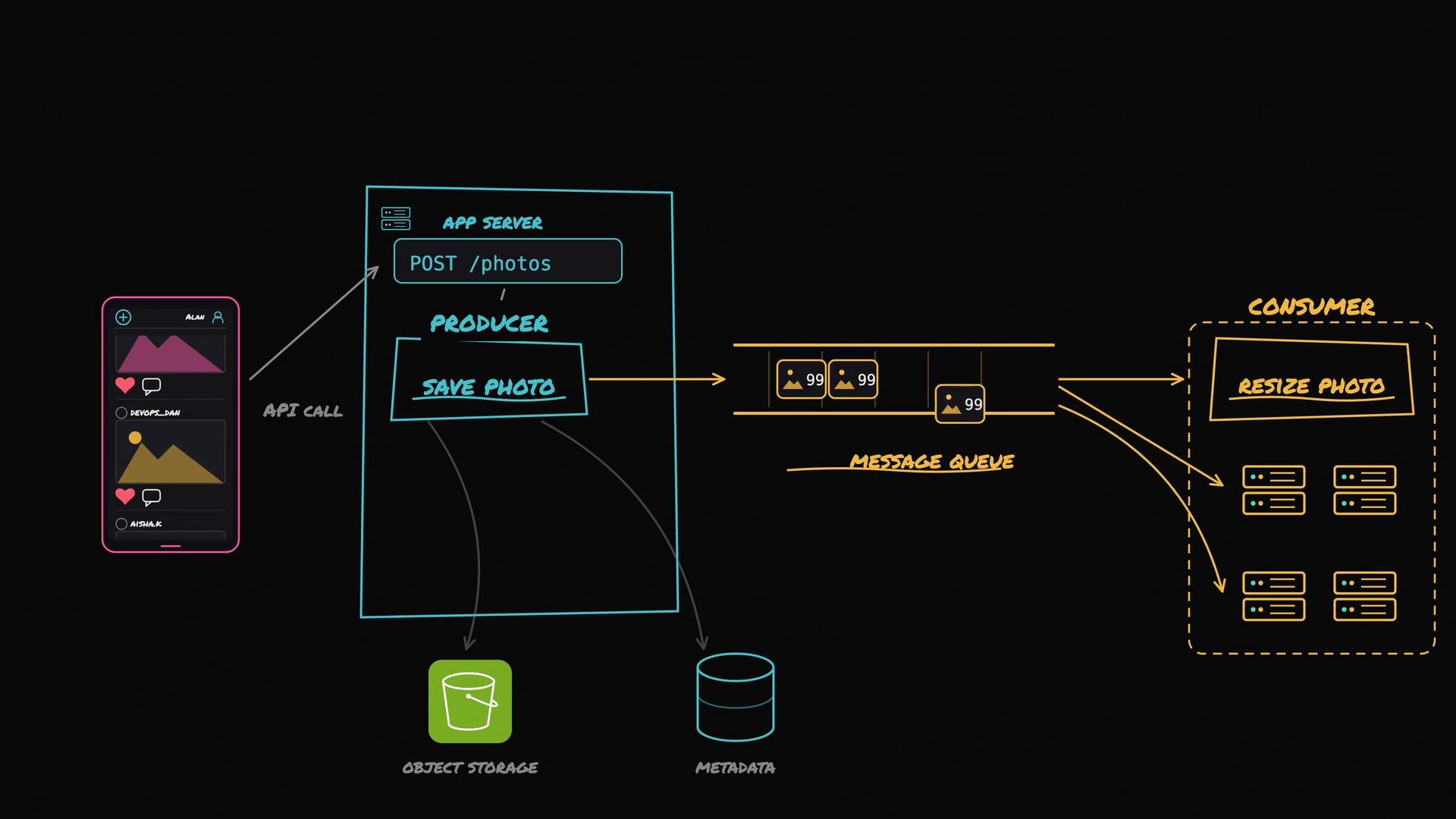
The image is a flowchart illustrating a photo processing system, showing steps from uploading photos via an app to resizing through a message queue system. It includes components like an app server, object storage, metadata, and a consumer for resizing photos.
Message queues typically expose visibility timeouts and acknowledgement semantics. Consumers should acknowledge/delete messages only after successfully finishing their work. Implement idempotency checks or persistent flags so re-delivered messages do not cause duplicate side effects.
Minimal examples (illustrative pseudocode) Producer — save the photo then enqueue a job:
Consumer — poll the queue and process jobs idempotently:
When to use message queues (quick guide) Summary Message queues let you safely hand off long-running or unreliable tasks, decouple producers from consumers, buffer traffic spikes, and simplify scaling and recovery. Common real-world options include RabbitMQ and Amazon SQS. For operations with critical side effects, combine queues with idempotency checks, deduplication, or transactional outbox patterns.

Watch Video