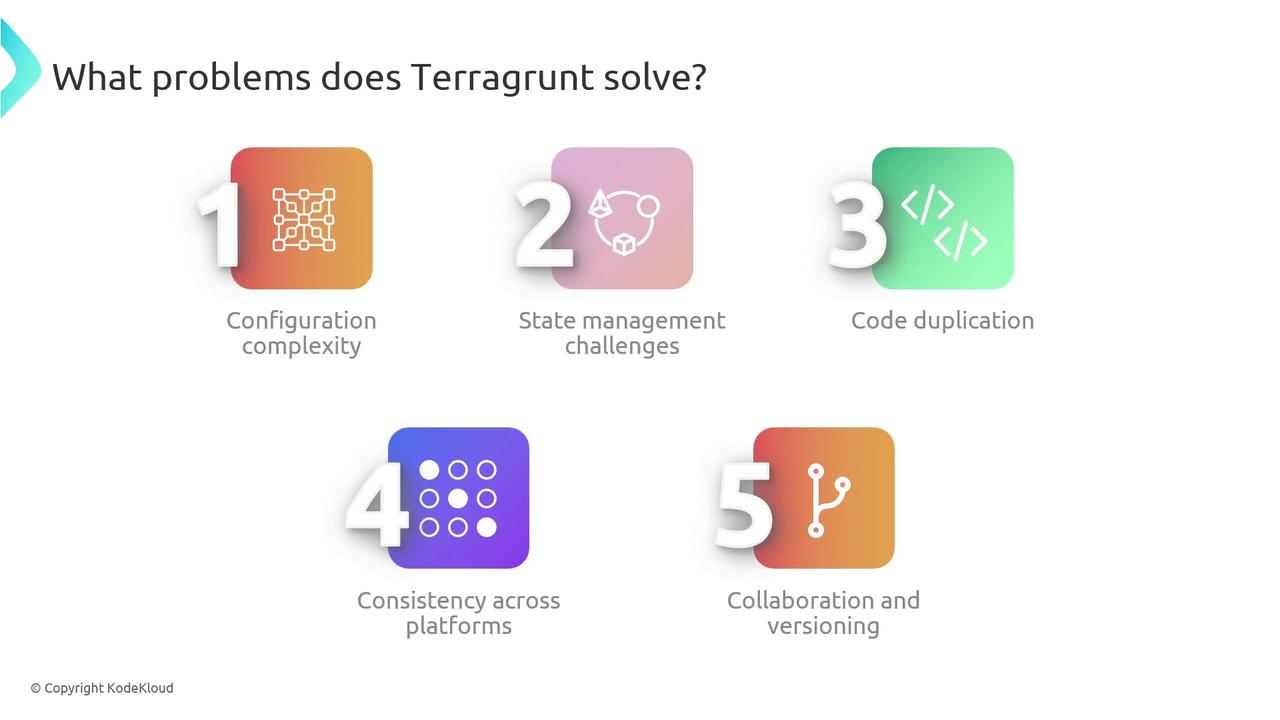
At a Glance
1. Configuration Complexity
As Terraform codebases grow, navigating dozens of.tf files and interdependent modules becomes challenging. Terragrunt enforces a clear directory hierarchy:
2. Remote State Management
Managing Terraform state across multiple environments and engineers introduces risk of state drift. Terragrunt automates backend setup in yourterragrunt.hcl:
3. Code Duplication
Repeating provider, backend, and variable definitions for each environment leads to errors and maintenance pain. Terragrunt’s DRY approach allows you to share common configuration:Use
dependency blocks to pass outputs between modules, further reducing repetition.4. Environment Consistency
Differences between dev, staging, and prod can cause unexpected behavior. By defining environment-specific variables and settings in separate folders, Terragrunt ensures each stage uses the intended configuration:5. Collaboration and Versioning
Multiple engineers working on the same Terraform code can collide on merges or apply the wrong versions of modules. Terragrunt addresses this by:- Isolated apply/plan contexts per environment
- Support for semantic versioning of modules
- Encouraging small, incremental changes