

- Respect model context limits (tokens).
- Speed up retrieval and ranking (smaller units are faster to search).
- Reduce noise and improve recall by limiting irrelevant text inside any one context window.
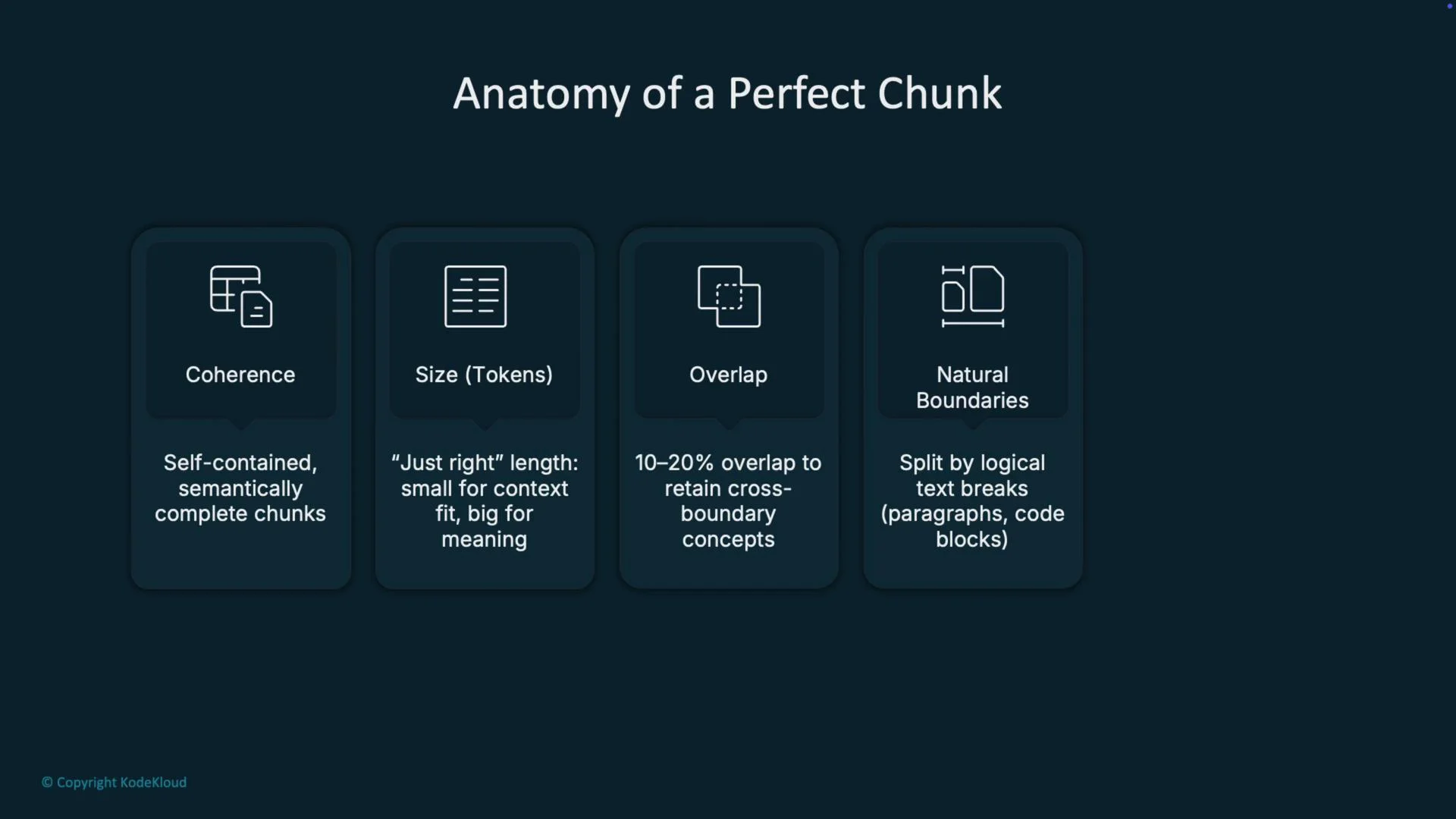
- Coherence: self-contained and semantically complete where possible (avoid cutting mid-sentence or mid-thought).
- Appropriate size: fits your target token limit while retaining required concepts.
- Overlap: intentional overlap with adjacent chunks (commonly ~10–20% or 1–2 sentences) so multi-sentence concepts don’t disappear across boundaries.
- Natural boundaries: prefer paragraph, heading, code block, or section boundaries when available.
- Provenance metadata: include source, document id, section/title, page number, timestamps, etc., so retrieved chunks can be traced to their origin.
Always pick sizes informed by your model’s context window and retrieval needs. Use the same tokenizer as your model to measure token counts accurately.
Core chunking strategies
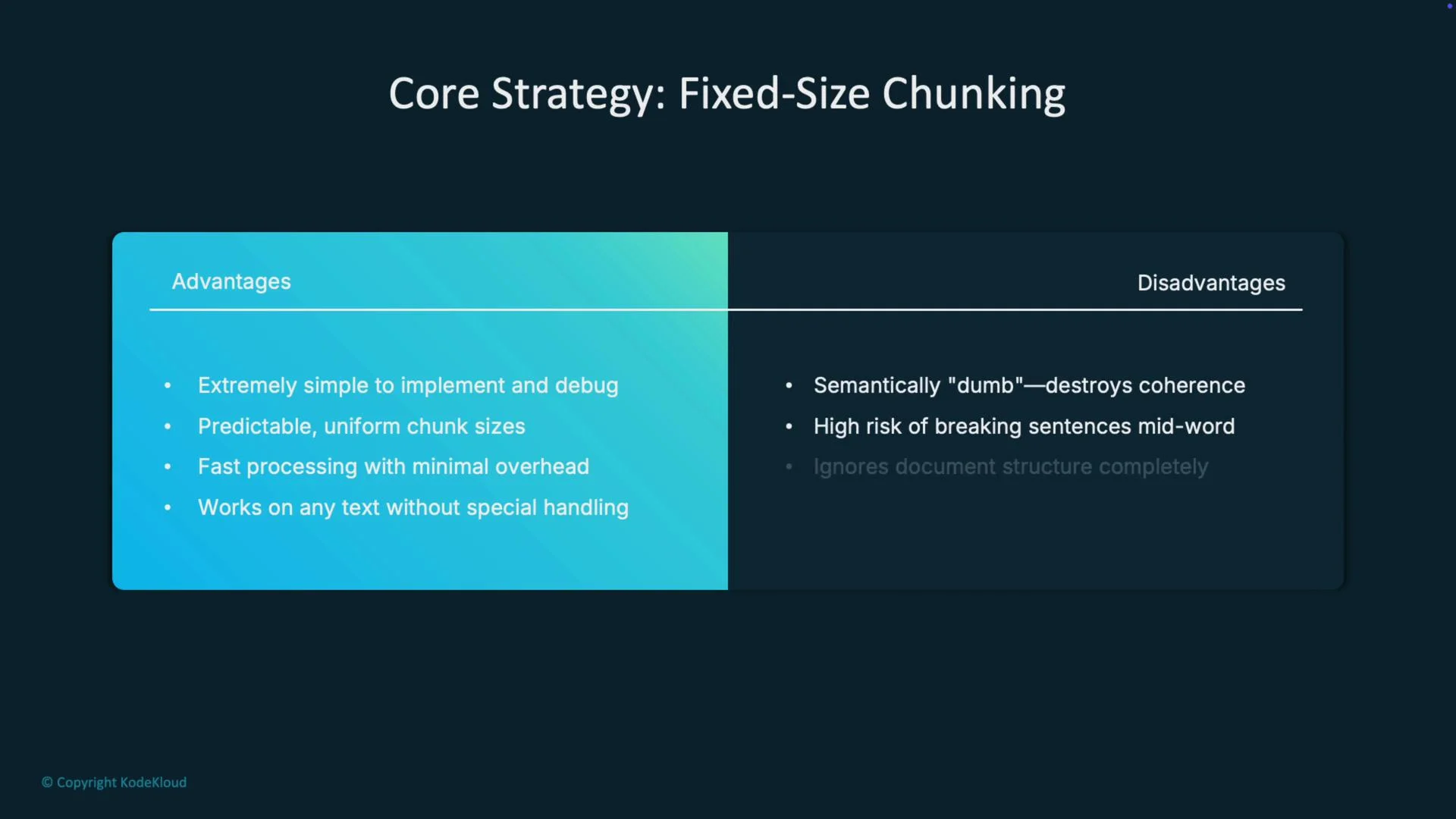
- Fixed-size chunking
- What it is: Split text into fixed N-character or N-token chunks, optionally with a fixed overlap.
- When to use: Quick ingestion pipelines, or when document structure is unavailable and speed/predictability is critical.
- Pros: Simple, predictable, and fast to compute.
- Cons: Semantically blind — may break sentences and reduce coherence.
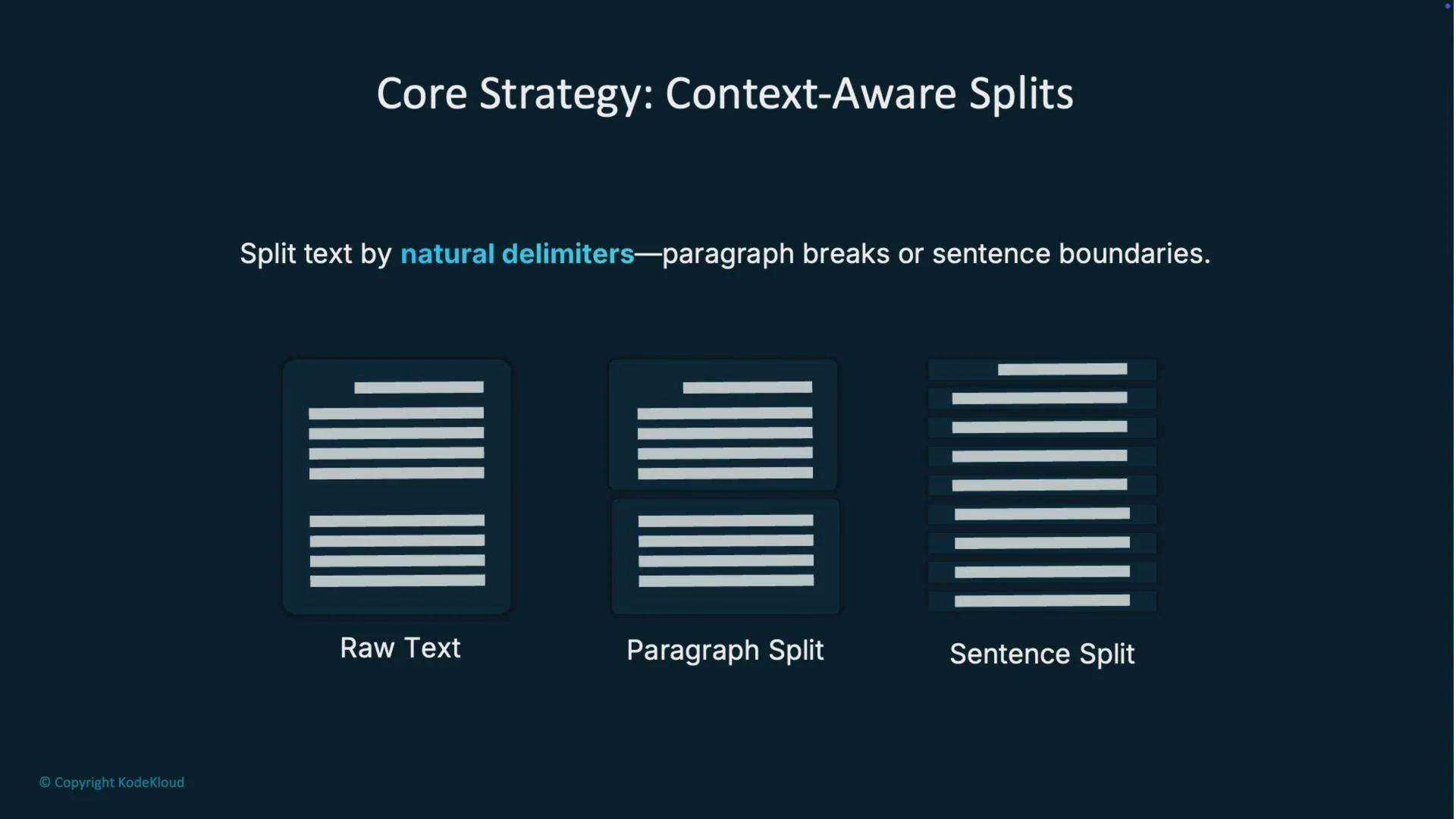
- Context-aware splits (paragraph / sentence splitting)
- What it is: Use natural textual delimiters — paragraphs, sentences, and line breaks — to create chunks.
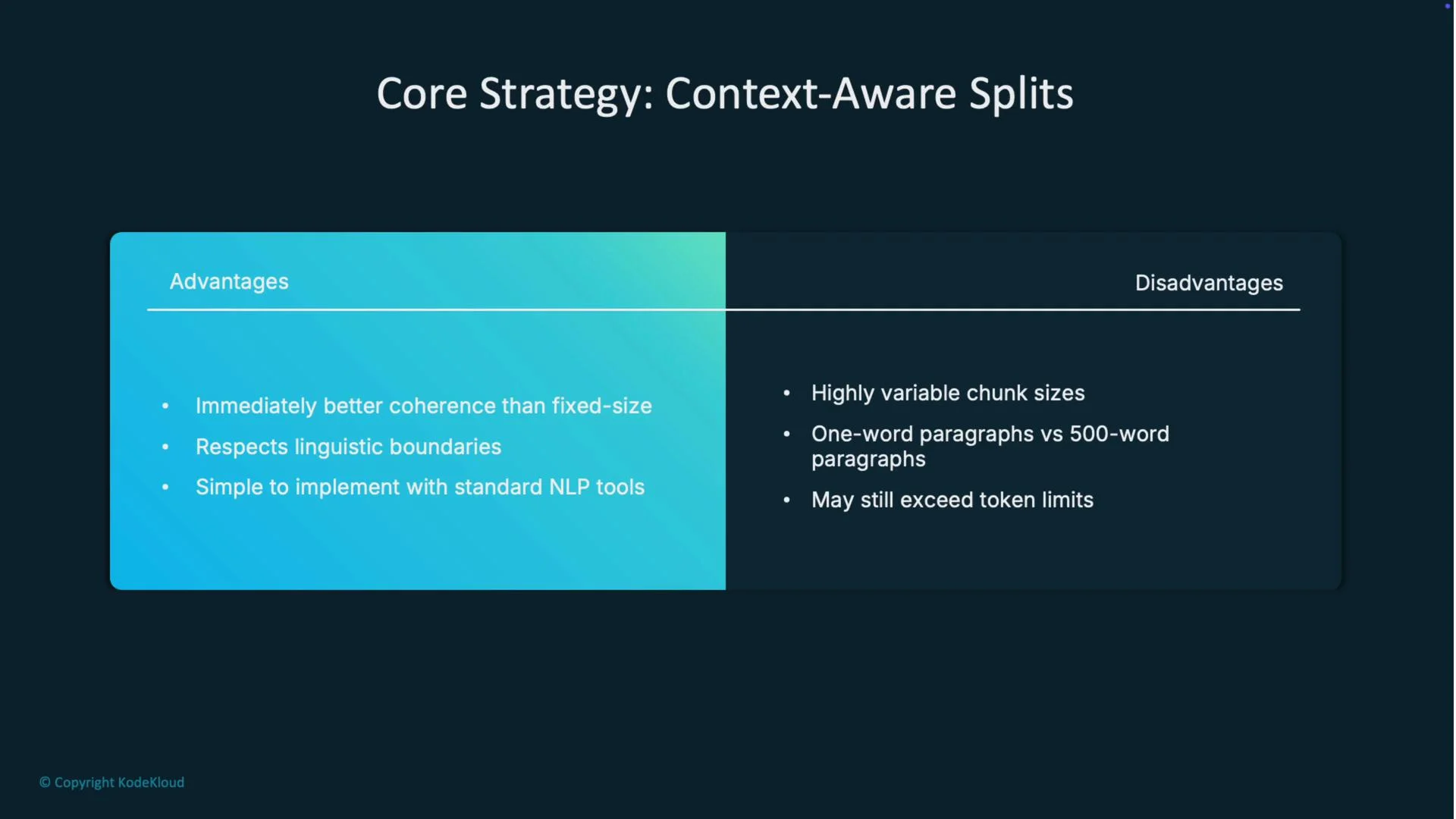
- Pros: Preserves linguistic boundaries and improves coherence compared to fixed-size splits. Easy to implement with standard NLP tools.
- Cons: Chunk sizes vary; long paragraphs may still exceed token limits and require further splitting.
- Combine paragraph/sentence splitting with a tokenizer check to ensure chunks fit your token budget.
- Apply small overlaps (1–2 sentences) to prevent loss of cross-boundary context.
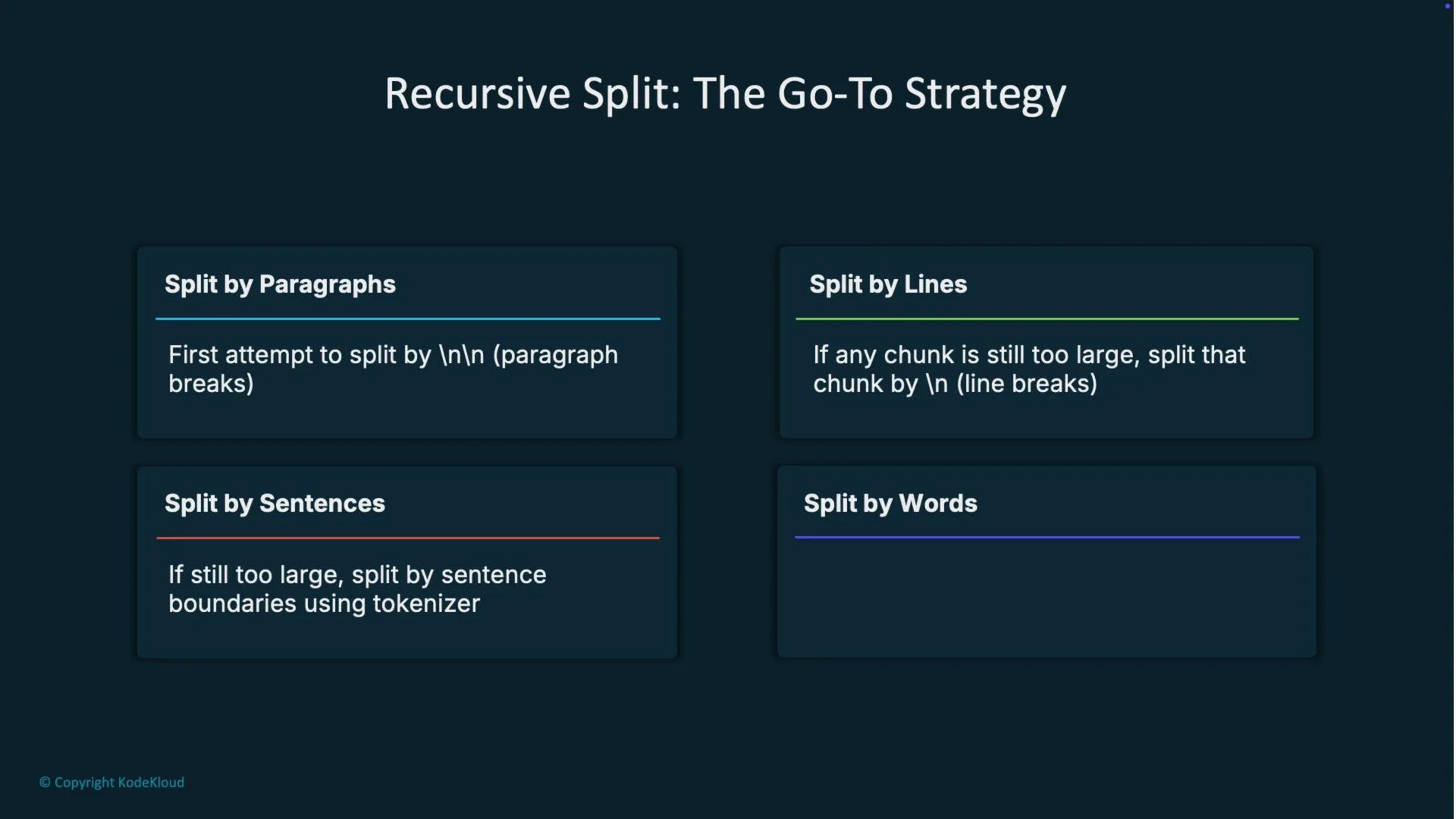
- Recursive split (recommended default)
- What it is: Multi-pass splitting that preserves the largest natural units first and only splits deeper when chunks exceed size constraints.
- Typical pass order: headings/sections → paragraphs → lines → sentences → words.
- Why use it: Balances coherence and size constraints by adapting to document structure and avoiding blind truncation.
- When to use: Default for most RAG pipelines — a strong choice for ~80% of use cases.
- Try to split by paragraph/section boundaries.
- If a chunk still exceeds token limits, split by line breaks.
- If still too large, split into sentences.
- As a last resort, split by words or fixed token slices.
- Header / Markdown splitting
- What it is: Use document structure (Markdown H1/H2/H3, or other structured headings) to keep headings and their content together.
- Pros: Excellent for technical docs, API references, and knowledge bases — preserves hierarchy and section context.
- Cons: Fails on unstructured prose and depends on well-formatted source documents.
- Semantic / topic-shift splitting (advanced)
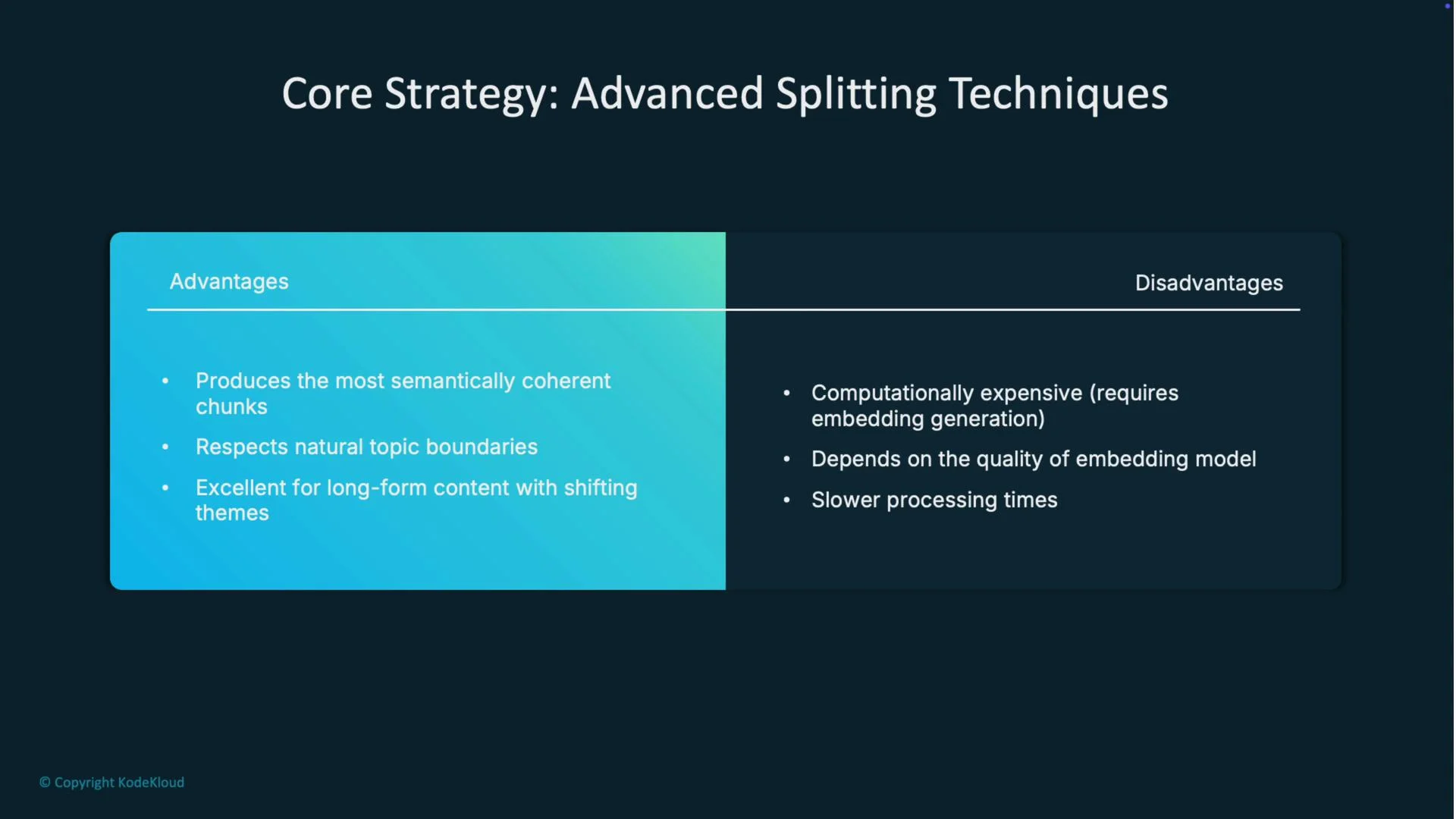
- What it is: Use embeddings to detect semantic similarity and place boundaries where similarity drops below a threshold.
- Process:
- Embed sentences or small units (e.g., with SentenceTransformers).
- Compute cosine similarities between adjacent embeddings.
- Insert a chunk boundary when similarity falls under a tuned threshold that indicates a topic shift.
- Pros: Produces highly coherent, concept-aligned chunks — ideal for long content with shifting themes.
- Cons: Computationally expensive and sensitive to embedding-model quality and threshold tuning.
- SentenceTransformers: https://www.sbert.net/
- Analyze your sources — are they structured (reports, Markdown) or unstructured (books, articles)?
- Default to recursive splitting — it provides a strong balance of coherence, size control, and simplicity.
- Build a ground-truth question set (queries with expected answers) and measure retrieval recall against top-k results.
- If recursive splitting underperforms:
- Use header/Markdown splitting for structured documents, or
- Use semantic/topic-shift splitting for long content with frequent theme changes.
- Consider hybrid approaches, e.g., header splitting to isolate sections, then recursive or semantic splitting inside each section.
- Retrieval recall: do the top-k retrieved chunks contain the correct evidence?
- Answer quality: does the LLM produce useful answers when given retrieved context?
Measure retrieval and end-to-end answer quality using a ground-truth dataset. Start with recall-focused tests (does the correct chunk appear in top-k?) and then measure final answer quality with your prompt/LLM setup.
Always use the tokenizer that matches your embedding/model to measure token counts accurately. Token counting mismatches are a common source of overflow and unexpected behavior.
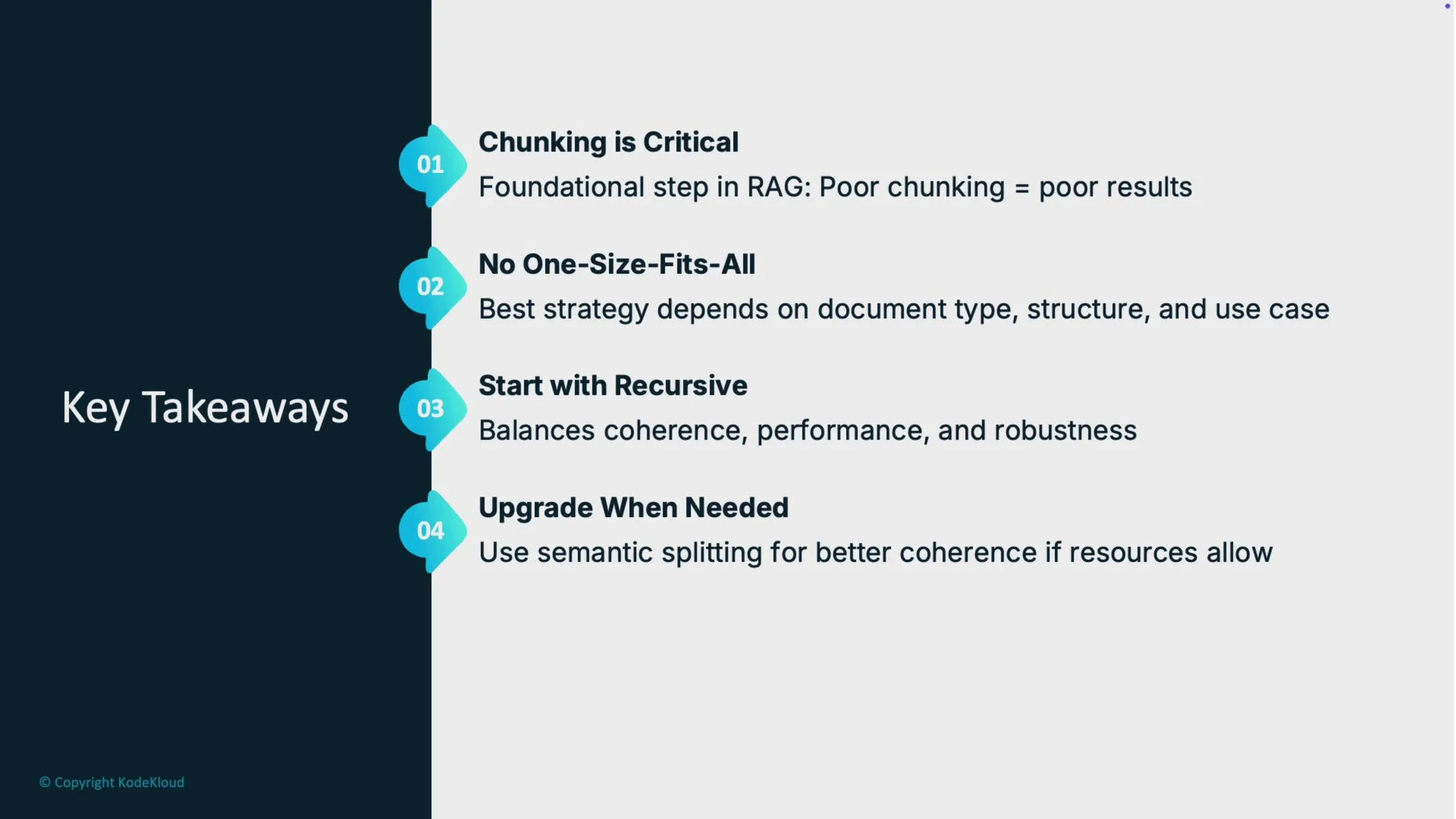
- Chunking is fundamental to RAG pipelines — poor chunking propagates errors downstream.
- No single best strategy fits every document — choose based on document structure, query patterns, and compute constraints.
- Start with recursive splitting as a default. It’s simple, fast, and effective for most cases.
- For long or thematically shifting content, consider semantic splitting (with higher compute cost) or hybrid strategies.
- Always test: build ground-truth queries, measure retrieval performance and answer quality, and iterate.
- RAG patterns and best practices: https://platform.openai.com/docs/guides/retrieval
- SentenceTransformers (semantic splitting): https://www.sbert.net/
- Tokenizers and byte-pair encoding: https://huggingface.co/docs/tokenizers/usage
- Evaluation guidance for RAG: experiment with recall/top-k and end-to-end answer scoring; consider fuzzy matching and semantic similarity metrics.