

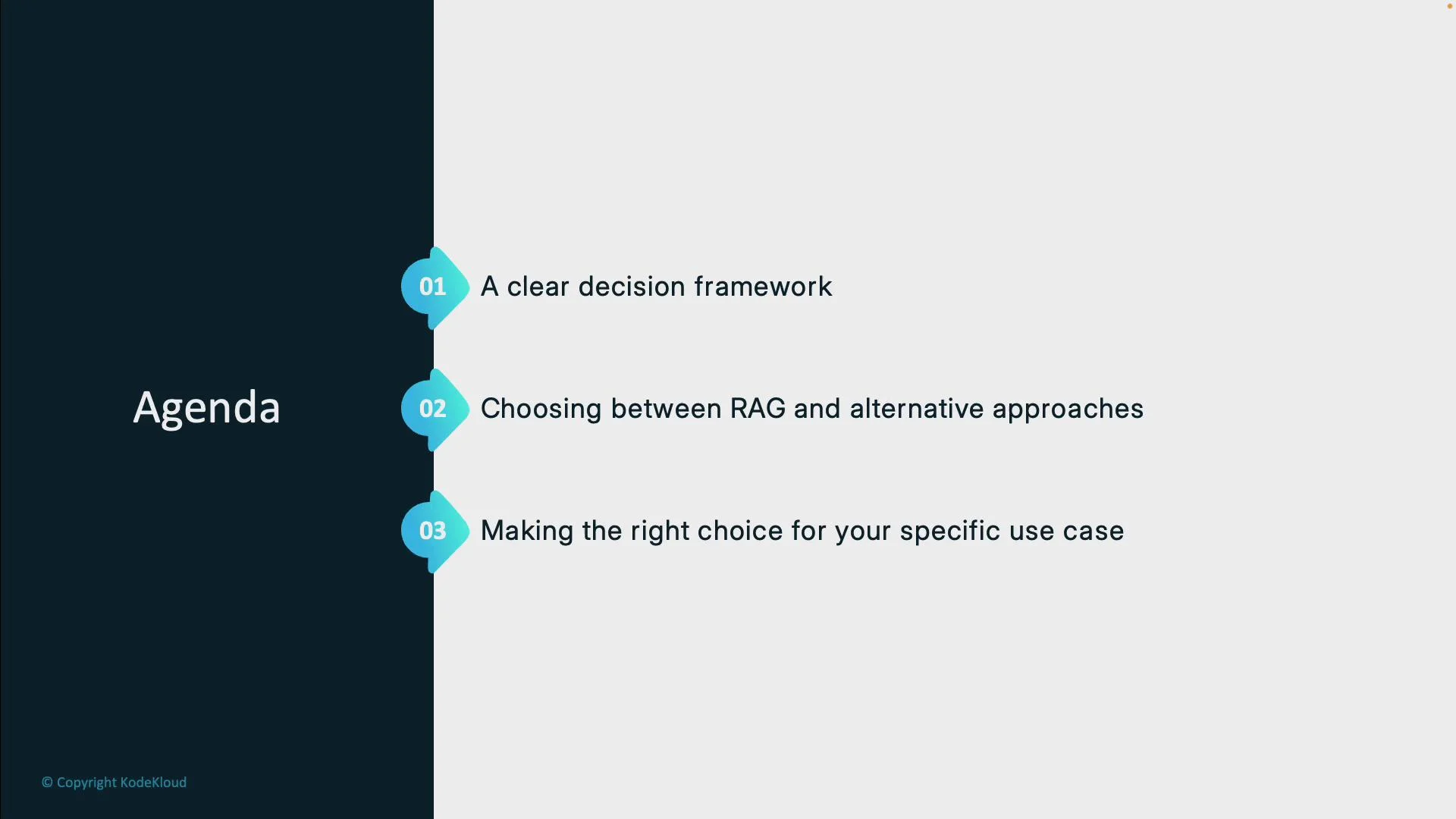
- Retrieval: fetch relevant documents, passages, or knowledge snippets from a knowledge base or vector index.
- Augmentation: assemble and filter the retrieved context to present the most relevant facts to the model.
- Generation: prompt a language model with the assembled context to produce the final answer.
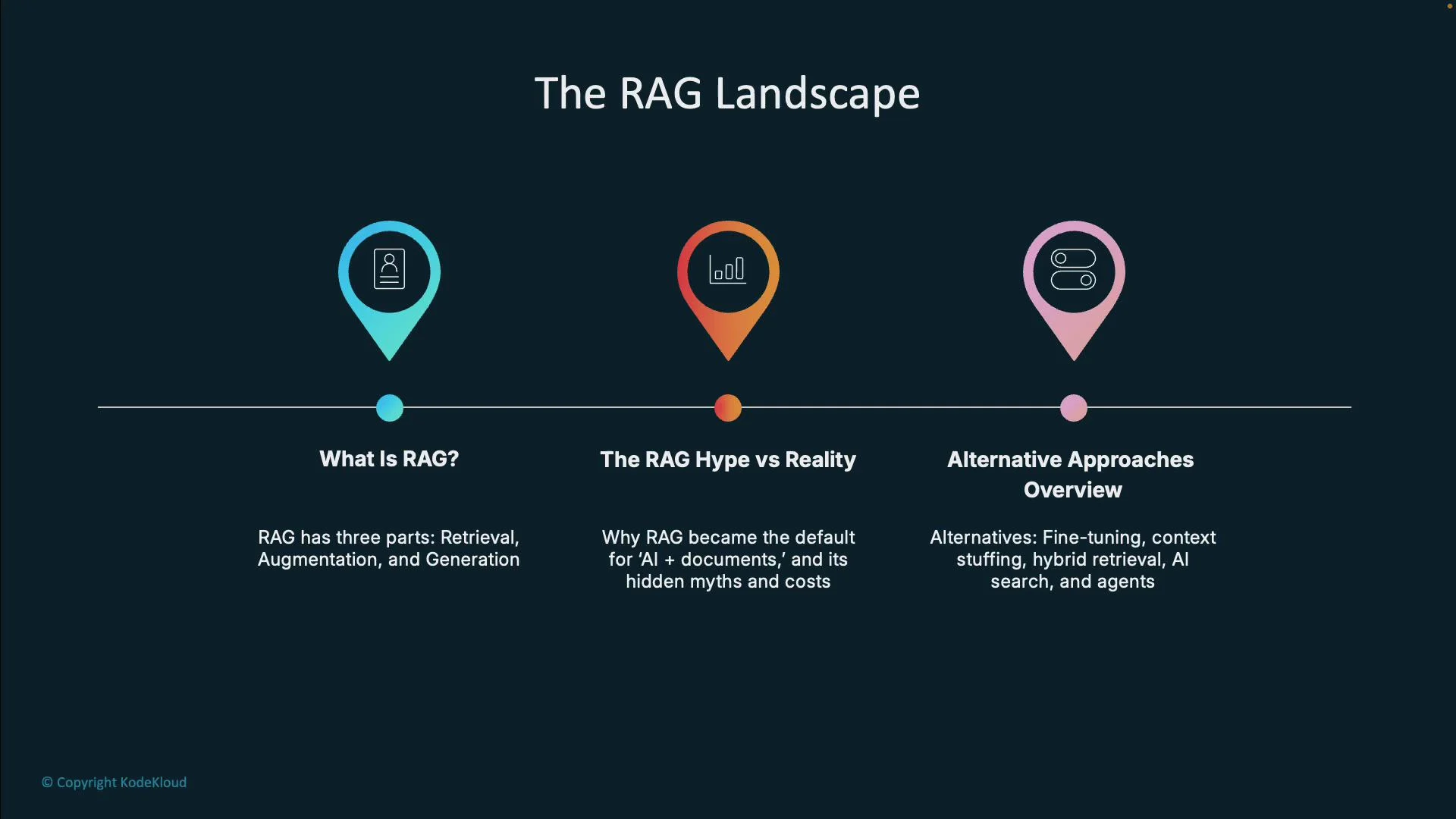
- Fine-tuning: adapt a model to your corpus so domain knowledge is internalized by the model. Best for stable datasets and when you need reproducible, deterministic behavior.
- Context window approaches (context-stuffing): directly include the most relevant content in the prompt without a retrieval service. Useful for small, focused datasets or single-document tasks.
- Hybrid retrieval / AI search: combine semantic search with traditional ranking, filters, and structured queries for robust retrieval without the full RAG complexity.
- Agents / tool-enabled systems: orchestrate specialized tools or modules (calculators, databases, APIs) from the model when actions beyond text generation are required.
Decision framework: practical questions
Use these dimensions to evaluate whether RAG is appropriate for your project.
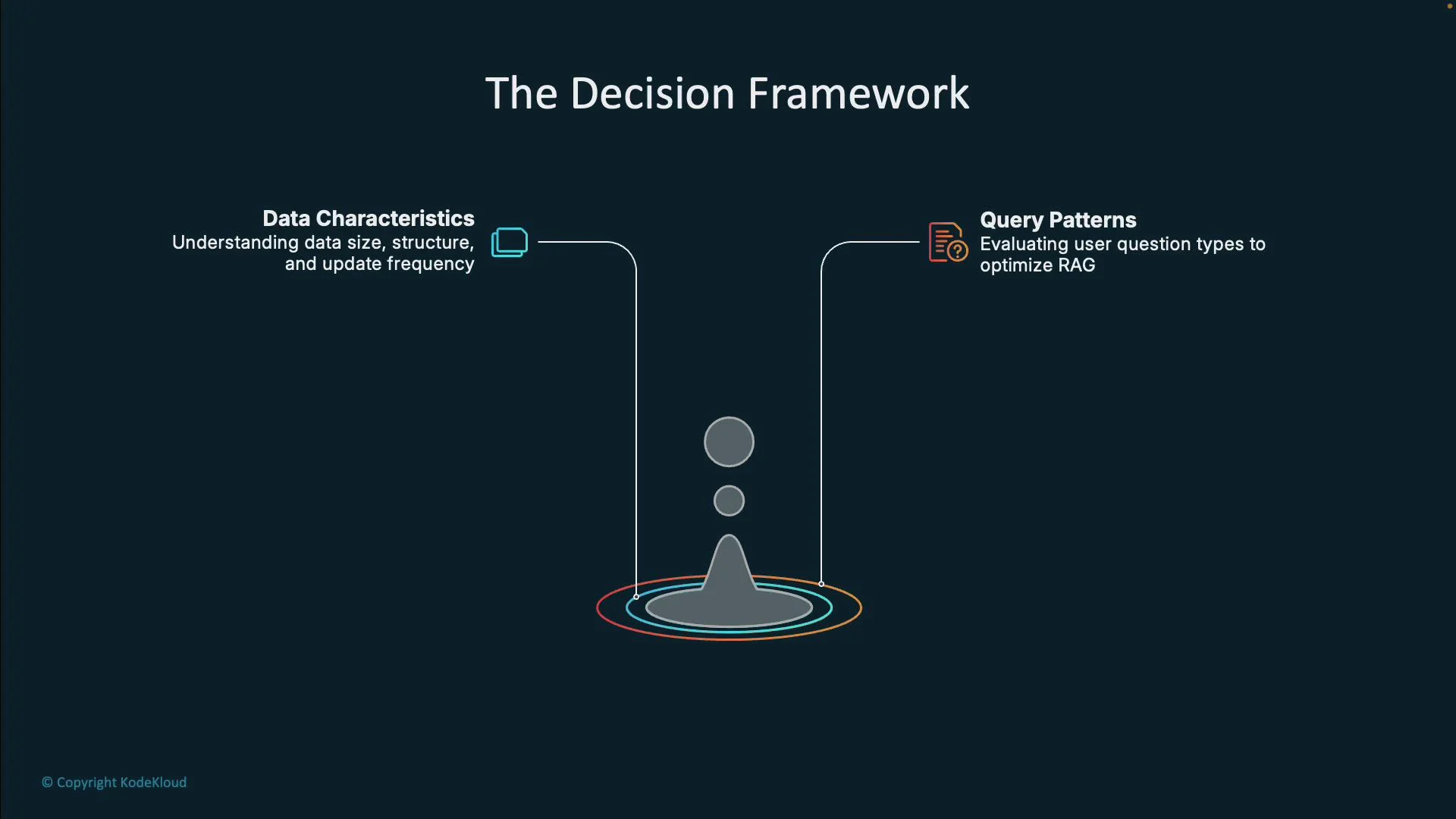
- Data characteristics
- Size: Is your corpus thousands of documents or millions? RAG scales better for large corpora.
- Structure: Are documents structured (tables, DBs) or unstructured (PDFs, images)? Structured sources can often be queried directly.
- Update frequency: Does content change daily or in real time? If so, retrieval-based designs (RAG or hybrid) are typically required to provide fresh answers. If data is stable long-term, fine-tuning becomes more attractive.
-
Query patterns
- Are queries broad and open-ended or very narrow and structured?
- Do users ask for historical trends (e.g., multi-year analytics) or real-time facts (e.g., this week’s metrics)?
- Does the task require reasoning across many documents, or will single-document lookups suffice?
-
Accuracy and auditability
- Do answers need to be 100% reliable and auditable every time? If yes, prefer retrieval plus human review, structured query systems, or fine-tuned models with deterministic outputs rather than free-form generation.
- If approximate answers are acceptable, RAG can provide fast, broad-coverage responses that are practically useful.
-
Constraints: latency and cost
- Latency: RAG adds retrieval, embedding, and (optionally) reranking steps. Can your application tolerate added response time?
- Cost: Measure both compute and infrastructure (vector stores, embedding services, re-ranking models) and per-request inference costs. High throughput or tight budgets may favor simpler approaches.
-
Resource investment and operational complexity
- Do you have the engineering capacity to build and maintain an index, retrieval layer, and monitoring? If not, consider managed search services, hybrid designs, or fine-tuning.
-
Use RAG when:
- The corpus is large and updated frequently.
- Users require fresh or long-tail facts not in pretraining.
- You can budget for the engineering and infrastructure required.
-
Consider fine-tuning when:
- Data is stable and limited.
- You need deterministic, low-latency answers.
- Offline evaluation and reproducibility are priorities.
-
Consider hybrid / search-first approaches when:
- You need robust retrieval and relevance with lower complexity than full RAG.
- You want a mix of structured queries and semantic matching.
-
Use agents when:
- The task requires tool use, step-by-step workflows, or interaction with external systems.
Key question: Is your data changing frequently and do users require fresh answers? If yes, prefer retrieval-based designs (RAG or hybrid). If not, fine-tuning or prompt-based techniques are often simpler and more cost-effective.
- Data properties: size, structure, and update cadence
- Query types and reasoning requirements
- Required accuracy, auditability, and latency
- Budget and engineering capacity
- Profile your data (size, types, update frequency).
- Log and sample real user queries.
- Prototype a simple search-first flow (semantic + lexical) and measure relevance and latency.
- If search-first fails to meet coverage or reasoning needs, prototype a RAG pipeline with re-ranking and grounding.
- If data is stable and you need predictability, evaluate fine-tuning on a subset of queries.
- Retrieval-Augmented Generation — original paper and concepts
- Vector search and indexing libraries: FAISS, Milvus, Annoy
- Managed vector stores: Pinecone, Weaviate, Milvus Cloud
- Best practices for prompt design and grounding