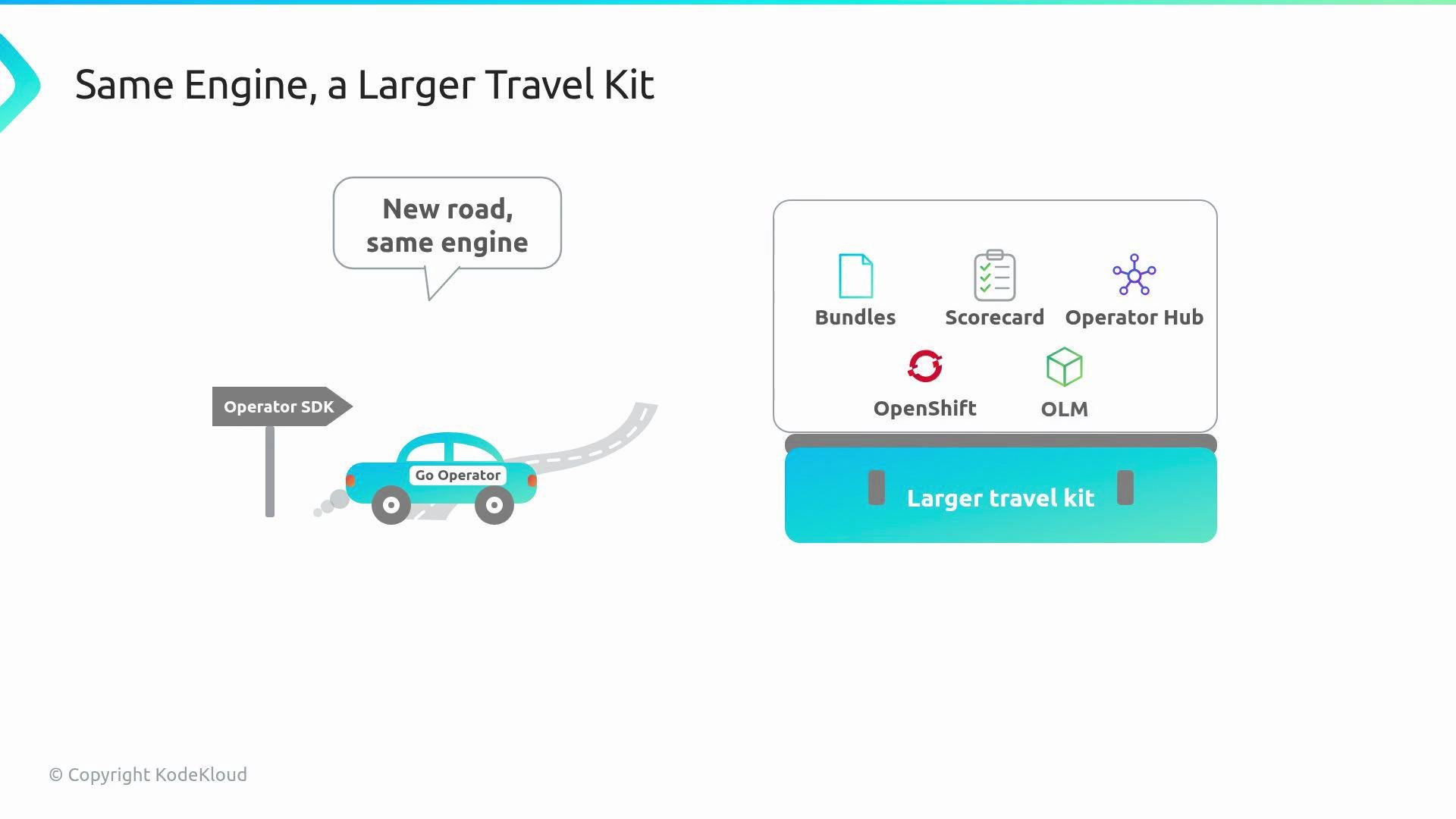
Operator SDK can look like a new route — but for a Go operator it is mostly the same engine with a larger toolkit around it. The names change — you’ll hear SDK, bundles, scorecard, OperatorHub, OpenShift, and OLM — but the reconcile idea underneath does not start over.
The image depicts a metaphor of a Go Operator car on an "Operator SDK" road, with a speech bubble saying "New road, same engine," alongside a larger travel kit containing items like Bundles, Scorecard, and OpenShift.
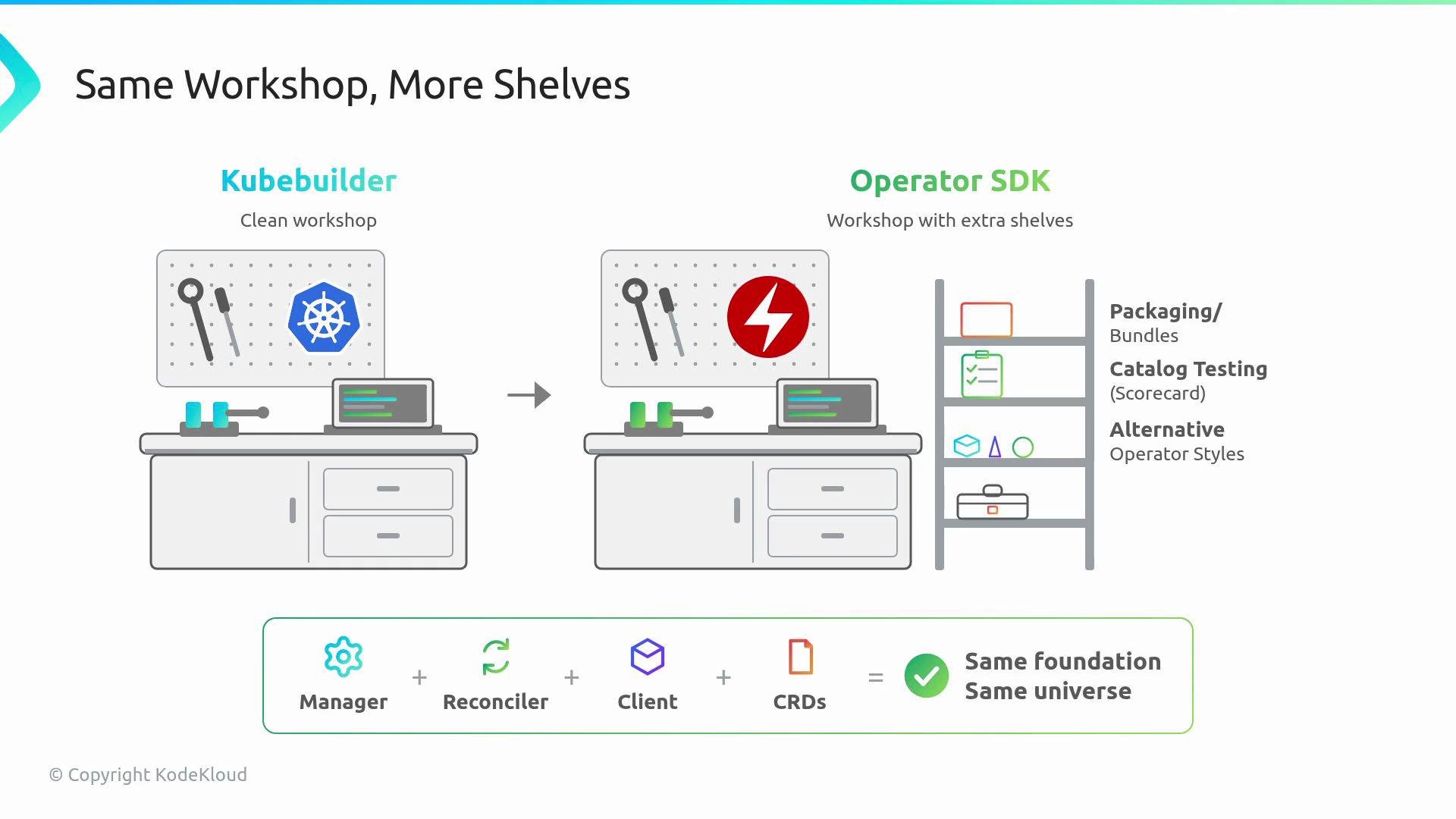
Summary: think of KubeBuilder as a tidy workshop for building a Go controller, while Operator SDK is that same workshop with extra shelves for packaging, catalog testing, and alternative operator styles. If you already know managers, reconcilers, the client, and generated CRDs, you’re not entering a different universe — both tools sit on top of controller-runtime.
The image illustrates a comparison between Kubebuilder and Operator SDK, highlighting the additional features of Operator SDK like packaging, catalog testing, and alternative operator styles. Both use the same foundational elements like Manager, Reconciler, Client, and CRDs.

The shared control-loop foundation

controller-runtime is the library that provides the patterns demonstrated here. The common control-loop pieces are:
  • Manager: starts controller processes and coordinates lifecycles.
  • Reconciler: receives reconciliation requests and implements desired-state logic.
  • Client: reads and writes Kubernetes objects.
  • Watches: notify the manager about object changes and enqueue reconcile requests.
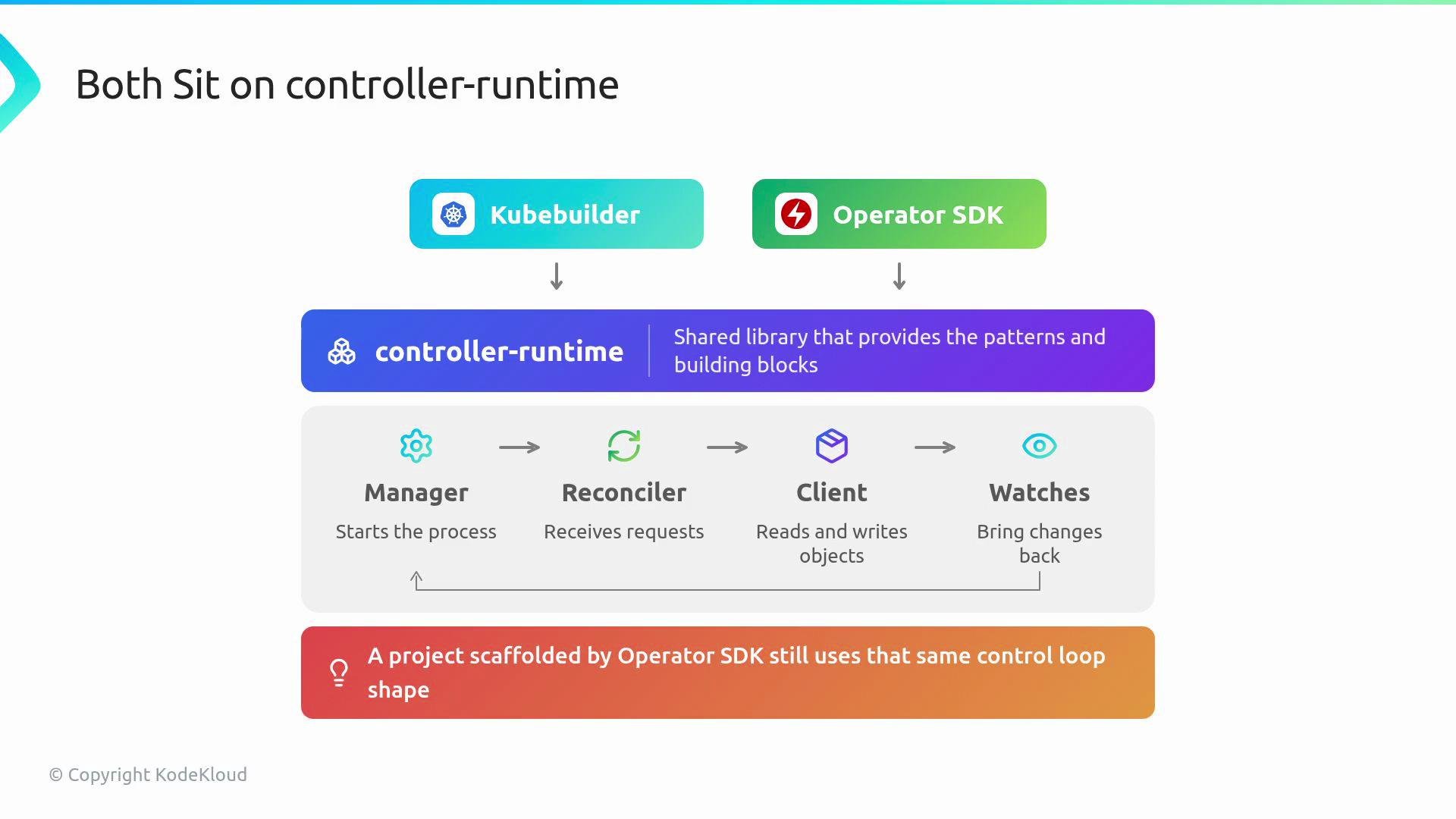
A project scaffolded by Operator SDK still uses that same control-loop shape; for a Go operator the layout and concepts should feel familiar.
The image outlines the relationship between Kubebuilder and Operator SDK, both of which rely on the controller-runtime. It illustrates the components of the control loop process: Manager, Reconciler, Client, and Watches.
Typical repository layout for a Go operator (scaffolded by either tool) looks like:

So which tool should you choose?

The right question is not “which tool is the real operator tool?” — it’s: what job around the operator do I need help with? KubeBuilder is strong when the main job is designing a Go API and writing reconcile logic. Operator SDK becomes attractive when you also need the surrounding lifecycle: packaging, validation, distribution, or support for non-Go operator styles.
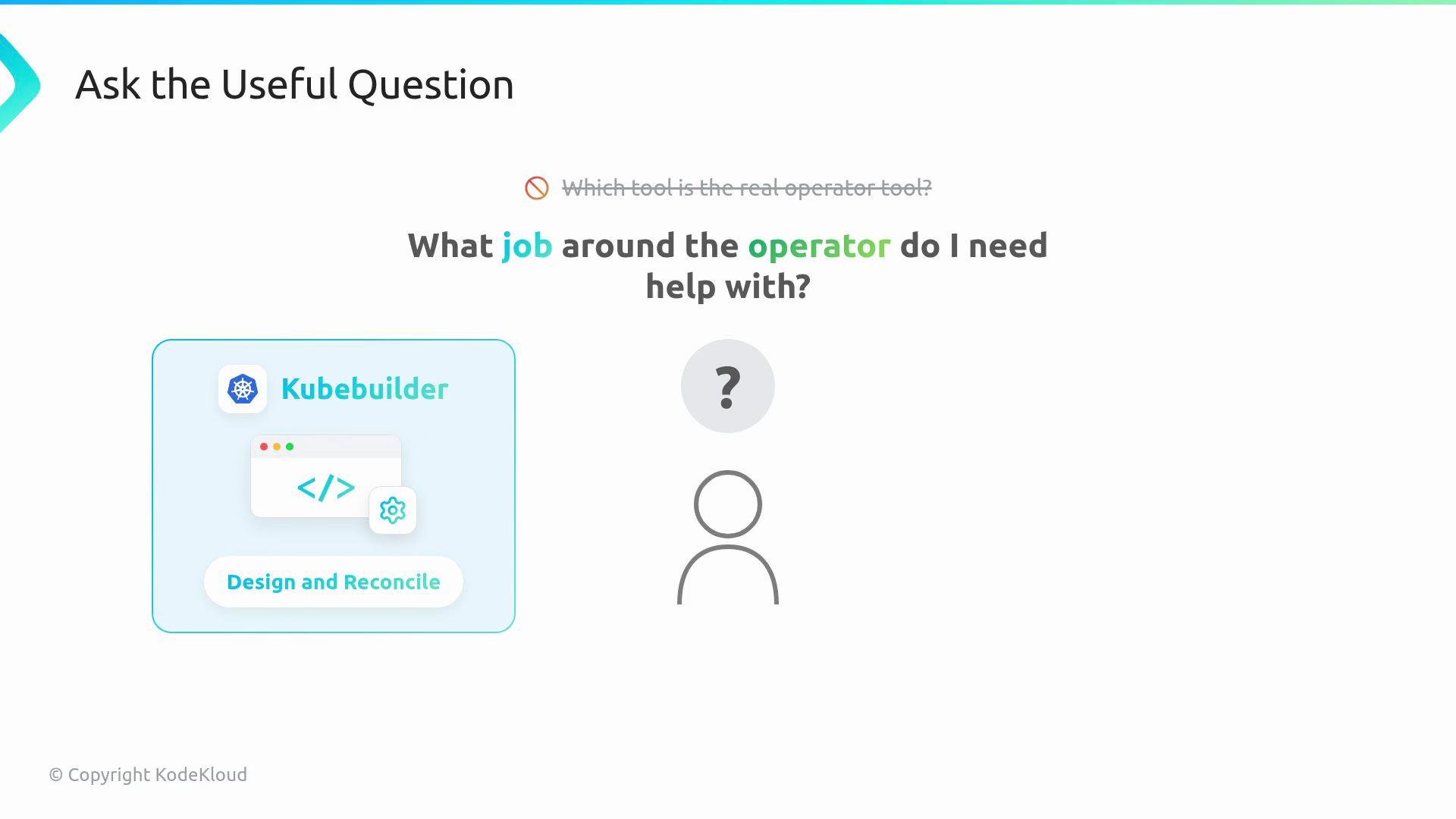
The image contains a guide on asking useful questions about using "Kubebuilder" for operator tasks, with emphasis on job-related queries. It features a design and reconcile icon along with a question mark over a user icon.

Quick comparison

Operator SDK and OLM / bundles

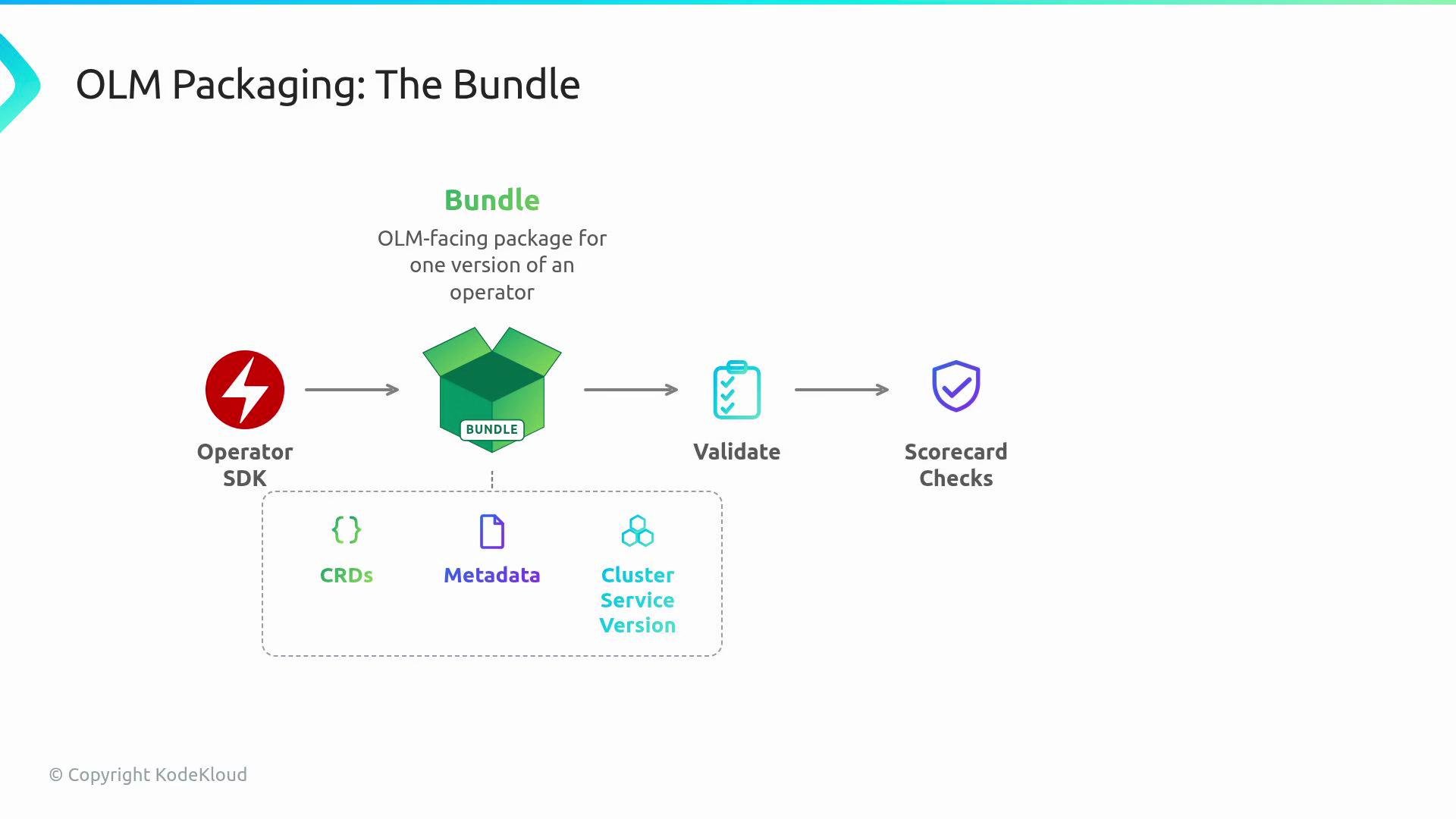
A bundle is the OLM-facing package for one version of an operator: it includes CRDs, metadata, and a ClusterServiceVersion. Operator SDK provides commands and workflows to:
  • scaffold a bundle structure,
  • assemble CRDs and manifest fragments,
  • run validations and the Operator SDK scorecard,
  • test operator installation using OLM.
The image illustrates the OLM Packaging process involving a bundle created using the Operator SDK, validated, and checked with a scorecard. It shows components of the bundle including CRDs, metadata, and cluster service version.

Operator SDK supports multiple operator styles

Operator SDK reaches beyond Go: it includes scaffolds and runtime support for Helm-based and Ansible-based operators. Those approaches trade custom Go reconcile code for a higher-level automation style. They’re not universally better — they’re simply different trade-offs that can speed development for certain use cases.
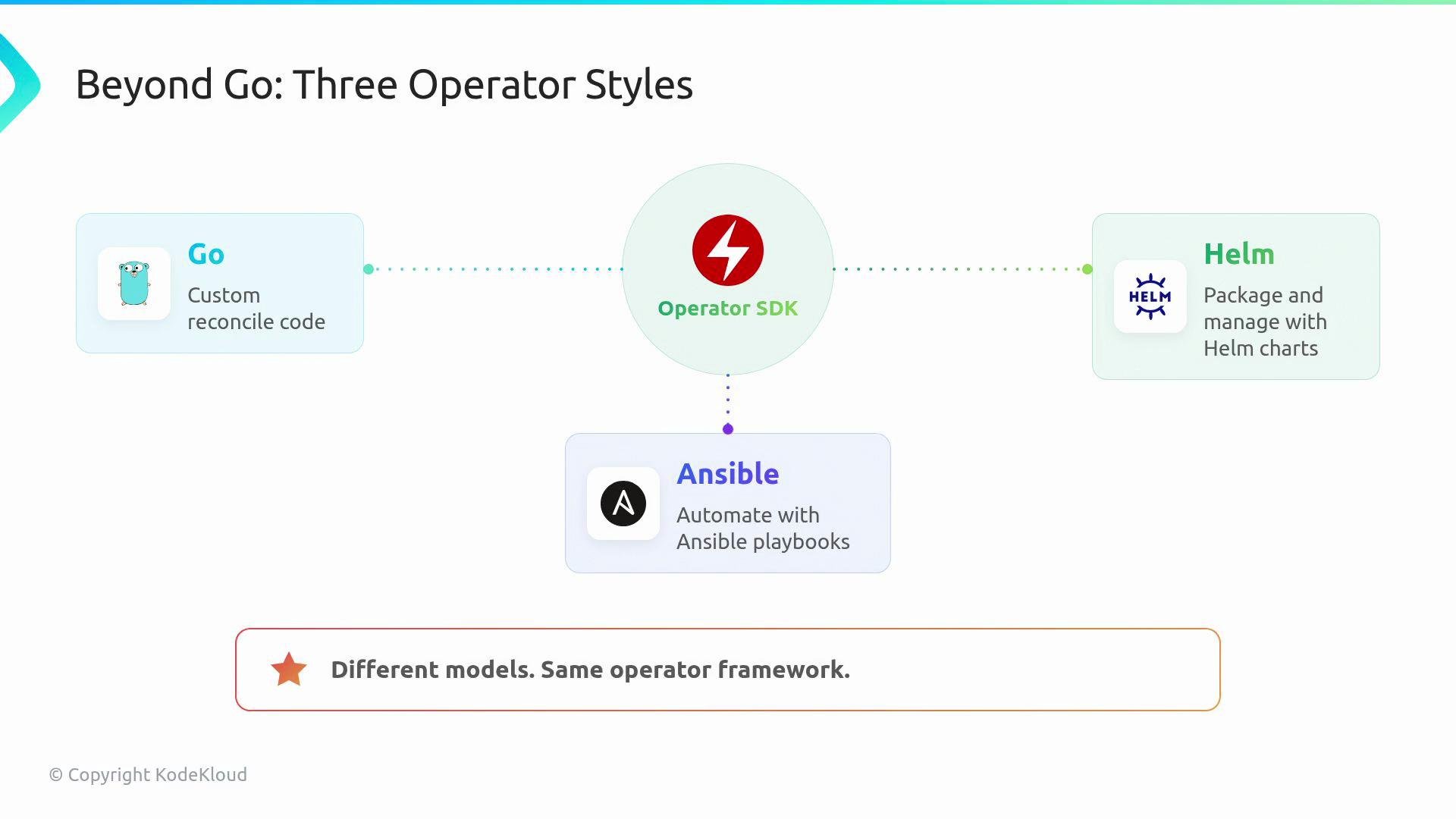
The image illustrates three operator styles for Kubernetes—Go for custom reconcile code, Ansible for automating with playbooks, and Helm for package management—linked by the Operator SDK framework. A note emphasizes "Different models. Same operator framework."

Practical guidance

  • Choose KubeBuilder if you want the clearest path to build a Go controller and you will ship raw manifests, Kustomize, Helm, or your own pipeline.
  • Choose Operator SDK if you need out-of-the-box packaging for OLM, want to publish to OperatorHub, plan to target OpenShift, require scorecard validation, or prefer Helm/Ansible scaffolds over Go code.
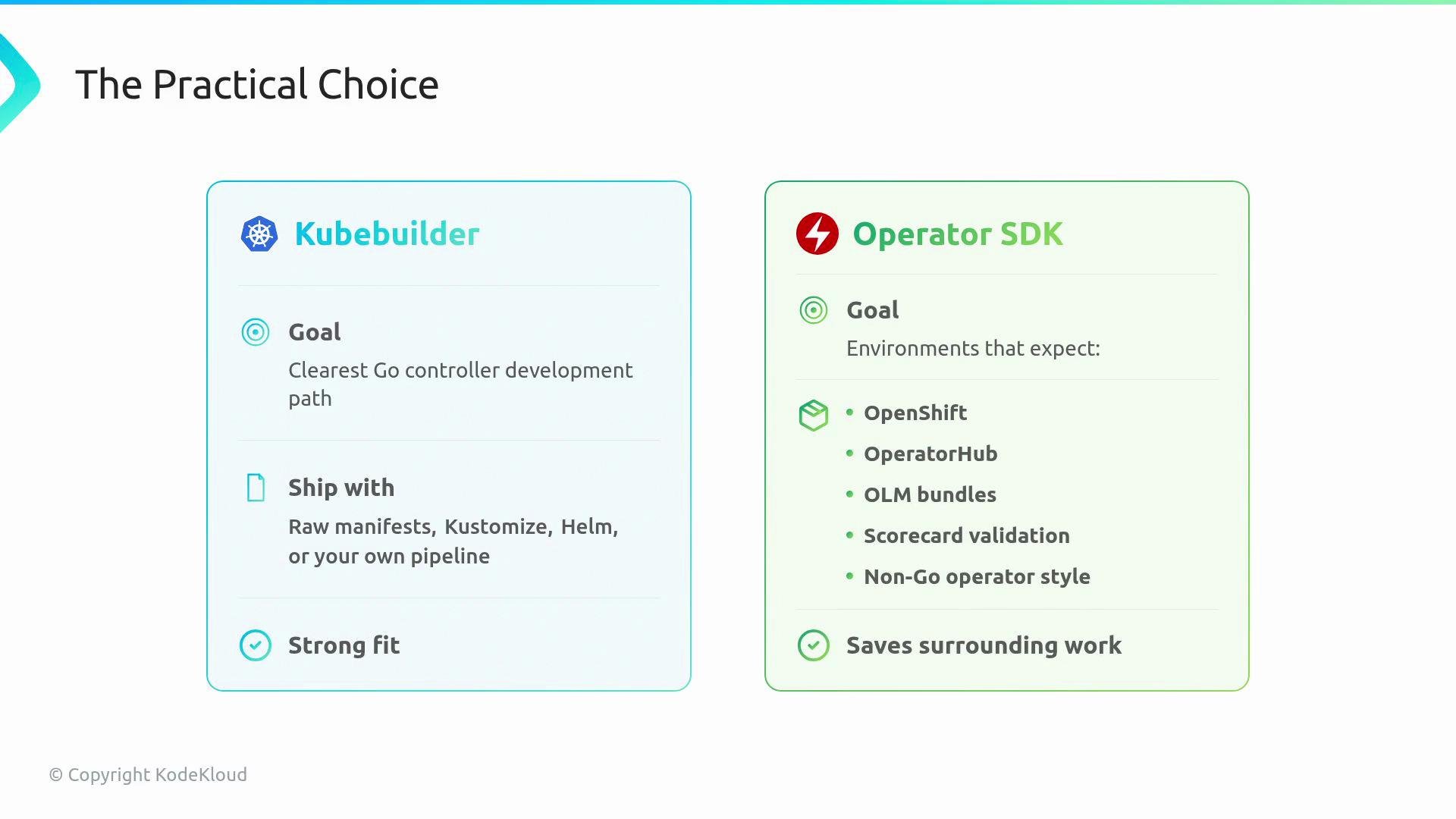
The image compares Kubebuilder and Operator SDK, highlighting their goals, features, and suitable use cases in a table format.
Both tools share the same underlying operator model. Choose KubeBuilder for focused Go controller development; choose Operator SDK when you want out-of-the-box packaging, OLM integration, or non-Go operator styles.
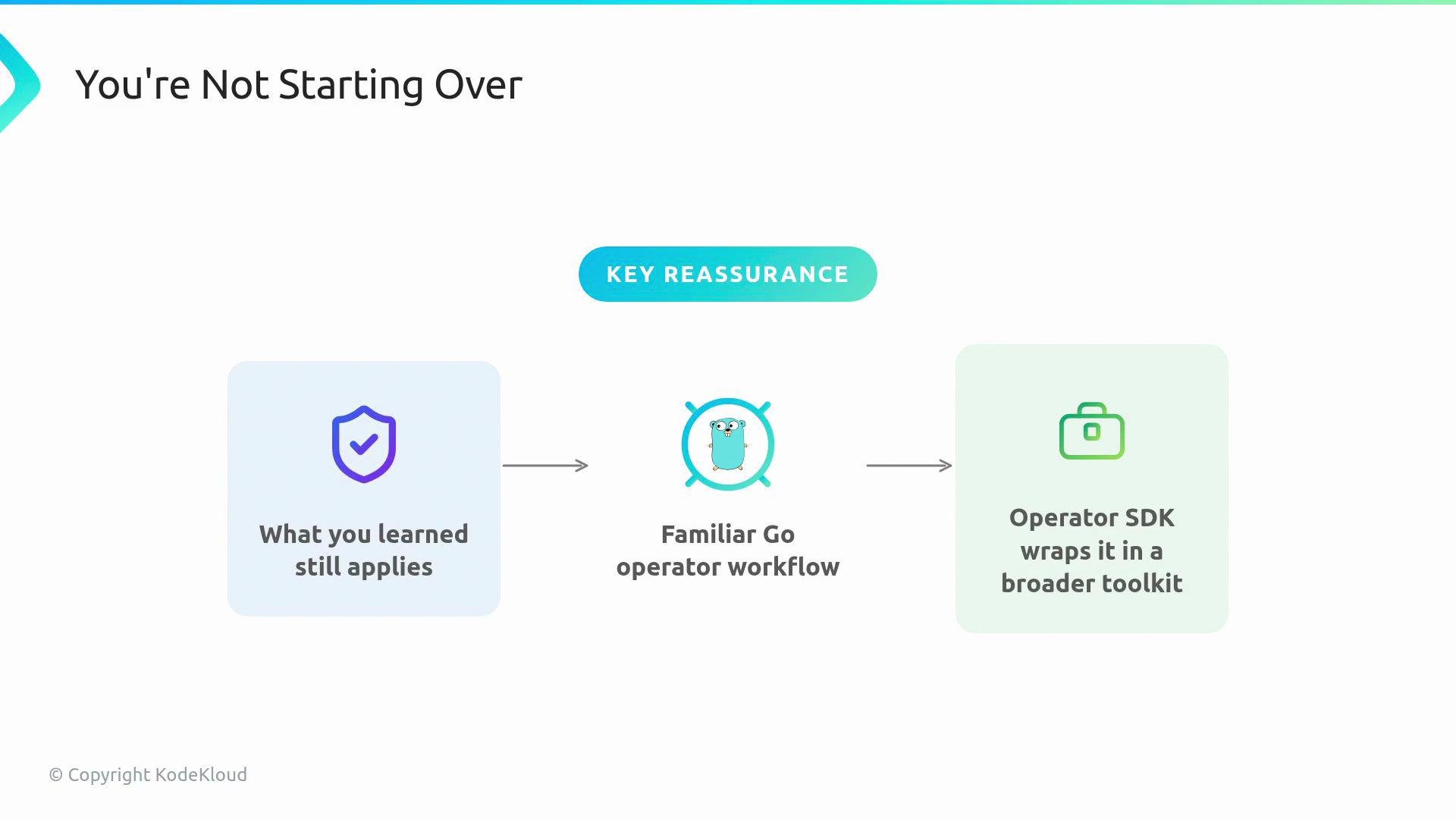
The key reassurance: you are not throwing away what you learned. Operator SDK does not replace the operator mental model — it wraps the familiar Go operator workflow in a broader distribution and ecosystem toolkit. A demo that scaffolds a web-app operator with Operator SDK and compares it to a KubeBuilder project usually highlights that the underlying control-loop patterns remain the same, not that the tooling is foreign.
The image explains a process reassuring that previous knowledge still applies with a familiar Go operator workflow, enhanced by the Operator SDK in a broader toolkit.

Watch Video