

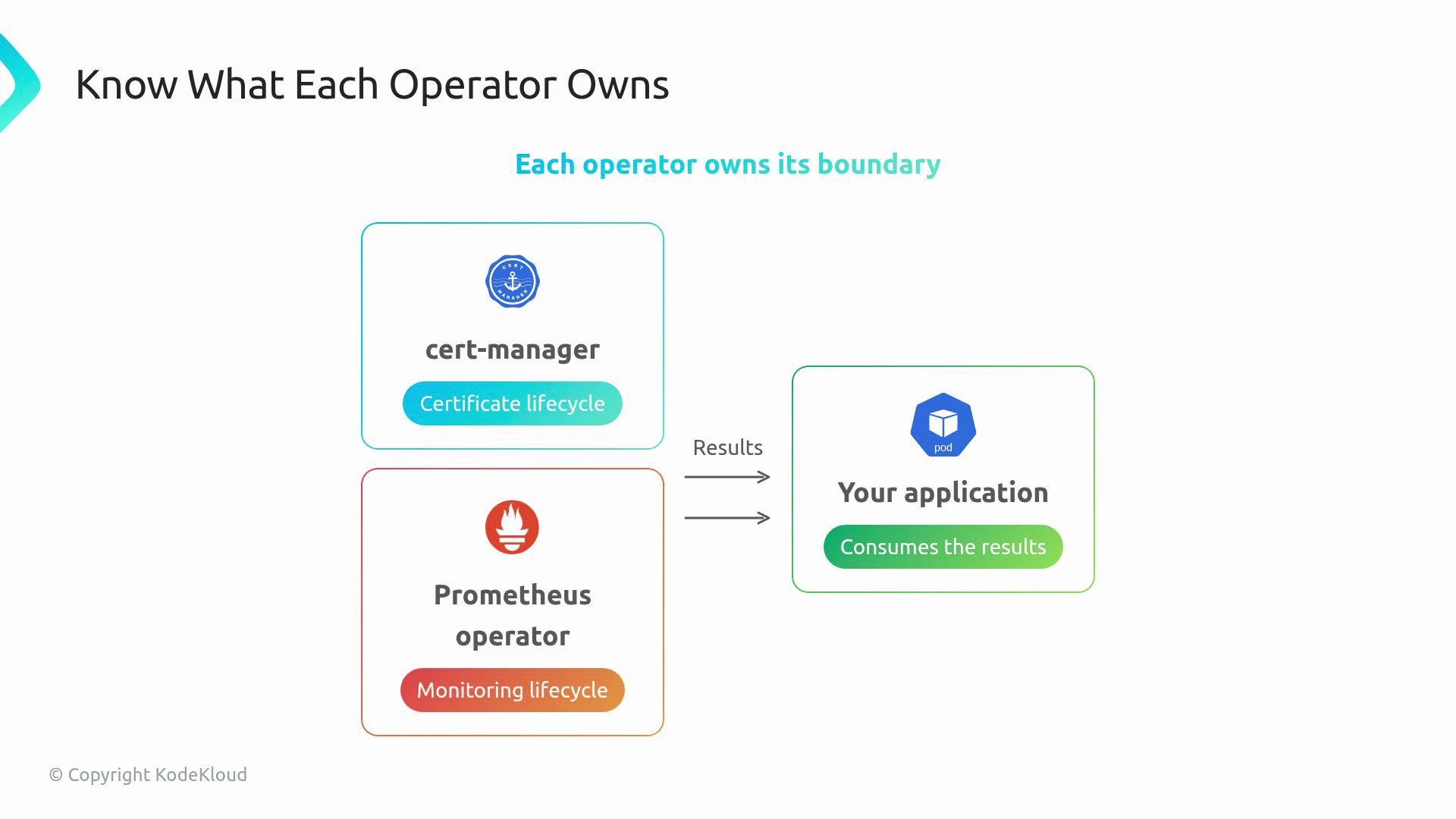
- cert-manager: exposes Kubernetes APIs such as
Issuer,Certificate, andCertificateRequest. Instead of creating TLS Secrets by hand, you declare aCertificateand cert-manager reconciles it into a KubernetesSecretthat applications consume. - Prometheus Operator: provides custom resources for running Prometheus and for selecting scrape targets. A
ServiceMonitorlets teams describe which services Prometheus should scrape without editing Prometheus’ config directly.
- Primary CRs:
Issuer/ClusterIssuer,Certificate,CertificateRequest - Outcome: Kubernetes
Secretcontaining TLS material - Common issuers: ACME (Let’s Encrypt), HashiCorp Vault, Venafi, self-signed
- Primary CRs:
Prometheus,ServiceMonitor,PodMonitor,Alertmanager - Outcome: Managed Prometheus instances with targets discovered via
ServiceMonitor/PodMonitor - Benefit: Teams describe scrape targets declaratively without changing Prometheus config directly
Key learning outcomes: Understand cert-manager’s Issuer → Certificate → Secret flow, learn how ServiceMonitor integrates services with Prometheus, and develop the habit of evaluating operator ownership boundaries before consuming resources.
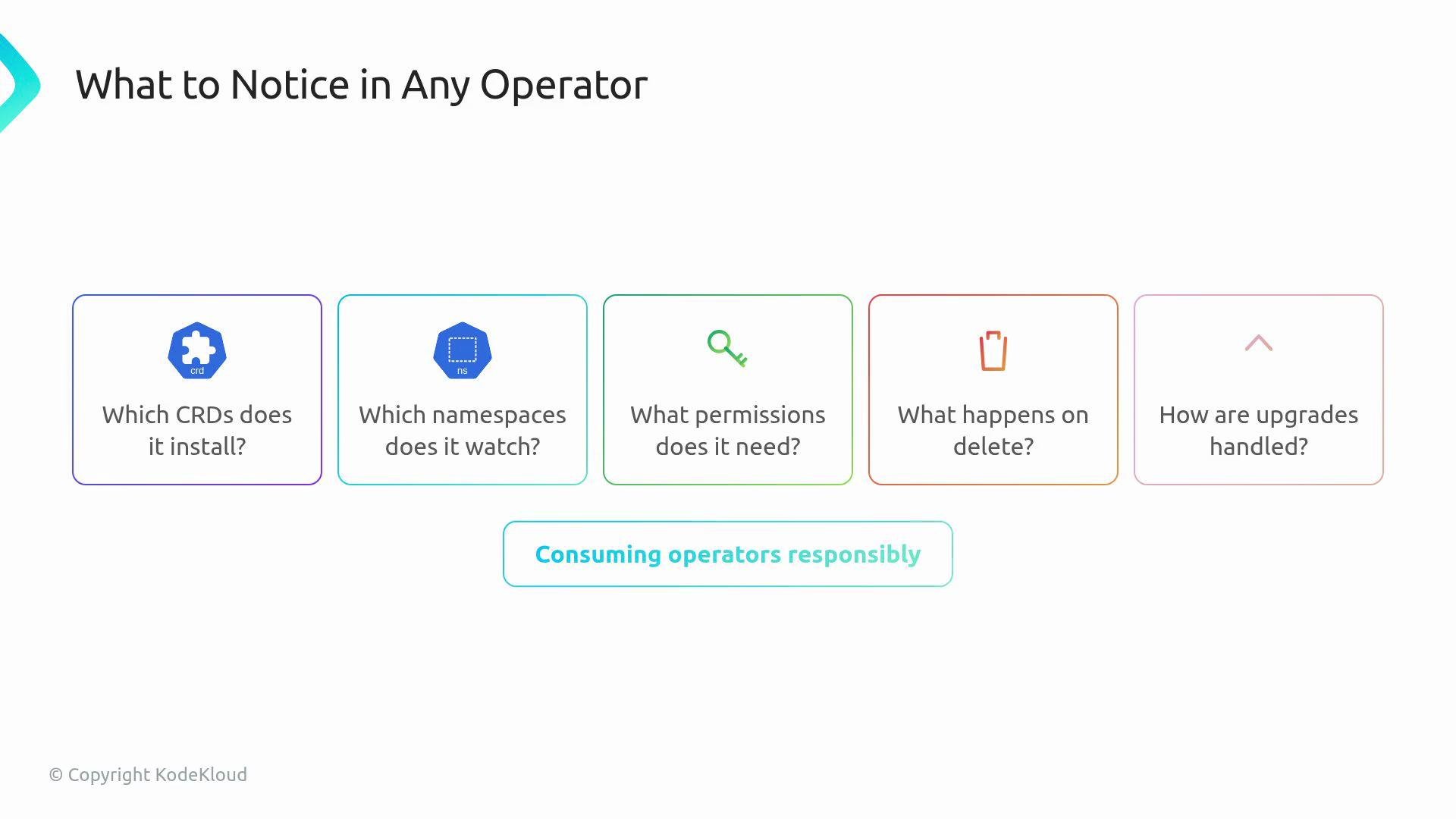
- What CRDs does the operator install? (names, versions)
- Which namespaces does it watch? (single-namespace, multi-namespace, cluster-scoped)
- What RBAC permissions does it require? (cluster roles, service accounts)
- What happens when a custom resource is deleted? (finalizers, leftover Secrets)
- How are upgrades handled? (CRD versioning, migration rules, operator lifecycle)
Before granting an operator broad cluster permissions or creating cluster-scoped CRs, confirm ownership and lifecycle expectations. Operators that own Secrets or Service configurations can impact many teams when misconfigured or upgraded.
- The following sections take a closer look at cert-manager (Issuer → Certificate → Secret) and the Prometheus Operator (Prometheus → ServiceMonitor → scrape targets), with examples and a lab that installs both operators in one cluster. That lab emphasizes reasoning about ownership: cert-manager owns certificate lifecycle, Prometheus Operator owns monitoring lifecycle, and your application resources consume their outputs.
- cert-manager documentation
- Prometheus Operator (kube-prometheus) documentation
- Kubernetes CRD concepts
- Kubernetes RBAC documentation