Up to this point you’ve been developing and testing the web app Operator primarily from a developer workflow: running the manager locally, watching reconciliation logs, adding status and finalizers, implementing CEL validation, and validating behavior inside a Kubernetes cluster. This lesson shifts the focus from “does the operator work?” to “how do other people install and run it?” In other words: how do you package the controller into a container image, publish it, and deliver repeatable install manifests so others (and CI/CD systems) can deploy and run the operator in their clusters? Packaging begins with the controller image. The operator manager is a Go binary, but Kubernetes runs containers. Kubebuilder scaffolds a Dockerfile that builds the manager and copies the compiled binary into a lightweight runtime image. Your tasks in this section are:
  • Inspect the Dockerfile build path and verify the binary ends up in the runtime image.
  • Connect the image tag you produce to the Deployment used by the operator manager.
  • Use the provided Makefile targets (scaffolded by Kubebuilder) to build, push, and deploy the operator.
Key Makefile targets you will use: Example workflow (end-to-end):
IMG is not cosmetic — the exact image reference you set becomes part of the generated install manifests (the container image field in the manager Deployment). If you set an incorrect IMG the cluster may pull the wrong image or the controller may fail to start. After deploying, verify the controller manager is running and is using the image you pushed:
Finally, create a WebApp custom resource and confirm the installed operator reconciles it from inside the cluster — the same behavior you validated locally should now occur with the controller running as a Kubernetes workload.
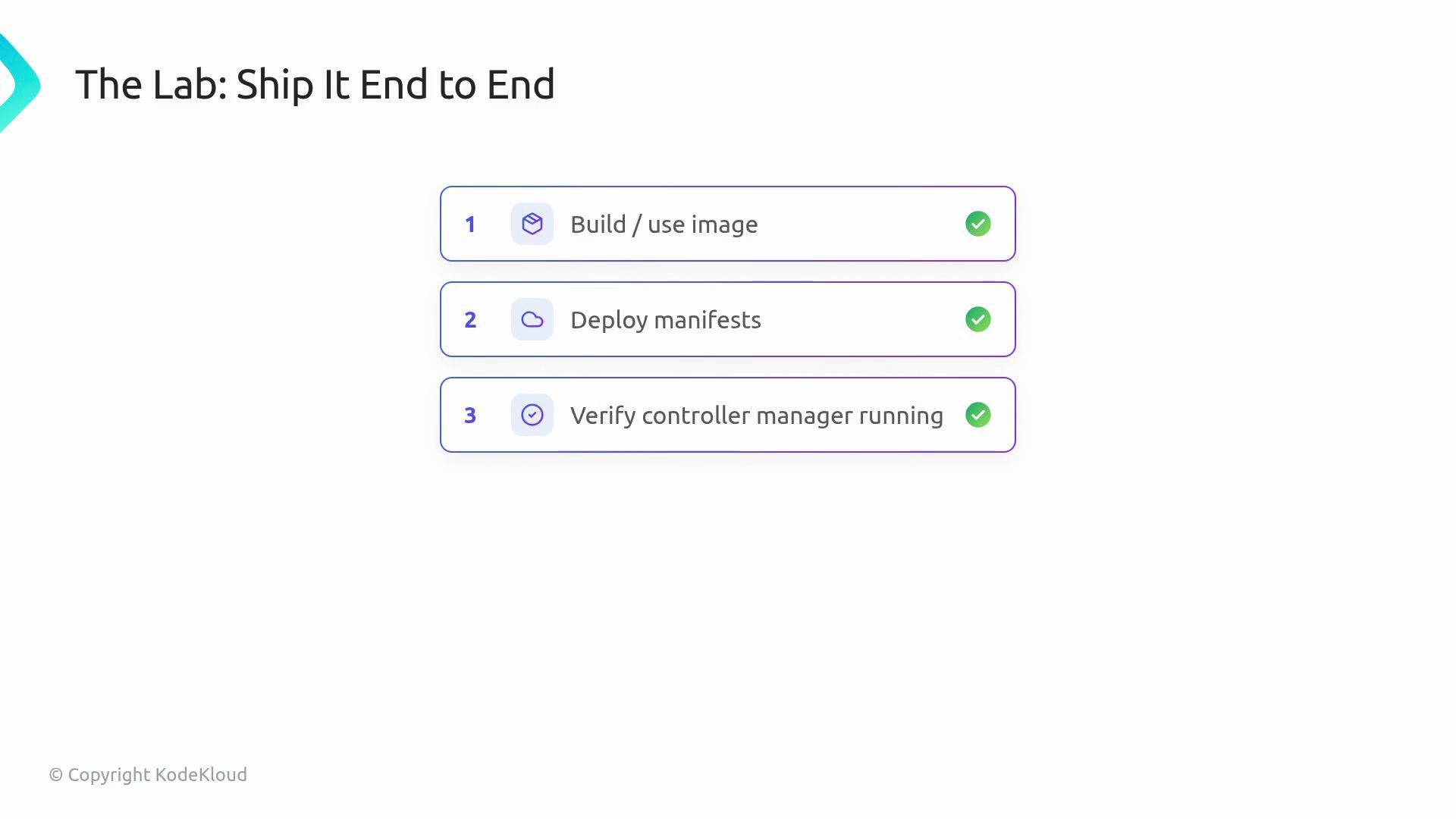
The image displays a three-step process titled "The Lab: Ship It End to End," which includes building/using an image, deploying manifests, and verifying the controller manager running, each marked as complete.
This section closes with a brief look at Operator Lifecycle Manager (OLM). OLM is not required for every operator deployment, but it’s important to understand its model: bundles, ClusterServiceVersions (CSVs), catalogs, and subscriptions. Raw manifests or a kustomize-based install are sufficient for many environments; OLM becomes valuable when you need install metadata, upgrade channels, and marketplace-style distribution. By the end of this section you will have a repeatable packaging and deployment path for the web app Operator: a container image, published install manifests, a verified manager running in-cluster, and an upgrade story you can use going forward.
When using the Makefile targets, always set IMG to the exact image reference you intend to deploy (including registry and tag). The deployed manifests will reference that value, so an incorrect IMG will cause the cluster to pull a different image or fail to start the controller.
Ensure you have credentials and write access to the target registry before running make docker-push. Also confirm the cluster can pull from that registry (private registries may require imagePullSecrets).

References

Watch Video