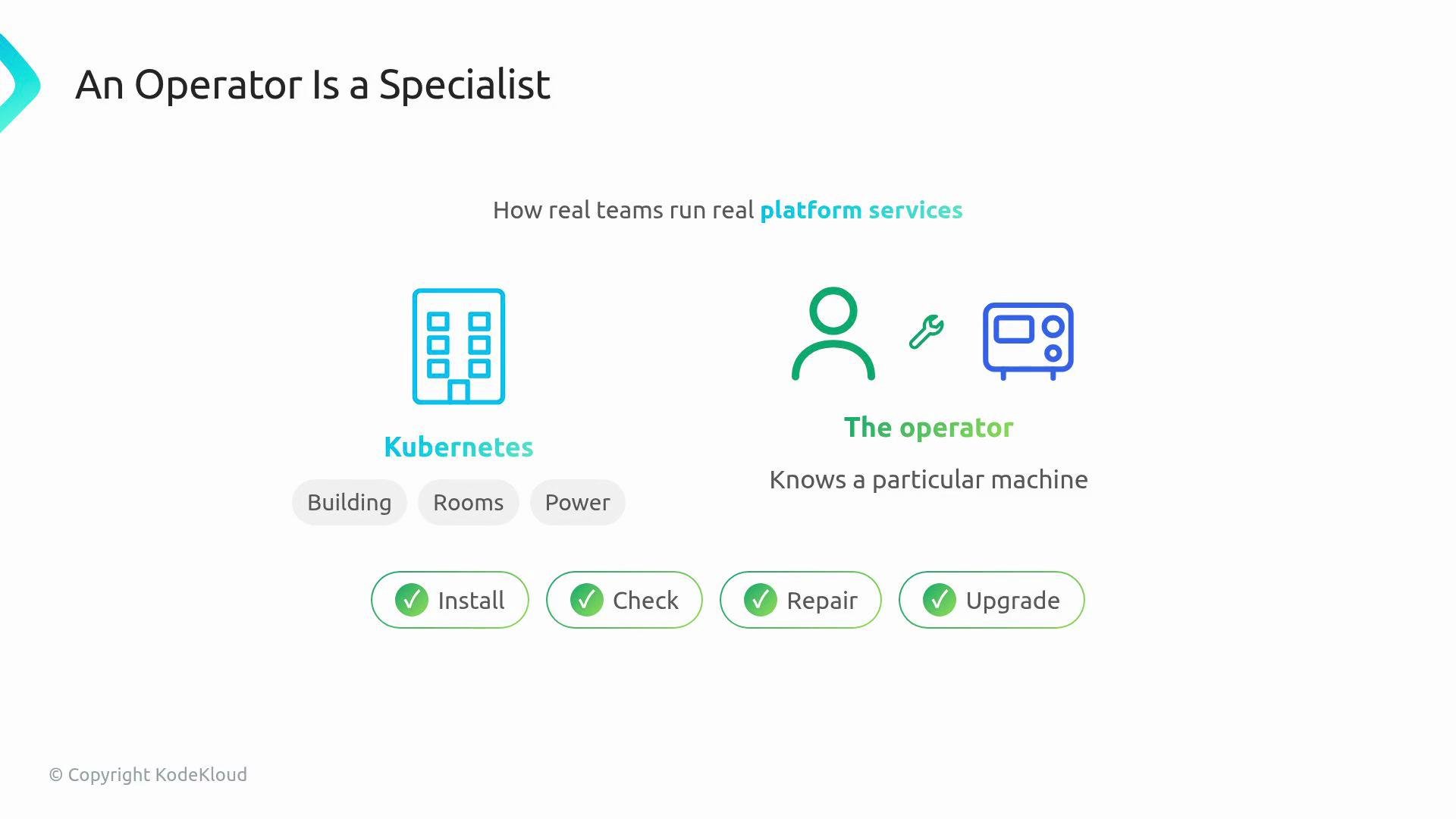
To fully understand the operator pattern, it helps to see how it appears in real tools people use every day. Operators are not just a theoretical pattern — many teams rely on operators to run production platform services on Kubernetes. Think of an operator as a specialist technician: Kubernetes provides the building, rooms, and power; the operator encodes the specialist knowledge for installing, checking, repairing, and upgrading a particular piece of software. That specialist knowledge is what makes an operator so useful.
The image explains how operators are specialists in running platform services with Kubernetes, focusing on tasks like installing, checking, repairing, and upgrading specific machines. It highlights the operator's knowledge of particular machines in relation to platform services.
Operators encapsulate operational expertise (backups, upgrades, failover, certificate lifecycle, etc.) as controllers that reconcile Kubernetes custom resources with a running system. Use CustomResourceDefinitions and controllers to declare intent and let the operator maintain the implementation.
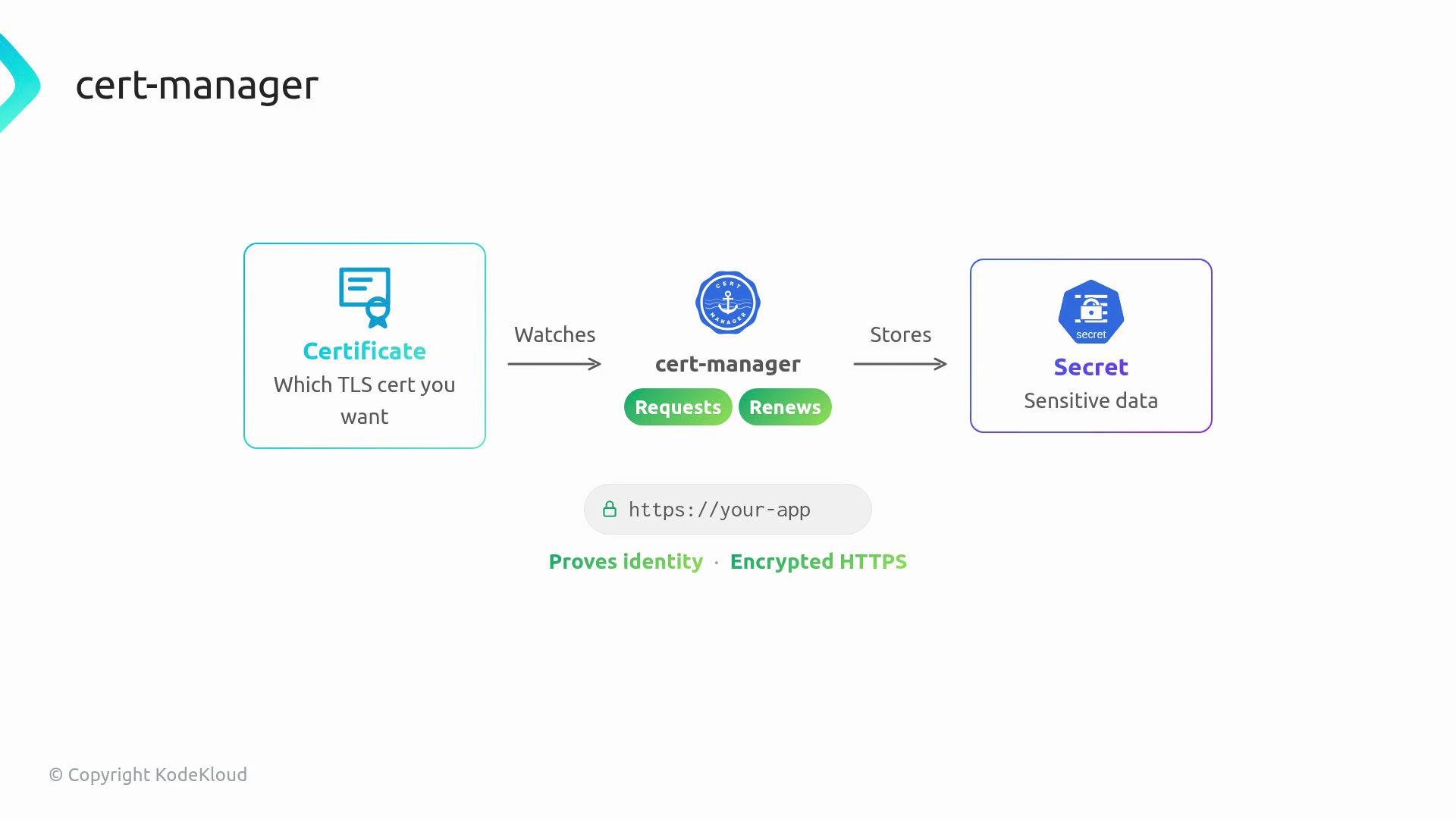
Cert-manager (TLS lifecycle)
  • You create a Certificate custom resource to declare the TLS certificate you need.
  • The cert-manager operator watches that Certificate, requests or renews the certificate from an issuer (for example ACME/Let’s Encrypt), and stores the resulting key material in a Secret.
  • Applications consume the Secret to enable HTTPS and mutual TLS.
The image shows a flowchart of the cert-manager process, which monitors and requests a certificate, then stores sensitive data as a secret to enable encrypted HTTPS connections.
Prometheus Operator (monitoring configuration)
  • Instead of hand-editing Prometheus scrape configuration files, you create higher-level resources like ServiceMonitor or PodMonitor.
  • The operator watches these objects and updates Prometheus’ configuration automatically so the monitoring system stays aligned with declared intent.
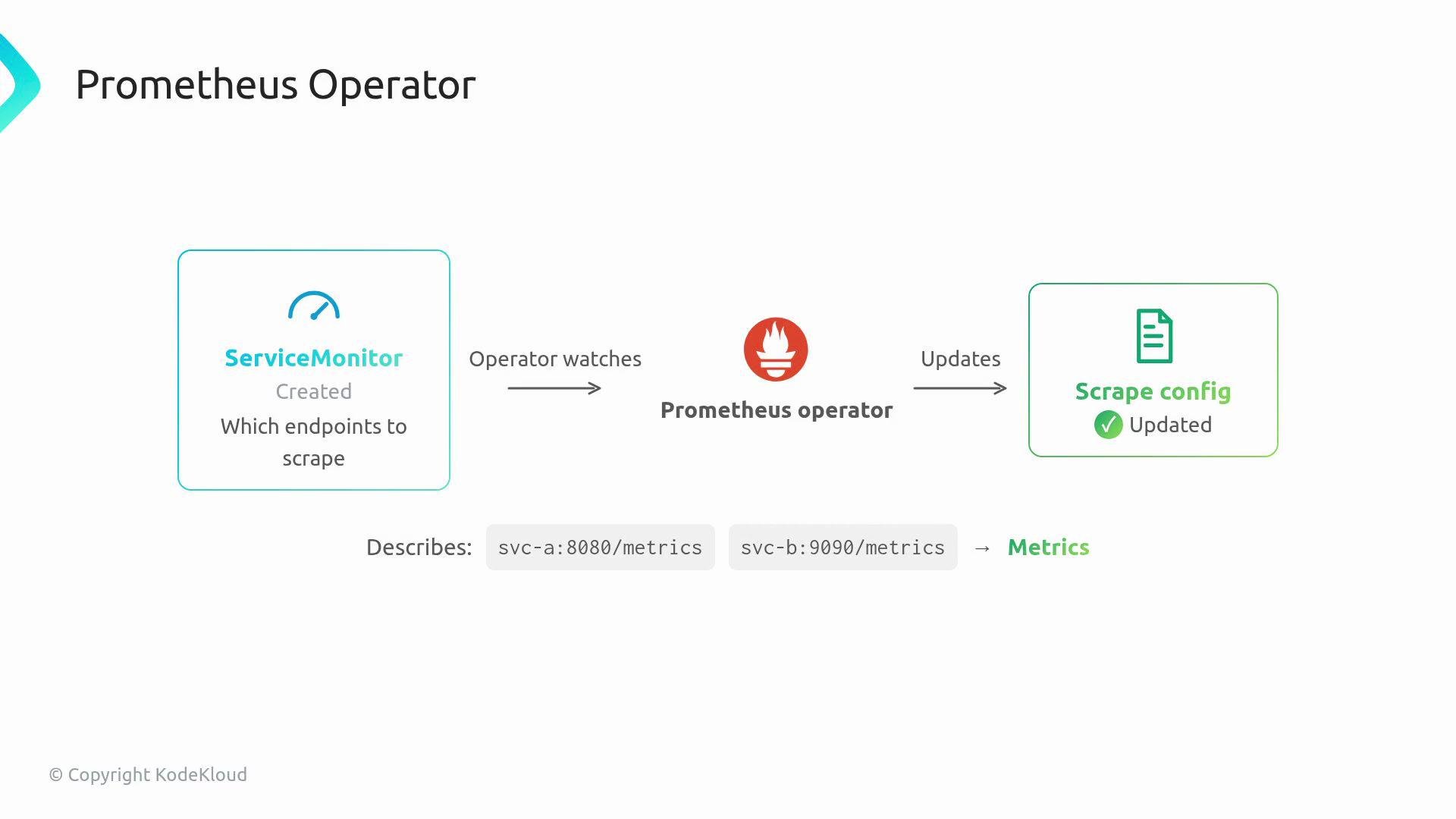
The image is a diagram illustrating how the Prometheus operator works, showing the process from creating a ServiceMonitor to updating the scrape configuration for metrics collection.
Databases (stateful workloads)
  • A PostgreSQL operator watches a PostgresCluster (or similarly named custom resource) and manages the full lifecycle of a database cluster: creating and reconciling StatefulSet objects, performing backups, orchestrating failover, and coordinating upgrades.
  • A StatefulSet is the Kubernetes workload type used for pods that need
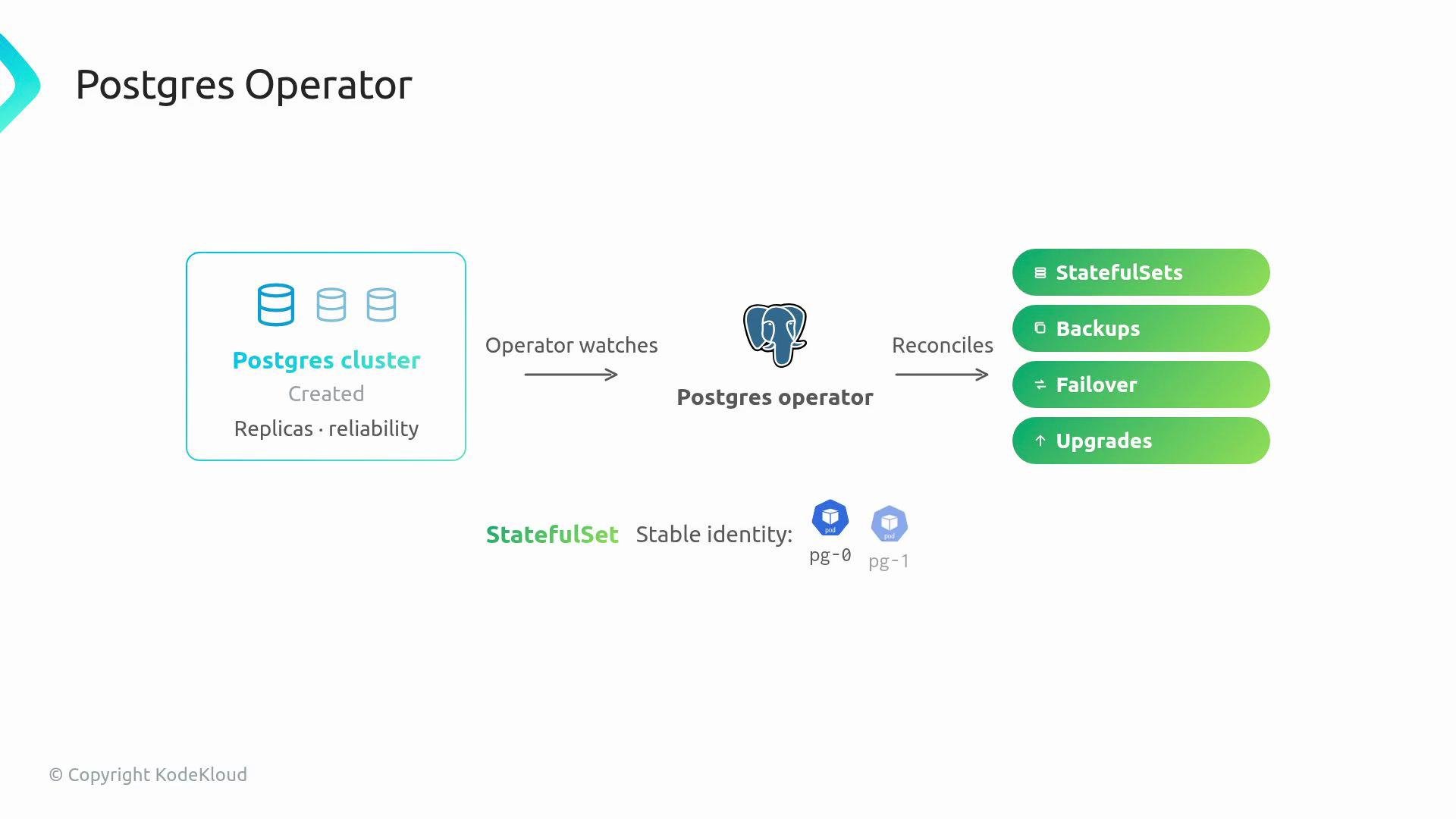
The image illustrates a Postgres operator setup, showing the creation of a Postgres cluster with replicas. It highlights the operator's role in handling statefulsets, backups, failover, and upgrades.
stable network identity and persistent storage — properties databases commonly require. Operators handle the complexity of ensuring replicas, leader election, and persistent volumes are created and reconciled. Strimzi provides a comparable pattern for Kafka. It exposes custom resources to describe Kafka clusters, topics, and users; its controllers then ensure the running Kafka infrastructure matches the declared configuration. The operator pattern repeats across projects:
  1. The user writes a custom resource such as Certificate, ServiceMonitor, a PostgreSQL cluster resource, or a Kafka cluster resource.
  2. A controller (the operator) watches that resource and detects when the real system diverges from the declared state.
  3. The controller creates or updates lower-level Kubernetes objects (for example Deployment, StatefulSet, Service, ConfigMap, Secret) and performs application-specific actions to reconcile the system.
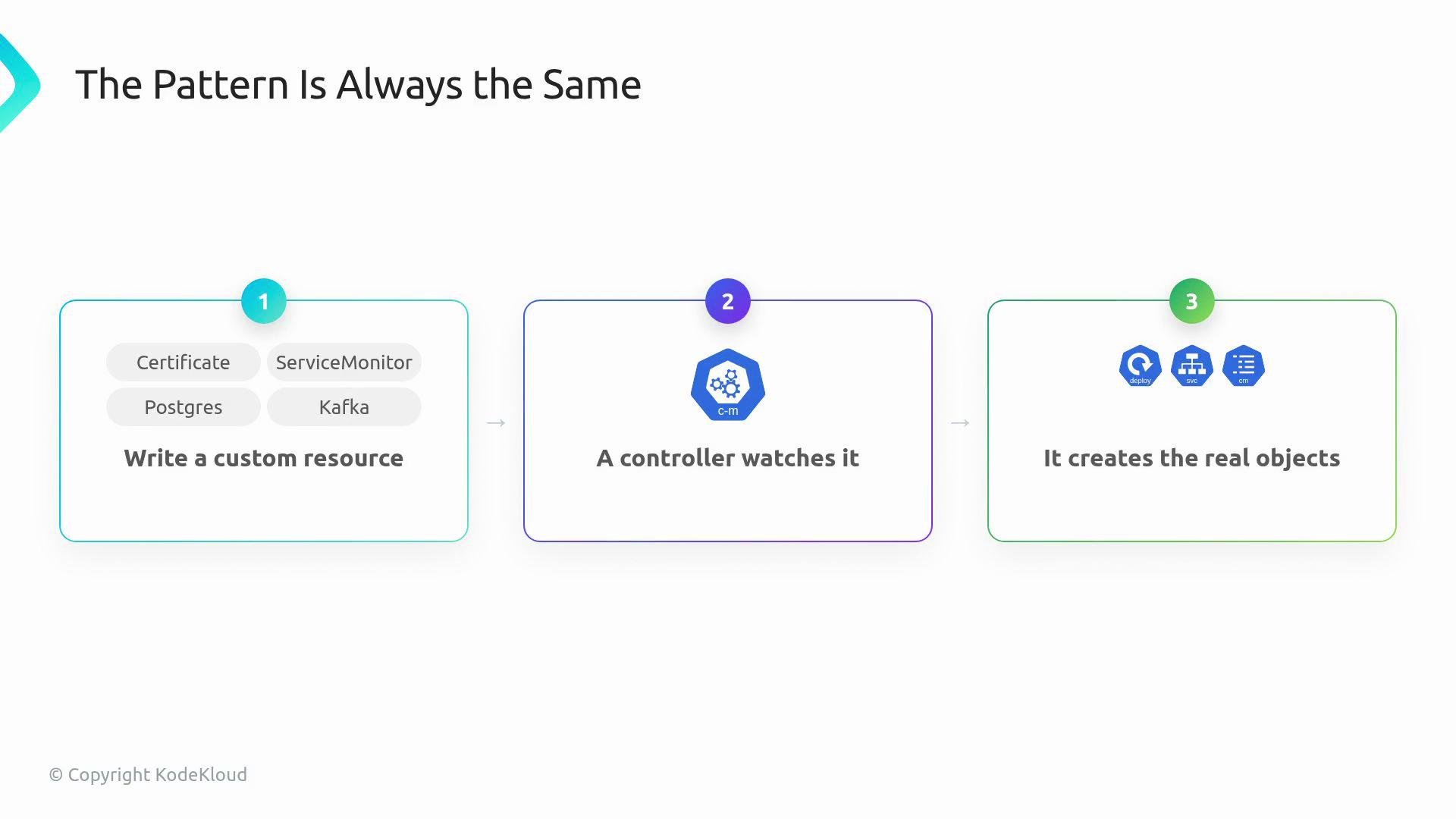
The image depicts a three-step process for creating custom resources, where a controller monitors the resources and then creates real objects.
Example: a beginner WebApp operator
  • In this learning example the custom resource is WebApp.
  • The controller reconciles the WebApp resource by creating a Deployment, a Service, and a ConfigMap.
    • Deployment: runs the application pods and manages rollouts.
    • Service: provides a stable network name and load-balancing.
    • ConfigMap: stores non-sensitive configuration consumed by pods.
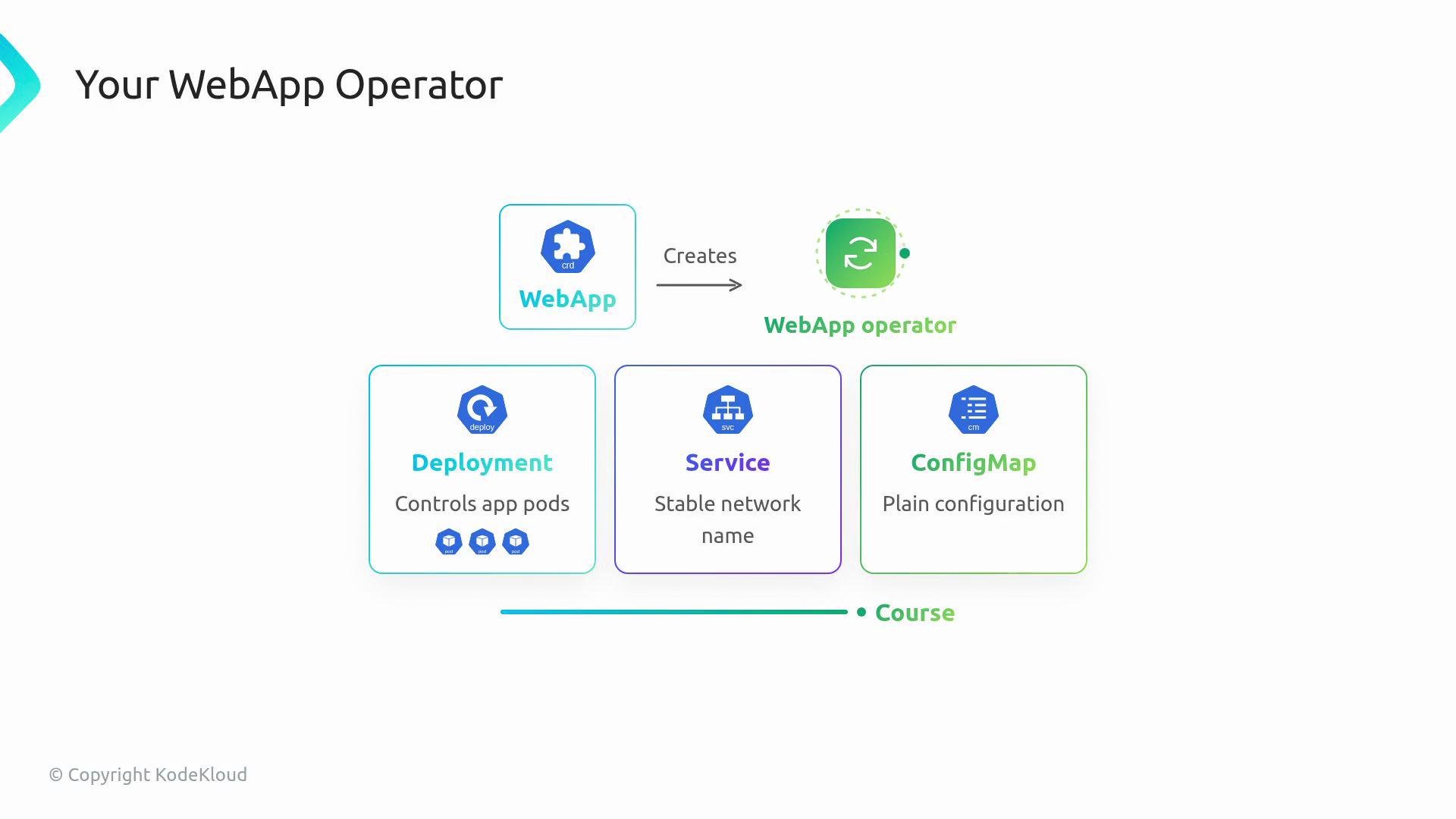
This small WebApp operator demonstrates the same pattern used by mature projects such as cert-manager, the Prometheus Operator, Postgres operators, and Kafka (Strimzi) — but at a manageable scope so you can learn the approach step by step.
The image depicts a diagram illustrating a WebApp operator that creates and manages deployments, services, and configmaps within a course context by KodeKloud.
Operator examples at a glance Links and references
When designing operators, be careful with permissions and automated actions: reconciliations that modify persistent state (databases, storage, certificates) require thorough testing, RBAC scoping, and clear upgrade/backup strategies.

Watch Video