

What you’ll learn (At a glance)
This course covers fundamentals through production-readiness, including practical scaffolding, reconciliation patterns, testing, and packaging.
For more context on Helm-based approaches, see the Helm for Beginners course: https://learn.kodekloud.com/user/courses/helm-for-beginners. For operator packaging and distribution, see OperatorHub and OpenShift: https://operatorhub.io and https://learn.kodekloud.com/user/courses/openshift-4.
Operator projects are commonly scaffolded using Kubebuilder or the Operator SDK. Depending on the scenario you may choose:
- A Helm-based operator (if you already have a Helm chart and prefer minimal Go code).
- A Go-based operator with Kubebuilder/Operator SDK (for deep integration, custom controllers, and advanced lifecycle management).
- Packaging for OpenShift/OperatorHub for distribution.
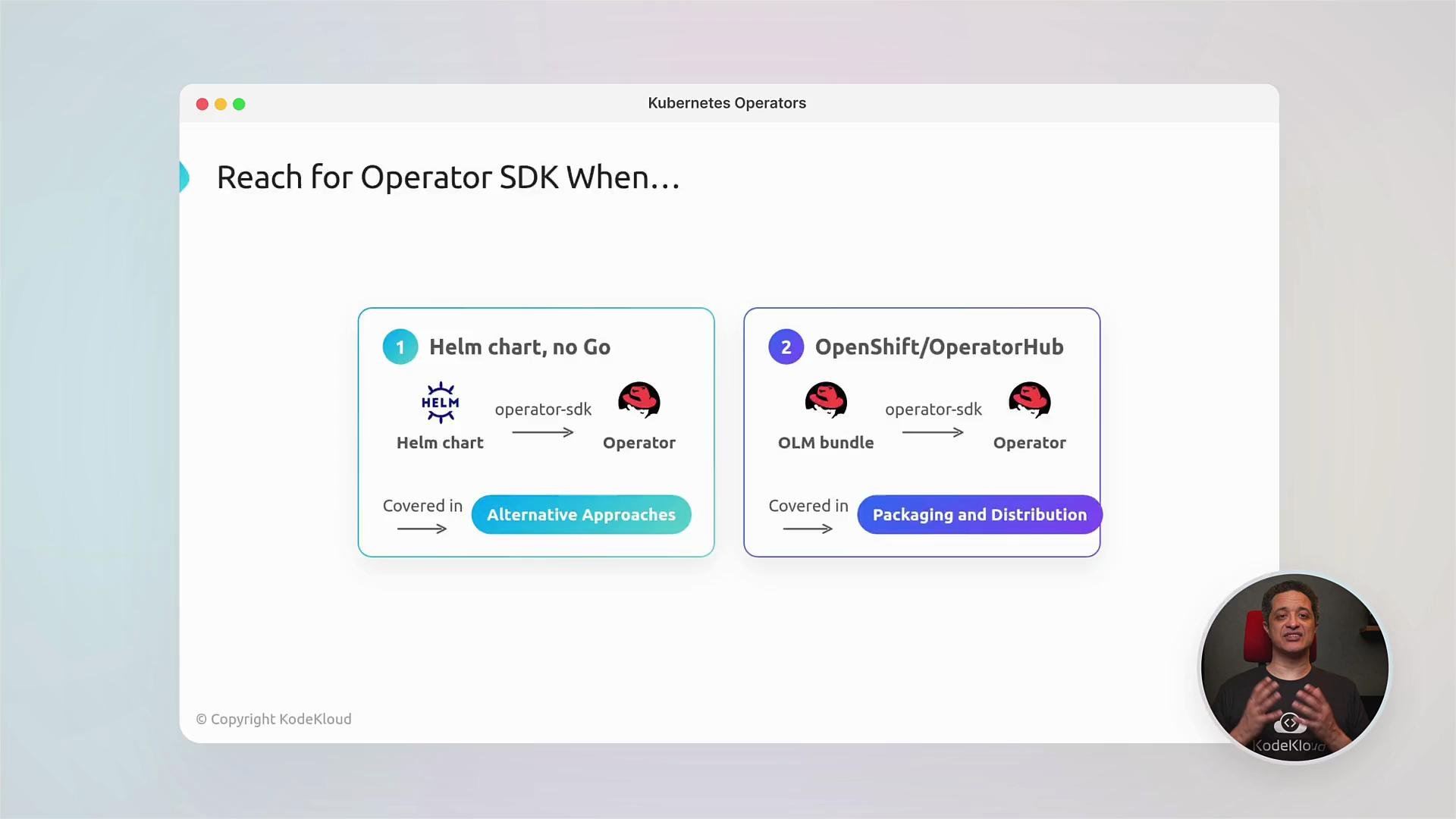
This course emphasizes a Go-based operator built with Kubebuilder and the Operator SDK to teach the reconciliation pattern, CRD design, webhooks, and production packaging. If you already have Helm charts, you can follow a Helm-based operator path instead.
Reconciliation: core of an Operator
The Reconcile loop compares desired state (from the custom resource) to actual cluster state, and then creates, updates, or deletes Kubernetes objects to converge toward the desired state. A typical reconciler from a Kubebuilder-generated controller looks like this:- Read the custom resource (CR) and validate fields.
- Compute desired child objects: Deployment, Service, ConfigMap, Secrets, etc.
- Reconcile child objects (create/update/delete) using client operations.
- Set OwnerReferences on children so Kubernetes garbage collects them automatically.
- Update the CR’s Status and emit Events for observability.
Admission webhooks and validating policies require cluster-level privileges and correct TLS setup. Test webhooks in a controlled environment to avoid disrupting cluster API server operations.
Packaging, integration, and monitoring
We cover operator packaging with the Operator SDK and Helm-based operators, and how to publish to OperatorHub or OpenShift catalogs. You’ll also learn to consume popular operators like Cert Manager and Prometheus Operator. When exposing metrics for Prometheus, a typical ServiceMonitor looks like this:CRD design and lifecycle
Designing CRDs and schemas is a core skill: define names, kinds, validation schemas (OpenAPI v3), and status subresources. A CRD schema excerpt could look like:Production readiness
The production-readiness section covers:- Unit and integration testing for controllers and webhooks
- CI/CD pipelines to build, test, and publish operator bundles
- Observability: exposing metrics, structured logs, traces
- Operational runbooks: upgrades, rollbacks, backup/restore, emergency procedures
Links and references
- Kubernetes Concepts: https://kubernetes.io/docs/concepts/overview/what-is-kubernetes/
- Kubebuilder: https://book.kubebuilder.io
- Operator SDK: https://sdk.operatorframework.io
- OperatorHub: https://operatorhub.io
- Prometheus Operator / ServiceMonitor docs: https://github.com/prometheus-operator/prometheus-operator
- Helm for Beginners (course): https://learn.kodekloud.com/user/courses/helm-for-beginners
- OpenShift 4 (course): https://learn.kodekloud.com/user/courses/openshift-4