

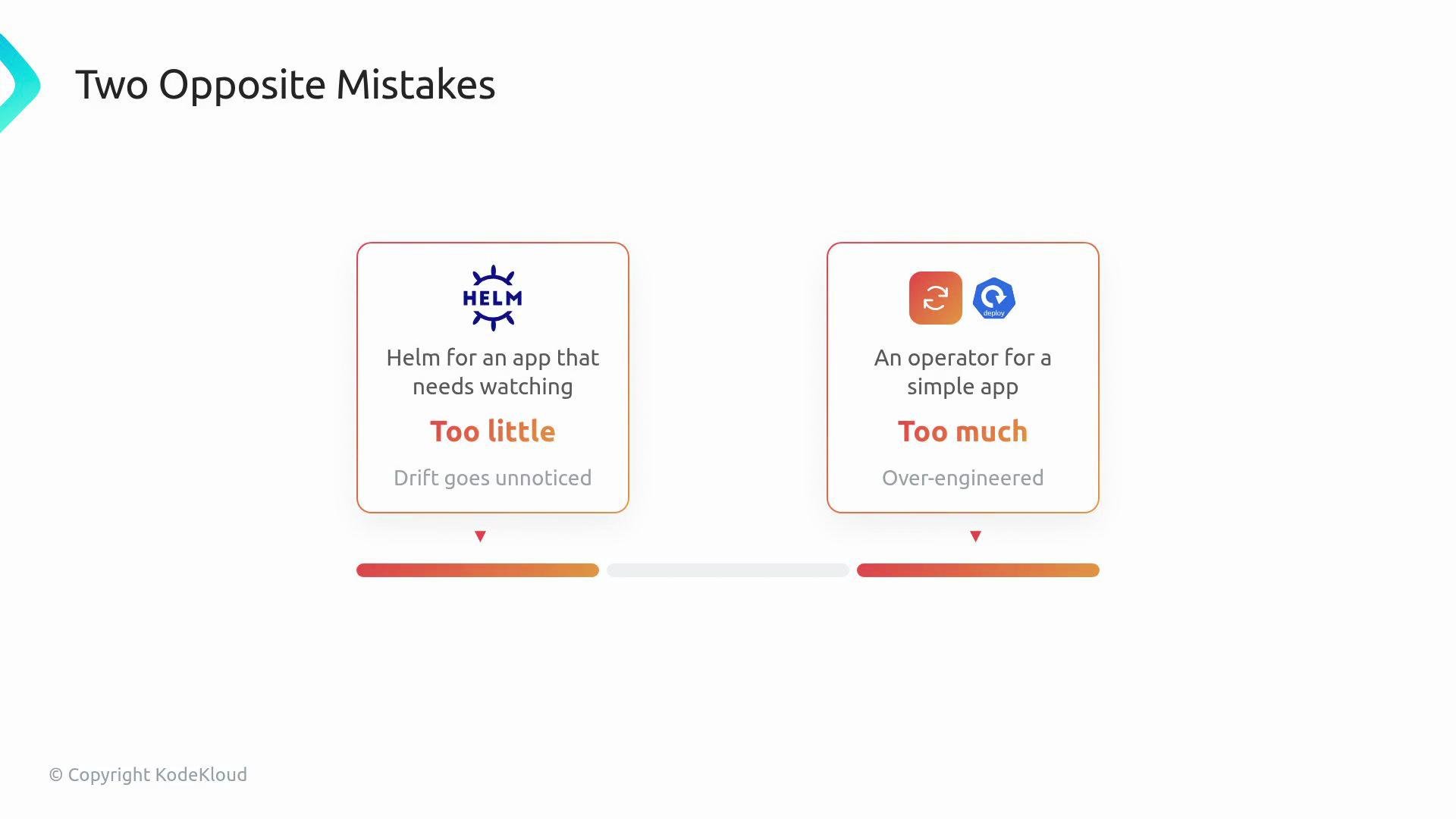
- Building an Operator when a Helm chart would have been sufficient (over-engineering).
- Using Helm for an application that requires a continuously running controller (insufficient automation).
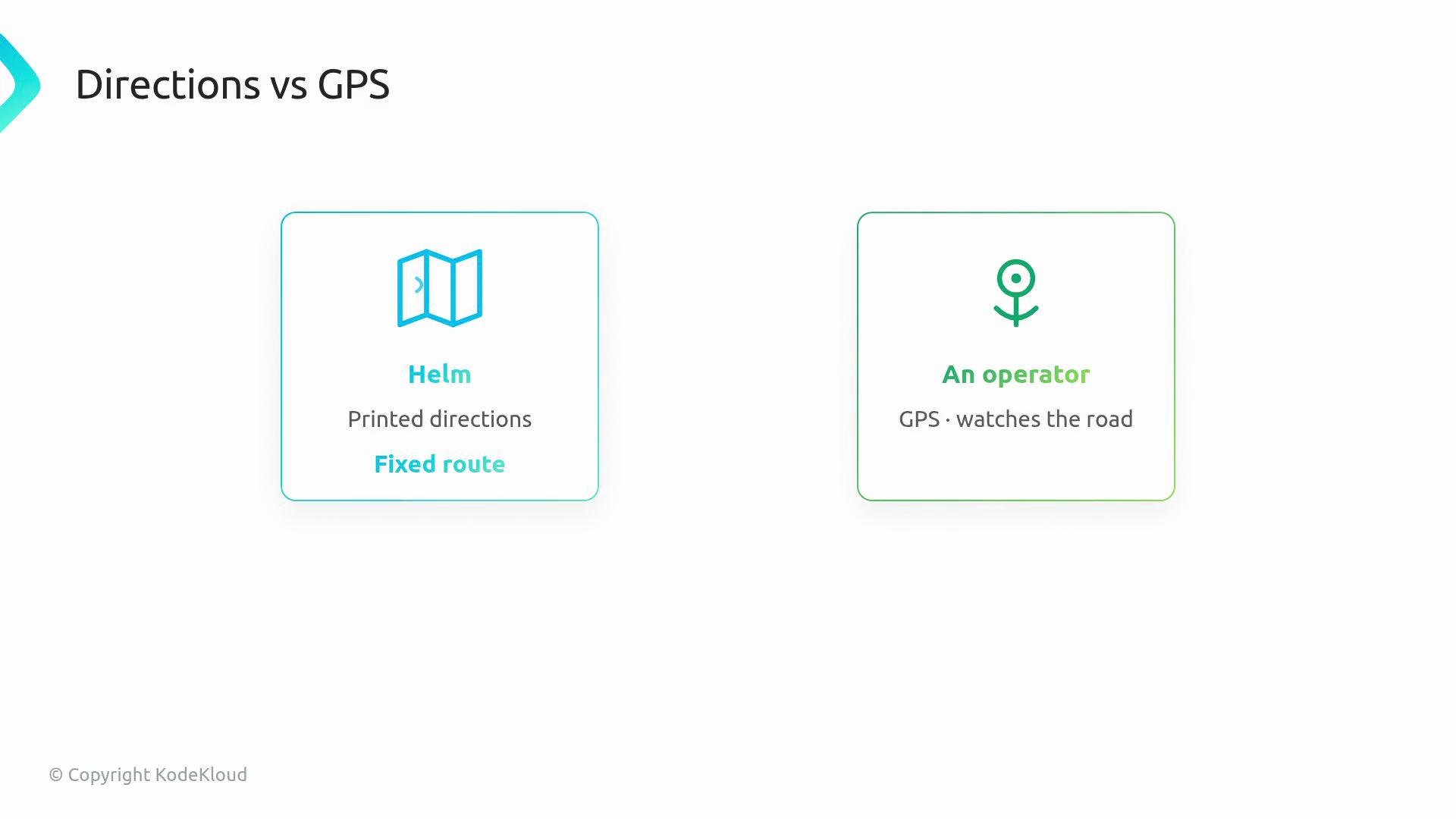
- Helm is like printing directions before you leave: you choose a destination, print the route, and follow it. That’s fine if nothing unexpected happens on the road.
- An Operator is like an active GPS: it watches the road continuously and can react when traffic, closures, or wrong turns appear.
- Helm packages Kubernetes YAML templates into charts, simplifying installs, upgrades, and rollbacks.
- For many workloads—Deployments, Services, ConfigMaps, and a few standard objects—Helm is the right tool: it renders templates, applies manifests, and tracks release history.
- Helm’s lifecycle is concentrated around install/upgrade/rollback; it does not run a continuous reconciliation loop.
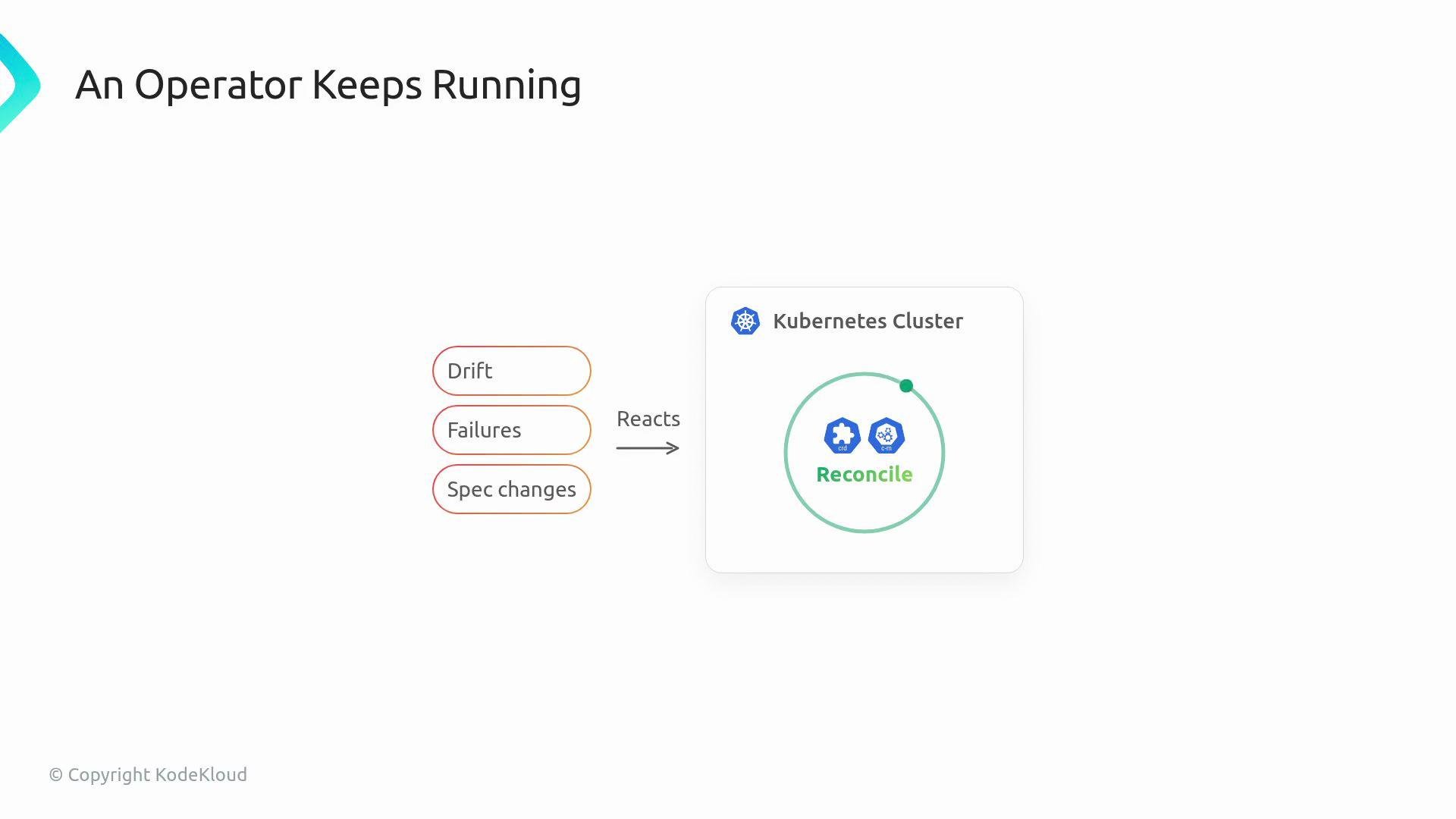
- An Operator is a continuously running controller inside the cluster that watches resources (often Custom Resources), compares desired vs actual state, and reconciles differences over time.
- Operators encode domain knowledge and operational logic in code, enabling application-aware automation that static templates cannot provide.
- Backups and restores that must guarantee correctness
- Automated failover with data-safety validation and fencing
- Certificate renewal and rotation workflows
- Coordinated or rolling upgrades that require application-aware sequencing
- Safe cleanup and garbage collection with dependency awareness
- Managing many tenant-specific instances with policy-driven automation
- Encoding runbook logic: check conditions and perform dependent steps only when safe
- Simple, declarative deployments where templating and lifecycle commands are enough
- Applications that don’t require ongoing, application-aware automation or stateful orchestration
- Teams that want to minimize engineering overhead and maintain chart-driven workflows
A hybrid option: Helm-based Operators
There’s a middle path called a Helm-based operator: expose a Custom Resource to users while using an existing Helm chart under the hood. This pattern is useful when:
- The chart already expresses the desired resources, but you want a Kubernetes-native API (CRD) and lightweight reconciliation.
- You need some automated reconciliation or simple lifecycle hooks without writing a full controller from scratch.
Use Helm when your primary need is packaging, templated manifests, and declarative installs/upgrades. Use an Operator when the application requires ongoing, application-aware operations and continuous reconciliation.
Avoid over-engineering: don’t build an Operator just because it’s possible. Conversely, don’t rely solely on Helm for applications that require continuous, domain-aware automation—this can lead to unnoticed configuration drift and outages.
- If your application needs a watcher with domain logic that runs continuously to reconcile state, build an Operator.
- If your application is well-described by templates and lifecycle commands, stick with Helm.