In this tutorial, we’ll build a Bash script that picks a random lunch spot from a list—without repeats—by combining indexed arrays and simple file-based persistence. This pattern is perfect for one-time draws, rotating duties, or any scenario where you want to consume items until the list is exhausted. Imagine a team of 20 colleagues who vote on their favorite restaurants each Friday. Everyone adds their go-to spot to an array. The script then:
  • Reads the list into memory
  • Selects a random entry
  • Displays it
  • Removes it from both memory and disk
  • Exits with an error if the list is missing or empty

Why In-Memory vs Persistent Storage?

  1. Manipulating data in memory means changes disappear once the script ends.
The image is a slide titled "Arrays demo" that explains "manipulating data in-memory," referring to initializing or modifying values directly in variables within a script or program.
  1. Persistent storage (files, databases) retains data between runs.
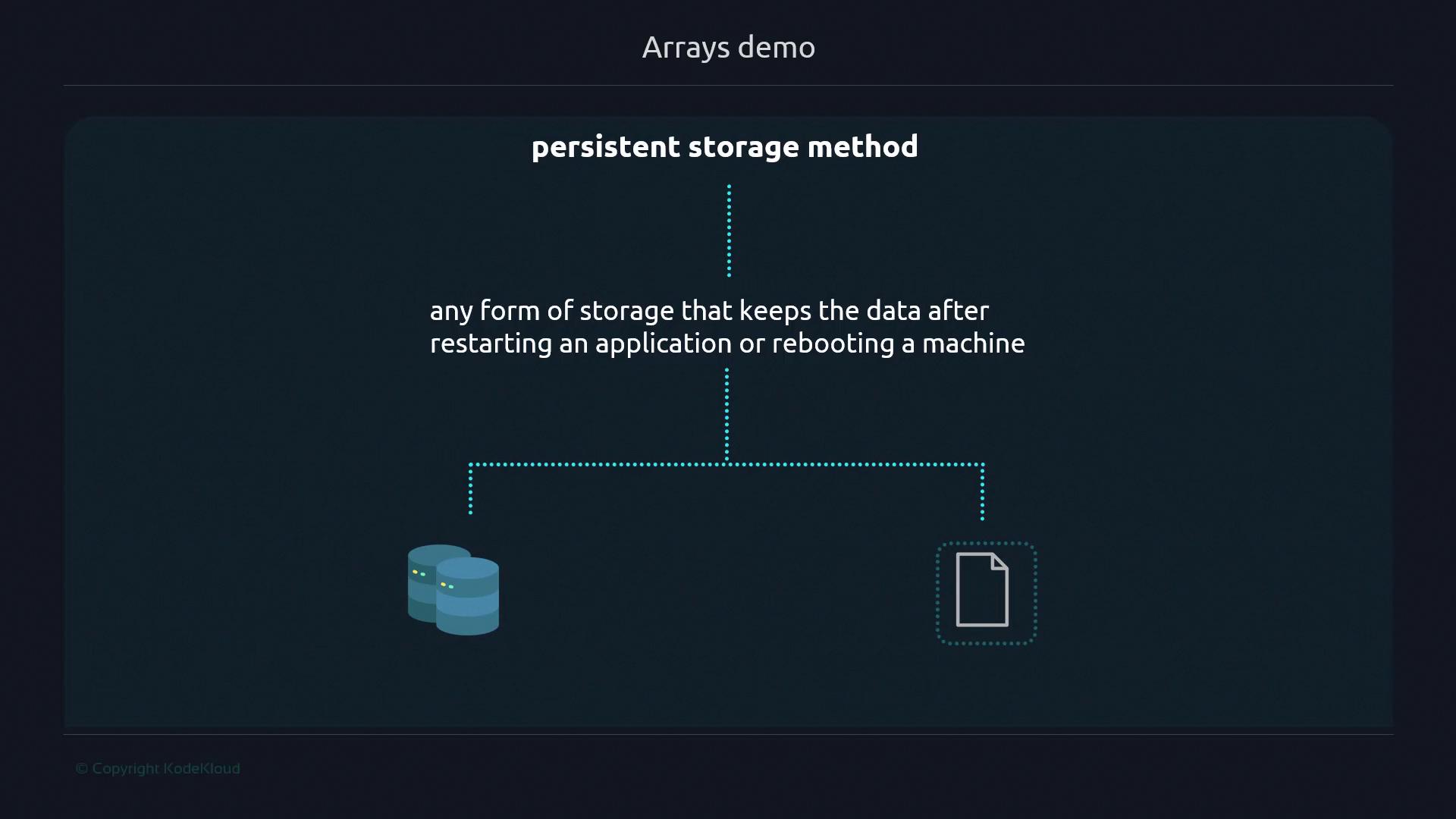
The image is a diagram titled "Arrays demo" that explains the concept of a persistent storage method, which retains data after restarting an application or rebooting a machine, with icons representing databases and files.
This script uses Bash 4.0+ for the mapfile builtin.

Key Bash Features

  • mapfile -t: Loads lines from a file (or stdin) into an array.
The image is a slide titled "Arrays demo" that describes the shell built-in command "mapfile," which reads input data and stores it in an array format, available from bash 4.0 onwards.
  • $RANDOM: Yields a pseudo-random integer between 0 and 32767.
The image is a slide from an "Arrays demo" presentation, describing a special shell variable "RANDOM" that generates a random integer between 0 and 32767.

Exit Code Reference


1. Prepare the Data File

Create food_places.txt with initial entries:

2. Initialize the Script

Create lunch_selector.sh:

3. Load and Validate the Array

Populate lunch_options and ensure it’s not empty:

4. Select and Display a Random Option

Choose a random index, echo it, and remove from the in-memory list:

5. Persist the Updated List

Write the remaining entries back to food_places.txt:

6. Complete Script

Here’s the full lunch_selector.sh. Don’t forget to make it executable:
Make it executable and run:
Each run prints a random, non-repeating lunch spot until the list is empty.

References

Watch Video

Practice Lab