

From idea to running service
Everything begins with an idea. You build a small application on your laptop and run it locally. For example, a minimal Python app:http://localhost:8080 for a web server). If your laptop is off, the service is inaccessible. To keep it available you must host it on an always-on machine: a server in a data center or a cloud VM.
Key challenges when moving from laptop to server:
- The target server must provide the correct runtime (Python, Java, etc.) and the same library versions.
- You need a predictable deployment process so the app behaves the same in production as in development.
- Build — convert your source into an executable form (packaging, compiling, or bundling dependencies).
- Deploy — move and run the build/artifact on the production server.
Collaboration: version control and hosted repos
As the team grows, developers work on the same codebase from different machines. Version control is essential to coordinate work and avoid conflicts. Git provides distributed version control; platforms like GitHub, GitLab, and Bitbucket provide central hosting, access control, pull requests, CI integrations, and issue tracking. Common Git commands:- Developers work locally and push code to a central repo.
- The central repo triggers other processes (builds, reviews, CI pipelines).
Continuous Integration / Continuous Delivery (CI/CD)
Manual builds and deployments become a bottleneck as features accumulate. CI/CD tools automate build, test, and deployment stages so you can release faster and with fewer errors. Popular CI/CD tools: Jenkins, GitHub Actions, GitLab CI/CD. A typical automated pipeline:- Pull code from the repository.
- Build artifacts (and optionally Docker images).
- Run automated tests.
- If tests pass, deploy to staging and/or production.
Dependency and runtime consistency: Containers with Docker
Different servers can have different runtimes and library versions. Containers package the app and its dependencies into a single image that runs consistently across environments. Docker workflow (typical):- Environment consistency across dev, test, and prod.
- Process isolation so multiple app instances can run on the same host.
Orchestration at scale: Kubernetes
When you run many containers across multiple machines you need orchestration to:- Maintain desired counts of running containers,
- Restart failed containers,
- Scale up/down with demand,
- Allocate resources across the cluster.
- Developers push code to GitHub.
- CI builds Docker images and stores them in a registry.
- Staging runs automated tests against those images.
- Kubernetes deploys approved images to production.
Infrastructure as Code (IaC): Terraform
Servers and cloud resources should be provisioned consistently. Manually creating resources via a cloud console is slow and error-prone — Terraform codifies infrastructure so it can be versioned, reviewed, and reapplied. Example (illustrative):- Provision VMs, networks, load balancers, and storage.
- Keep infrastructure state in source control.
- Detect and correct configuration drift.
Configuration management: Ansible
After provisioning, servers often need in-guest configuration (install packages, template config files, ensure services are running). Ansible is commonly used for these tasks. Common pattern:- Terraform provisions VMs, networks, and cloud resources.
- Ansible runs playbooks to configure the machines themselves.
Observability: Prometheus and Grafana
Provisioning, CI/CD, and orchestration are only part of the story. You must monitor application health and infrastructure to detect issues early and act on them.- Prometheus scrapes metrics from applications and infrastructure and stores time-series data.
- Grafana builds dashboards and visualizations from Prometheus and other metric sources.
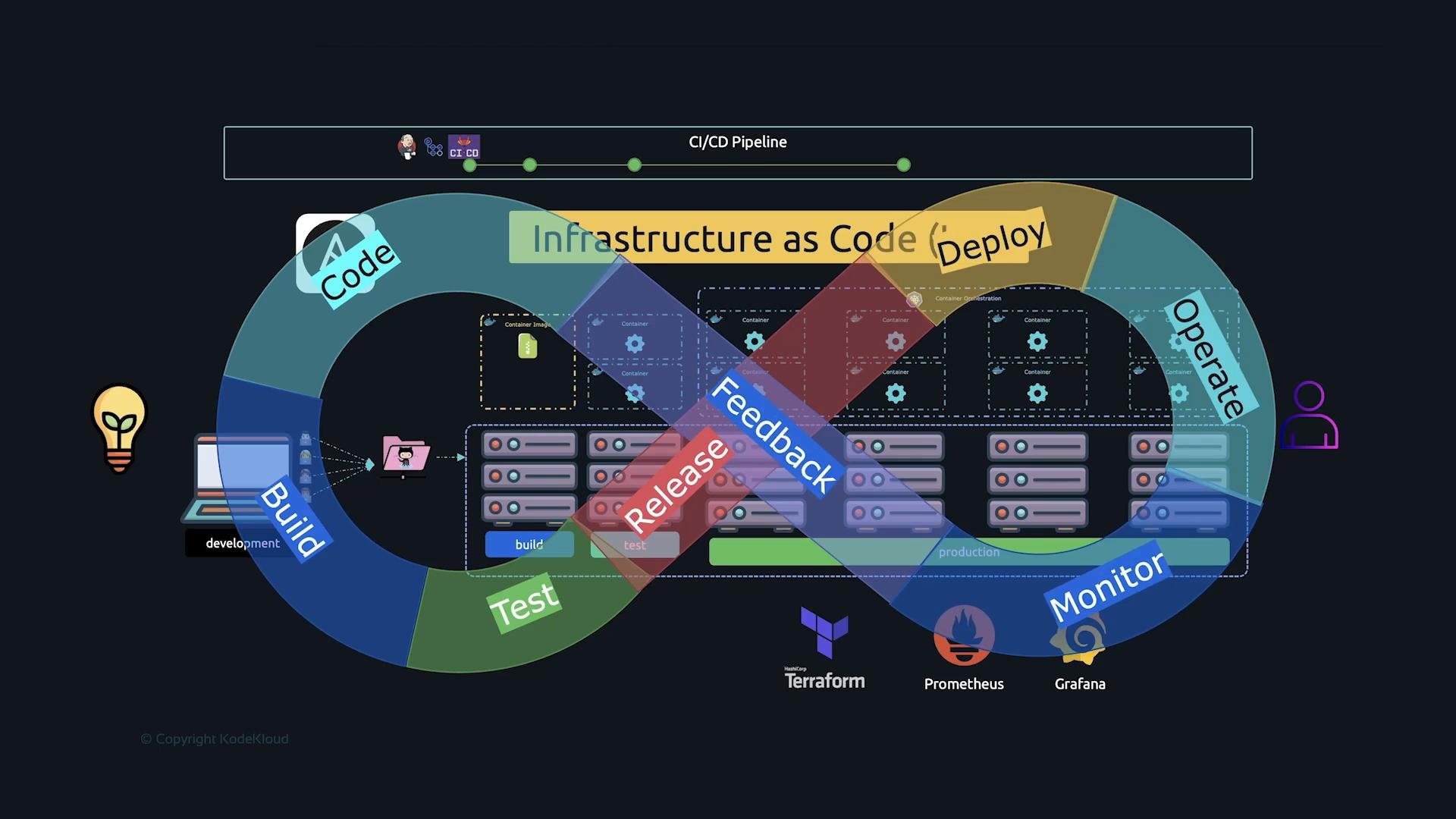
Putting it all together: the DevOps infinity loop
With CI/CD pipelines and container images deployed by Kubernetes, code changes flow through automated stages and reach production faster. Monitoring feeds performance and health data back into planning and development — completing the DevOps cycle. DevOps = people + processes + tools focused on continuous delivery of value: build, test, deploy, operate, monitor, and iterate.Quick tips for getting started
- Start small: use Git + a basic CI pipeline to automate builds and tests.
- Containerize when you need environment consistency across machines.
- Add orchestration (Kubernetes) when you need to manage many containers or require advanced scheduling and scaling.
- Introduce IaC (Terraform) to make provisioning reproducible and reviewable.
- Use Ansible or similar for configuration tasks that run inside VMs or when you need configuration templating.
- Instrument apps early so Prometheus/Grafana can provide meaningful feedback.
DevOps emphasizes automation, collaboration, and continuous feedback. Start small (source control + CI), then gradually add containers, orchestration, infrastructure-as-code, configuration management, and monitoring as your needs grow.
Links and references
- Kubernetes Basics
- Terraform Documentation
- Docker Documentation
- Prometheus | Grafana
- Learn more courses referenced above on the linked KodeKloud pages.