

What “Managed Kubernetes” means
With a managed Kubernetes service, the cloud provider operates the control plane on your behalf. That typically includes running and maintaining the API servers, etcd, the scheduler, controller-manager, and many of the surrounding operational tasks such as backups, upgrades, and certificate rotation. Managed services reduce on-call load because many paging incidents tied to control-plane components are handled by the provider.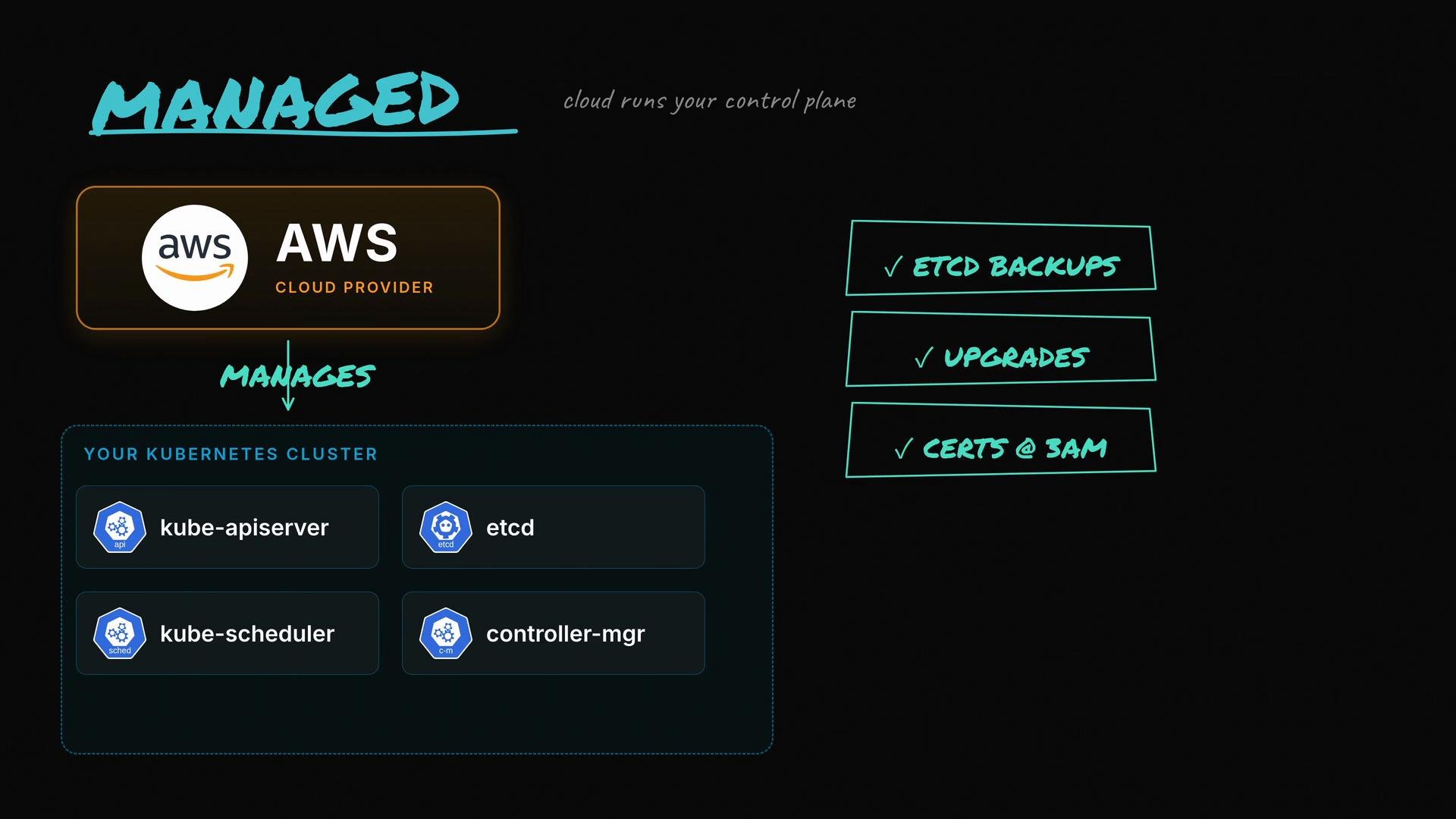
- AWS EKS — managed control plane with worker node options (managed node groups, Fargate).
- Google GKE — integrated control plane plus autopilot options.
- Azure AKS — managed control plane with Windows node support.
What “Self-Managed Kubernetes” means
In a self-managed deployment you run your own control plane components: API servers, etcd, scheduler, controller-manager, backups, upgrades, monitoring, and on-call support. This gives you full control and customization but also increases operational complexity and responsibility. Teams that need bespoke control-plane configuration or want to avoid provider-specific limitations often choose this route.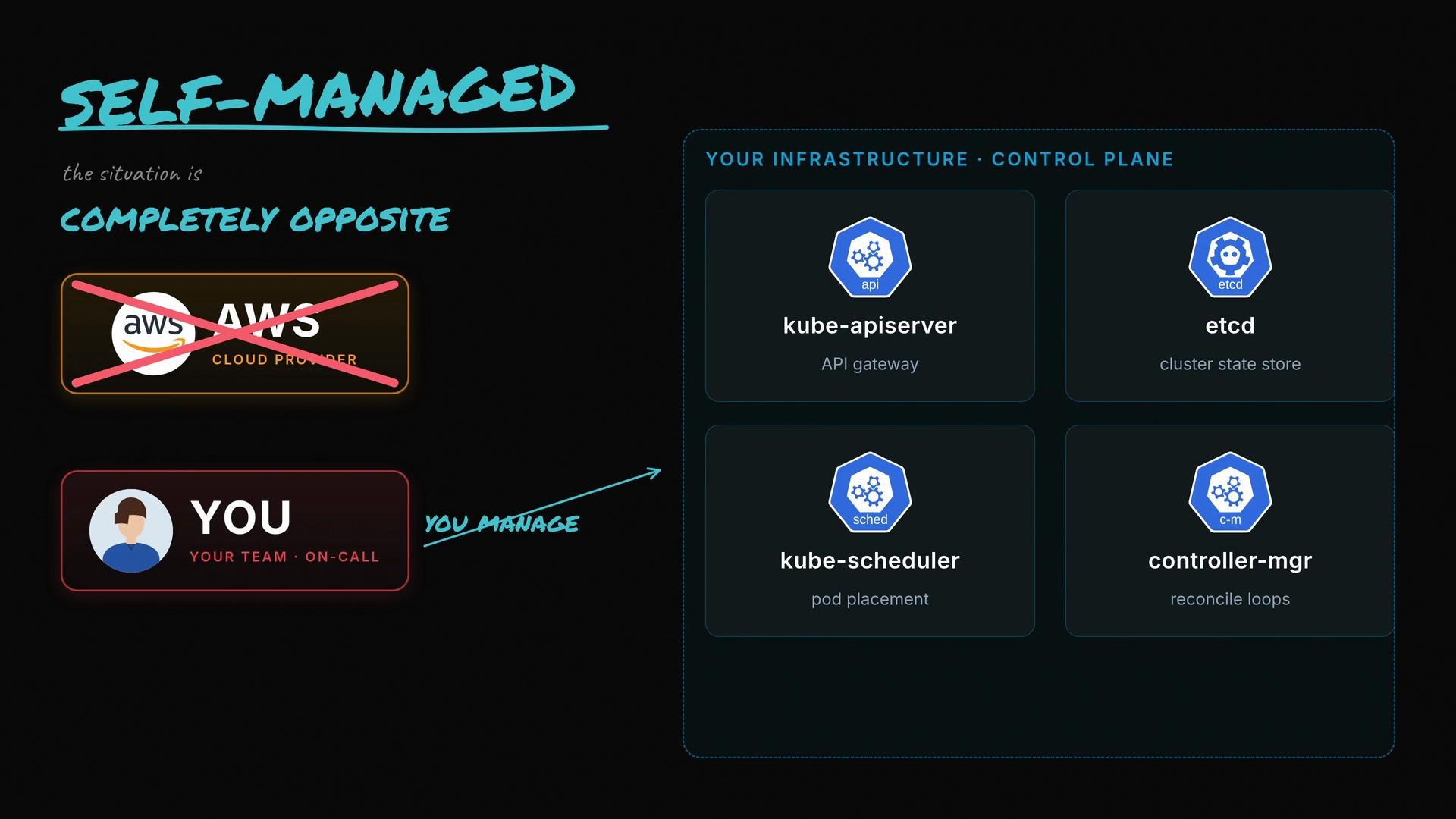
- You require specific control-plane configurations or experimental Kubernetes features.
- You need to run Kubernetes on-premises or in a hybrid environment.
- Compliance or data residency rules restrict provider-managed control planes.
A middle ground: Lightweight & opinionated distributions
There’s also a middle ground between fully managed and raw upstream installations. Lightweight or opinionated distributions like K3s, RKE2, and Talos reduce the operational surface and resource footprint while still giving teams more control than a managed service. They are often chosen for edge deployments, single-board computers, or teams wanting simpler ops without fully outsourcing the control plane. Examples:- K3s — lightweight, single binary distribution for constrained environments. (https://k3s.io)
- RKE2 — Rancher’s hardened Kubernetes distribution. (https://rke2.io)
- Talos — immutable OS for Kubernetes with strong security defaults. (https://www.talos.dev)
When choosing between managed, self-managed, or a lightweight distribution, weigh team expertise, operational bandwidth, compliance requirements, cost sensitivity, and how much control or customization you need.
Quick comparison of common trade-offs
Operational considerations checklist
- Team and on-call capacity: Do you have SRE/ops capacity to run control plane and etcd 24/7?
- Compliance and data residency: Are there regulations requiring you to run control plane components in-house?
- Cost model: Compare managed-service pricing versus the cost of hiring ops personnel and running servers.
- Upgrade/backup strategy: Who will handle etcd backups, cluster upgrades, and recovery testing?
- Integrations and tooling: Do you rely on ecosystem tools that expect upstream behavior, or are you flexible?