

Alan1). The backend first consults the cache; on a hit it returns cached data, on a miss it reads the database, populates the cache, and returns the result. We’ll build that flow step-by-step and show where it breaks and how to harden it.
Version one — naive approach
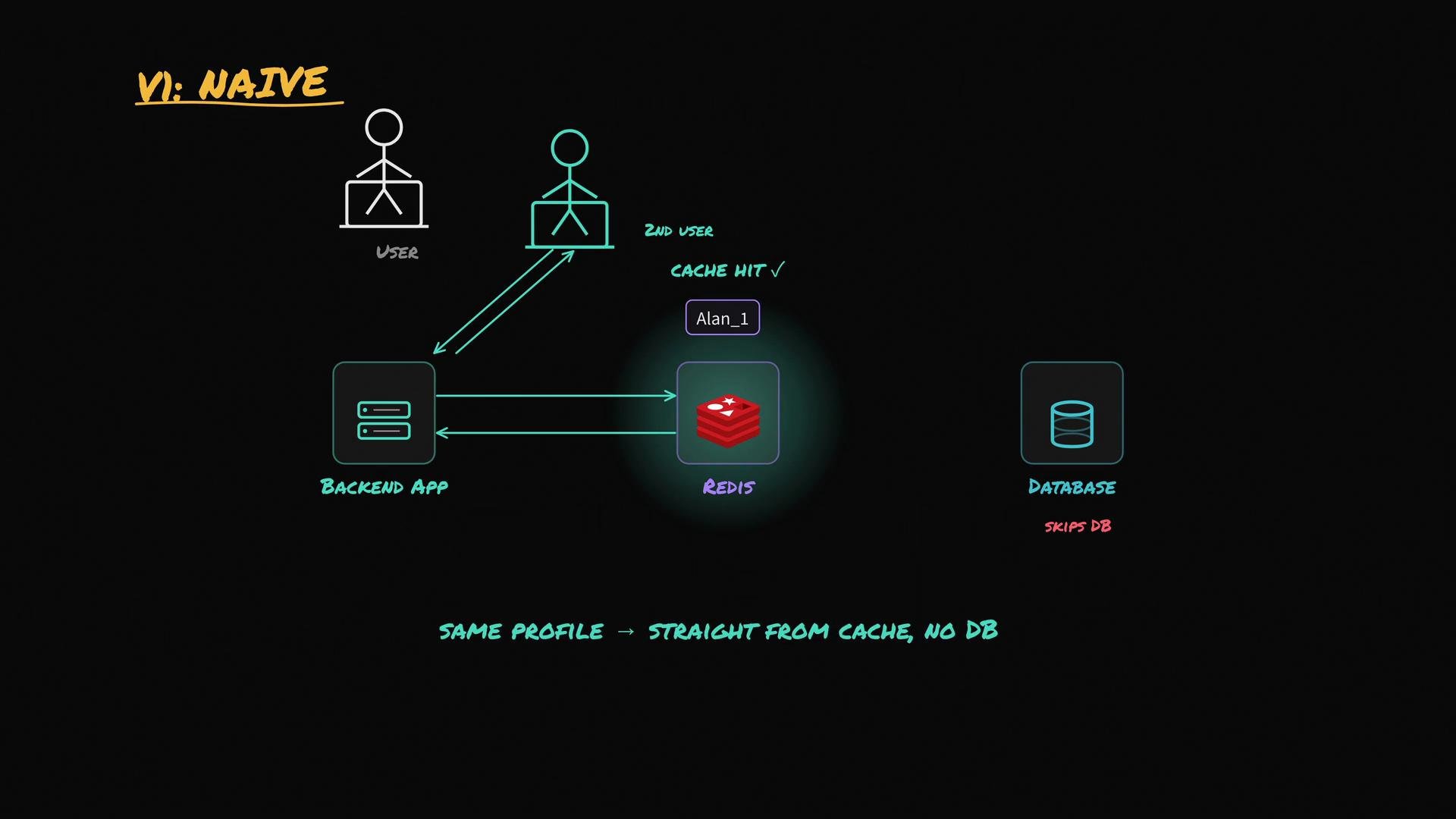
When a request asks for a user profile (e.g., Alan1), the application follows the cache-aside pattern:
- Check cache.
- If present (cache hit) → return cached value.
- If absent (cache miss) → read from DB, write result to cache, and return to client.
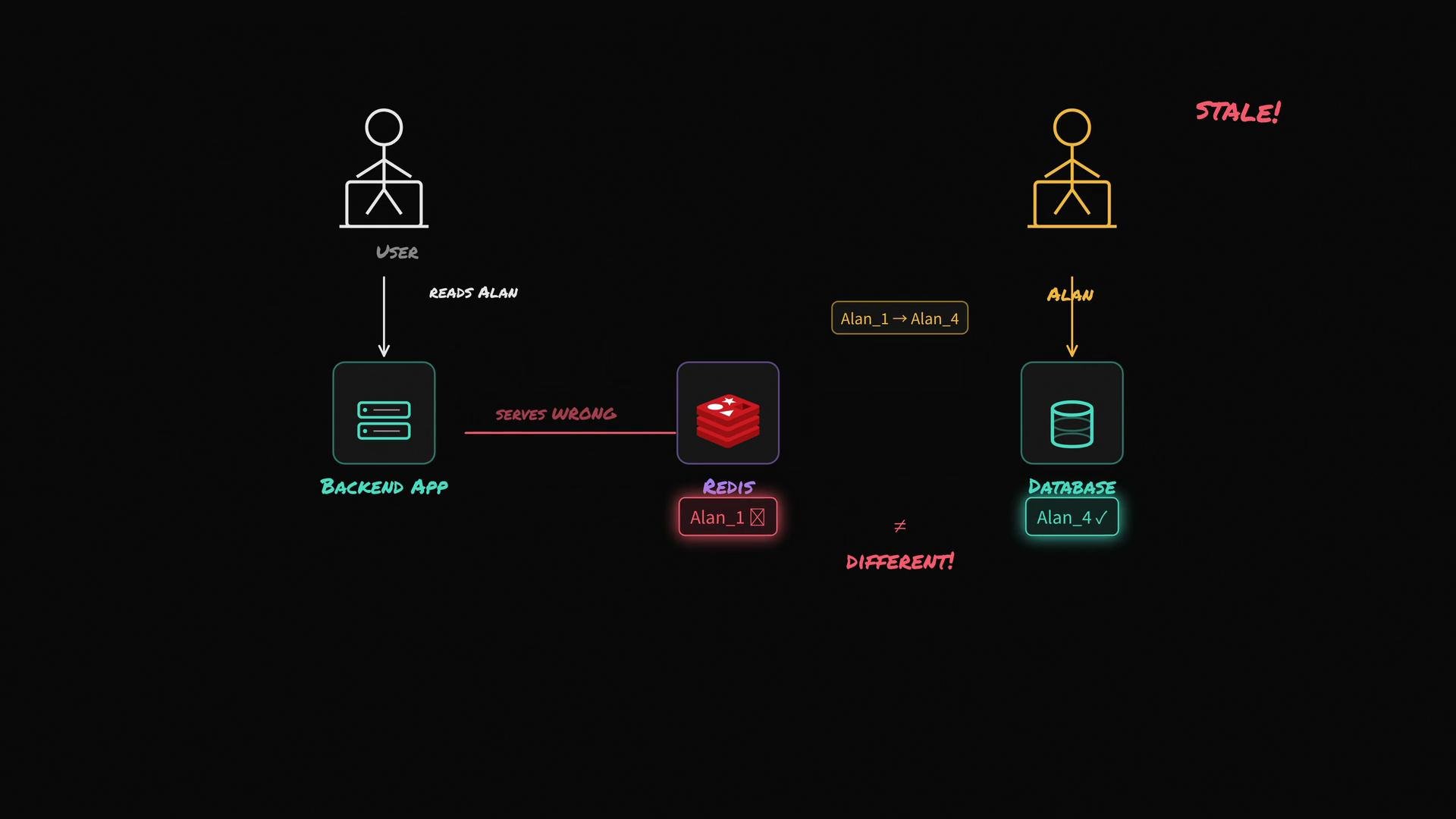
Alan1 updates their username to Alan4 in the database, the DB contains the fresh value but the cache still holds the old Alan1. Unless the application explicitly updates or evicts the cache entry during the write, clients will continue to see stale data.
- TTL (time-to-live): add expiration to cache entries so stale values are eventually evicted. For example, set a 5-minute TTL per profile key.
- Active invalidation: when the database is updated, explicitly evict (or update) the corresponding cache entry.
- Ordering: for the cache-aside pattern, a safe approach is to commit the DB write and then invalidate the cache (or populate the cache after the DB transaction commits). Other variants include write-through and write-back caches, each with different trade-offs.
- Write-through: writes go to cache first and synchronously to DB; simplifies reads but increases write latency.
- Write-back: writes are buffered in cache and flushed to DB later; can improve write throughput but risks data loss on failures.
- Single-flight / Request coalescing
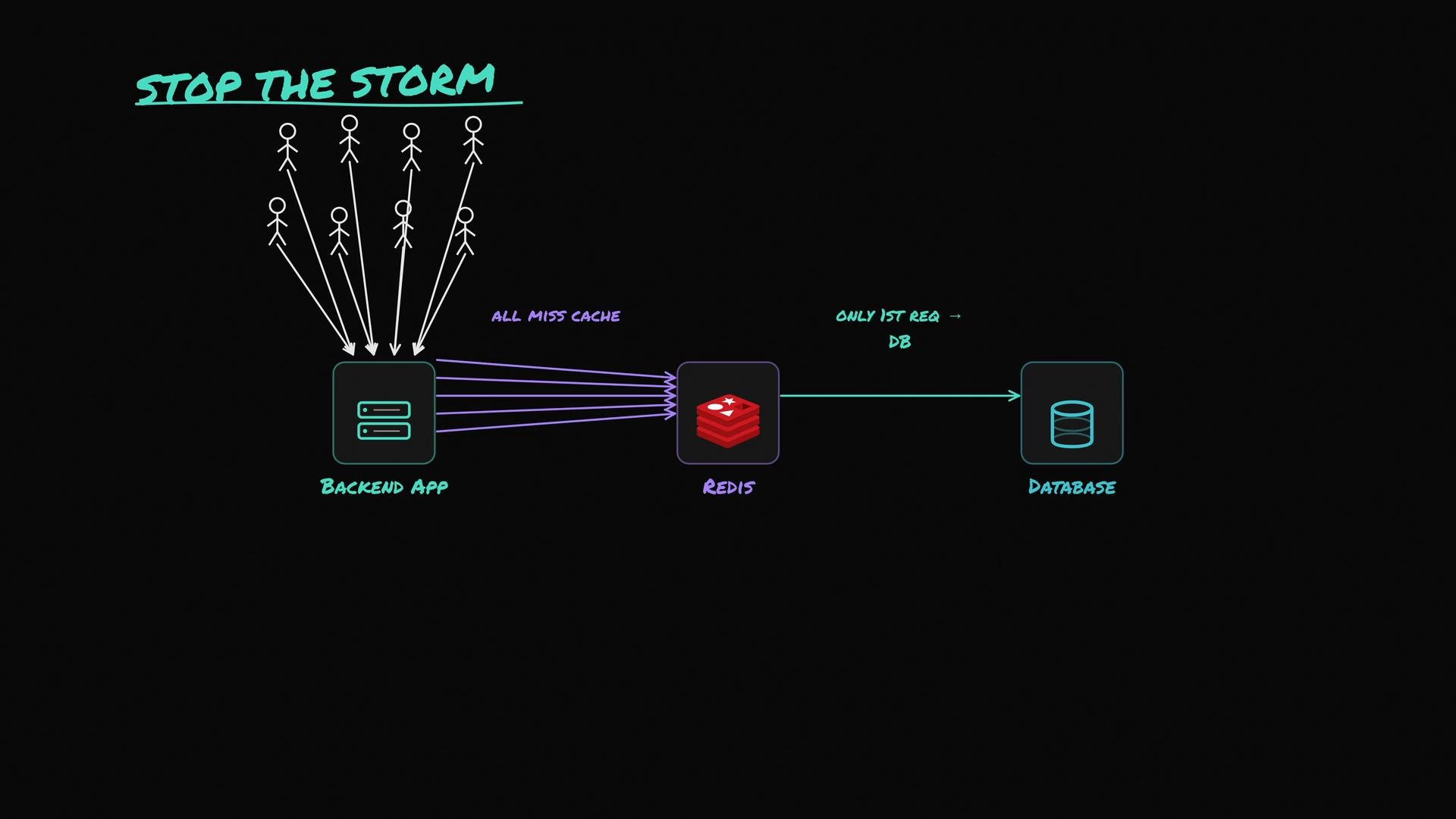
- Ensure that when multiple concurrent requests miss the same key, only one request queries the database and populates the cache; other requests wait and then read the cached value.
- In single-process systems, in-memory synchronization (e.g., mutexes) is sufficient. In distributed systems, use short-lived per-key locks in Redis, a coordination service, or a distributed single-flight implementation.
Use single-flight/coalescing so concurrent cache misses for the same key result in a single database load.
- TTL jitter
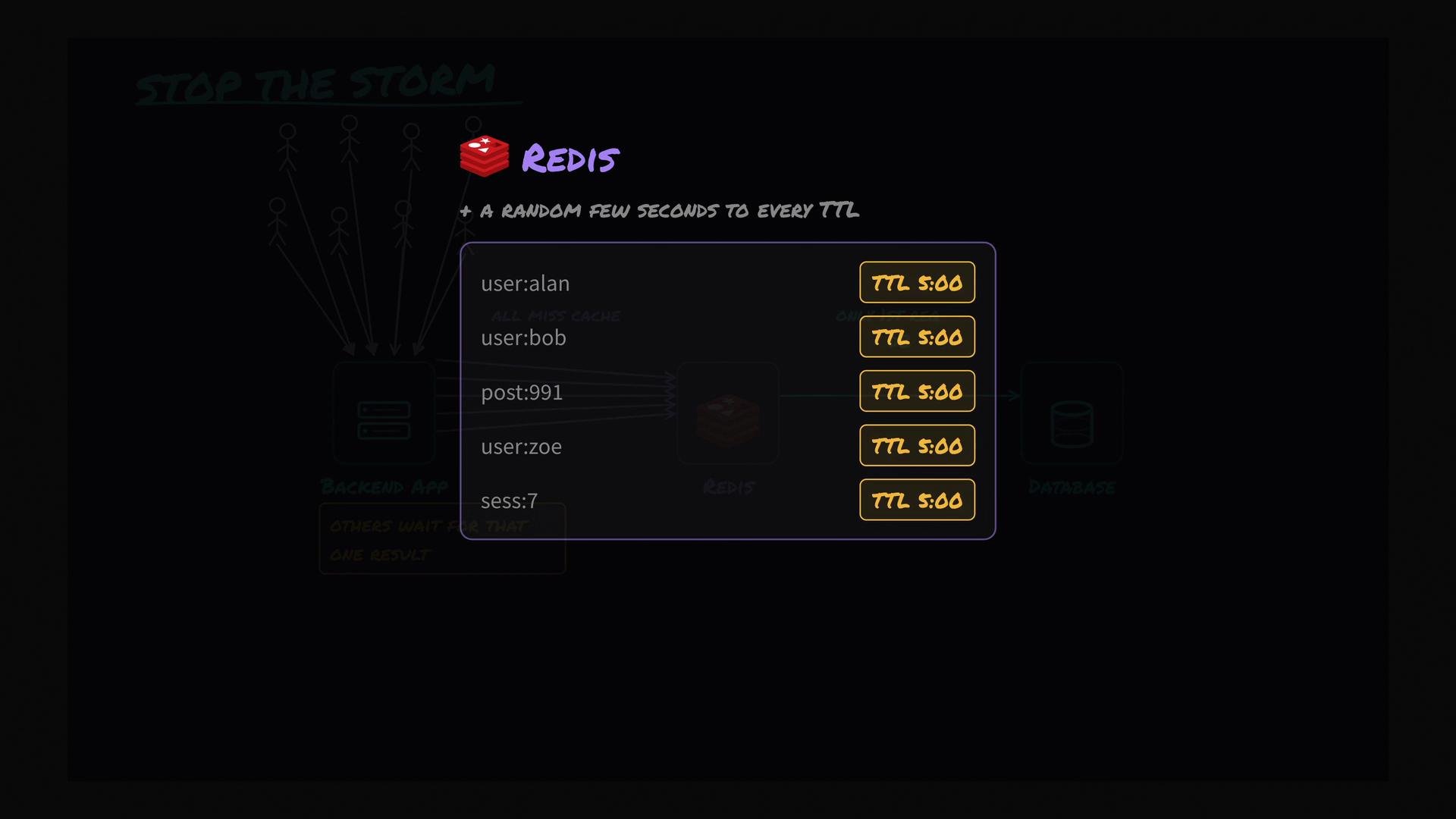
- Add a small random offset to TTLs so keys do not all expire at the exact same time. This smooths expiration and reduces synchronized load spikes.
- Replication for extremely hot keys
- When a single key’s read volume exceeds what one cache node can serve, replicate that object across multiple cache nodes (read replicas) so multiple nodes can serve reads for the same key.
- Sharding distributes keys across nodes but does not split one key; replication or read-multiplexing increases aggregate read capacity for extremely popular objects.
Final guidance and warnings
- Combine techniques: TTL + invalidation + single-flight + jitter + replication as appropriate for your workload.
- Measure and tune TTLs, lock durations, and replication strategies based on traffic patterns, read/write ratios, and acceptable staleness.
- Test failure scenarios (network partitions, cache evictions, DB latency spikes) to validate that cascading failure is contained.
Be careful: caching introduces complexity — staleness, invalidation, race conditions, and potential for cache stampedes. Combine TTL, invalidation, single-flight, TTL jitter, and replication as appropriate to balance freshness, latency, and system resilience.
- Cache-aside pattern: https://learn.microsoft.com/en-us/azure/architecture/patterns/cache-aside
- Singleflight (Go): https://pkg.go.dev/golang.org/x/sync/singleflight
- Redis docs: https://redis.io/
- Write-through vs write-back: https://en.wikipedia.org/wiki/Write-through_cache and https://en.wikipedia.org/wiki/Write-back_cache
- TTL / Time to live: https://en.wikipedia.org/wiki/Time_to_live_(networking)
- Jitter and backoff guidance: https://aws.amazon.com/blogs/architecture/exponential-backoff-and-jitter/