

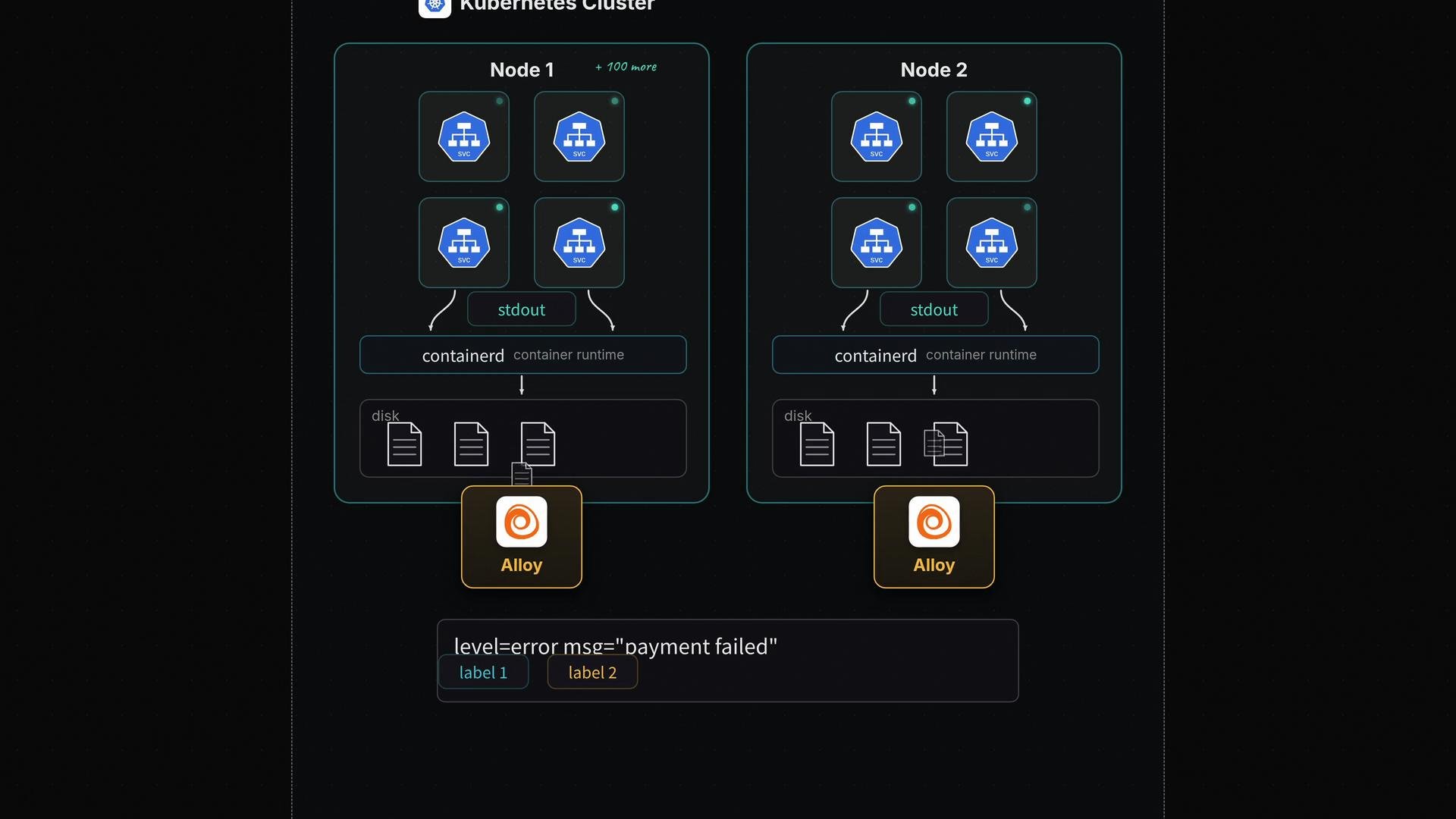
- Containers write logs to standard output. The container runtime (containerd/CRI-O) captures stdout and writes node-local log files.
- Those plain-text logs are scattered across nodes; if a node fails, its logs are lost.
- To avoid data loss and enable centralized querying, run a log-collector on every node and send logs to a durable backend.
- Deploy Grafana Alloy as a DaemonSet so Kubernetes schedules one Alloy pod per node.
- Each Alloy instance tails the container runtime’s log files and enriches every line with Kubernetes metadata: namespace, pod, container, node, and labels.
- These labels make searches efficient and let you trace where a log line originated.
- Instead of indexing full log text like Elasticsearch, Loki indexes only labels (metadata) attached to log streams.
- Incoming logs are grouped into compressed chunks. Completed chunks are written to an object store (for example, Amazon S3), which stores the raw log text.
- Loki maintains a lightweight index mapping label combinations to chunks. Queries first use label selectors to narrow the set of candidate chunks, then scan the relevant chunks for matching log lines.
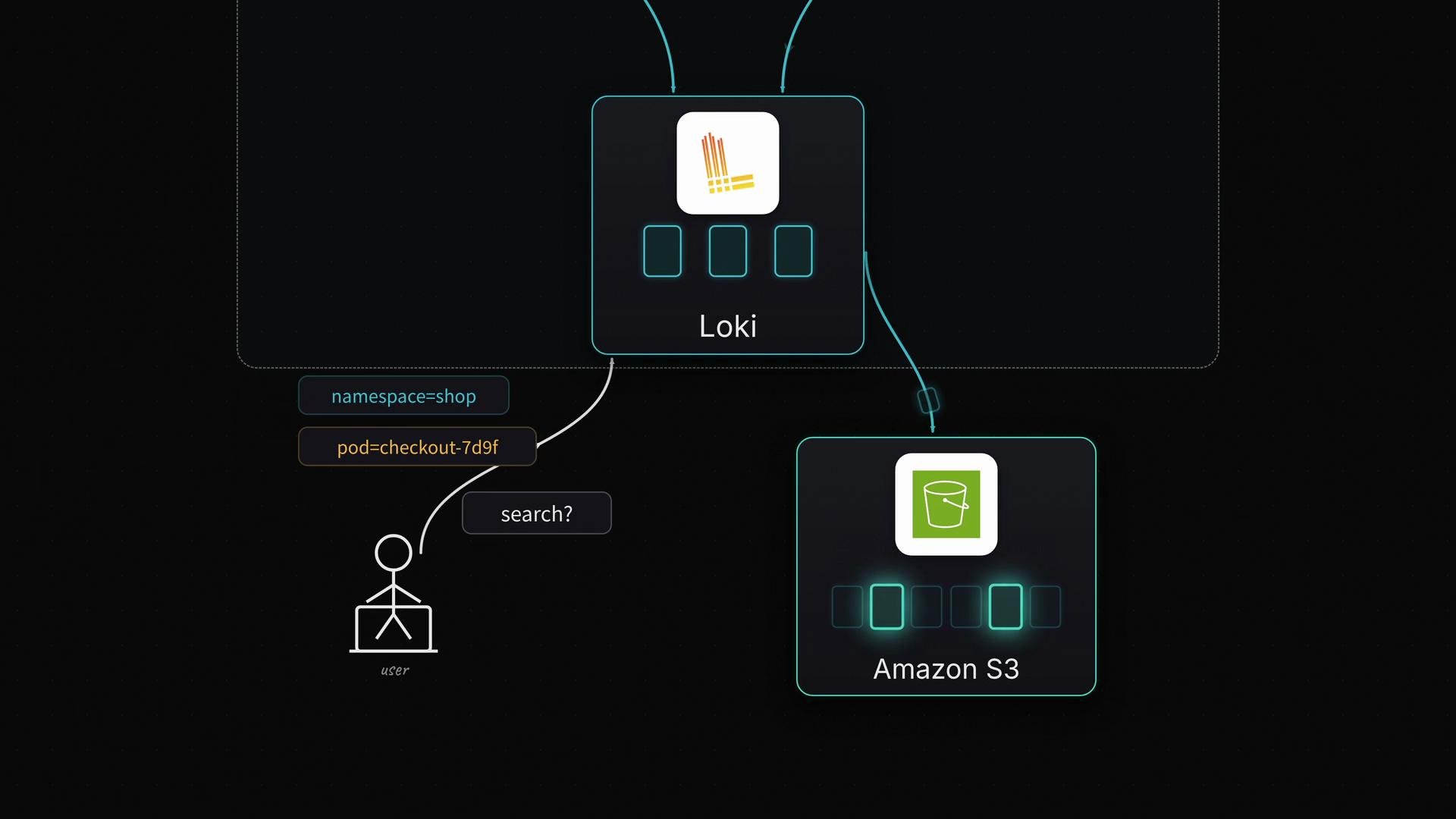
- Label-based indexing keeps the index small and cheap to operate.
- Compressed chunks in object storage are cost-effective for long-term retention.
- Most queries include labels (e.g.,
namespace,service,pod), so Loki avoids scanning unnecessary data by selecting only a few chunks.
- Add Loki as a Grafana data source to view logs and build dashboards that combine metrics and logs.
- Grafana + Loki enable quick context switching: from a metric spike to logs filtered by the same labels and time window.
Design labels carefully: include
service, environment, namespace, pod, and node identifiers so queries can efficiently narrow the search space.- A dashboard shows a CPU spike at 02:00.
- In Grafana, open the same 02:00 time window and select the affected service or pod labels.
- Search the log lines for errors (for example, “payment failed”) to correlate metrics with application events.
Best practices and considerations
- Retain raw chunks in object storage for as long as business requirements dictate.
- Tune chunk size and compression for your write/query patterns.
- Ensure Alloy (or your collector) correctly attaches labels to each log stream.
- Monitor Loki’s index and object store throughput to avoid bottlenecks.
If you need frequent full-text searches across all logs, evaluate the increased indexing cost with Elasticsearch. Loki is optimized for label-filtered queries and long-term, cost-efficient storage.