

-
Ingestion (offline / pre-processing)
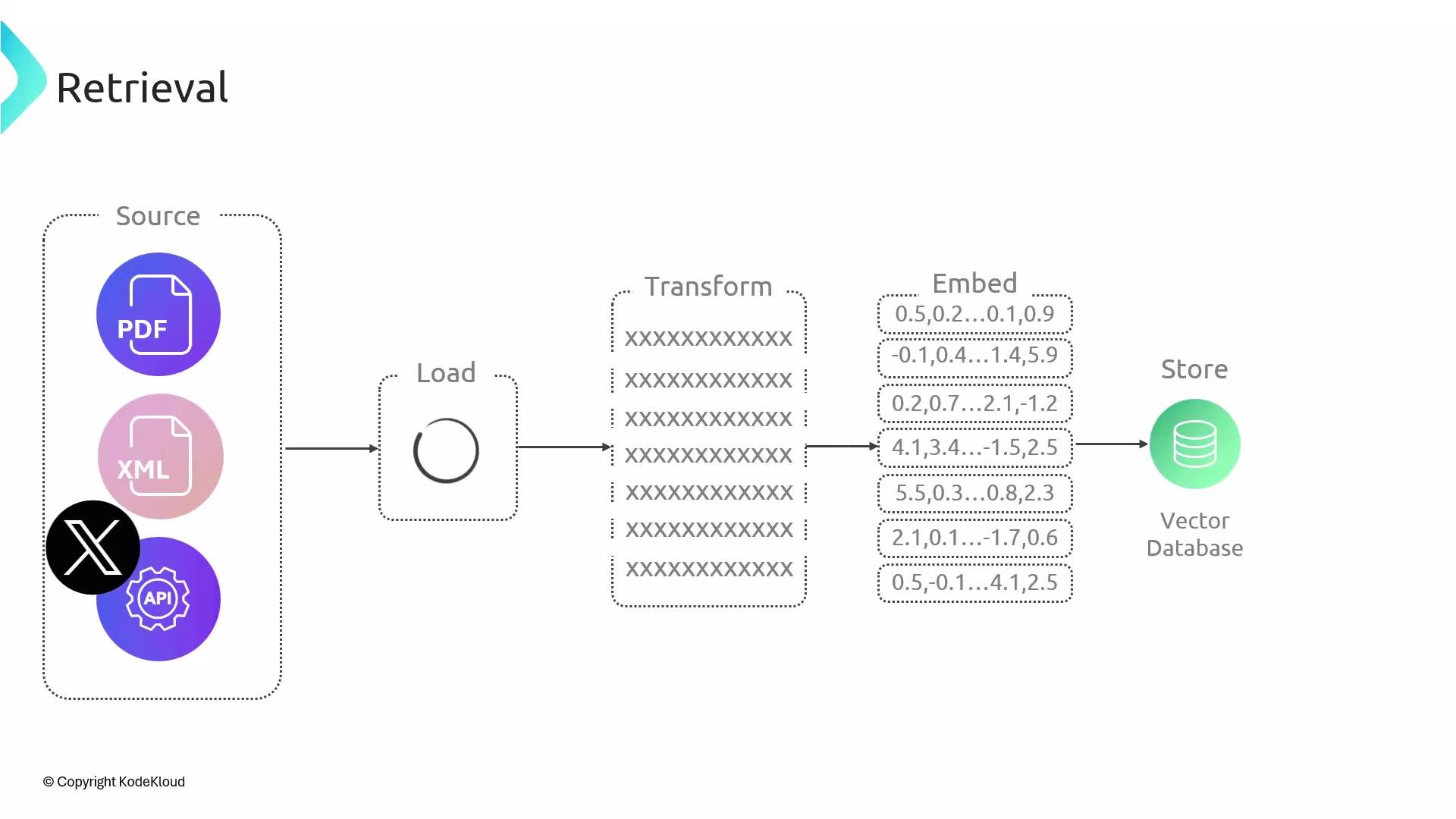
- Acquire data from sources: PDFs, XML, APIs, web pages, databases, and more.
- Clean and transform documents, extract metadata, and split text into passages or chunks that are retrieval-friendly.
- Convert each passage into a vector embedding using an embedding model (e.g., OpenAI embeddings, Hugging Face models).
- Store embeddings and metadata in a vector database (e.g., FAISS, Pinecone, Weaviate) that supports efficient similarity search and filters.
-
Retrieval (online, per-request)
- Encode the user query into an embedding.
- Perform a nearest-neighbor search against the vector database to find the most relevant passages.
- Retrieve and rank passages, then inject that context into the prompt sent to the LLM.
Best practices
- Document splitting: Use semantic-aware chunking (sliding windows, section-aware splits) so passages preserve complete facts and context.
- Embedding selection: Match the embedding model’s capabilities to your domain and query types. Re-embed only when necessary (e.g., model upgrades, significant content changes).
- Metadata design: Store document identifiers, section headings, source timestamps, and any domain-specific tags to enable filtering and provenance.
- Vector DB configuration: Tune index type, distance metric, and recall/latency trade-offs for your expected query patterns.
- Update strategy: Combine batch re-indexing with incremental updates for new or changed documents to keep latency and cost manageable.
- Use passage-level retrieval rather than whole-document retrieval to keep the injected context concise and focused.
- Apply simple reranking (BM25 or an LLM-based reranker) after vector similarity to improve precision.
- Include provenance and source links in the final LLM response so users can verify facts.
- Monitor retrieval quality via relevance metrics and user feedback loops, then iterate on splitting and embedding choices.
Design the ingestion and update processes (batch updates, incremental indexes, and re-embedding strategies) carefully. Good document splitting, metadata, and embedding selection significantly improve retrieval relevance and downstream LLM responses.
- OpenAI Embeddings
- FAISS (Facebook AI Similarity Search)
- Pinecone vector database
- Weaviate vector search engine
- Kubernetes Documentation — for deploying retrieval infra