Welcome back! This lesson explains Autonomous Agent Frameworks: what they are, how they work, and how to choose and operate them safely in production. Topics covered:
  • Core capabilities of autonomous agents
  • Key differences — autonomous vs. scripted agents
  • The agent loop — Sense → Plan → Act → Reflect
  • Example frameworks: Auto-GPT, AgentOps, SuperAGI, AutoGen
  • Framework selection guidance and best practices for safe autonomy
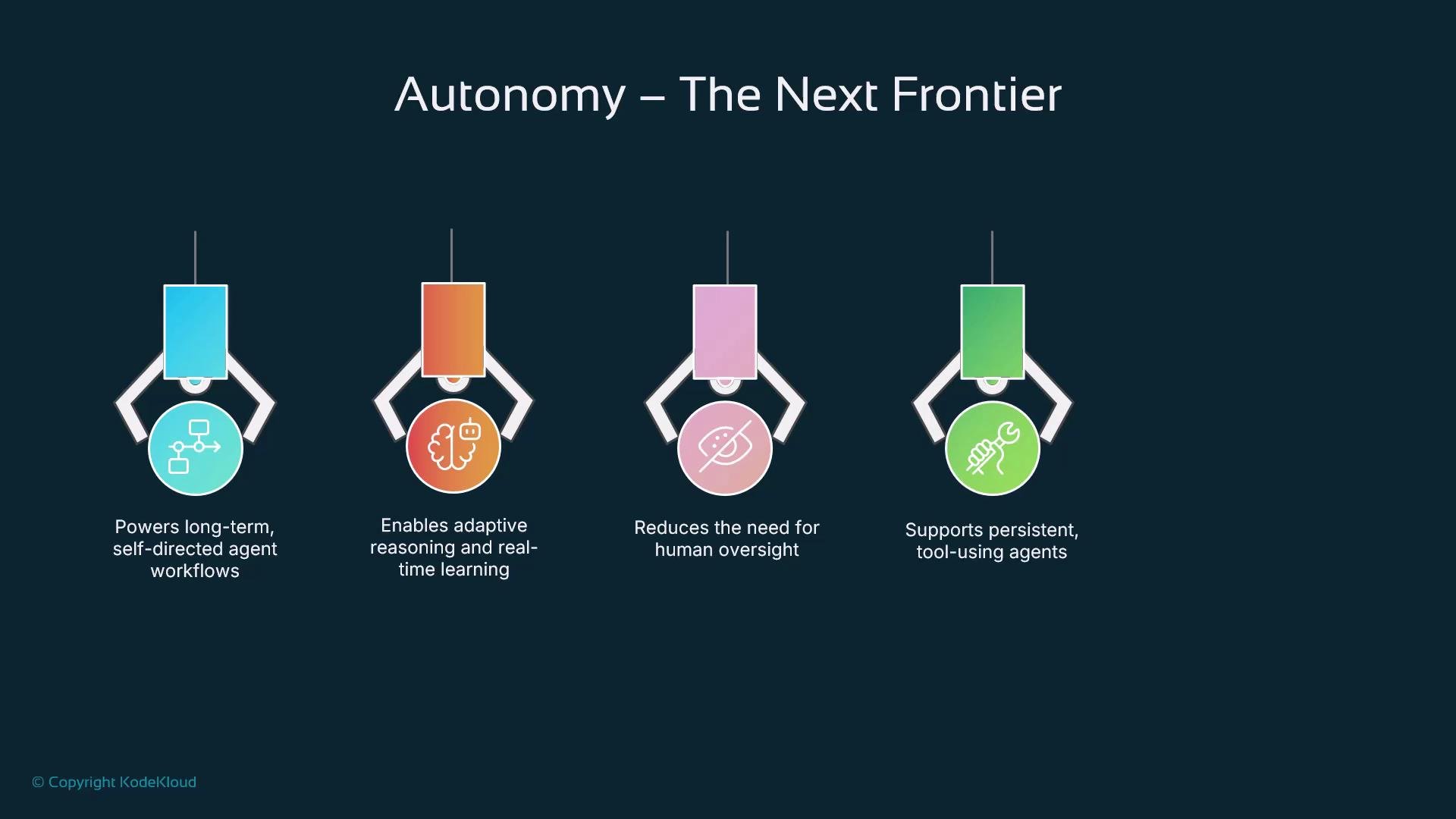
Autonomous agent frameworks are the next evolution in AI systems. They enable agents to accept goals, plan multi-step strategies, invoke tools and APIs, persist state across sessions, and learn from outcomes with minimal human direction. Properly designed frameworks let agents handle open-ended tasks, recover from failures, and adapt to changing data and environments.
The image illustrates four aspects of autonomy, highlighting self-directed workflows, adaptive reasoning, reduced need for human oversight, and support for persistent, tool-using agents.
Autonomous agents extend single-prompt systems in several important ways:
  • Persistence: Maintain state and memory across steps and sessions.
  • Goal orientation: Decompose high-level objectives into subtasks and milestones.
  • Tool orchestration: Discover, select, and chain external tools or APIs.
  • Reflection: Evaluate outcomes and adjust future plans.
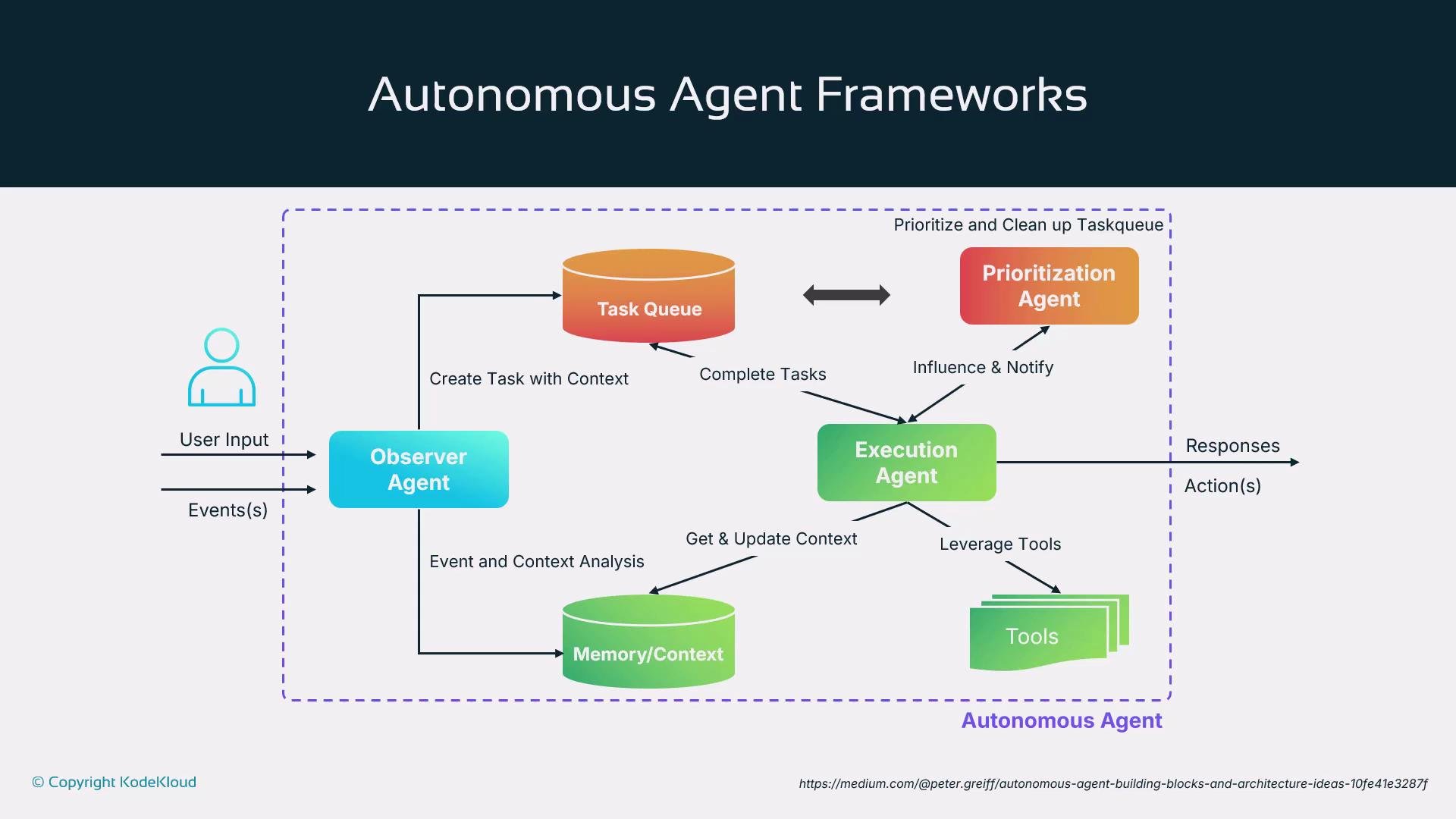
These behaviors rely on modular components such as planners, memory stores, tool layers, and execution pipelines. The diagram below shows a common agentic architecture where specialized agents collaborate to handle tasks end-to-end.
The image depicts a flowchart of an Autonomous Agent Framework, showing interactions between components such as an observer agent, task queue, prioritization agent, execution agent, memory/context, and tools. It outlines the process for handling user inputs and events, prioritizing tasks, and executing actions.
Typical flow in a modular autonomous system:
  1. Input / Events: User requests or external triggers arrive via UI or API.
  2. Observer agent: Performs initial analysis and converts events into contextualized tasks.
  3. Task queue: Tasks are enqueued for processing.
  4. Prioritizer: Reorders, deduplicates, or discards low-value tasks.
  5. Execution agent: Pulls prioritized tasks, fetches relevant memory/context, chooses tools, and carries out actions.
  6. Memory updates and responses: Results are stored and returned to users or external systems; memory updates inform future cycles.
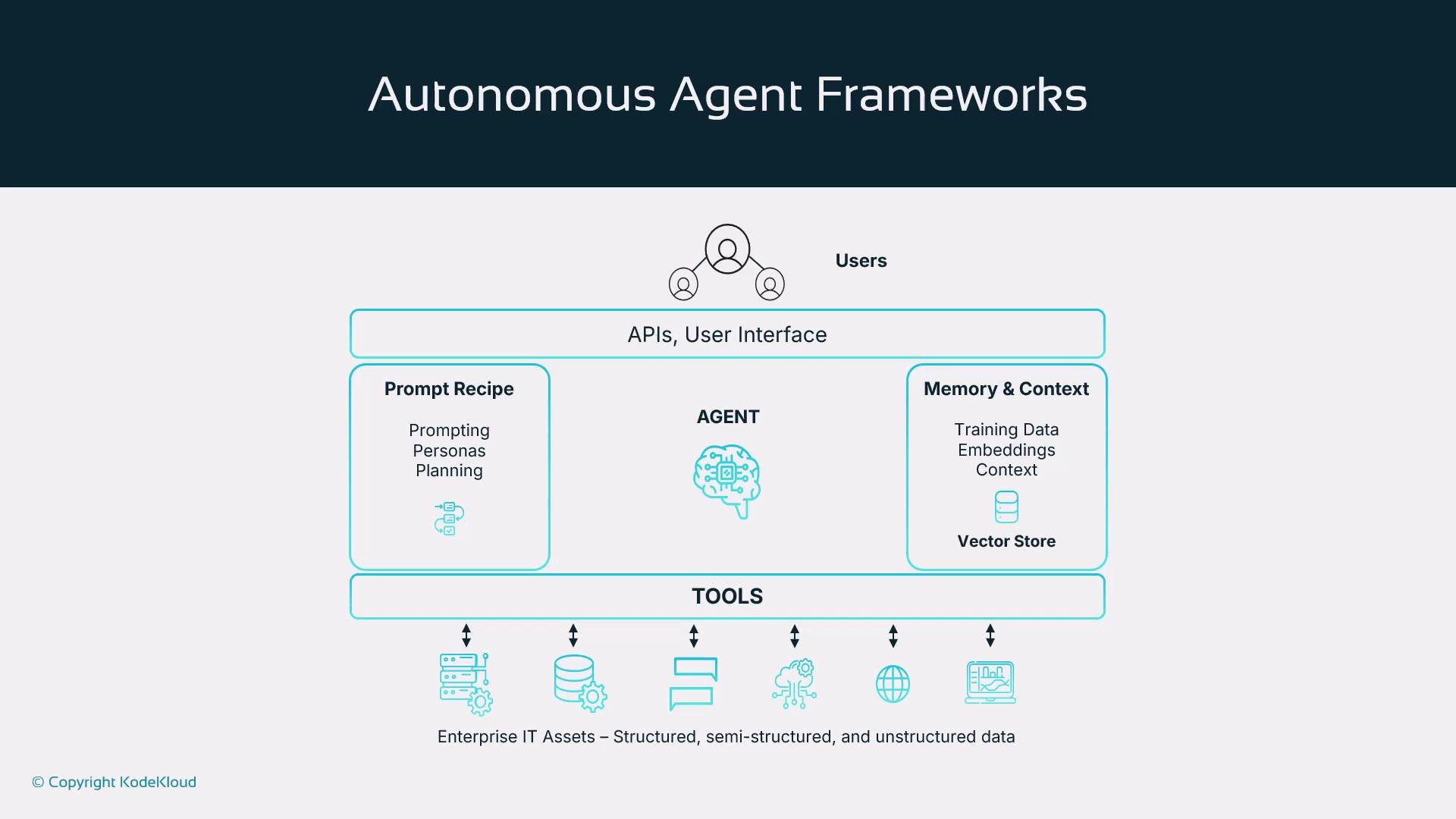
Next, consider the functional building blocks that enable an agent to behave autonomously.
The image illustrates an "Autonomous Agent Framework," highlighting components such as users, APIs, prompt recipes, tools, and memory & context, along with their interactions and integration with enterprise IT assets.
Core components (stack overview)
LayerPurposeExamples / Notes
Users / APIsSources of goals and data that drive agentsUI, webhooks, scheduled jobs, integrations
Agent corePersona, prompting strategy, planning rulesPrompt recipe / policy, constraints, planner
Memory & contextShort-term chat context and long-term storageEmbeddings, vector stores, RDBMS, caches
Tools layerAccess to enterprise assets and external servicesDatabases, cloud APIs, web crawlers, custom functions
Execution & orchestrationTask queues, prioritizers, worker agentsJob schedulers, orchestrators, retry policies
These components enable agents to plan, act, and respond in real time while maintaining context and leveraging external systems. Core autonomous capabilities Autonomous systems require several capabilities to operate without constant human intervention:
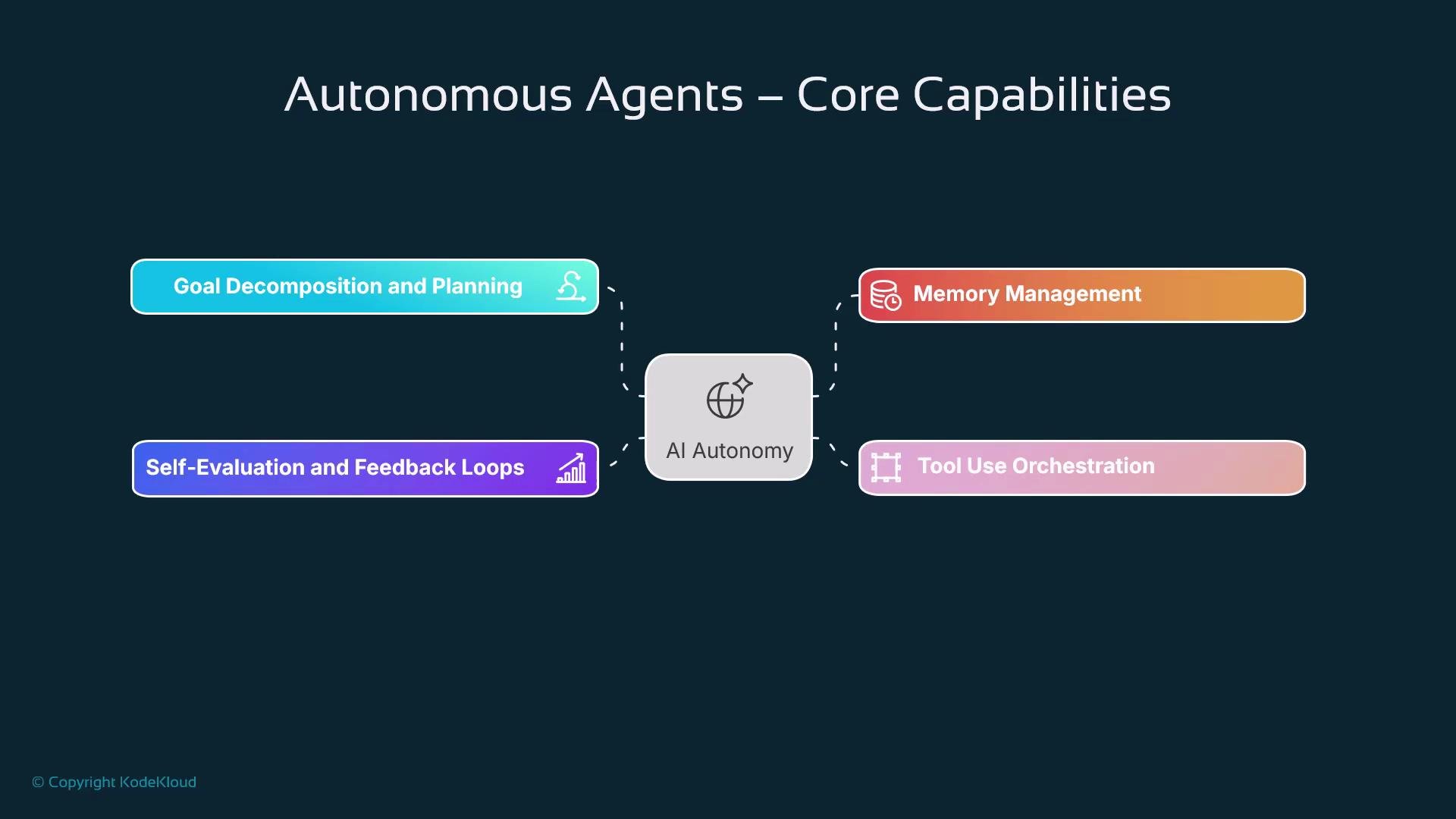
The image is a diagram titled "Autonomous Agents – Core Capabilities," showing four core capabilities of AI Autonomy: Goal Decomposition and Planning, Memory Management, Self-Evaluation and Feedback Loops, and Tool Use Orchestration.
  • Goal decomposition & planning: Break goals into actionable subtasks and schedule them.
  • Memory management: Maintain short-term context and long-term knowledge for decision making.
  • Tool orchestration: Select, invoke, and compose tools to complete actions.
  • Self-evaluation & feedback loops: Assess outcomes, log signals, and update strategies.
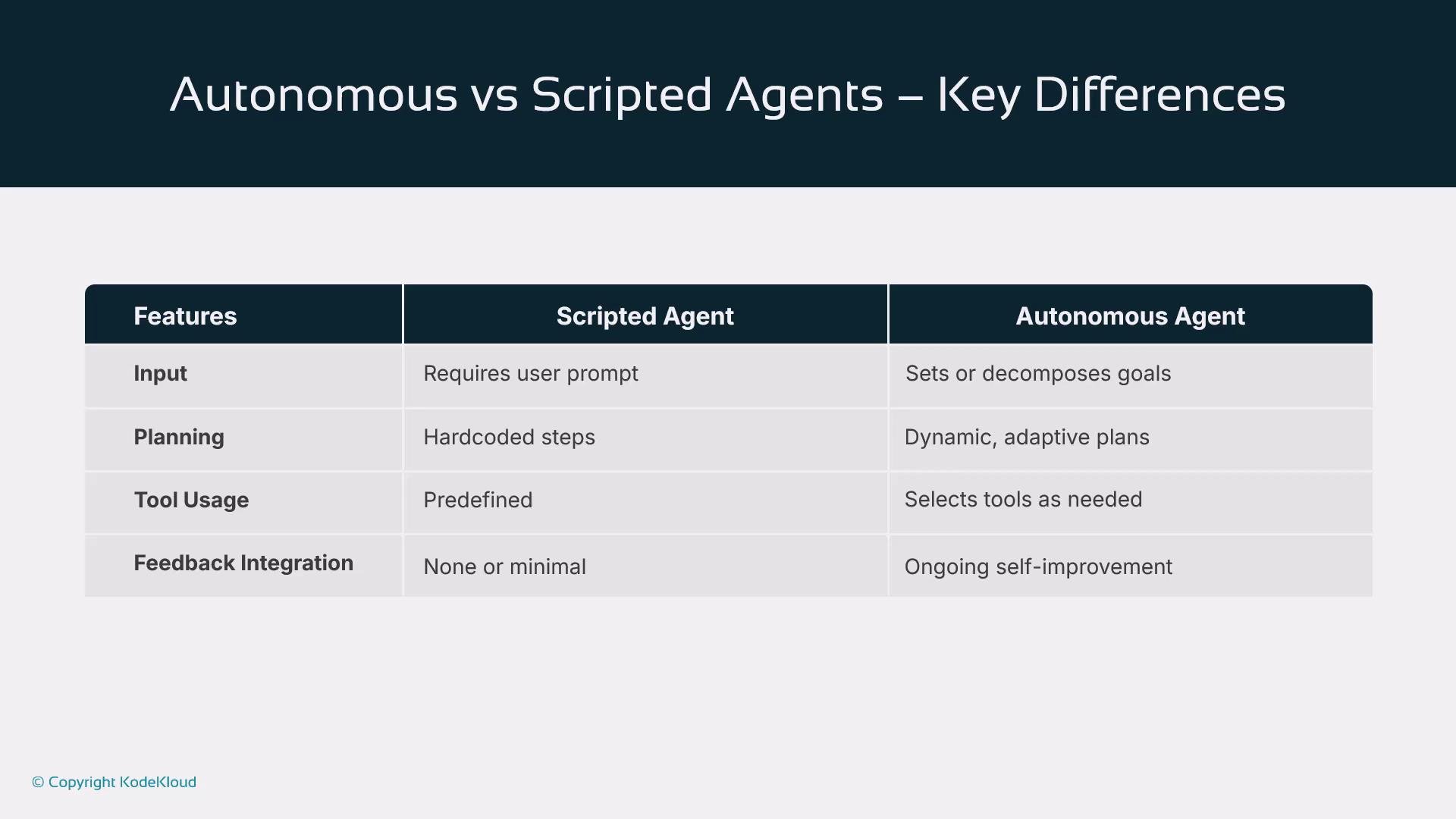
Comparison: Scripted vs Autonomous agents Autonomous agents differ fundamentally from scripted systems in how they receive input, plan, use tools, and learn:
The image is a table comparing scripted agents and autonomous agents, highlighting differences in input, planning, tool usage, and feedback integration.
Key differences:
  • Input handling:
    • Scripted: Waits for direct user prompts; follows predefined flows.
    • Autonomous: Can define goals and act proactively based on observations.
  • Planning:
    • Scripted: Rigid, hand-coded flows.
    • Autonomous: Dynamic, adaptive planning that can re-plan with new information.
  • Tool usage:
    • Scripted: Calls a fixed set of functions.
    • Autonomous: Selects and composes tools from a library as needed.
  • Feedback:
    • Scripted: Limited learning from past interactions.
    • Autonomous: Incorporates signals to improve behavior over time.
Agent loop (Sense → Plan → Act → Reflect) The agent loop is the core operational cycle that powers incremental progress and continuous improvement.
  • Sense: Collect observations from inputs, system state, or memory — parse prompts, read files, query databases, or monitor services.
  • Plan: Decompose objectives into subtasks, choose tools, and order actions or API calls.
  • Act: Execute the plan — call tools/APIs, write files, or trigger other agents.
  • Reflect: Evaluate outcomes, log metrics, update memory, and adjust future planning. Re-enter the loop with a revised plan when needed.
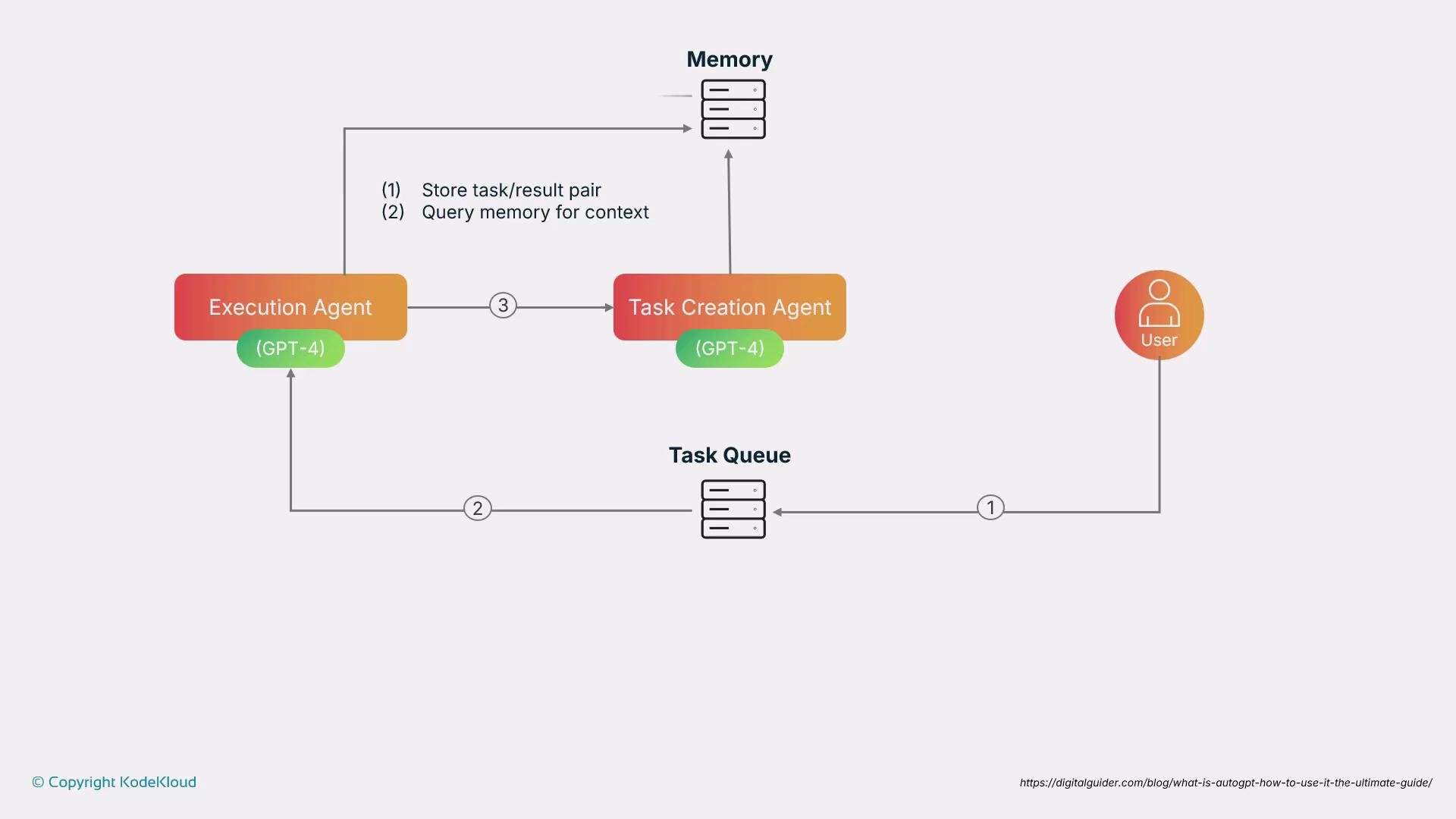
This cycle supports error correction, convergence to goals, and safe interference detection. Auto-GPT and task-based loops Auto-GPT is one of the earliest widely used open-source autonomous agent prototypes. It demonstrates a loop of prompting, task creation, memory storage, and tool use to complete multi-step objectives (for example, “build a website”). Auto-GPT is useful for prototyping but can face challenges with long-term context retention, robust error recovery, and enterprise-grade observability.
The image is a flowchart illustrating a system involving a user, task queue, memory, and two agents (Task Creation Agent and Execution Agent) using GPT-4, showing data flow and interaction steps.
Flow example:
  • User submits an objective.
  • Execution agent performs tasks and writes results to memory.
  • Task-creation agent uses memory to generate follow-up tasks.
  • Prioritizer refines and orders the task queue for subsequent execution.
AgentOps: observability and lifecycle management AgentOps is a meta-framework that adds production features—observability, governance, and lifecycle tooling—to agent deployments. It often integrates with frameworks like LangChain and Auto-GPT to capture logs, trace tool calls, visualize decision paths, and audit behavior. Observability and governance are critical for safe agent adoption in enterprises. AgentOps commonly includes:
  • CI/CD pipelines and deployment tooling for agents and tools
  • Tool and agent registries
  • Agent monitoring, metrics, and centralized logging
  • LLM gateways and environment separation (dev/UAT/prod)
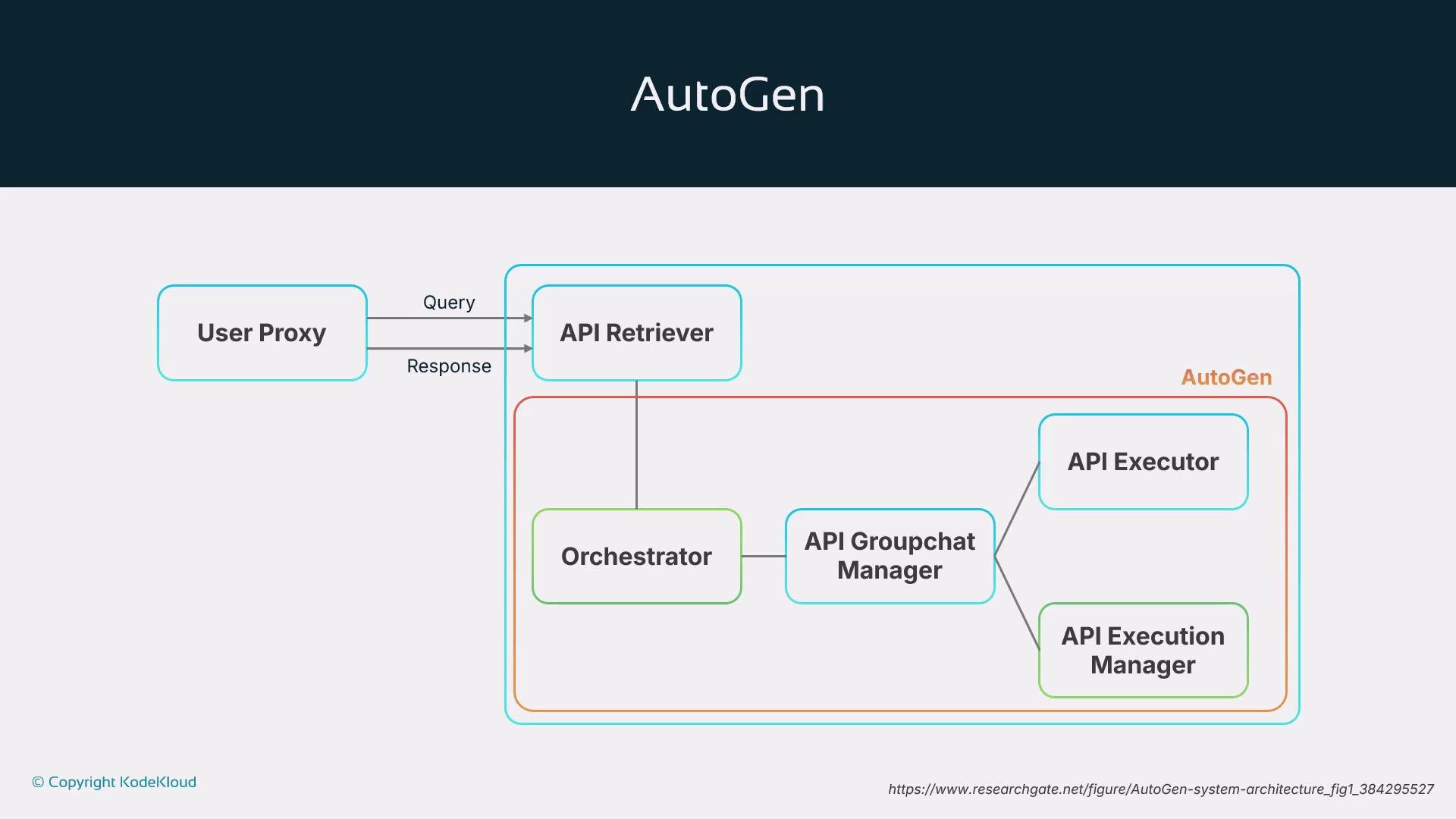
SuperAGI: production-grade orchestration and observability SuperAGI targets production use cases with task queues, a GUI dashboard, multi-model support, and multiple memory backends. It supports parallel agent execution and visual tracing of tasks, aiding debugging and scaling. SuperAGI is extensible for custom tool integrations and operational telemetry. A common hierarchical, multi-agent orchestration pattern—used by SuperAGI-style systems—has a central orchestrator delegating to specialized agents; sub-agents collaborate and aggregated results are returned with telemetry and retries handled at scale. AutoGen: conversational multi-agent orchestration AutoGen (Microsoft) uses conversational interfaces between agents (and between users and agents) to coordinate task execution. Agents can ask clarifying questions, pass structured data, and collaborate via chat-style interactions. AutoGen supports memory modules, custom tools, and multi-step planning, making it well-suited for enterprise scenarios requiring formal coordination across teams and data sources.
The image is a flowchart diagram of the "AutoGen" system architecture, showing interactions between components like User Proxy, API Retriever, Orchestrator, API Groupchat Manager, API Executor, and API Execution Manager. It illustrates the flow from user queries to responses through various modules.
Framework selection guidance Choose frameworks based on your use case, maturity requirements, and operational constraints.
FrameworkBest forStrengths
Auto-GPTPrototyping and personal experimentsSimple loop-based autonomy; fast to iterate
SuperAGIProduction-grade agentsDashboards, job queues, telemetry, scale
AgentOpsObservability & governanceAuditing, lifecycle management, compliance
AutoGenConversational multi-agent workflowsFormal agent-to-agent coordination and tool orchestration
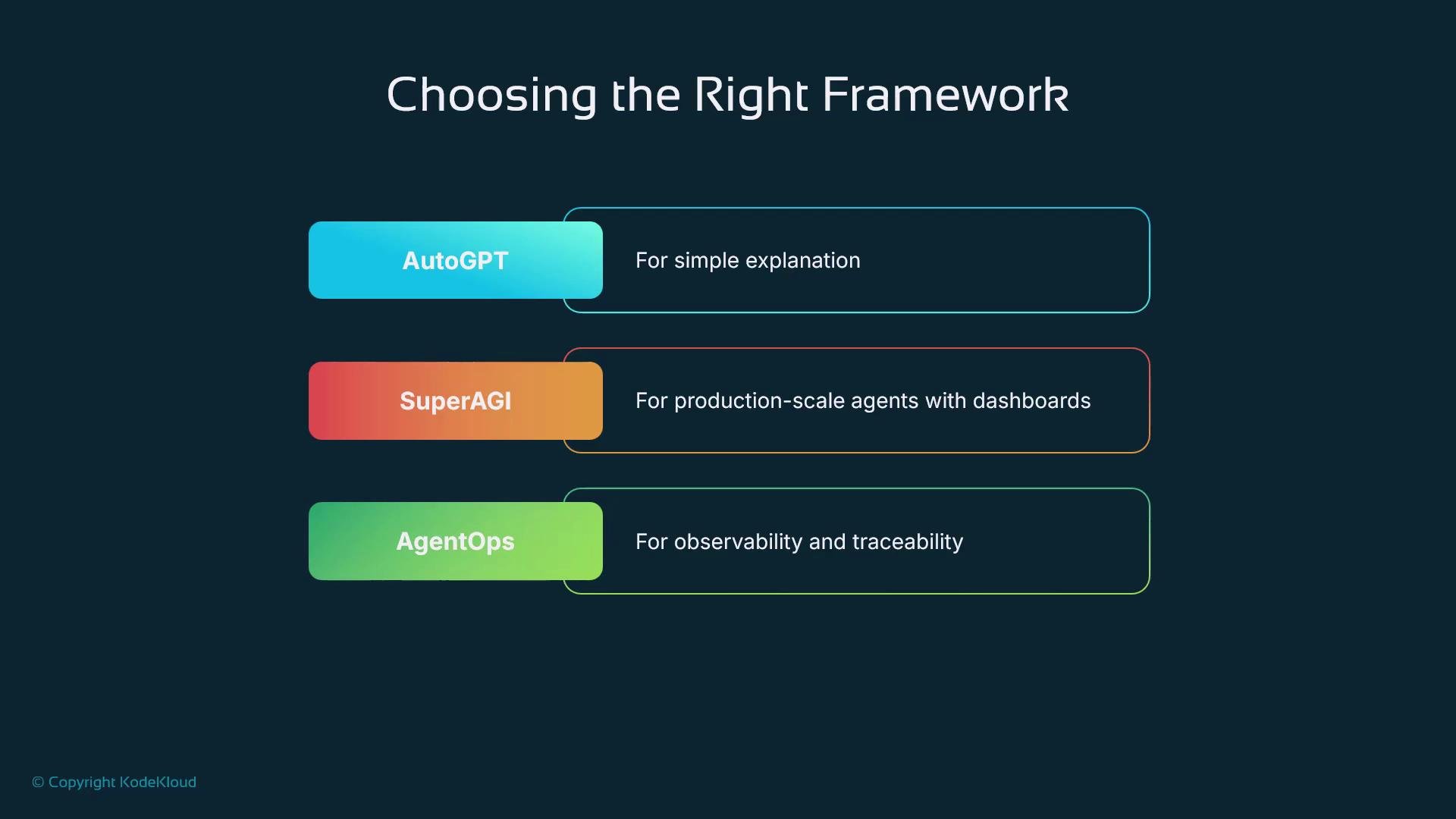
The image lists three frameworks for different purposes: AutoGPT for simple explanations, SuperAGI for production-scale agents with dashboards, and AgentOps for observability and traceability.
Best practices and safeguards
  • Control costs: Track and limit token usage and external tool calls.
  • Resilience: Implement retry logic with exponential backoff and sensible timeouts.
  • Guardrails: Enforce maximum step counts, budget limits, and runtime caps to avoid runaway processes.
  • Least privilege: Grant minimal permissions for tool access and separate environments (dev/UAT/prod).
  • Observability: Log every plan, tool invocation, memory access, and outcome for debugging and audits.
  • Recovery: Add success/failure signals, automated rollback, and human-in-the-loop approvals for high-risk operations.
Autonomous agents can take irreversible actions if misconfigured. Always test agents in isolated environments, enable strict access controls, and add human-in-the-loop approval for high-risk operations.
Design considerations (quick checklist)
  • Define clear goal boundaries and escalation paths.
  • Instrument telemetry at the tool and plan levels.
  • Use modular prompt recipes and policy constraints to control agent behavior.
  • Validate memory sources and retention policies to avoid stale or biased context.
With a modular architecture, robust memory and tool integration, the Sense-Plan-Act-Reflect loop, and production-grade observability, you can build autonomous agents that are safe, auditable, and effective for real-world automation. Links and references For further reading:

Watch Video