Guidance on securing and ethically governing multi‑agent systems, covering threat surfaces, authentication, privacy, sandboxing, bias mitigation, and human oversight.
Welcome back!This lesson covers security and ethical considerations for multi-agent systems (MAS). You’ll learn why security and ethics are critical in MAS, which threat surfaces are unique to multi-agent architectures (data leakage, collusion, adversarial agents), and practical controls such as identity/authentication, authorization, privacy handling, ethical alignment, bias mitigation, defensive architecture (sandboxing, limits, escalation), secure inter-agent communication, and human oversight. We close with an operational checklist for secure, ethical MAS deployments.
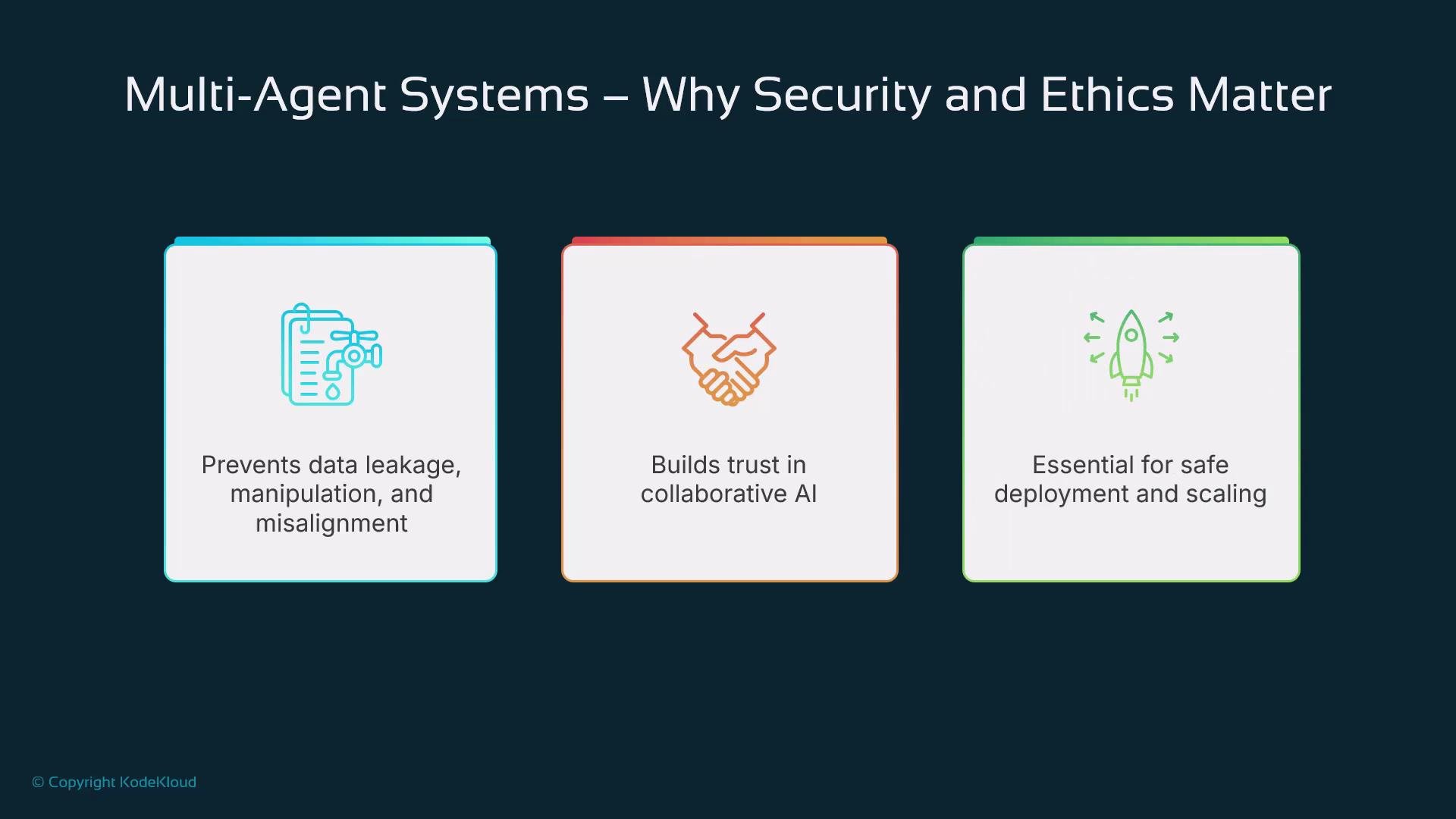
Multi-agent systems (MAS) raise both opportunity and risk. Multiple semi‑autonomous agents interacting across shared context, tools, and communication channels increase the complexity of safety, security, and governance. It’s not enough for each agent to be “smart” — the system as a whole must be designed to protect data, prevent misuse, and remain aligned with human values throughout interaction flows.Why MAS expands the attack surface
Because agents can act independently and compose capabilities, risks multiply:
More endpoints and credentials to secure.
Greater chance of misinterpretation or conflicting objectives between agents.
Shared memory and tooling increase blast radius for compromise.
Harder to enforce consistent ethical rules and safety constraints across agents.
Key threat surfaces in MASBelow are the most critical threat surfaces mapped to examples and mitigations to help you prioritize defenses.
Threat surface
Example risk
Typical mitigations
Communication spoofing and injection
An attacker sends a fake planner->writer message instructing harmful actions
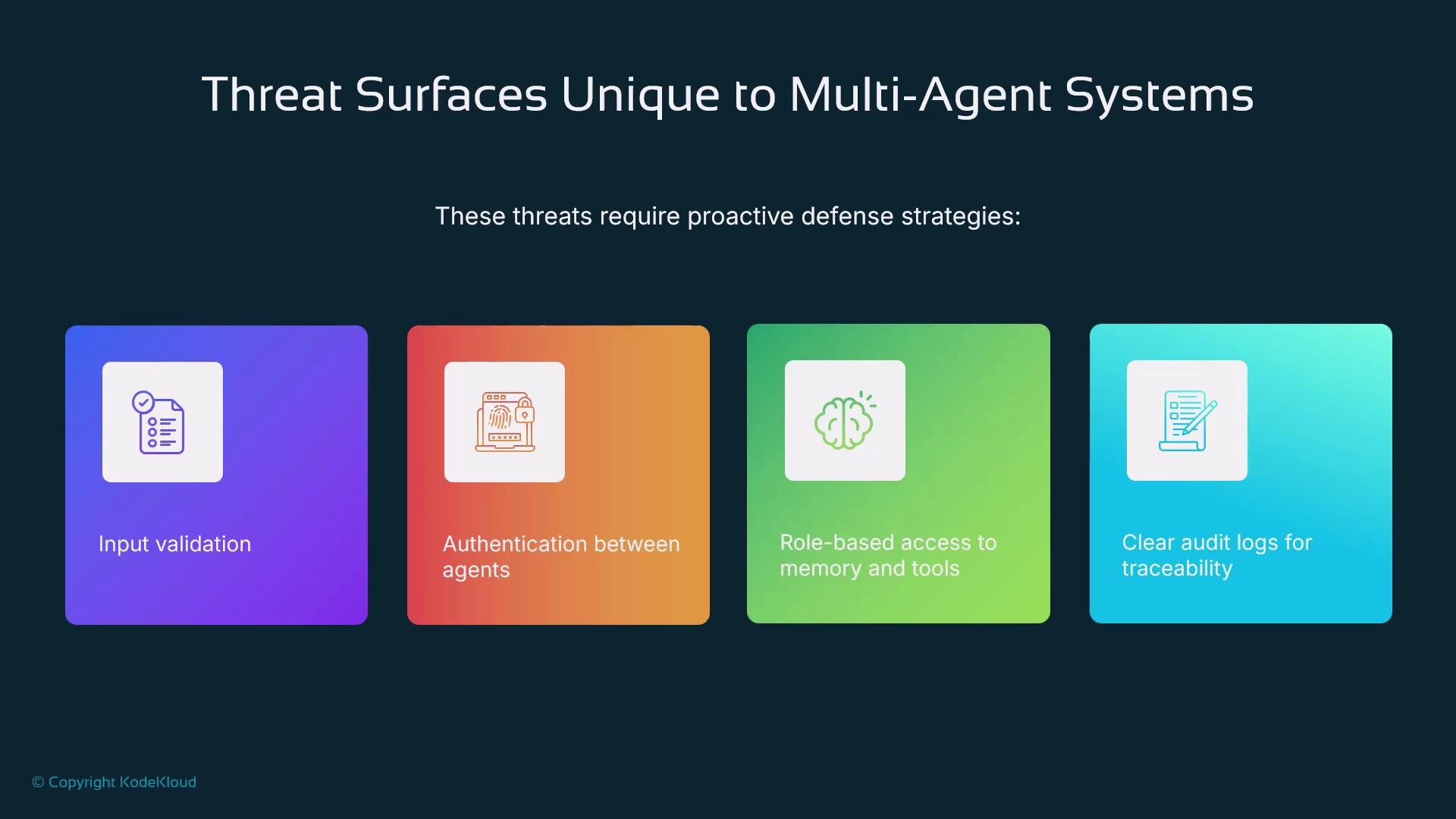
Design multi‑agent systems defensivelyMAS failures can cascade across the system. Defensive design focuses on prevention, containment, and rapid detection:
Create scoped memory (per-session or per-task isolation) and TTL for context.
Sign and authenticate every message between agents.
Apply least-privilege RBAC for tools, APIs, and data access.
Run untrusted code in sandboxes and enforce runtime limits.
Require layered verification or human approval for high-risk side effects.
Maintain comprehensive, structured audit logs for observability and incident response.
Data leakage, collusion, and emergent behaviorWhen agents share memory or communicate with weak guards, sensitive data can leak or be persisted beyond intended scope. Agents may also collude (intentionally or accidentally) and amplify errors or bias through repeated reprocessing.
Defenses to consider:
Strict session isolation and per-session encryption keys.
Memory redaction, TTL (time-to-live) expiration, and automatic purging of ephemeral data.
Behavioral monitoring and anomaly detection for agent outputs.
Provenance tracking so downstream agents can weight or ignore low‑quality sources.
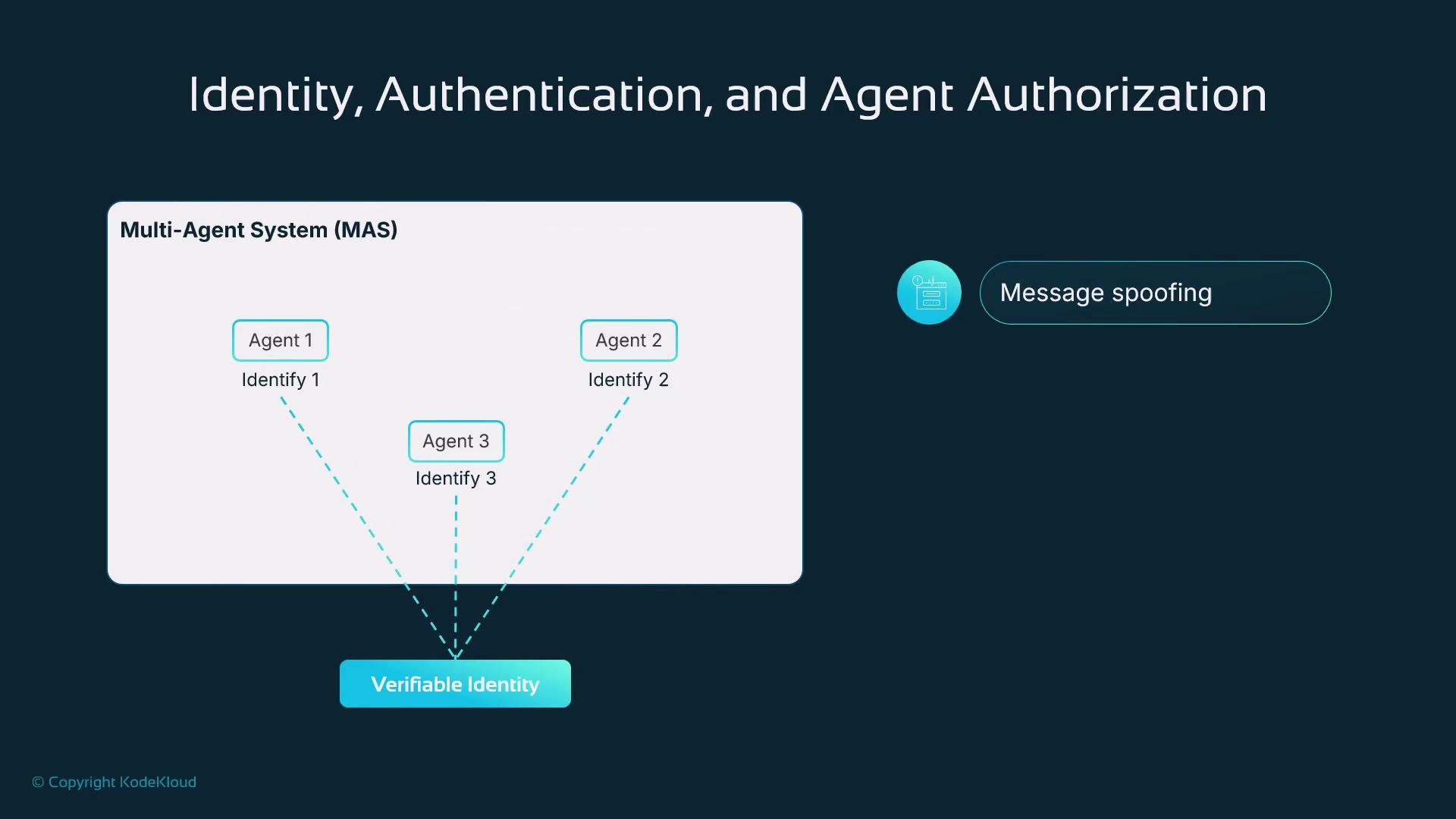
Identity, authentication, and authorizationTreat agent identity like microservice identity: verify who is speaking, restrict what they can do, and verify that actions are authorized.
Best practices:
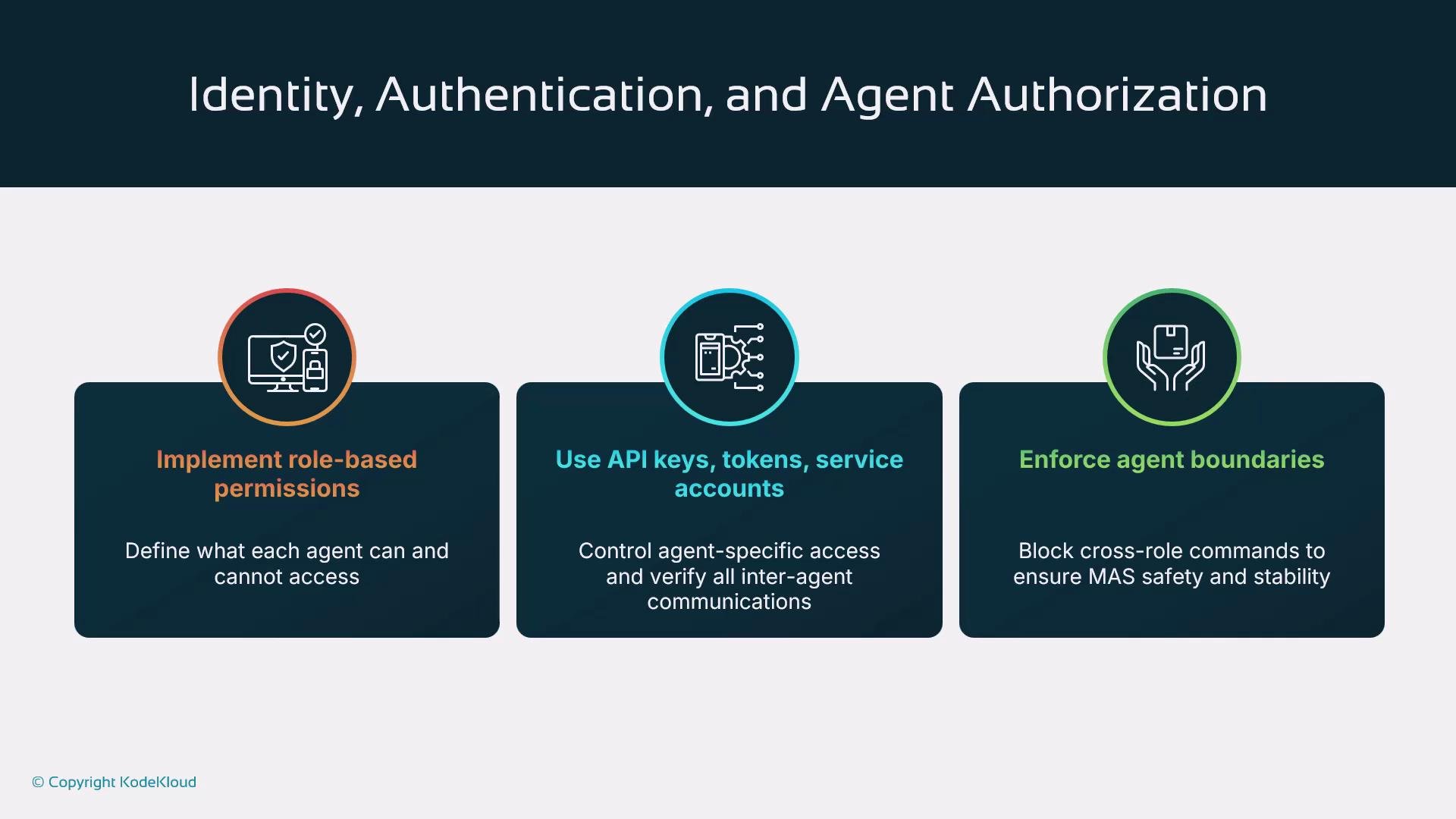
Issue per-agent credentials (API keys, tokens, service accounts).
Apply role-based access control (RBAC) and least privilege: only grant the permissions required for an agent’s role.
Enforce strict agent boundaries and monitor for privilege escalation patterns.
Handling sensitive information and privacyAgents often handle PII and other confidential information. Apply standard data protection principles:
Encrypt sensitive data in transit and at rest.
Avoid persistent storage of sensitive context unless needed for compliance or audit.
Implement memory redaction, TTL expiration, and session-based isolation.
Remove or redact tokens, credentials, and personal identifiers before persisting shared context.
Log access events with user/agent identifiers for accountability.
Ethical alignment across agentsDifferent agents may pursue different objectives (efficiency, coverage, creativity). To ensure coherent, responsible behavior:
Implement centralized checks or an arbiter/supervisor agent that enforces constraints.
Use weighted-scoring, voting, or supervisor overrides to resolve conflicts between agents.
Route ambiguous or high‑risk outputs to human reviewers.
Bias amplification and mitigationBias introduced early can be amplified downstream. Mitigation techniques:
Add bias and fairness audits at pipeline stages.
Track sources and provenance so downstream agents can consider origin quality.
Use diverse datasets and enforce source diversity rules for research agents.
Introduce human review for sensitive decisions and continuously monitor for distributional drift.
Containment, sandboxing, and escalationPlan for failure modes and minimize the blast radius:
Execute untrusted code in sandboxes with runtime and resource limits.
Enforce message length, API call, and retry limits.
Escalate uncertain or high-risk actions to human operators or higher‑trust agents.
Monitor in real time and retain structured logs for incident forensics.
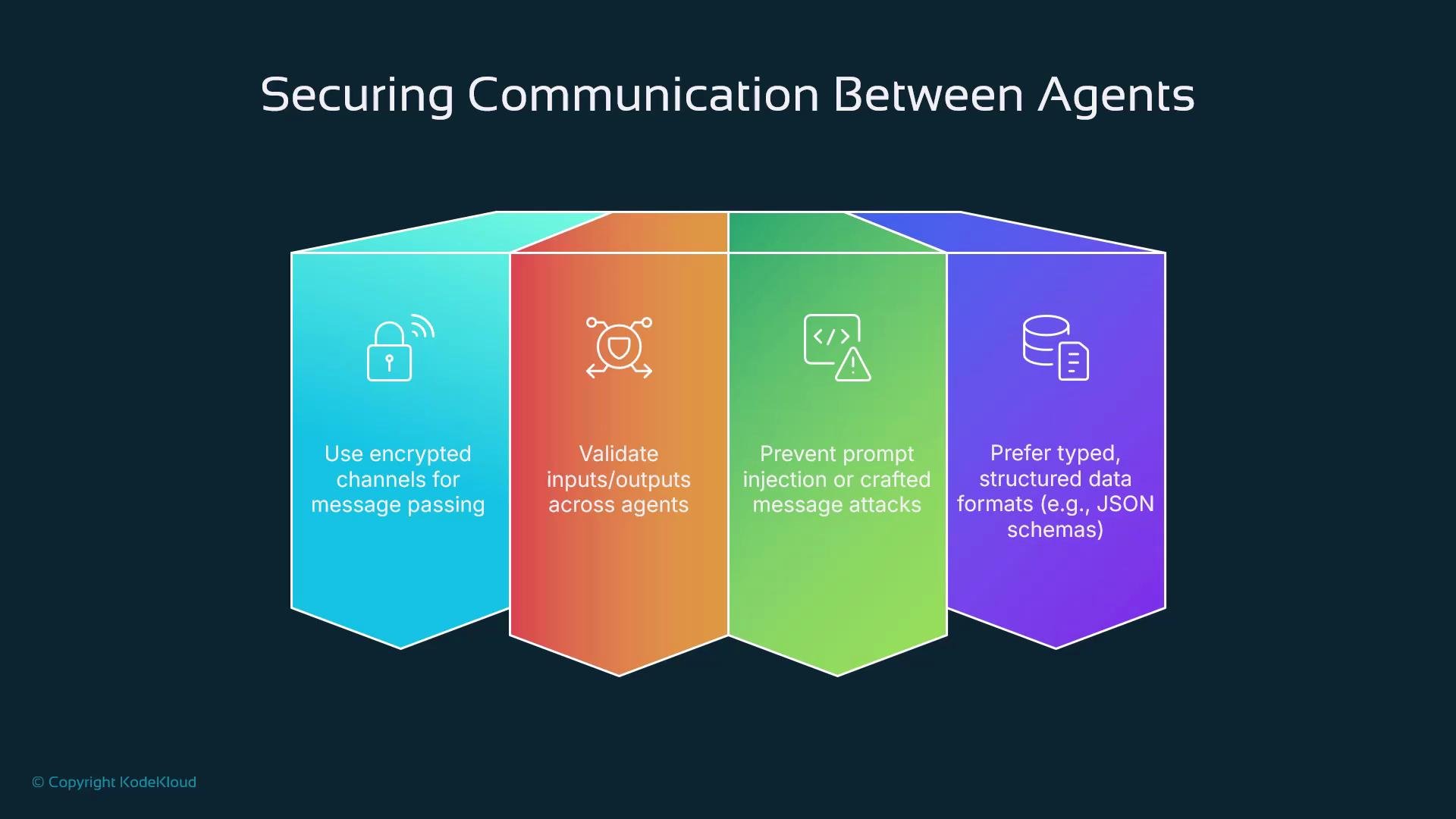
Secure inter‑agent communication and validationAll inter-agent messages should be authenticated, encrypted, typed, and validated. Prefer structured formats over free text to reduce injection risks.
Use encrypted channels (TLS) and sign messages where applicable.
Authenticate every sender and validate authorization for requested actions.
Prefer structured schemas (JSON + JSON Schema) to detect malformed input and reduce ambiguity.
Sanitize payloads to defend against prompt injection and message overflow.
Example: FastAPI + Pydantic message validation and API key check
# pythonfrom fastapi import FastAPI, Header, HTTPExceptionfrom pydantic import BaseModelapp = FastAPI()class AgentMessage(BaseModel): sender: str recipient: str kind: str payload: dict# Example per-agent API keysAPI_KEYS = {"agent-a": "secret-token-a", "agent-b": "secret-token-b"}def verify_api_key(x_api_key: str): # Validate that the provided API key matches a known agent key if x_api_key not in API_KEYS.values(): raise HTTPException(status_code=401, detail="Invalid API key")@app.post("/message")def receive_message(msg: AgentMessage, x_api_key: str = Header(...)): verify_api_key(x_api_key) # Additional authorization checks here (see authorize() below) return {"status": "accepted", "sender": msg.sender, "recipient": msg.recipient}
Role-based authorization example
# pythondef authorize(agent_id: str, action: str) -> bool: role_permissions = { "writer": {"write_document", "read_context"}, "planner": {"create_plan", "read_context"}, } role = get_role_for_agent(agent_id) # implement your lookup return action in role_permissions.get(role, set())
Operational checklist for secure, ethical MASUse this operational checklist as a starting point and tailor it to your domain and compliance requirements.
Area
Minimum controls
Identity & auth
Per-agent identity, API keys or certs, mutual TLS, signed tokens
Authorization
RBAC, least privilege, scoped tool access
Communication
Encrypted channels, signed messages, schema validation
This checklist is an operational guide — adapt it to your domain and regulatory needs. For high-impact systems, prioritize human-in-the-loop gates, stronger isolation, and frequent security reviews.
Closing summaryMulti-agent systems deliver powerful distributed intelligence, but they introduce new security and ethical challenges. Map your threat surfaces (communication, shared memory, tool access), enforce agent identity and least privilege, validate and sandbox interactions, and implement system-level ethical constraints. Combine automated defenses with human oversight, monitoring, and structured logs to deploy MAS responsibly and at scale.