

What exactly are Large Language Models (LLMs)?
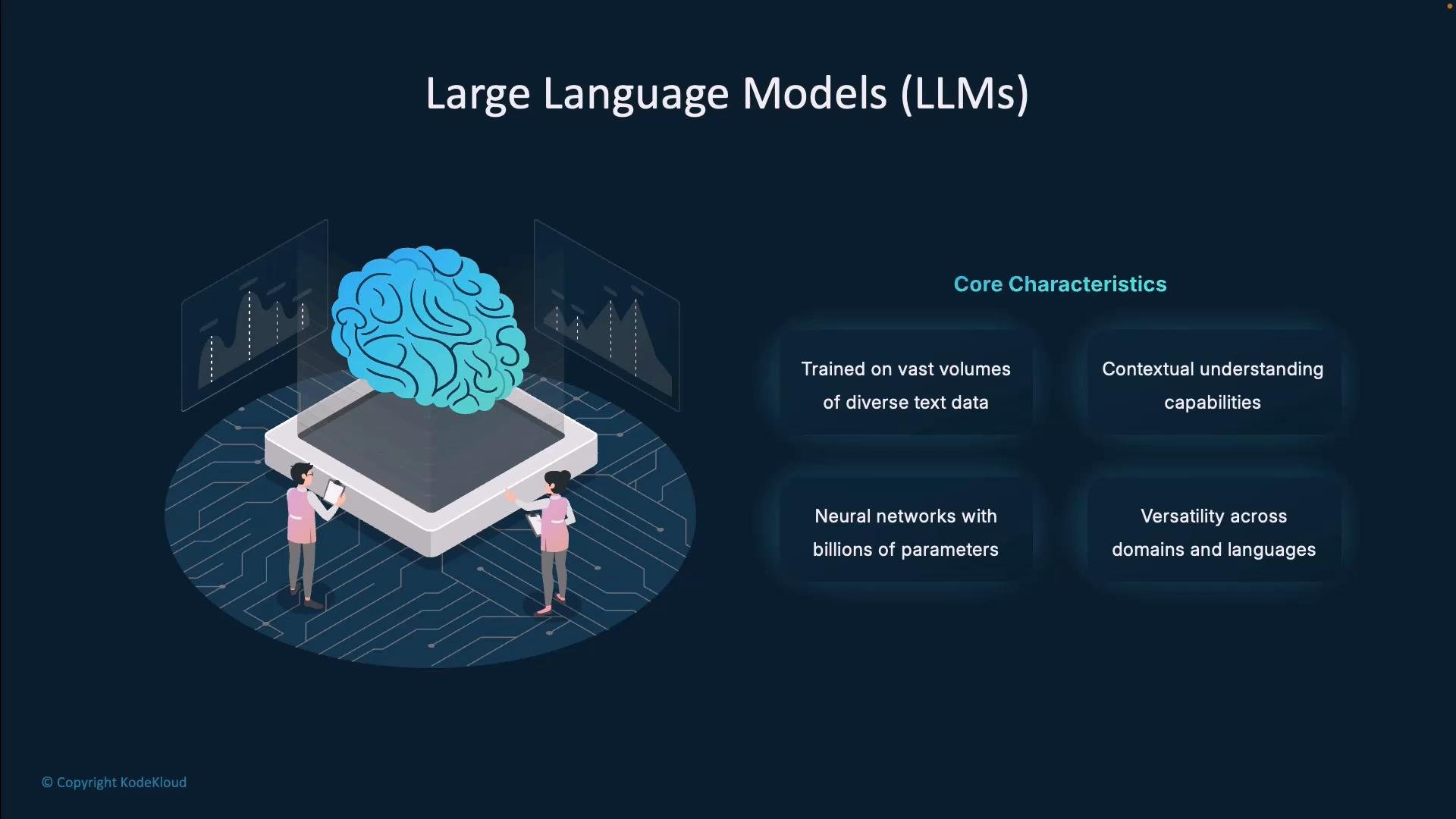
Large Language Models are deep learning systems designed to understand, generate, and manipulate human language — including source code. Instead of relying on hand-written rules, LLMs learn statistical patterns from extremely large corpora of text and code. Key characteristics:- Trained on vast and diverse text corpora (documentation, books, websites, and code repositories) to learn patterns across domains and languages.
- Contextual understanding: they interpret tokens relative to surrounding content, which is essential for producing correct, relevant code.
- Large neural architectures: billions (or more) of parameters enable richer representations; larger models often improve predictions but come with compute and latency trade-offs.
- Cross-domain versatility: the same architectures can handle natural language, technical documentation, and multiple programming languages.
How GitHub Copilot leverages LLMs
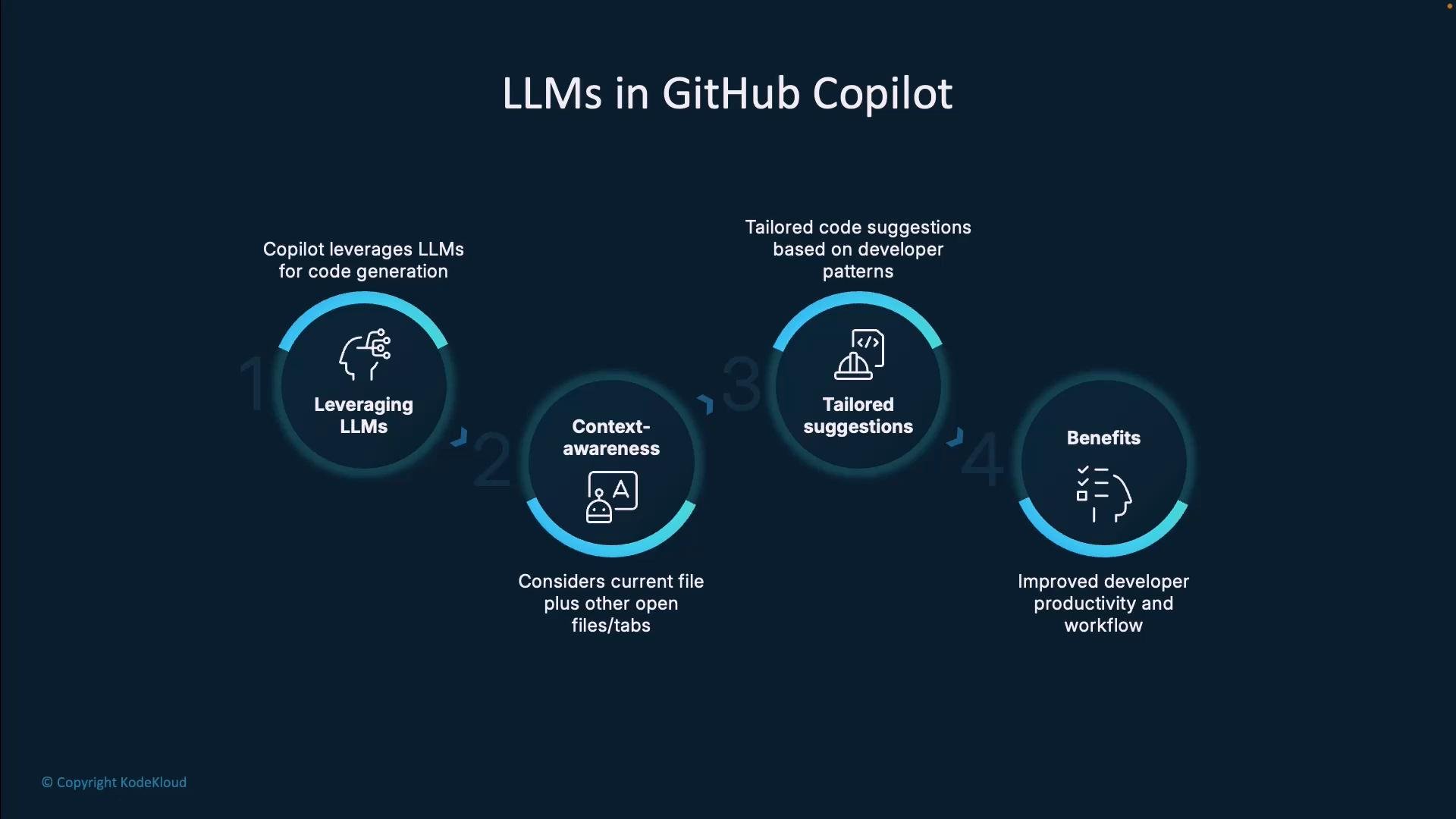
GitHub Copilot uses LLMs that have been fine-tuned for programming tasks. These models are trained on large code and text corpora (including public repositories), enabling them to learn syntax, idioms, and common patterns across many languages. Important Copilot capabilities:- Code generation: from single-token completions to full functions, boilerplate, or project scaffolding.
- Project-aware suggestions: Copilot can consider the current file, open files, and editor context so suggestions align with your project’s imports and established patterns. The effective context depends on the model’s window and editor integration.
- Personalized suggestions: interaction signals (accepts, edits, rejections) can adapt suggestions over time depending on product and account settings.
- Productivity assistance: Copilot helps scaffold implementations, propose algorithms, write tests, and generate documentation—reducing cognitive overhead and accelerating workflows.
Typical Copilot workflow (high-level)
- Developer types code or a comment in the editor.
- If Copilot is enabled, the editor sends the current context (file contents, open files, cursor position) to the Copilot service.
- The service processes context and may return zero or more suggestions.
- No suggestions → developer continues coding.
- Suggestions → returned to the editor for preview.
- Developer accepts, modifies, or rejects suggestions.
- Accepted code is inserted; the updated context informs subsequent suggestions.
- Rejected suggestions still provide insight and may influence future interactions.
Copilot model lineup (current and evolving)
Copilot supports multiple LLMs so teams can balance speed, accuracy, and specialization. Availability depends on IDE integration and subscription level.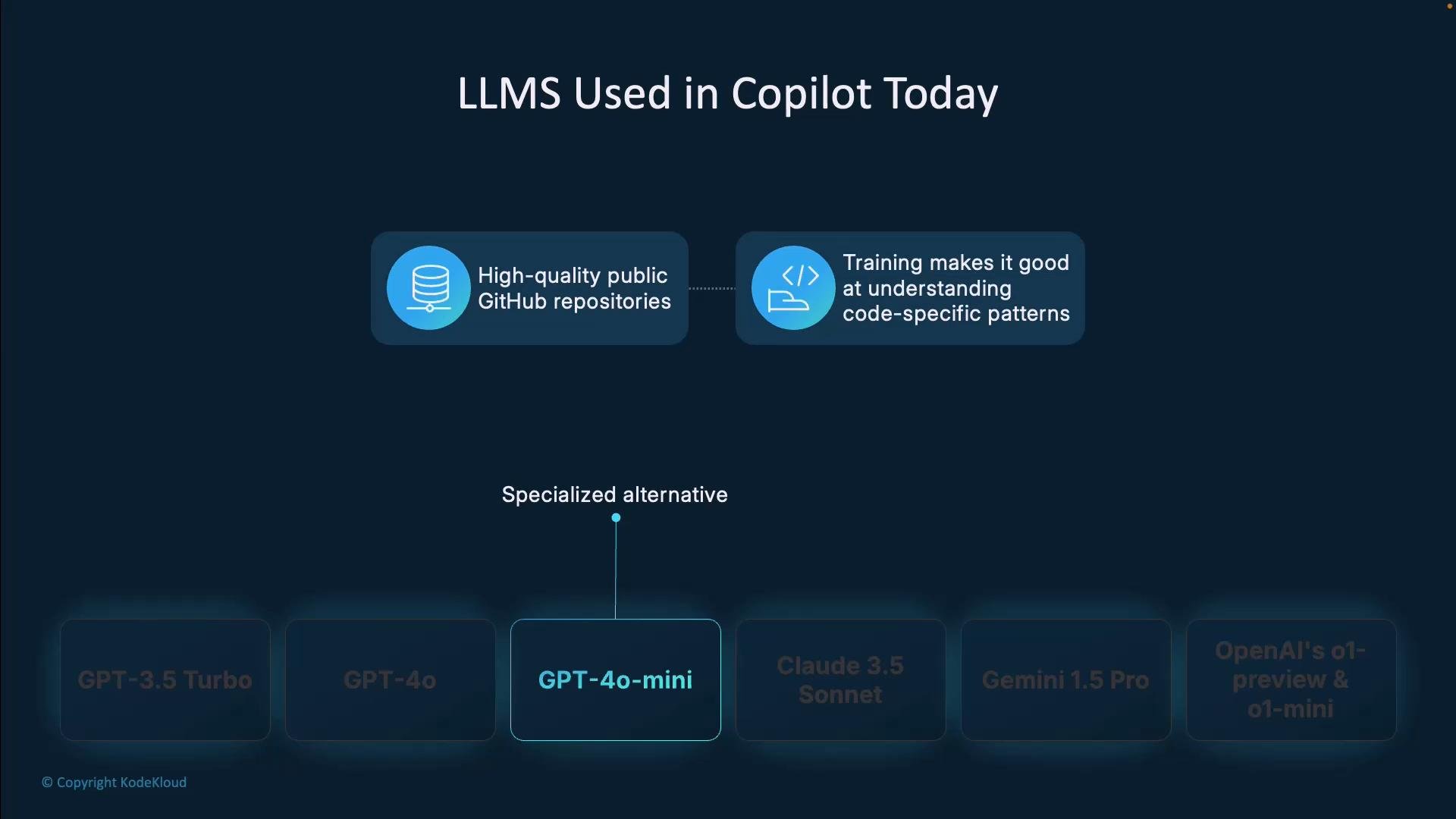
Expanding model options and vendor integrations
GitHub has explored additional models and vendor partnerships to broaden choice and address different safety, latency, and cost requirements. Examples discussed or piloted include:- Anthropic’s Claude variants (different safety and architectural trade-offs)
- Google Gemini Pro (another performance and optimization profile)
- New OpenAI code-focused variants and mini models optimized for programming tasks
Real-world developer impact
Copilot delivers measurable improvements across many workflows:- Faster task completion: independent studies and internal reports show substantial speedups for routine tasks (some reports cite improvements up to ~55% for specific tasks).
- High suggestion utility: developers accept about 30% of inline suggestions on average; even rejected suggestions often inspire better approaches.
- Language onboarding: Copilot accelerates productivity in unfamiliar languages by providing idiomatic examples and patterns.
- Common use cases: generating boilerplate, implementing algorithms, writing unit tests, using unfamiliar APIs, translating code between languages, and improving documentation. Teams report better prototyping speed and test coverage.
Future directions for Copilot
GitHub and model providers are evolving Copilot in ways that aim to deepen assistance and broaden scope:- More fine-grained, language- or task-specific model options.
- Larger context windows so models can reason over more of a codebase.
- Better program understanding (reasoning about behavior, not only syntax).
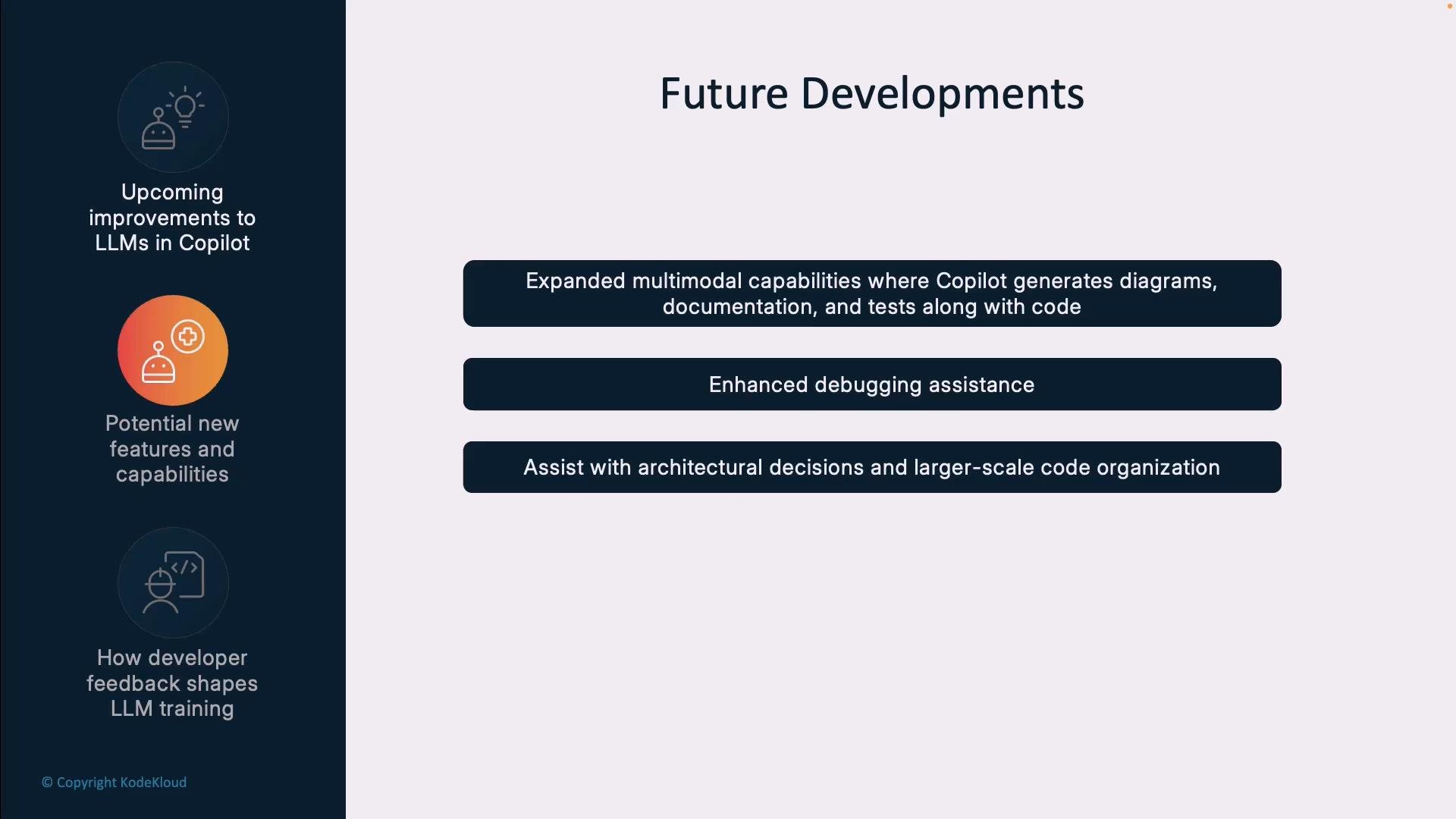
- Expanded multimodal capabilities (diagrams, documentation, tests alongside code).
- Stronger debugging assistance and higher-level architectural guidance for large codebases.
Feedback and model improvement
Developer feedback is a core part of model refinement. Copilot collects signals about accepted, modified, and rejected suggestions; combined with human feedback (for example, RLHF), these signals help prioritize improvements and make future suggestions more relevant.Your interactions with Copilot (accepting, editing, or rejecting suggestions) directly inform model refinement and help improve future suggestions.
Summary
LLMs are the foundation of GitHub Copilot: large-scale code and text training, combined with project-aware context and ongoing feedback, enable contextually relevant code suggestions. Copilot’s multi-model strategy, growing vendor integrations, and roadmap toward larger context windows and multimodal assistance aim to further improve developer productivity, shorten learning curves, and extend assistance from completion to debugging and design guidance.Links and references
- GitHub Copilot: https://github.com/features/copilot
- GitHub Copilot docs: https://docs.github.com/en/copilot
- OpenAI: https://openai.com
- Anthropic: https://www.anthropic.com
- Google Gemini: https://cloud.google.com/gemini