

Real-world example: the Bookinfo application
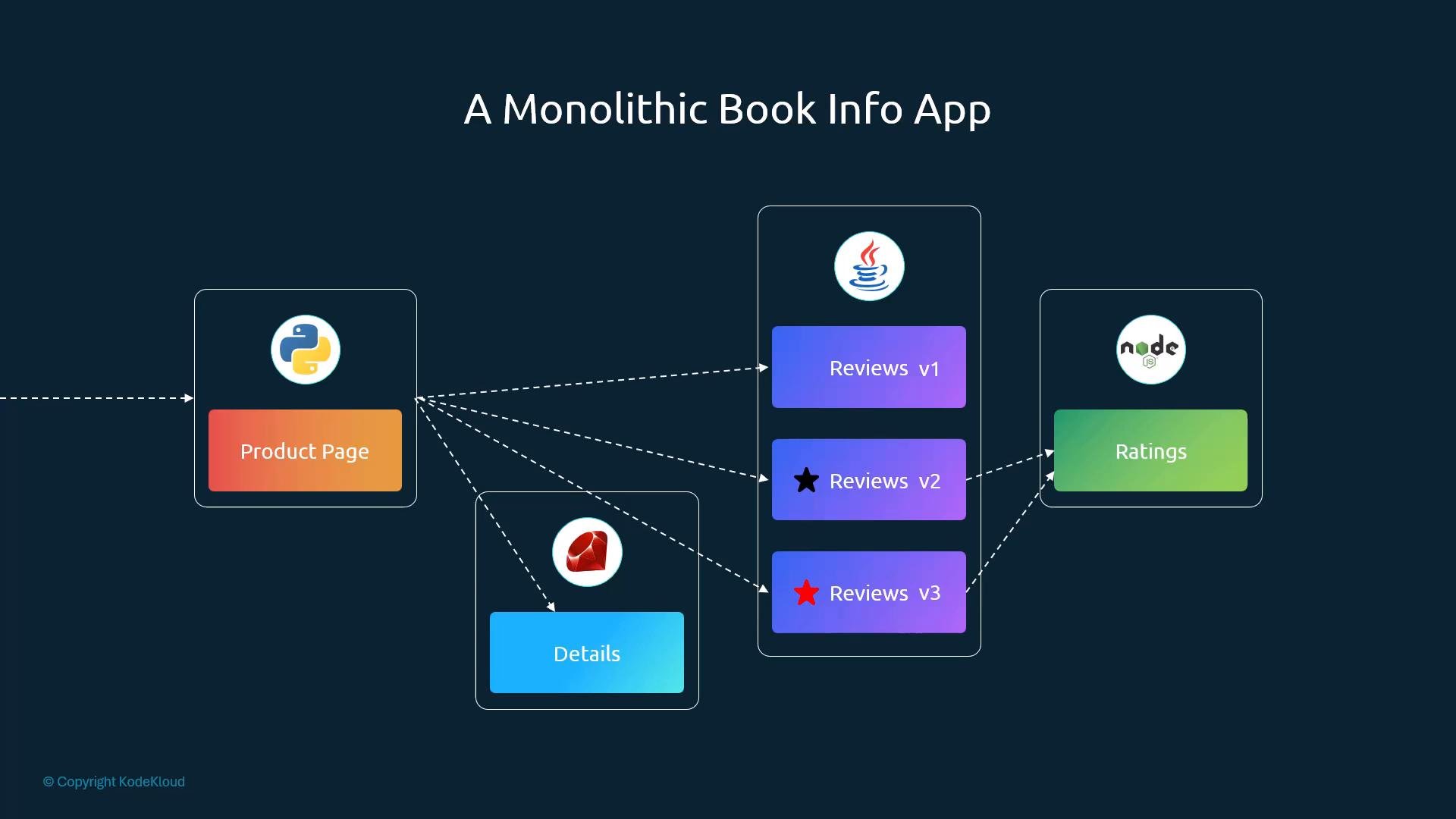
Throughout this article we use the Bookinfo example to illustrate the trade-offs. In its monolithic form, Bookinfo contains four modules bundled together:- details
- reviews
- ratings
- product page
User flow and coupling in the monolith
- A customer loads the product page.
- The product page retrieves book details and reviews from the appropriate modules.
- The reviews module queries the ratings module for rating counts.
From monolith to microservices
Refactoring a monolith into microservices is neither trivial nor instantaneous. It requires cultural, organizational, and technical change and opens the door to cloud-native patterns. In a microservices design for Bookinfo, each module becomes an independently deployable service owned by a team and implemented with technologies that match the team’s needs. For example:- Product page → Python
- Details → Ruby
- Reviews → Java (multiple versions)
- Ratings → Node.js
- v1 (no stars)
- v2 (black stars)
- v3 (red stars)
Benefits of microservices
Moving to microservices delivers measurable advantages:- Independent scaling: scale the ratings service without affecting others.
- Independent deployments: teams deploy individual services without coordinating full-system releases, reducing risk and cycle time.
- Polyglot stacks: teams choose languages and frameworks that suit their domain.
- Fault isolation: failures in one service are less likely to take down unrelated services.
- Faster fixes and rollbacks: smaller focused releases with clear ownership improve operational agility.
Cross-cutting concerns and the problem of “fat” microservices
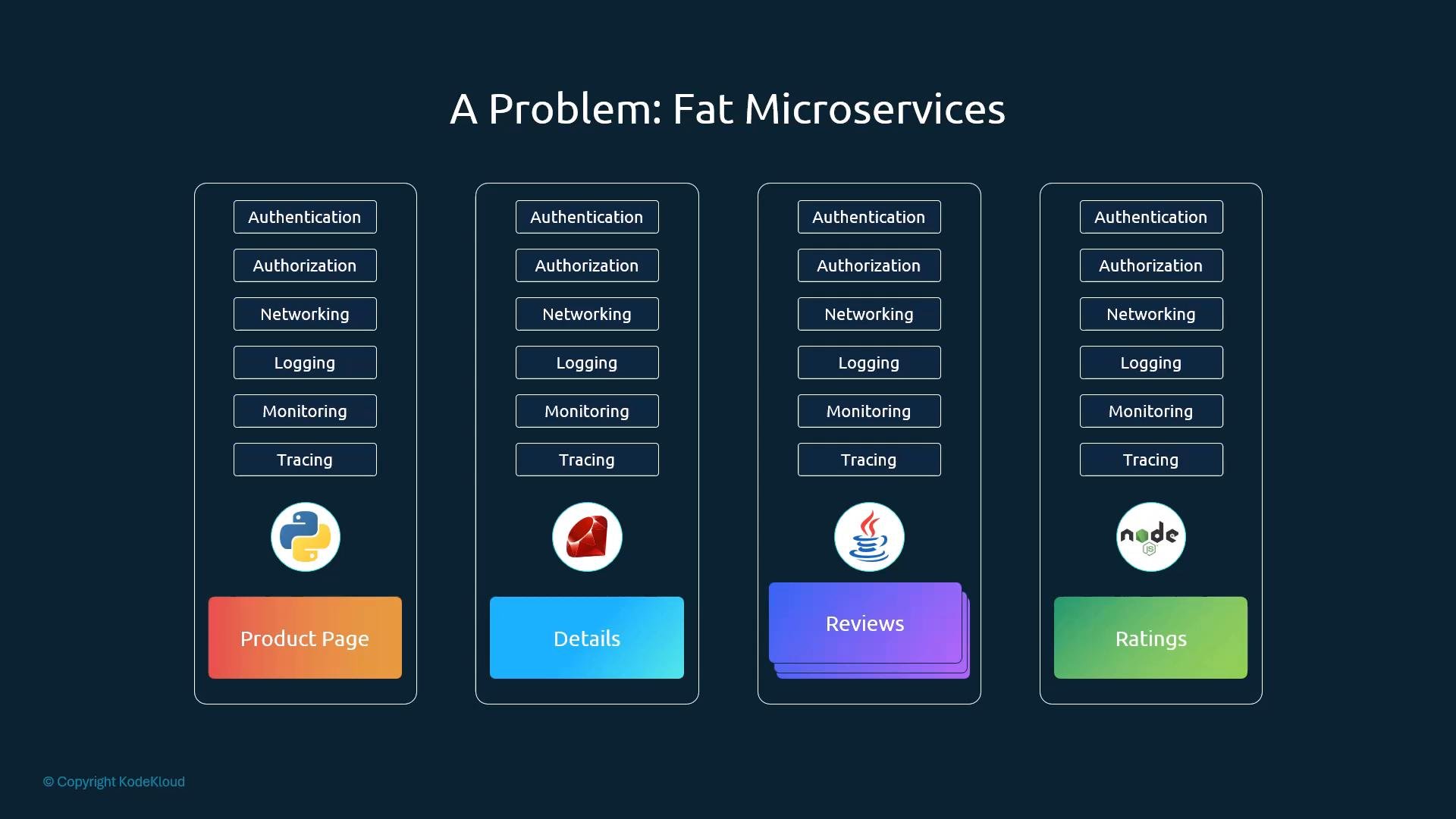
A naive lift-and-shift to many small services can recreate the original problem: if each service re-implements networking, authentication, authorization, service discovery, logging, monitoring, tracing, and data-transfer logic, then services become “fat” again. When cross-cutting concerns are duplicated across services:- Teams repeatedly solve identical operational problems in different ways.
- Upgrading agents, certificates, or monitoring configurations becomes a coordination headache.
- Developers must learn infrastructure and policy details unrelated to their business logic.
- The intended agility of microservices is diluted by duplicated non-functional code.
Additional operational challenges
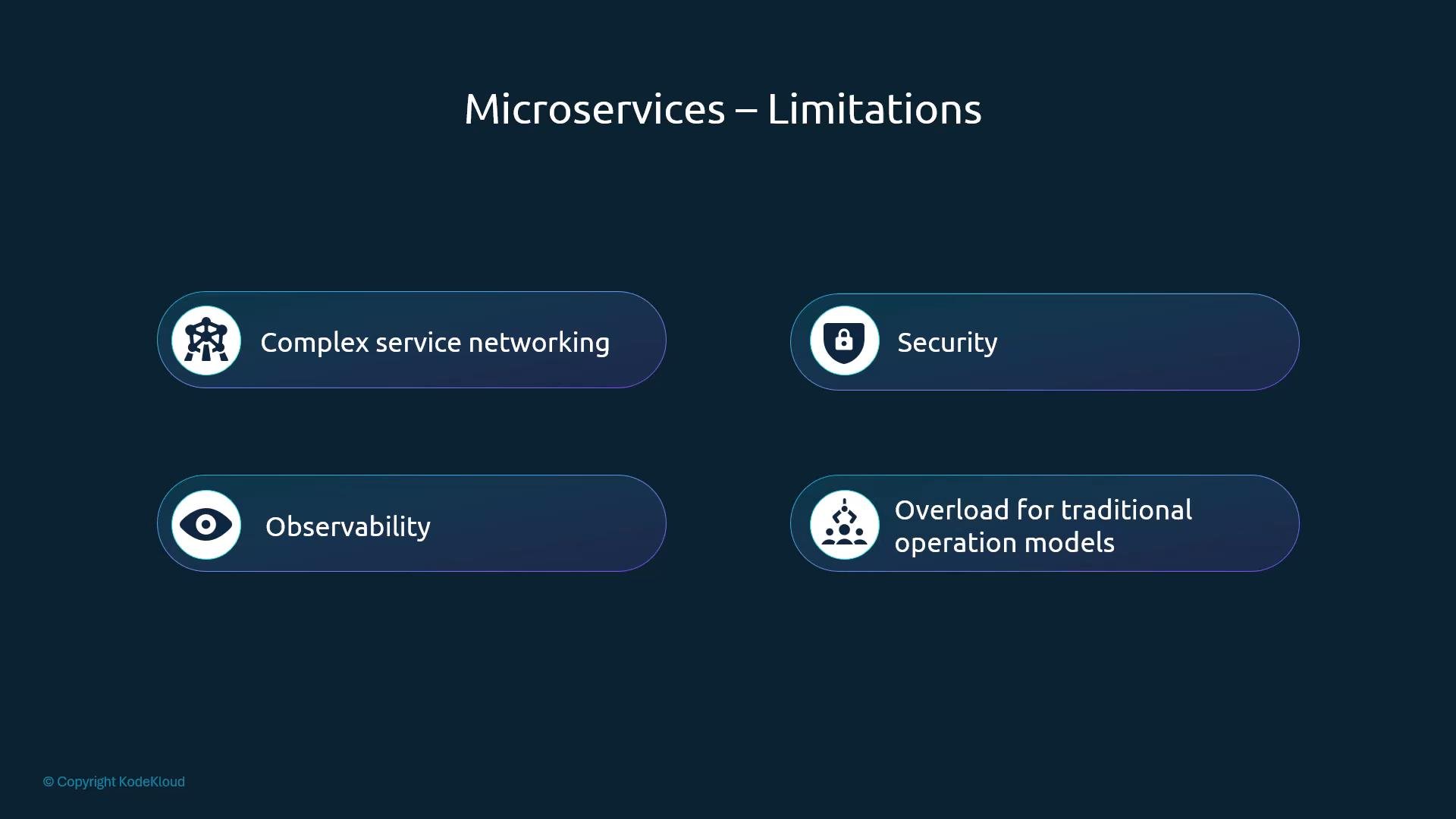
Distributed microservices introduce additional complexity beyond duplicated cross-cutting code:- Service discovery and routing: determining which service version to call and how to split traffic for experiments.
- Networking complexity: service-to-service communication needs timeouts, retries, circuit breakers, and routing policies.
- Security: securing communication end-to-end and enforcing consistent authentication and authorization across services.
- Observability: tracing requests across services requires consistent logging, metrics, and distributed tracing to pinpoint failures.
- Operational overhead: heterogeneous tech stacks and many deployable units increase the burden on traditional ops models.
Comparing architectures
A cultural shift: DevOps and shared responsibility
To succeed with microservices, teams commonly adopt DevOps practices—development and operations collaborate and share responsibility for deploying, monitoring, and operating services. Key practices include:- Automation (CI/CD)
- Standardized tooling and runtime contracts
- Platform teams that encapsulate infrastructure concerns
- Observability as a built-in concern
- Security and policy enforcement at the platform level
Refactoring a monolith into microservices is not only a code change—it requires organizational alignment, automation, and a platform that addresses cross-cutting concerns so teams can remain focused on core business logic.
Next steps
This article will continue by examining how service meshes and platform patterns can centralize or offload cross-cutting concerns—like traffic management, security, and observability—so that microservices remain small, focused, and operable.References and further reading
- Kubernetes Documentation
- Introduction to service mesh concepts (search for “service mesh overview”)
- Microservices architecture patterns and anti-patterns (search for “microservices best practices”)