What is a service mesh? A service mesh is a configurable infrastructure layer that centralizes networking features for microservices, so you don’t have to embed networking logic inside each service. It abstracts and externalizes cross-cutting networking concerns—security, routing, resilience, and observability—so application teams can focus on business logic. At a high level, a service mesh uses a lightweight proxy deployed alongside each application instance (a sidecar container). These sidecar proxies handle all inbound and outbound traffic for the service instances; collectively they form the data plane. A separate control plane configures and coordinates those proxies, applying policies for routing, security, and telemetry. The control plane manages configuration and policies for the proxies, controlling traffic routing, security rules, and observability settings. Moving these concerns out of application code centralizes policy, improves consistency, and simplifies secure, observable communication between services.
A presentation slide titled "Service Mesh — A Glance" showing a quoted definition that describes a service mesh as a configurable infrastructure layer handling communication between microservices without changing their code. The quote is displayed in a stylized speech-bubble box on a dark background.
Key capabilities and common use cases With a service mesh you can dynamically configure how services communicate. Typical capabilities include:
  • Traffic management: advanced routing, A/B testing, canary releases, retries, timeouts, and circuit breaking to improve reliability and control rollout behavior.
  • Security: automatic mutual TLS (mTLS) for workload-to-workload encryption, identity-based authentication and authorization, and certificate rotation.
  • Observability: distributed tracing, metrics, and centralized logging to visualize request flows, latency, and error rates across services.
  • Service discovery and health checking: track available instances, route only to healthy pods, and perform intelligent failover when instances are degraded.
  • Load balancing: distribute requests across healthy instances, use locality-aware balancing, and remove failing instances from rotation.
How these responsibilities translate into benefits: Mutual TLS ensures encrypted communication and strong identity between workloads. Observability features let you trace requests across services to pinpoint performance issues or failures. Service discovery and health checks allow the mesh to route traffic only to healthy endpoints and to avoid ones that are failing.
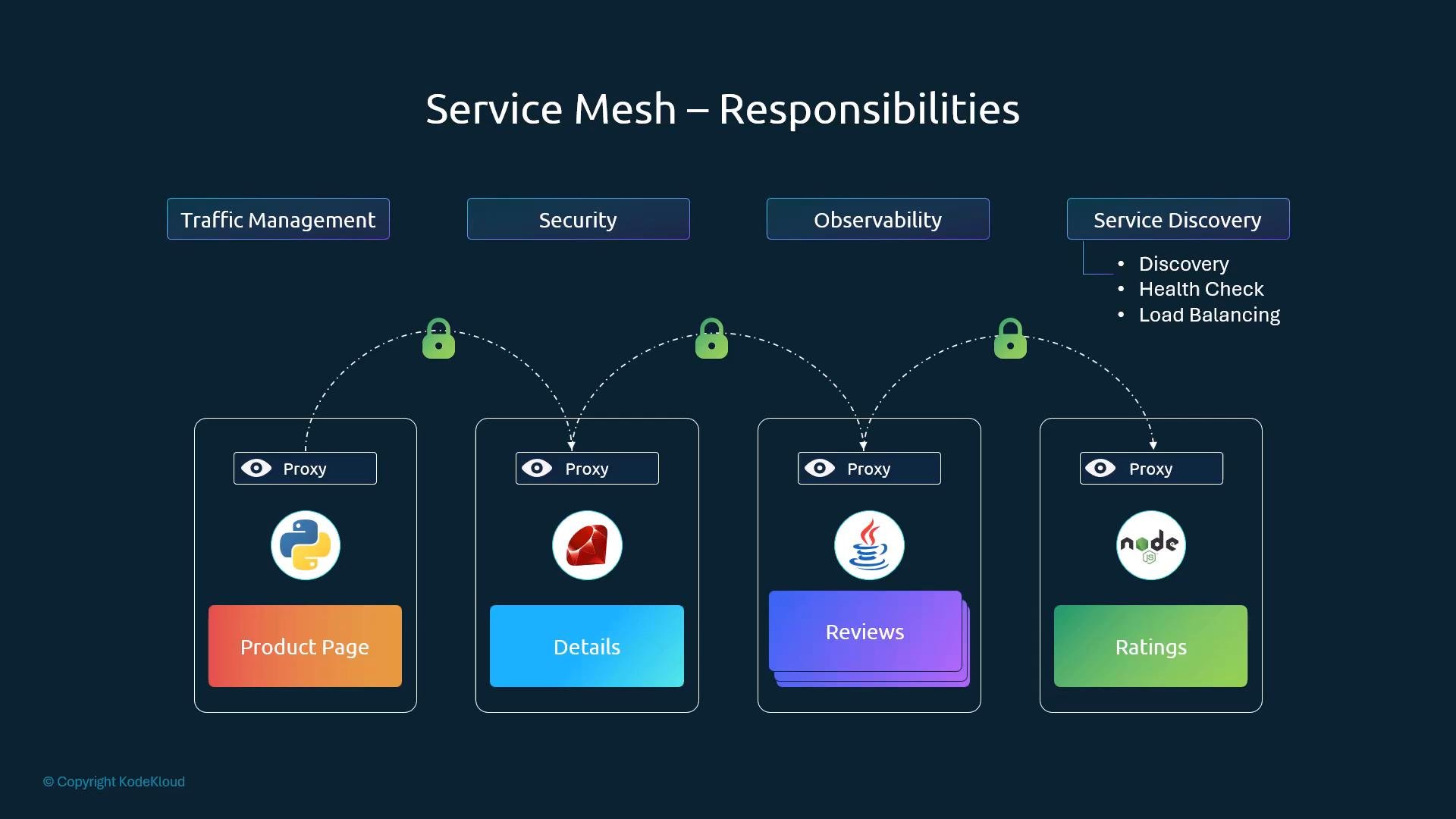
An infographic titled "Service Mesh — Responsibilities" showing traffic management, security, observability, and service discovery applied across four microservices (Product Page, Details, Reviews, Ratings) with sidecar proxy boxes and padlock-secured connections. Each service includes language logos (Python, Ruby, Java, Node.js) and a note about discovery, health checks, and load balancing.
Service mesh responsibilities typically include traffic management, security (mTLS and access control), observability (tracing/metrics), service discovery, health checks, and load balancing — all handled outside of your business logic.
Data plane vs Control plane — how they interact
  • Data plane: Composed of the sidecar proxies that run next to each application instance. These proxies intercept and enforce routing, security, and telemetry for application traffic. Because the proxy is transparent to the application, teams can enable features without changing application code.
  • Control plane: Provides centralized configuration, policy distribution, certificate management, and orchestration for the proxies. The control plane translates high-level intents (routing rules, access policies) into per-proxy configuration, and pushes it to the data plane.
Common deployment patterns and projects
  • Istio: full-featured control plane with a powerful policy model and extensive integrations.
  • Linkerd: lightweight, performance-focused service mesh with a small operational footprint.
  • Consul (HashiCorp): service mesh and service discovery combined, with multi-platform support.
These projects implement the same basic pattern—sidecar proxies for the data plane and a control plane to manage them—but differ in operational complexity, feature set, and performance trade-offs. Further reading and references If you want practical examples (installation, policy configuration, and tracing integration), start with the official guides for Istio or Linkerd. They provide step‑by‑step tutorials for adding a mesh to an existing Kubernetes cluster and for enabling mTLS, tracing (Jaeger/Zipkin), and metrics (Prometheus).

Watch Video