Practical guide to tmux covering sessions, windows, panes, copy paste, key bindings, and basic configuration for terminal multiplexing.
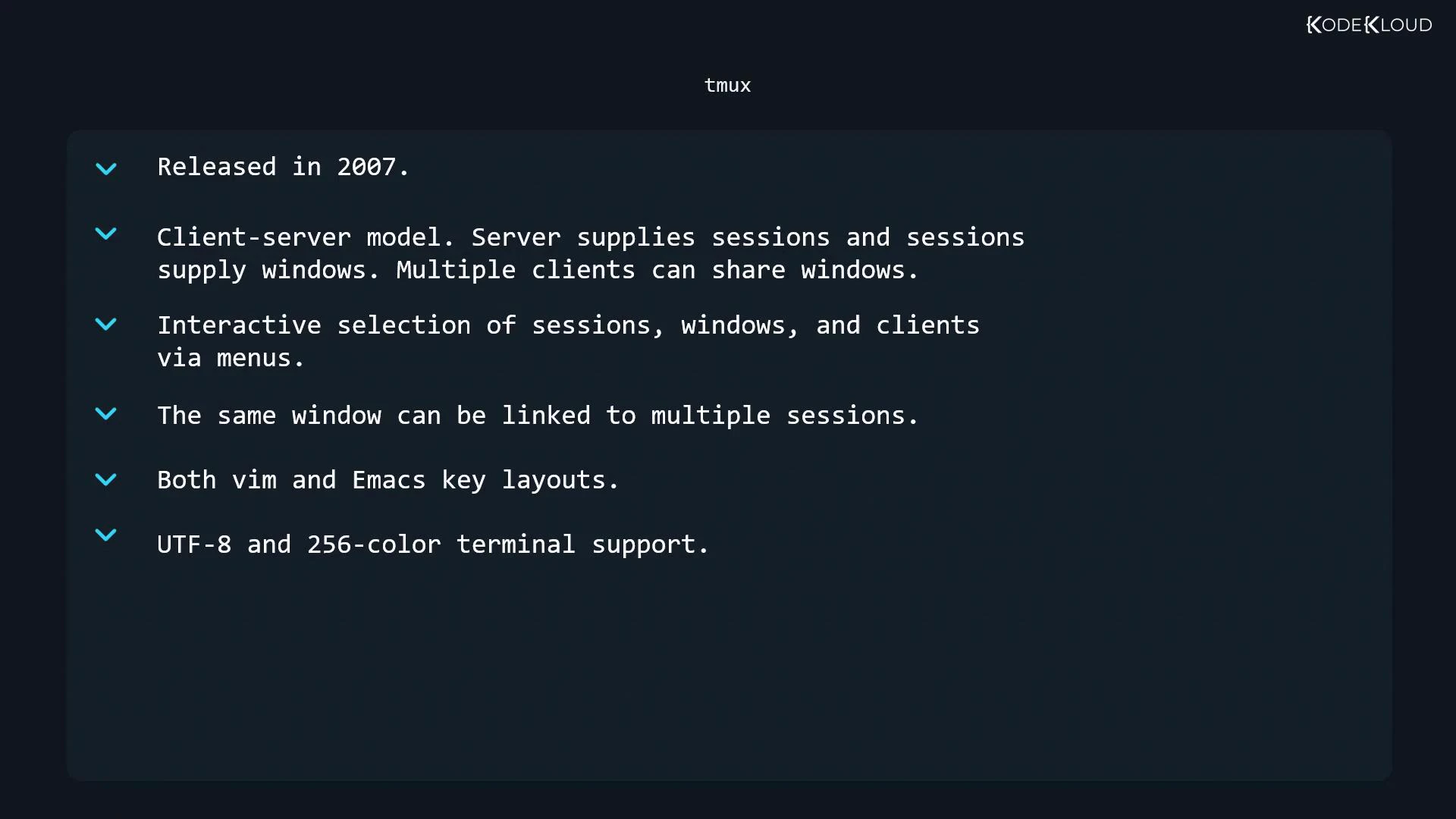
This lesson covers tmux fundamentals: what tmux is, how to start it, and how to work with sessions, windows, panes, copy/paste, and basic configuration.tmux (first released in 2007) is a modern terminal multiplexer similar to GNU Screen but with several enhancements:
Client–server model: a single server manages multiple sessions; each session contains windows, and windows can be shared between clients.
Interactive menus for selecting sessions, windows, and clients.
The same window can be linked to multiple sessions.
Supports both Vim and GNU Emacs key layouts.
Full UTF-8 and 256-color terminal support.
Getting started
Start tmux from your shell:
$ tmux
This opens a shell inside tmux and shows a status bar along the bottom of the terminal. The default command prefix (leader key) is Ctrl+b (referred to below as “prefix”).Status bar contents
Session name
Window index (tmux counts windows from 0)
Window name (by default tmux shows the running program name and updates it automatically)
An asterisk (*) indicates the currently visible window
Host name, time, date, etc.
Example: start tmux and create a named session and window
# Start tmux (interactive)$ tmux# Start tmux with a named session and named window (from shell)$ tmux new -s "LPI" -n "Window zero"# tmux status line (illustrative)# [LPI] 0:Window zero* "debian" 19:01# 27-Aug-19
WindowsWindows are top-level workspaces inside a session. Each window can contain multiple panes.Common window operations
Action
Keys / Command
New window
prefix + c (Ctrl+b then c)
Rename current window
prefix + , (Ctrl+b then ,), type name, Enter
List windows (chooser)
prefix + w (Ctrl+b then w) — navigate with arrows, Enter to select
Panes (splitting windows)Panes are subdivisions of a window; each pane is a full pseudo-terminal.Basic pane operations
Action
Keys
Split horizontally
prefix + ” (Ctrl+b then “)
Split vertically
prefix + %
Kill current pane
prefix + x (confirmation asked)
Move between panes
prefix + Arrow keys
Last active pane
prefix + ;
Resize by 1 line
prefix + Ctrl + Arrow
Resize by 5 lines
prefix + Alt + Arrow
Swap with previous pane
prefix + {
Swap with next pane
prefix + }
Toggle zoom for a pane
prefix + z
Show clock in pane
prefix + t (quit with q)
Convert pane to its own window
prefix + !
Quick reference (text)
Split horizontally: Ctrl + b, "Split vertically: Ctrl + b, %Kill pane: Ctrl + b, xMove pane focus: Ctrl + b, ARROWLast active pane: Ctrl + b, ;Resize by 1 line: Ctrl + b, Ctrl + ARROWResize by 5 lines: Ctrl + b, Alt + ARROWSwap with previous: Ctrl + b, {Swap with next: Ctrl + b, }Zoom pane: Ctrl + b, zClock: Ctrl + b, t (quit with q)Pane -> Window: Ctrl + b, !
SessionsA session is a collection of windows. Sessions allow you to organize work and attach/detach clients.Session commands
Action
Command / Keys
List sessions (chooser)
prefix + s (inside tmux), OR from shell: tmux ls
Create a new session (shell)
tmux new -s NAME
Create session (inside tmux)
prefix + : then type new or new -s NAME
Rename session
prefix + $
Attach to session
tmux attach -t NAME (short: tmux a)
Detach from session
prefix + d
Select which client to detach
prefix + D
Kill a session
tmux kill-session -t “SessionName”
Refresh client terminal
prefix + r
Examples
# List sessions$ tmux lsLPI: 2 windows (created Tue Aug 27 19:01:49 2019) [158x39] (attached)# Attach to a session (when only one exists)$ tmux attach# Kill a session from the shell$ tmux kill-session -t "Second Session"
Be careful: killing a pane, window, or session terminates processes running
inside it. Save work before confirming any kill operation.
Copy / paste and scrollbacktmux provides its own copy/scrollback mode that allows selecting text, copying to an internal buffer, and pasting between panes.Steps to copy and paste
Enter copy/scrollback mode: prefix + [
Navigate with arrow keys, PageUp/PageDown, or vi-style keys (if configured).
Start selection with Space.
Move to the end of selection.
Copy selection with Enter (puts it into tmux buffer).
Paste into the current pane with: prefix + ]
Manage buffers from shell
# List tmux buffers$ tmux list-buffers# Show a buffer by index$ tmux show-buffer -b 0# Save a buffer to a file$ tmux save-buffer -b 0 /tmp/tmux-buffer.txt
Configuration
System-wide config: /etc/tmux.conf
Per-user config: ~/.tmux.conf
Start tmux with an alternate config file: tmux -f /path/to/config
Common ~/.tmux.conf examplesChange prefix to Ctrl+a and unbind default Ctrl+b:
That covers the essentials: starting tmux, working with sessions, windows, and panes, using the copy/paste buffer, and adding simple configuration. Use the tables and command summaries above as a quick reference while you practice.