

This course has been updated to align with the SOA-C03 exam. The material includes the changes introduced in C03, so following the course will prepare you for the new objectives.
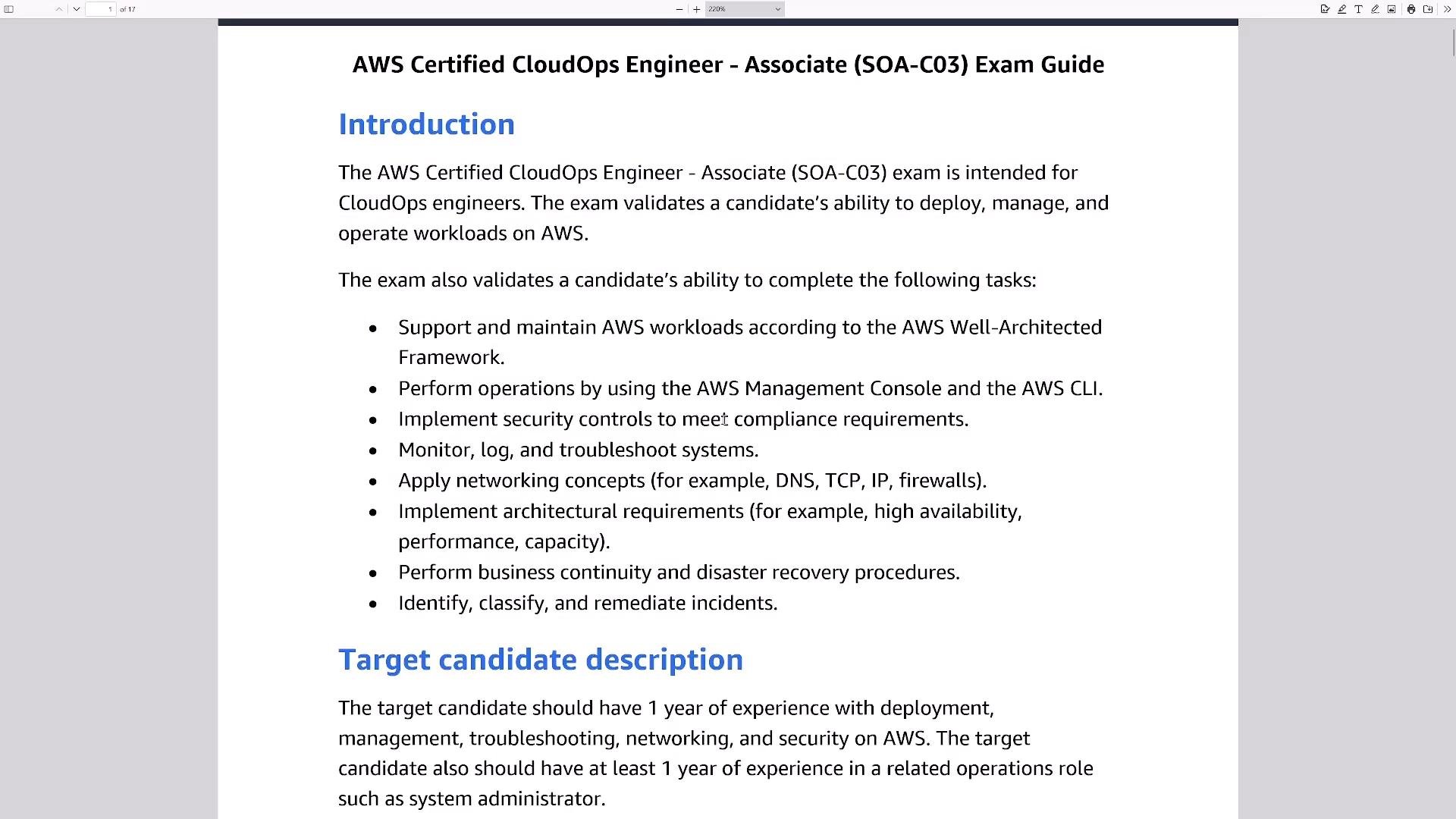
- Monitoring, logging, metric analysis, and incident remediation workflows.
- Operational networking and architecture patterns for availability, performance, and capacity.
- Business continuity, backup, and disaster recovery (DR) procedures.
- Supporting AWS workloads using both the AWS Console and the AWS CLI.
- The guide recommends roughly one year of hands-on AWS deployment experience plus one year in a related operations role.
- Familiarity with the AWS Well‑Architected Framework, the AWS CLI, the console, and infrastructure-as-code (CloudFormation or AWS CDK) is advised.
- General networking and security knowledge (VPCs, ACLs, security groups, IAM) and familiarity with monitoring concepts are expected.
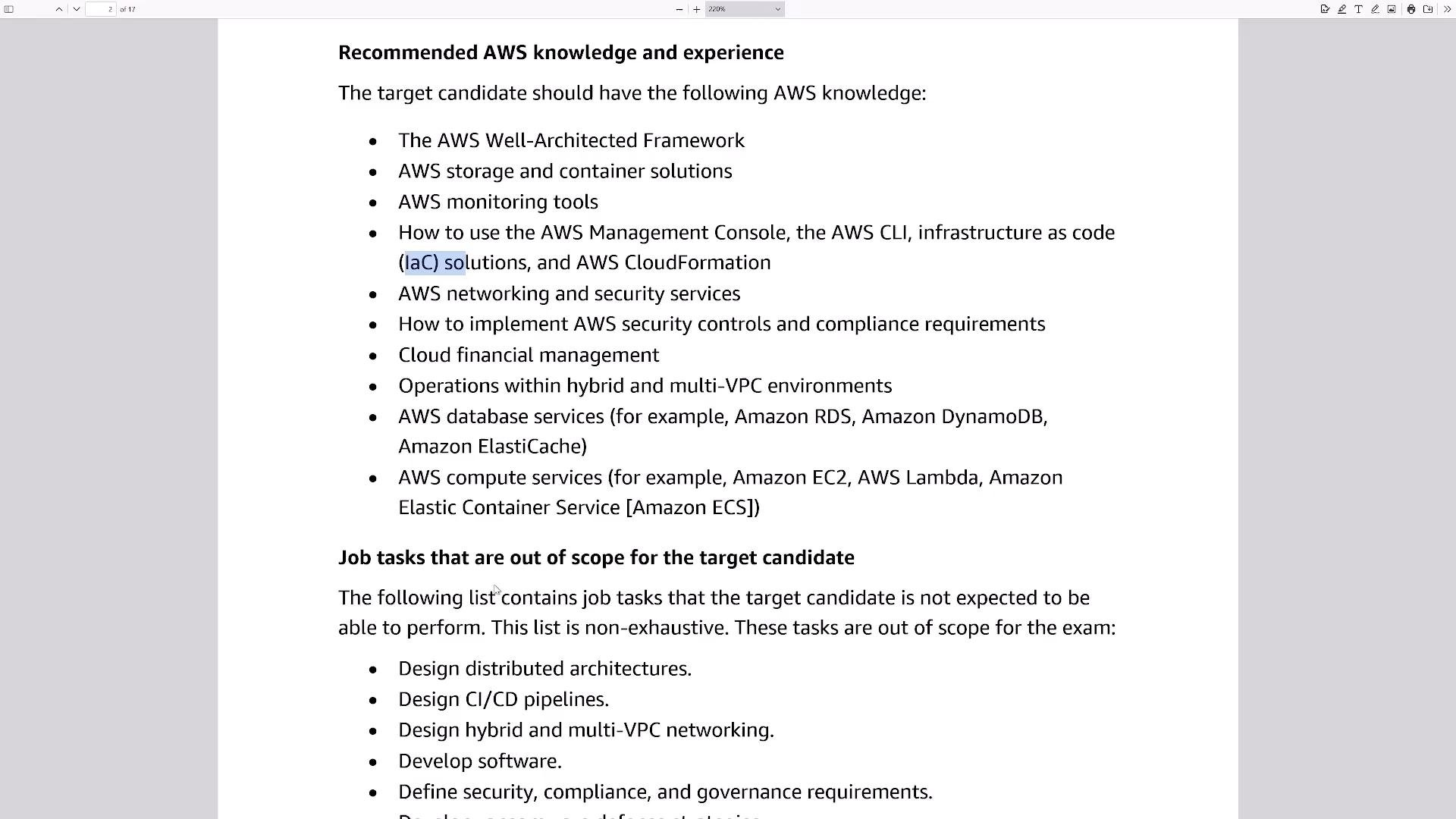
- Deep software development and advanced CI/CD pipeline design.
- Very large-scale distributed architectures and complex hybrid/multi-VPC networking.
- Extensive cost modeling and detailed financial TCO analysis (cost topics have less emphasis in C03).
- Certain advanced security and capacity planning topics beyond operational controls.
You may encounter unfamiliar or oddly phrased questions; some of these can be pretest items. They do not affect your scored result, but treat every question carefully.
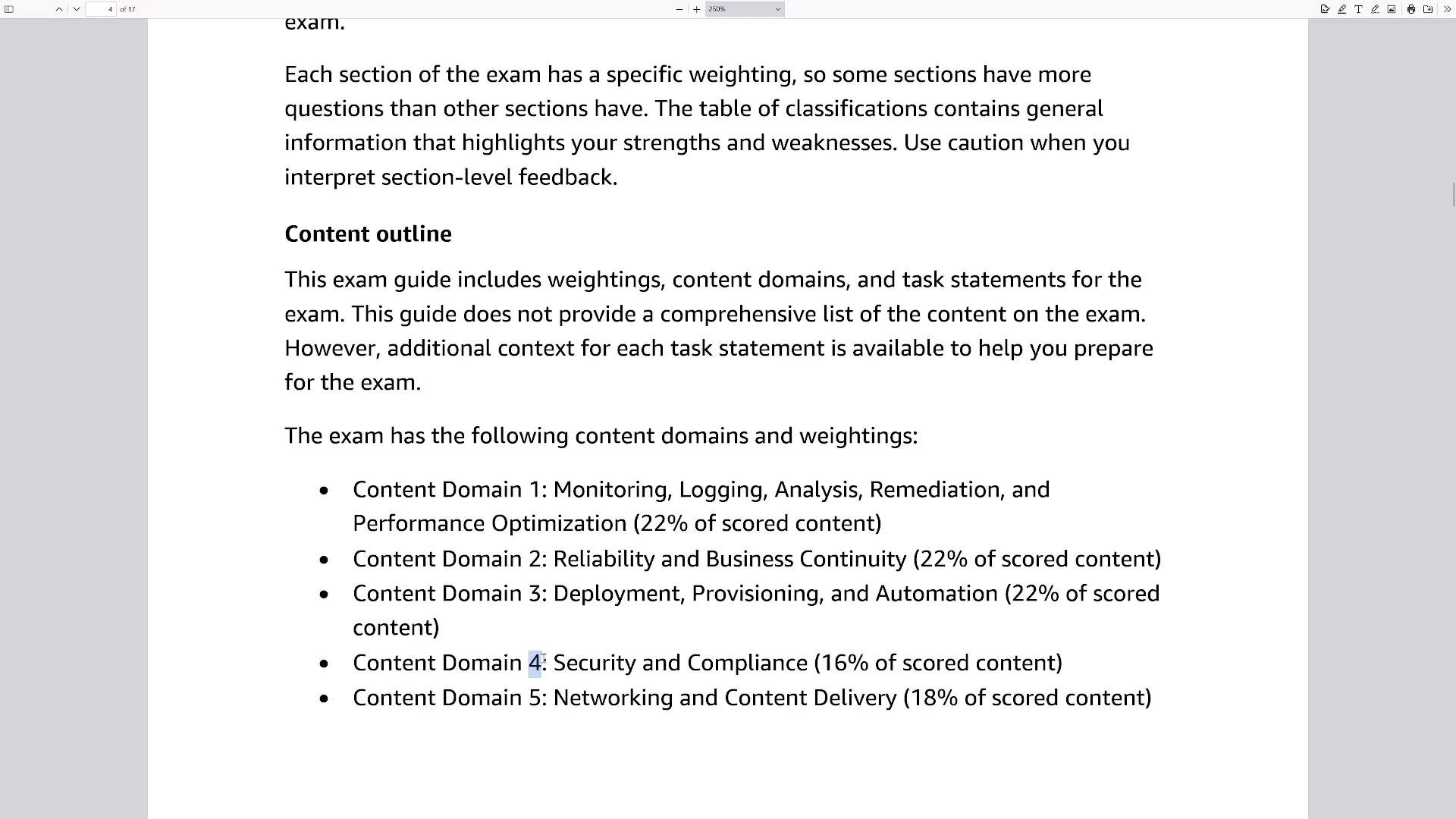
- The six-domain layout was condensed into five domains for C03; content was reorganized and weight shifted.
- The first three domains now carry a larger portion of the exam weight: monitoring, reliability, and deployment-related topics are emphasized.
- Security remains significant; networking/content delivery occupies a smaller share compared to the first three domains.
- Monitoring and observability: CloudWatch metrics, logs, metric filters, dashboards, and alarms.
- Event routing and notifications: EventBridge, SNS, and how they integrate with remediation.
- Troubleshooting and remediation workflows: incident response steps, root-cause analysis, and automation of fixes.
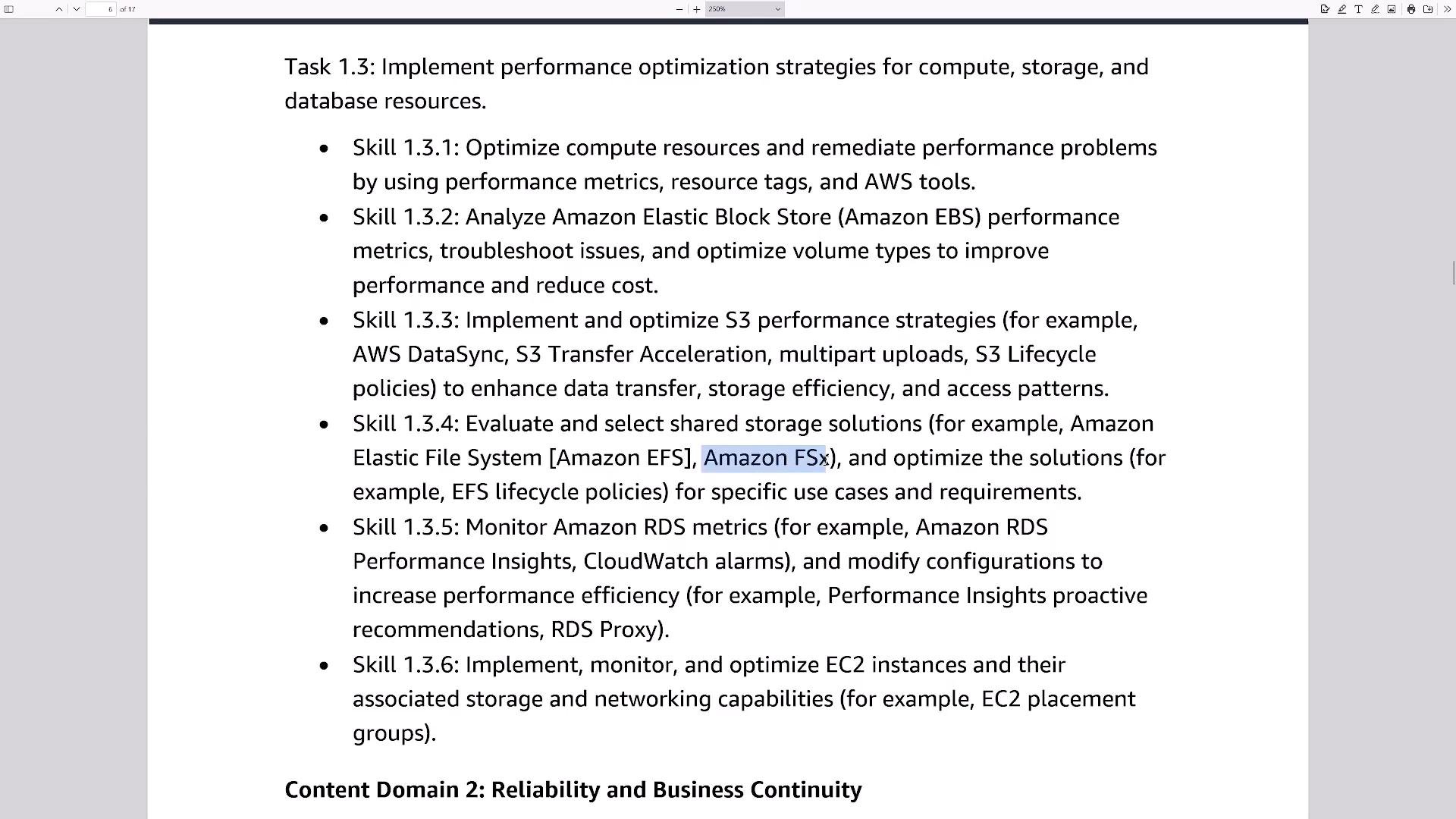
- Performance optimization: compute sizing, storage performance (EBS/EFS/FSx), and database tuning (RDS/Aurora).
- Read the full exam guide and make a checklist of every service and task listed.
- For each in-scope service, practice basic operational tasks in a sandbox account: monitor, back up, restore, and troubleshoot. Hands-on familiarity beats memorization.
- Focus on workflows and operational mechanics rather than deep feature-by-feature knowledge.
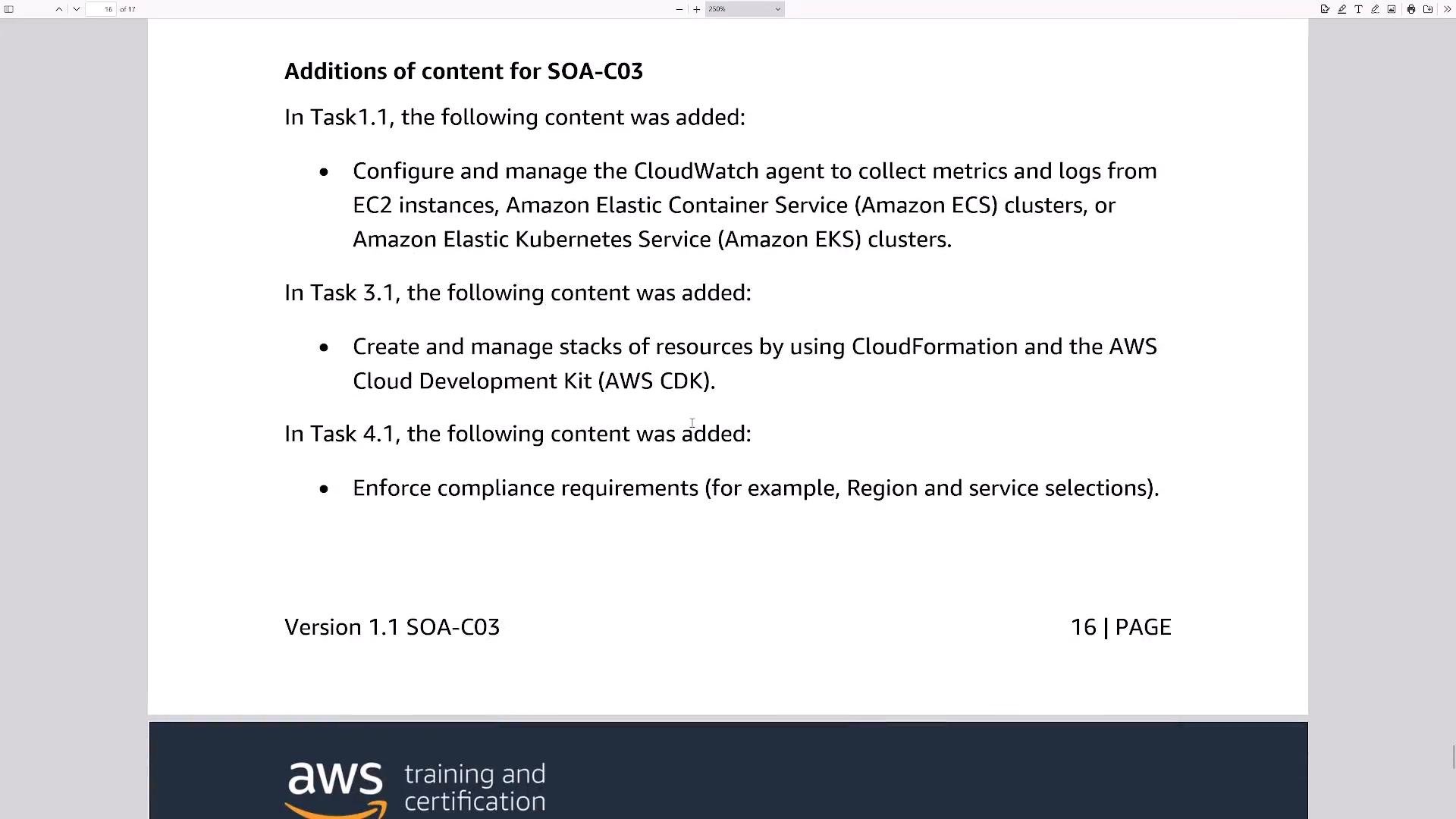
- Learn common agents and tooling: configuring the CloudWatch Agent for EC2/ECS/EKS is now explicitly tested.
- Review CloudFormation and AWS CDK basics for creating and managing stacks (including StackSets).
Changes and additions specific to SOA‑C03
- Explicit new tasks: configuring the CloudWatch Agent for EC2/ECS/EKS and creating/managing stacks via CloudFormation and AWS CDK (StackSets referenced).
- Emphasis on enforcing compliance controls and operational tasks tied to compliance.
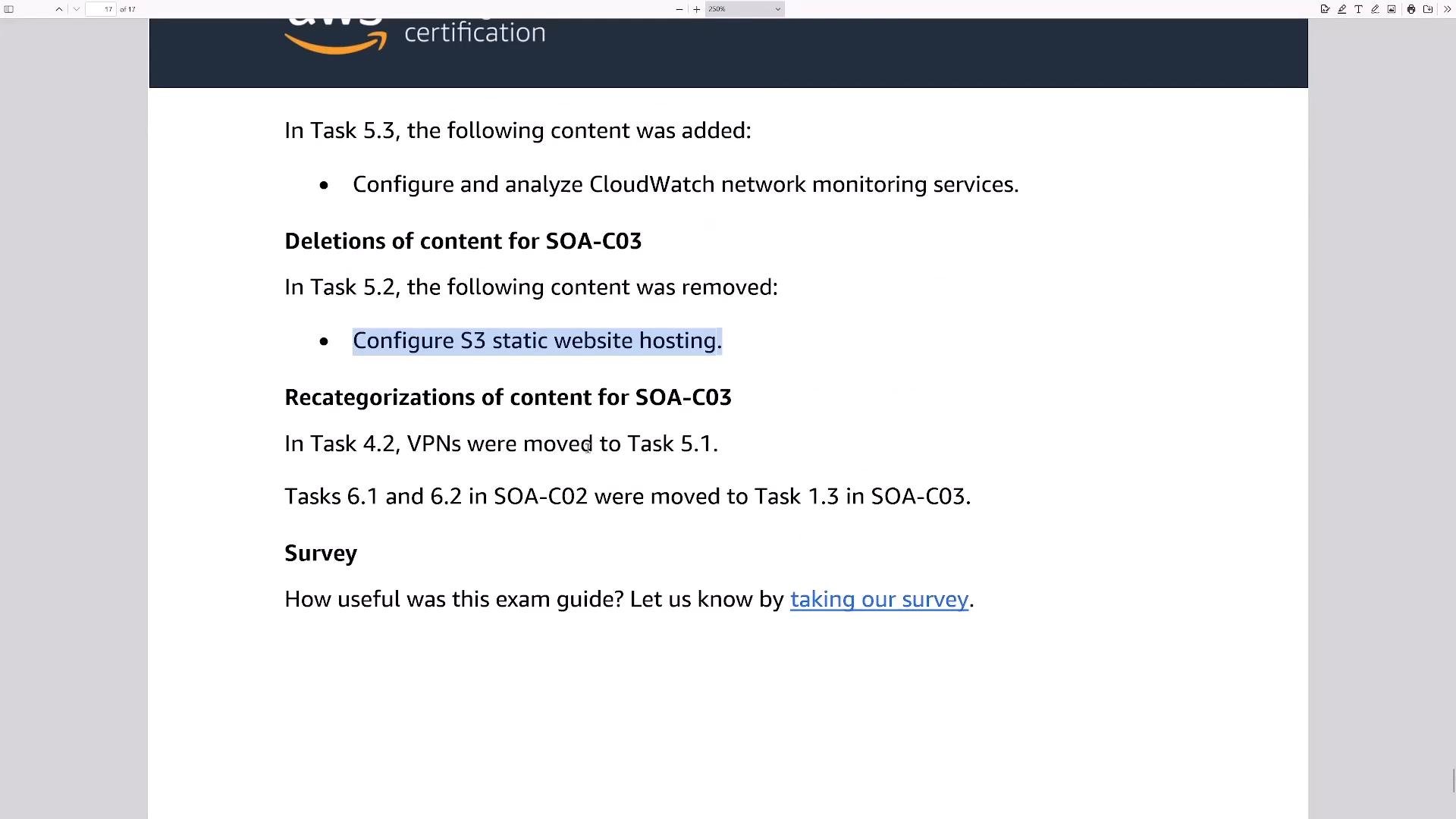
- Some previous items were removed (for example, S3 static website hosting is no longer in scope).
- Cost tools such as Cost Explorer and CUR appear but have reduced emphasis vs earlier exam versions.
- Containers (EKS, ECS, ECR) are in scope for operational tasks; know basic troubleshooting and monitoring patterns.
- Serverless: Aurora Serverless is specifically called out; many other serverless services are not heavily emphasized.
- Most ML services are out of scope, but the guide does not always label items consistently — operational questions could reference an ML service as context.
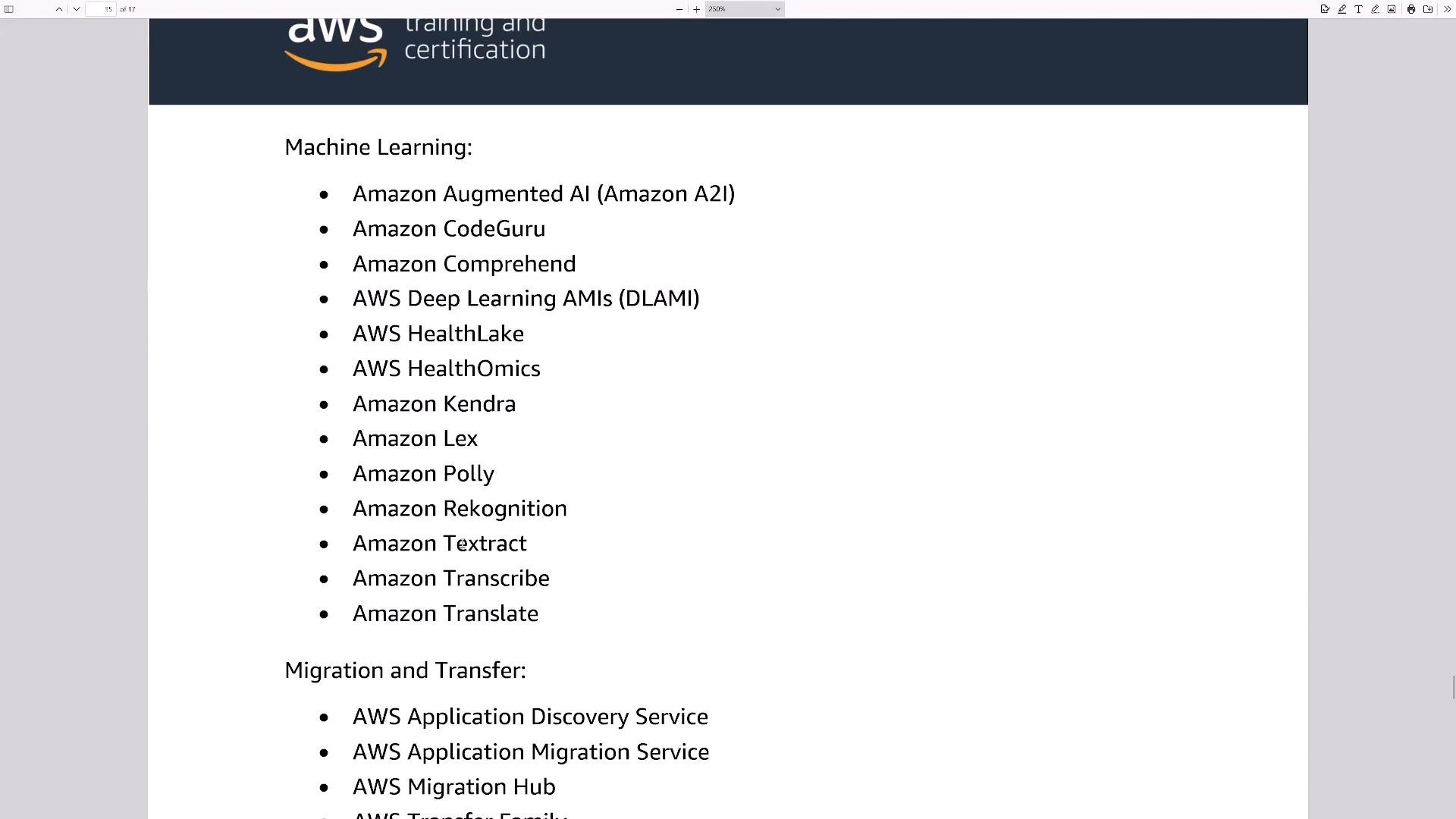
- If a service is not explicitly marked out-of-scope, it could still appear in an operational question as context. When in doubt, focus on operational mechanics (monitoring, backups, scaling, and remediation) rather than domain-specific deep knowledge (for example, ML algorithms).
- The guide includes a table comparing content moved between domains and removed tasks. Key takeaway: performance optimization content was redistributed and domain consolidation increased the weighting of monitoring, reliability, and deployment tasks.
- Read the exam guide end-to-end and create a checklist of every service and task mentioned.
- For each checklist item you don’t know well, perform a short hands-on lab or read the AWS docs to learn operational behaviors (monitoring, backups, restore, troubleshooting).
- Prioritize monitoring, logging, analysis, remediation workflows, and deployment/reliability patterns — these domains have the most weight.
- Practice answering scenarios: identify the problem, list diagnostic steps, and choose the least disruptive remediation.
- Treat every question on exam day seriously — you won’t know which questions are pretest items.