

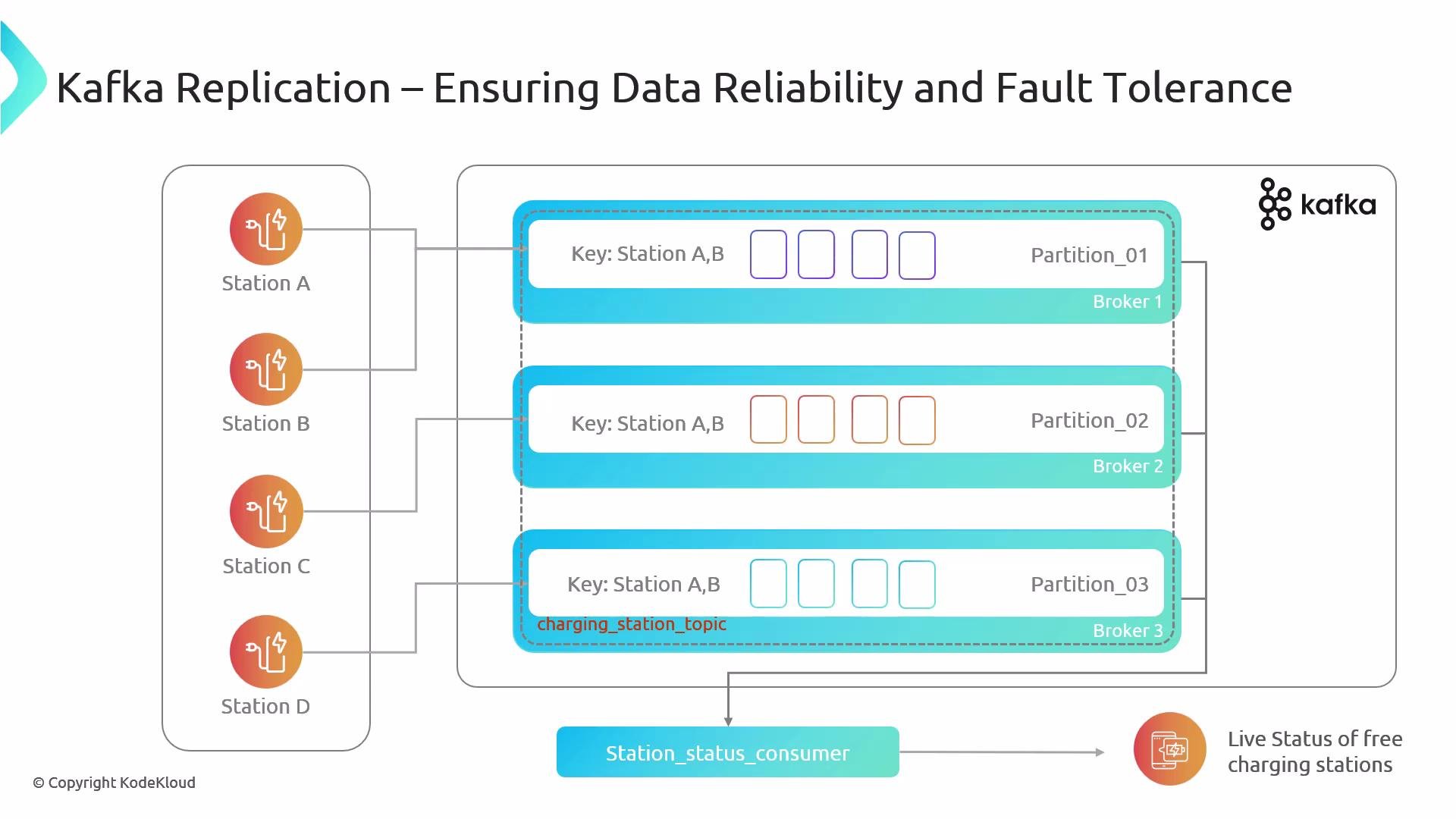
- High availability: If a broker hosting a partition leader fails, another replica can be promoted to leader so producers and consumers can continue operating.
- Fault tolerance and durability: Multiple copies of each partition protect against data loss when brokers crash. Followers continuously replicate the leader’s log so data is preserved.
- Faster recovery: With replicas available, Kafka can quickly elect a new leader for a partition without data loss.
- Operational resilience: Replication factor and in-sync replica (ISR) management let you tune durability vs. availability.
- Read scalability (specific setups): Replication does not increase write throughput (writes hit the leader), but some deployments can serve reads from followers or reassign leaders for load balancing.
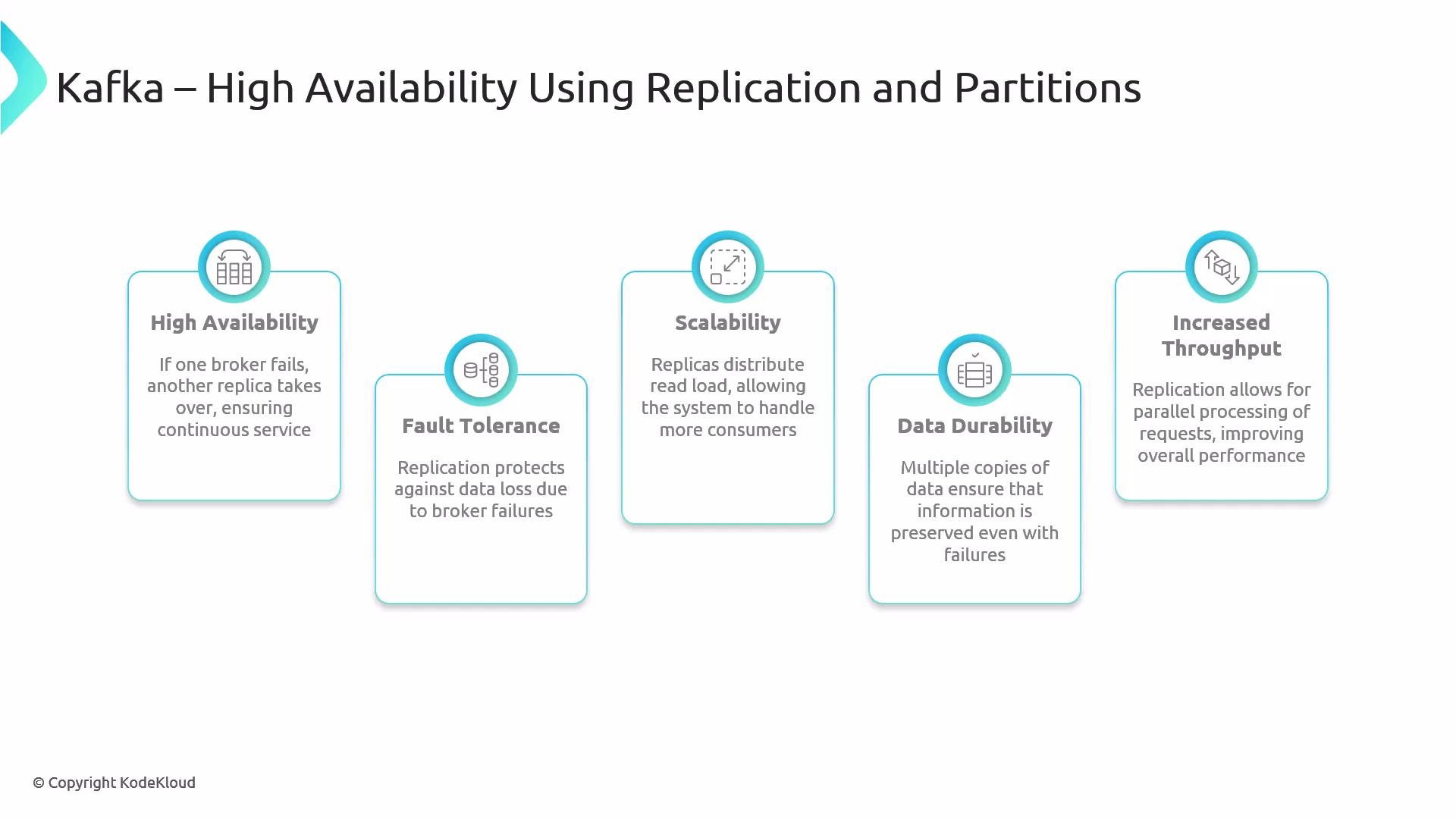
- A producer sends a record for partition 1 to its leader (broker 1).
- The leader appends the record to its local log.
- Followers (broker 2 and broker 3) replicate the leader’s log segments.
- If broker 3 (a follower) goes down, the cluster loses one replica but still has leader + another follower. Producers and consumers continue normally; the controller can later replicate data to restore the desired replica count.
- If broker 1 (the leader for partition 1) fails, Kafka elects a new leader from the in-sync replicas (for example, broker 2) so producers and consumers resume interaction with the new leader. Leader election is automatic (subject to cluster configuration), minimizing downtime.
In Kafka, each partition has one leader and one or more follower replicas. Producers and consumers interact with the leader. Followers replicate the leader’s log and can be promoted to leader if the current leader fails. The replication factor controls how many copies of each partition exist.
- Replication factor: Set to at least 2; 3 is typical to withstand one broker plus maintenance operations. Higher values increase durability but use more storage.
- ISR (in-sync replica) management: Only replicas sufficiently up-to-date are eligible for leader election. Monitor ISR sizes and set appropriate
min.insync.replicasif you need stronger durability guarantees. - Producer acknowledgements:
acks=0: Very low latency, no durability guarantee.acks=1: Leader acknowledged; risk if leader fails before replication.acks=all: Waits for all in-sync replicas — strongest durability, higher latency.
- Monitoring: Track replica lag, ISR changes, and controller health to detect and mitigate replication issues early.
- Rebalancing & reassignment: Use automated tools or
kafka-reassign-partitions.shto restore replication factor after failures or to rebalance replicas across brokers.
- Partitioning provides parallelism and distributes data across brokers.
- Replication keeps copies of partitions across brokers for durability, fault tolerance, and high availability.
- Together, partitioning and replication make Kafka resilient and suitable for production-grade event streaming.
- Apache Kafka Documentation — Replication: https://kafka.apache.org/documentation/#replication
- Kafka Producer Configuration — acks: https://kafka.apache.org/documentation/#producerconfigs_acks
- Kafka Topic Management — kafka-topics CLI: https://kafka.apache.org/documentation/#basic_ops