

- Schema enforcement
- Dead Letter Queue (DLQ)
- Controlled retries
- Message filtering / transformation
1. Schema enforcement
Enforce a strict schema at the producer boundary so events conform to a predefined contract. Use a Schema Registry with Avro, Protobuf, or JSON Schema to centrally manage schemas and compatibility rules.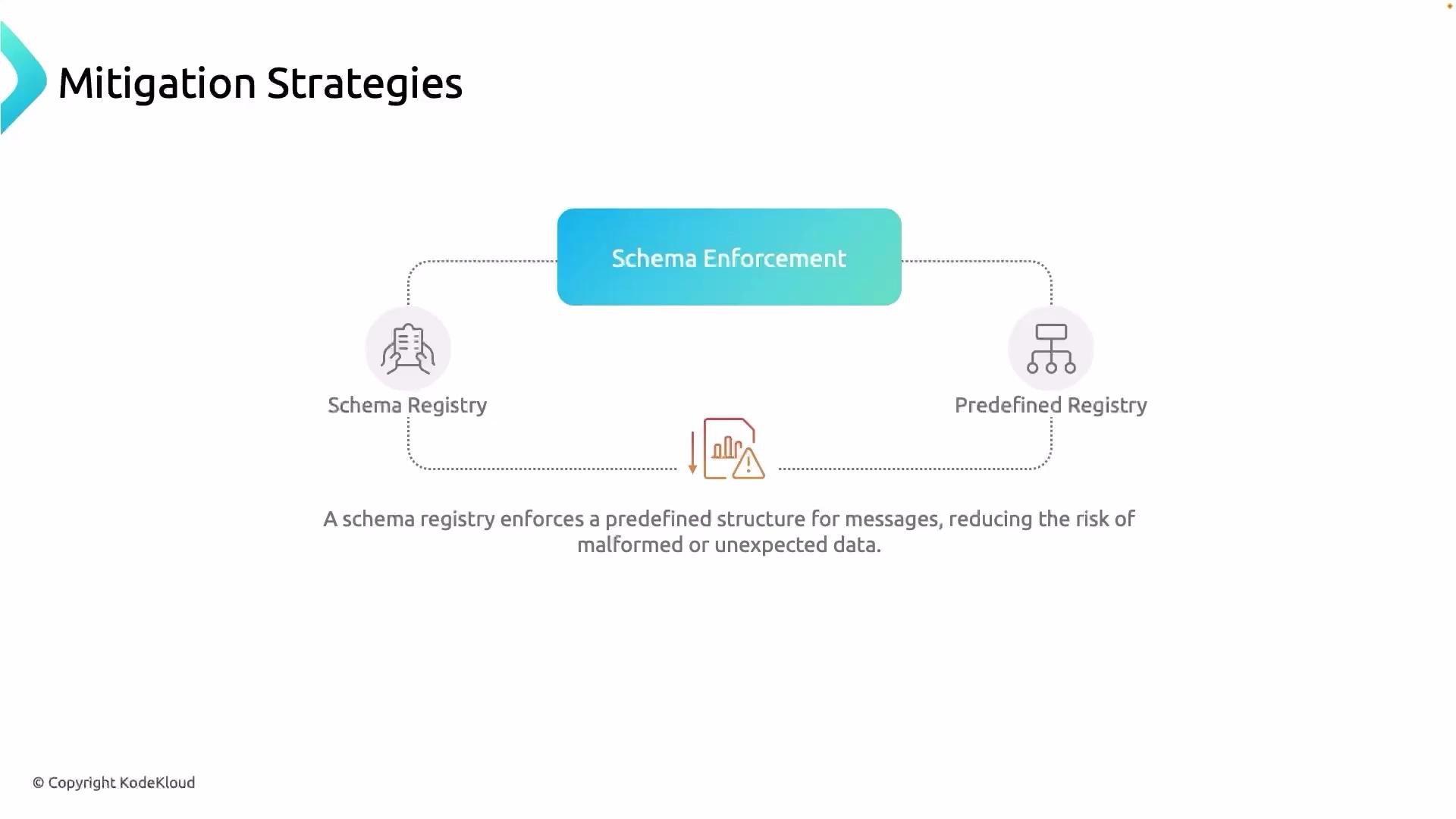
- Producers register or reference schemas with the Schema Registry when they serialize events.
- Consumers read a schema identifier embedded in the message to deserialize correctly; caching schemas avoids constant registry calls.
- The Schema Registry enforces compatibility rules (backward, forward, full, or none) to allow safe schema evolution.
- Benefits: catches structural issues early at the producer, provides a clear contract for consumers, and avoids many classes of poison pills.
- Limitations: does not prevent all runtime errors (e.g., invalid values inside valid fields) and requires governance for schema evolution.
2. Dead Letter Queue (DLQ)
When an event cannot be processed safely—even if it conforms to schema—route it to a Dead Letter Queue (a dedicated Kafka topic) for later inspection, remediation, or replay.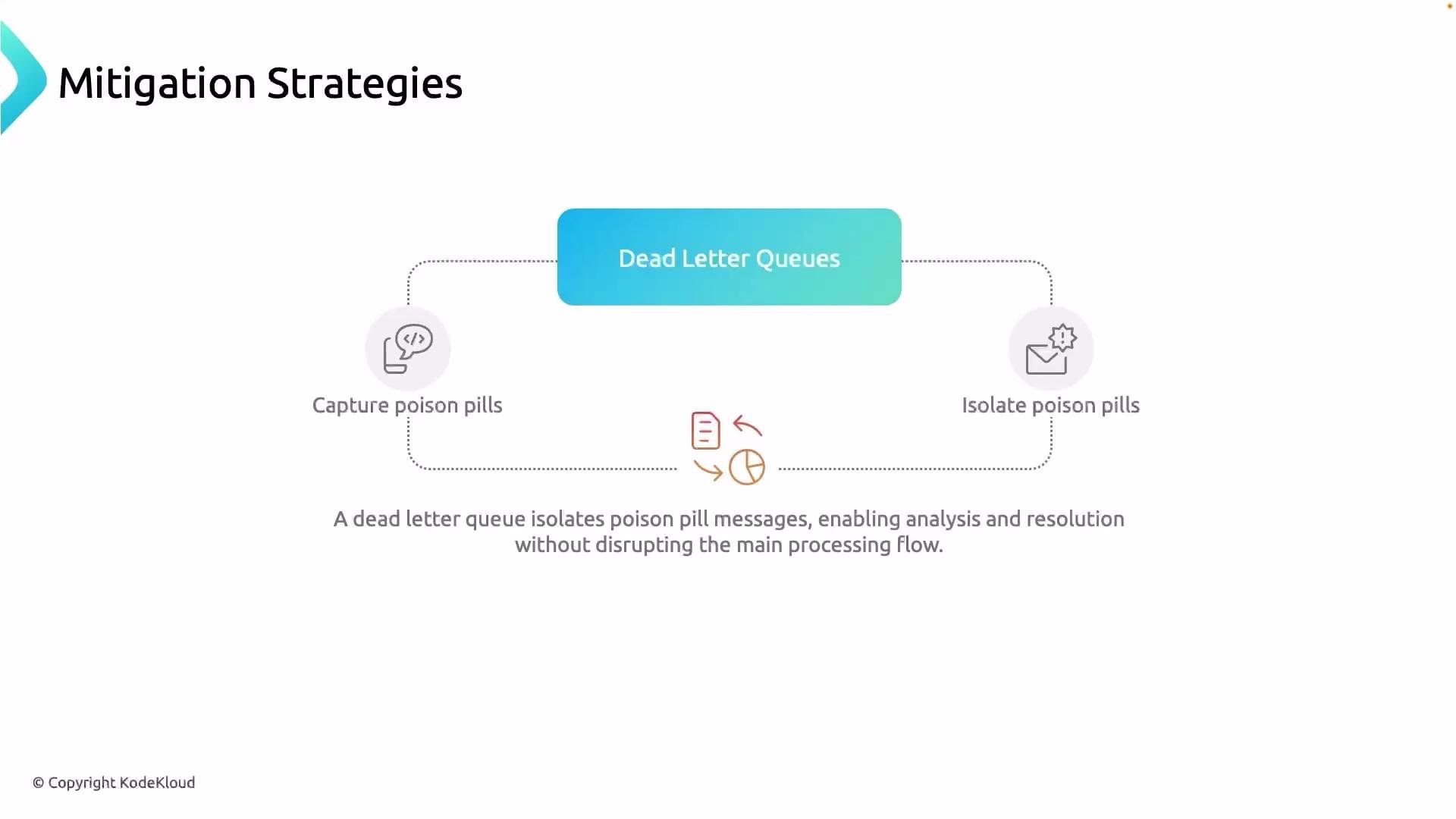
- Include structured metadata with each DLQ message to make triage efficient. Example metadata payload:
- Limit retention or archive DLQ topics to object storage to control storage costs.
- Monitor and alert on DLQ activity so operators can triage and act quickly.
A dead letter queue is a practical defense: it isolates bad messages without blocking the main processing flow and preserves them for inspection, remediation, and safe replay.
- Name DLQ topics clearly (e.g.,
orders.dlq), and store the original metadata and payload to allow easy replay. - Provide tooling or dashboards that let engineers reprocess selected DLQ entries after fixes.
3. Retry mechanism
Use bounded retries with exponential backoff and idempotent processing to handle transient failures (e.g., network timeouts, downstream outages). Retries can often resolve issues without requiring human intervention.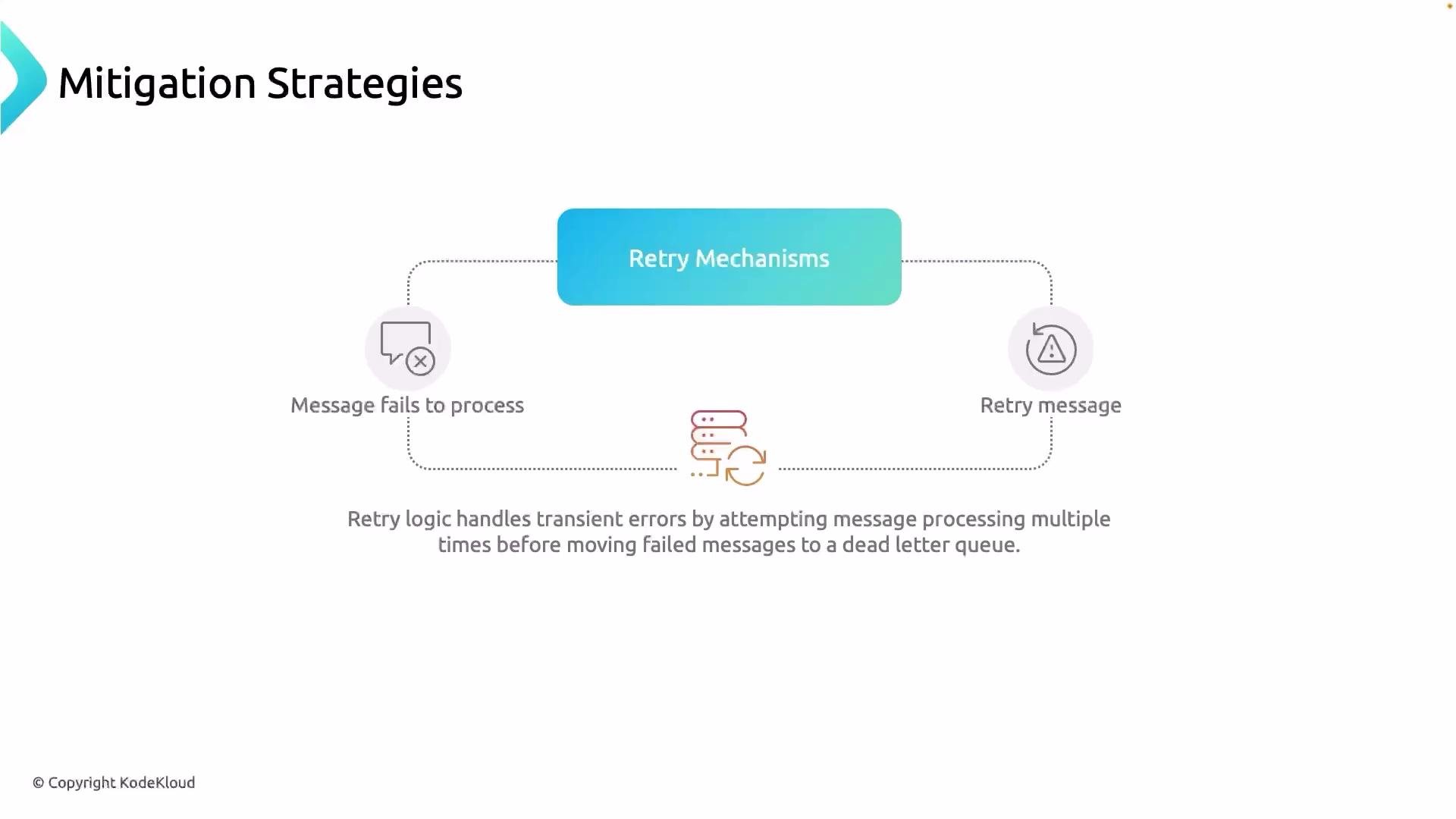
- Limit retries to a small number (e.g., 3–5 attempts) and use exponential backoff with jitter to reduce thundering-herd effects.
- Track retry counts in message headers or an external store so consumers can decide when to stop retrying.
- After reaching the max retries, move the message to the DLQ and include retry metadata.
- Ensure consumers are idempotent to avoid duplicate side effects during retries.
Unbounded or aggressive retries can overload your cluster and amplify failures. Always bound retries and prefer moving persistent failures to the DLQ.
- In-flight retry loop inside consumer (careful: can block consumer progress).
- Use separate retry topics with increasing delay (e.g.,
topic.retry.5s,topic.retry.1m) and a scheduler or Kafka Streams to re-introduce messages after delay.
4. Message filtering and transformation
Filter or transform messages upstream so downstream business logic receives only the fields it needs, reducing the surface for unexpected values to cause failures. Use Kafka Streams or ksqlDB to perform stateless filtering or enrichment before handoff.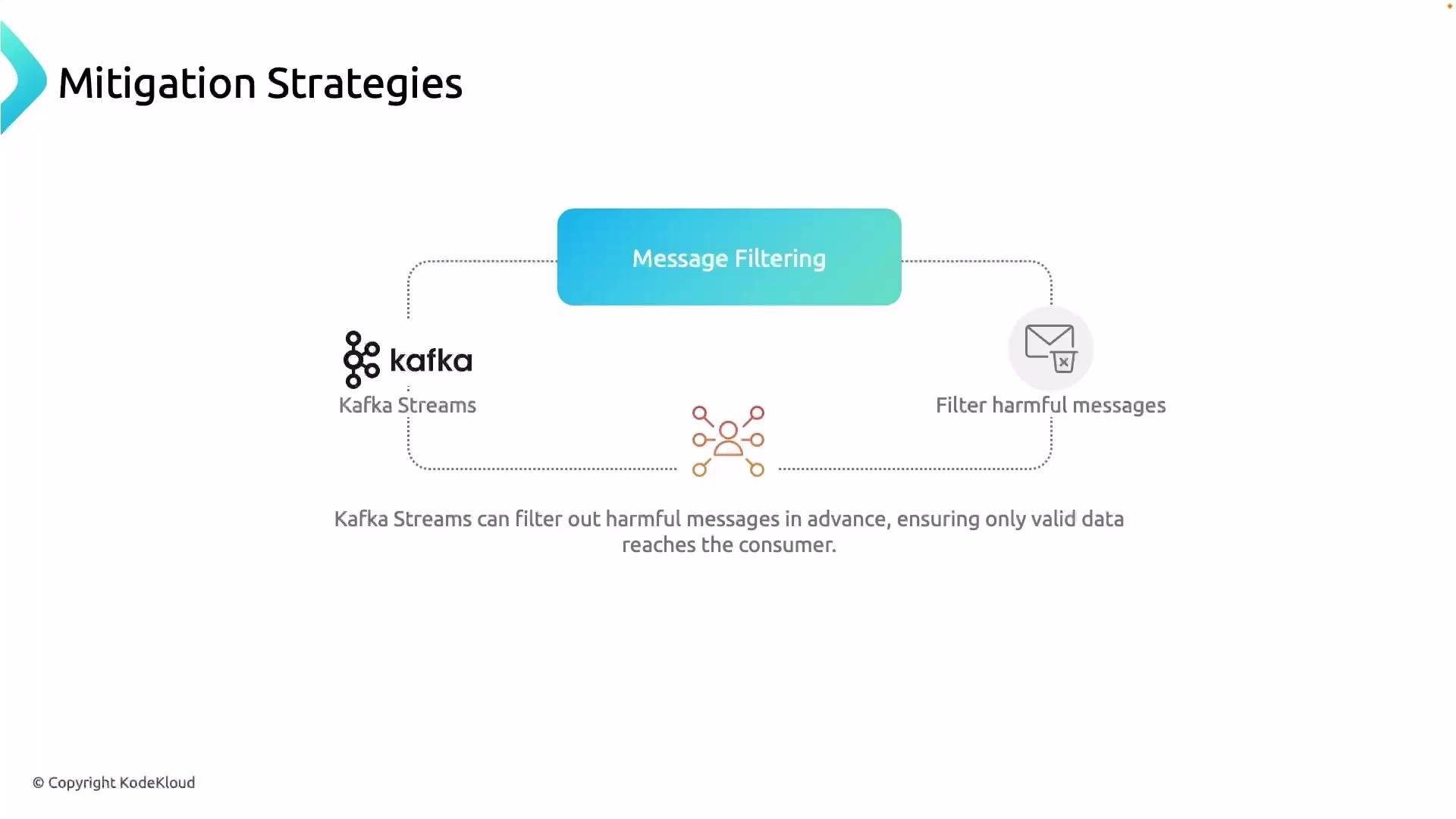
- If a message field is irrelevant to a consumer, filter it out and avoid parsing risk.
- If a field is required for business logic but occasionally malformed, fix the producer or add defensive validation in the consumer.
- For complex transformations or enrichment, use Kafka Streams or ksqlDB to offload processing from consumers and centralize transformation logic.
- Kafka Streams / ksqlDB for upstream stateless filter/transform.
- Consumer-side defensive parsing with explicit validation for required fields.
Strategy comparison
Combining strategies for resilience
A layered approach is most effective:- Enforce structure with a Schema Registry.
- Retry transient failures with bounded backoff.
- Send persistent failures to a DLQ with rich metadata for triage.
- Use Kafka Streams / ksqlDB to filter or transform messages where appropriate.
- Producer validates against schema and writes to
orders. - Consumer attempts processing; on transient failure, retries locally or via retry topic.
- If processing still fails, consumer pushes message and metadata to
orders.dlq. - Operations team inspects
orders.dlq, fixes producer bug or consumer logic, and replays fixed messages.
Links and references
- Apache Kafka Documentation
- Confluent Schema Registry
- Kafka Streams Documentation
- ksqlDB Documentation
- Enforce schemas with a Schema Registry to prevent structural surprises.
- Route unprocessable messages to a DLQ for analysis and replay.
- Implement bounded retries with exponential backoff and idempotent processing.
- Filter or transform messages upstream when only a subset of fields is needed.