

- A concise definition of Apache Kafka and its primary use cases
- How Kafka integrates producers and consumers in a data architecture
- Key Kafka concepts: topics, partitions, brokers, producers, consumers, and retention
- Where to find further reading and official documentation
What is Apache Kafka?
Apache Kafka is a distributed event streaming platform built for large-scale, high-throughput, low-latency data streams. Kafka excels at:- Durable, fault-tolerant storage of event streams
- A publish/subscribe model that decouples producers (writers) from consumers (readers)
- Enabling real-time stream processing, event sourcing, and analytics
Kafka is commonly used for event sourcing, stream processing, log aggregation, and real-time analytics. It acts as a durable, scalable backbone for transporting events between systems.
How Kafka fits into a data architecture
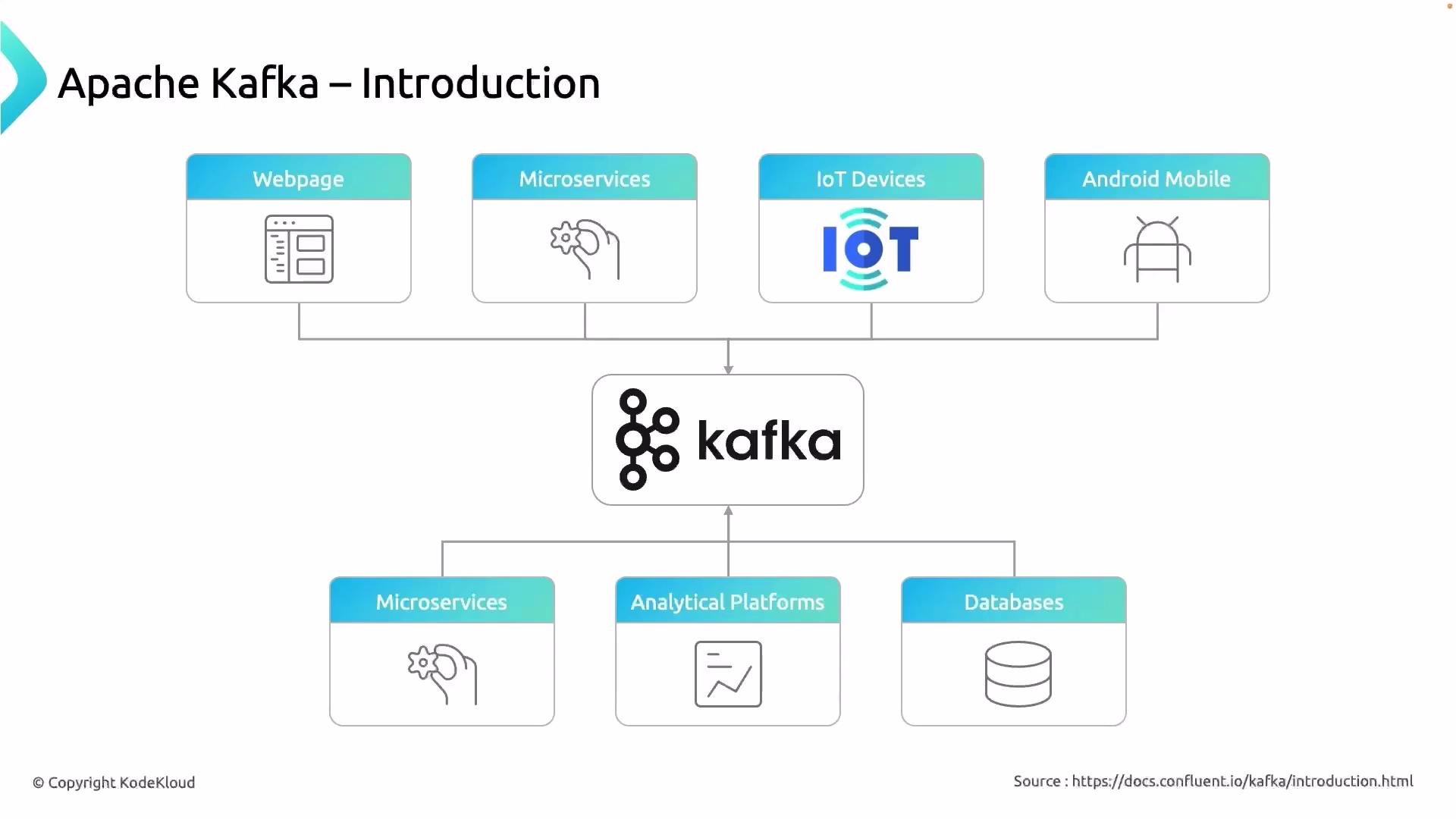
Many systems generate events (web apps, mobile apps, IoT devices, microservices). Kafka sits in the middle as a central, durable event bus: producers publish events to Kafka topics, and one or more consumers subscribe to those topics to process, analyze, or store the data. This decoupling allows independent scaling and resilience across services.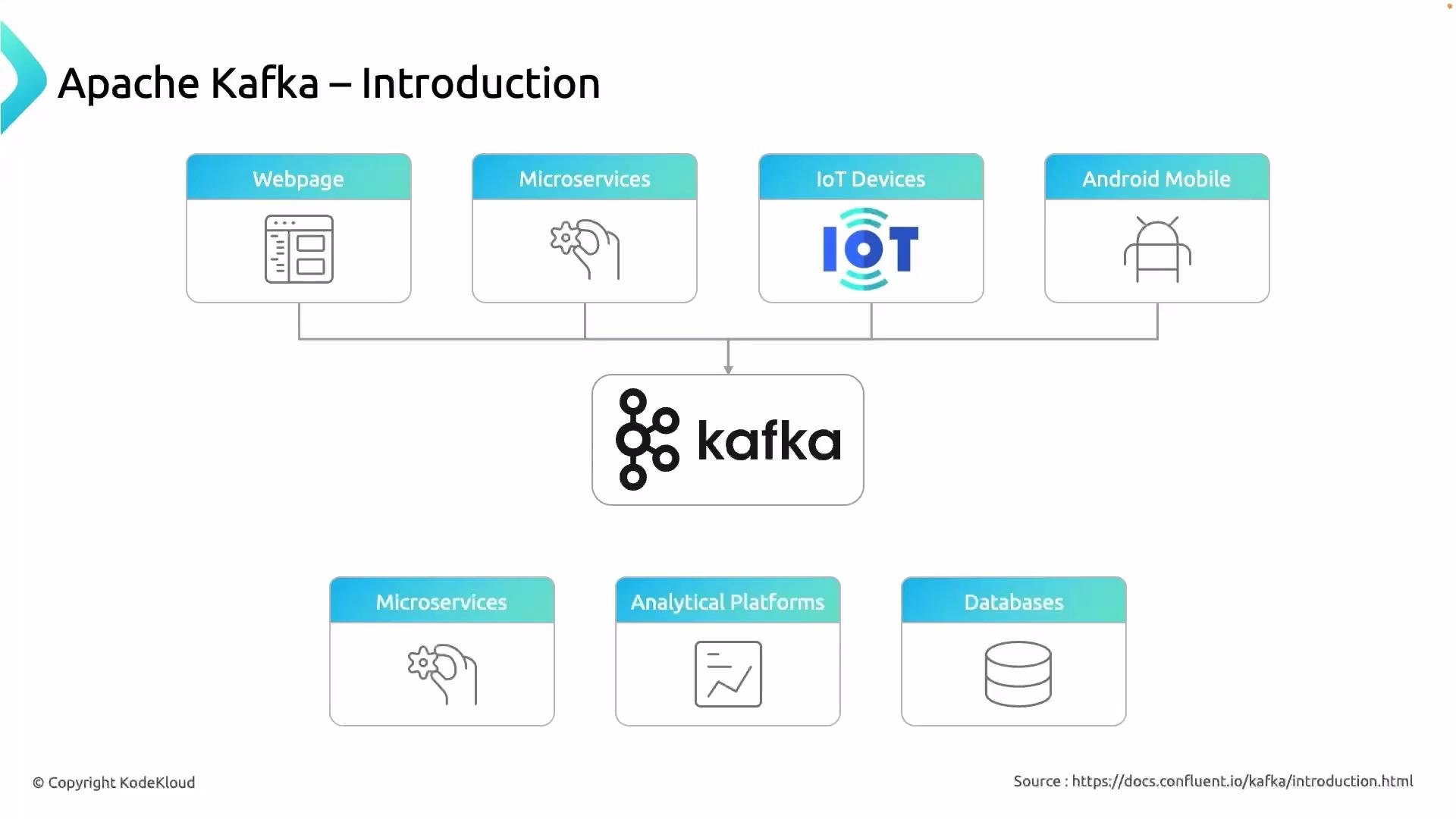
- Left: producers (web pages, microservices, IoT devices, mobile apps) generate events.
- Center: Kafka topics receive and durably store those events.
- Right: consumers (microservices, analytics platforms, databases) subscribe to topics and process or persist the events.
Core Kafka concepts
Below are the fundamental building blocks you will encounter when working with Kafka.Why use Kafka instead of point-to-point integrations?
- Decoupling: Producers and consumers evolve independently without direct dependencies.
- Scalability: Partitions allow distributed processing across consumers.
- Durability: Events are stored reliably for replay or auditability.
- Multiple consumers: Different teams or systems can independently consume the same events.
- Real-time processing: Enables streaming analytics and near-real-time reactions.
Links and references
- Apache Kafka official documentation: https://kafka.apache.org/documentation/
- Confluent Kafka resources: https://www.confluent.io/resources/
- Event streaming overview: https://www.confluent.io/what-is-event-streaming/