

Scenario
Dash0, a software vendor, is moving to a multi-cloud, containerized platform managed by a central Platform DevOps team. They adopted an Infrastructure-as-Code approach using tools such as Kustomize, Terraform, and Ansible to define infrastructure and application deployments in code. However, their initial processes contained several operational flaws. At first, team members manually applied Kubernetes manifests from a single Git branch without versioning, peer reviews, or automation. Changes were applied directly to the cluster, which made it impossible to audit reliably or trace who made what change and when.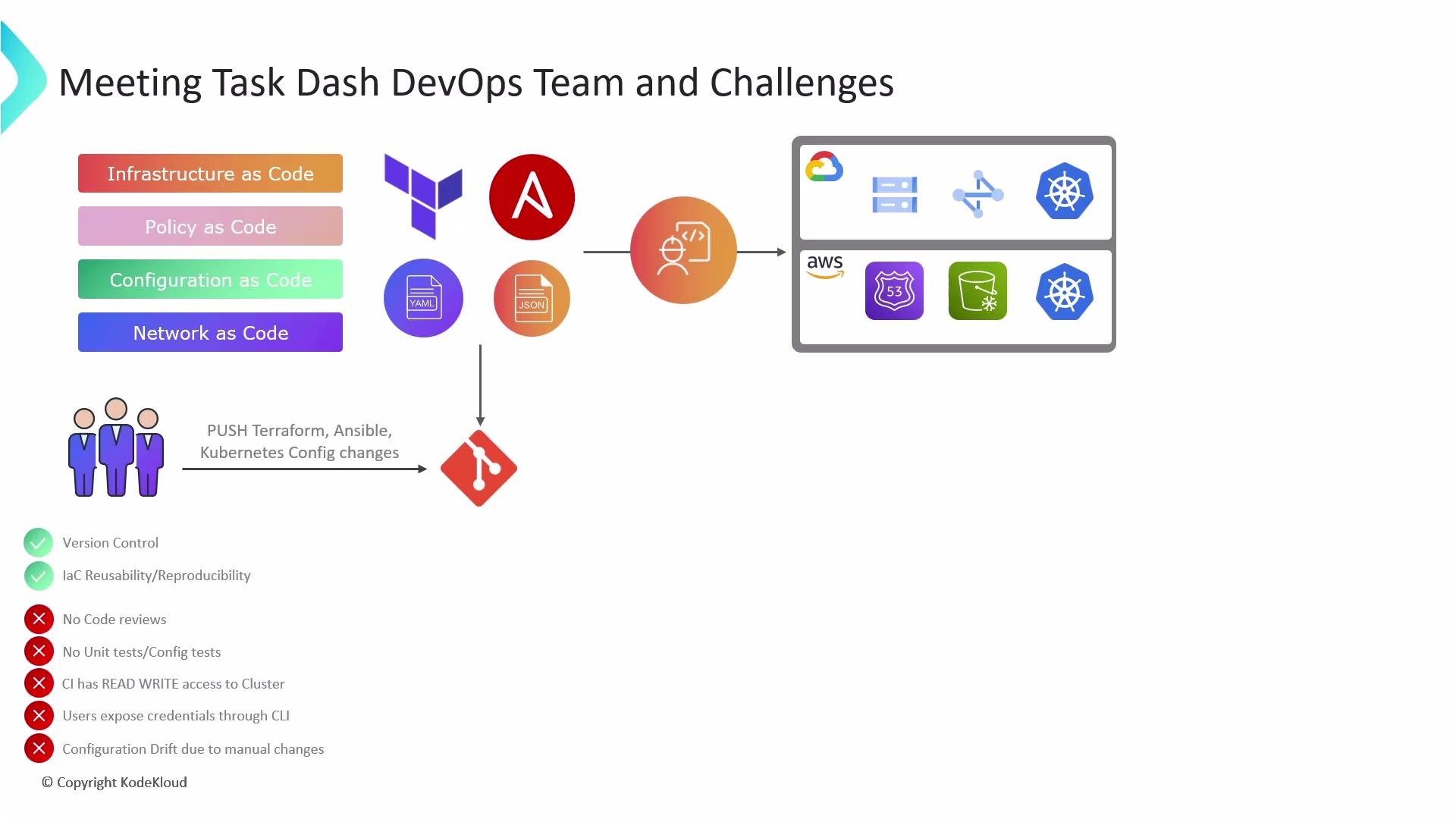
What is GitOps?
GitOps is a methodology that treats Git as the single source of truth for the desired system state and uses automated, auditable mechanisms to reconcile the live cluster state with Git. Instead of pushing changes into the cluster from outside, GitOps relies on pull-based agents (controllers) running inside the cluster to continuously compare and apply the declared state from Git.GitOps: Store the desired state in Git, and use automated controllers (pull-based agents) inside the cluster to continuously reconcile the live state with Git. This improves auditability, reduces credential exposure, prevents configuration drift, and simplifies disaster recovery.
Key benefits of GitOps
- Auditability: Every change is a Git commit, enabling complete history, code review, and traceability.
- Reduced credential exposure: Controllers running inside the cluster fetch manifests; external systems do not need persistent cluster credentials.
- Declarative convergence: Continuous reconciliation brings the cluster to the declared state, preventing drift.
- Faster, reliable rollbacks: Revert a commit in Git to roll back the desired state, and the controller will converge the cluster accordingly.
- Improved DR posture: The Git repo contains the canonical desired state, so restores are more predictable.
How GitOps works (high level)
- Developers or operators create commits (changes) in Git to update infrastructure or application manifests.
- A GitOps controller inside the cluster watches the Git repository for changes.
- When a change is detected, the controller pulls the desired state and reconciles the live cluster to match it.
- Any drift is reported or automatically corrected according to policy.
Links and references
- Kubernetes Basics
- GitOps principles and best practices — see documentation from major GitOps projects (Argo CD, Flux) for implementation details.
- Kustomize tooling guide
- Terraform basics training
- Ansible for automation