

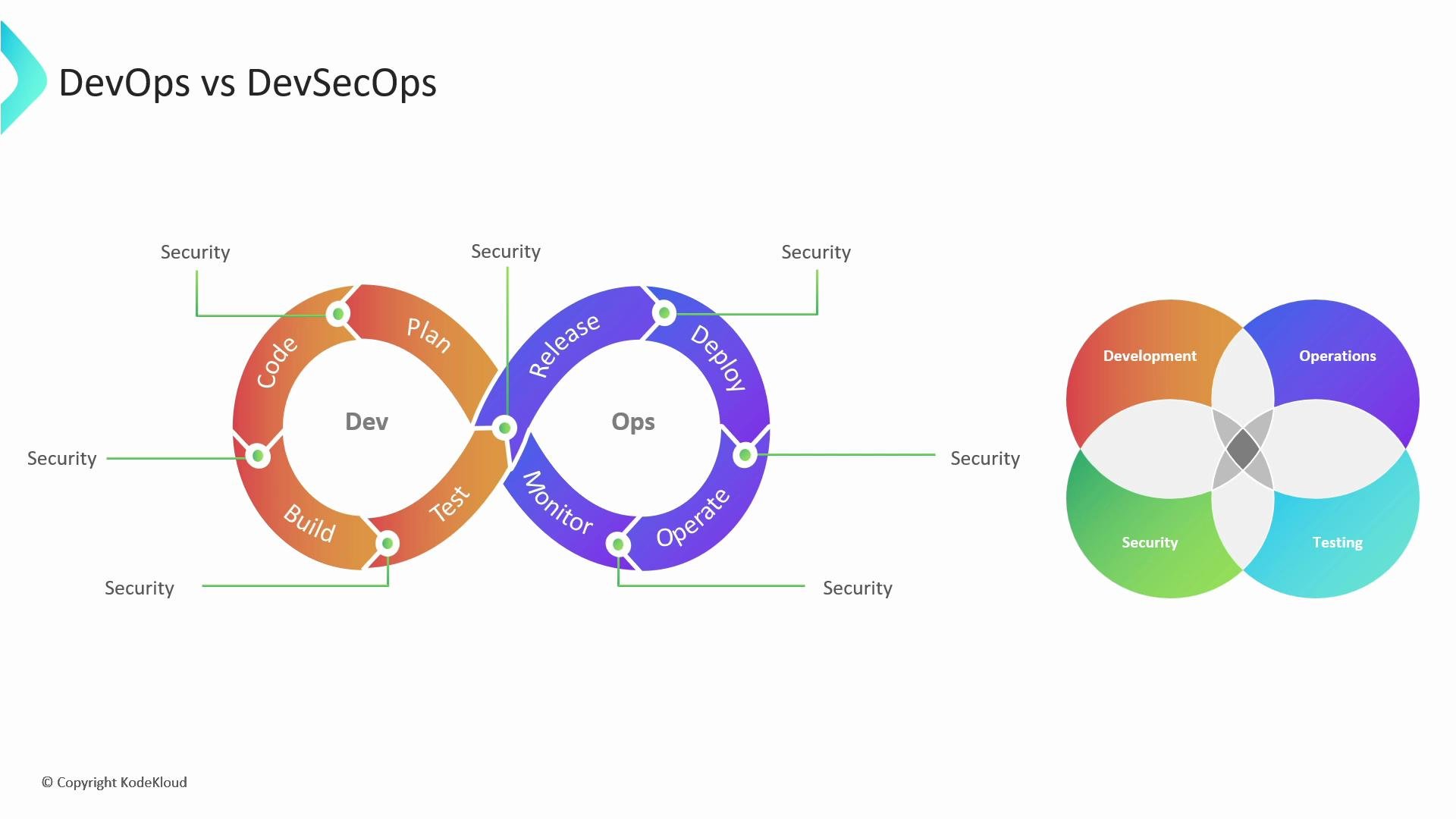
Typical DevOps pipeline (example flow)
A common continuous delivery flow looks like this:- Developer commits code to a central Git repository (see Git for Beginners).
- A CI/CD server (for example, Jenkins, GitHub Actions, or GitLab CI/CD) pulls the changes, runs unit tests and linters, and produces artifacts (binaries, container images).
- Artifacts are deployed to staging/QA for integration, acceptance, and dynamic testing.
- After verification, artifacts are deployed to production—commonly as containers (see Docker Training Course for the Absolute Beginner) orchestrated by platforms like Kubernetes (see Kubernetes for the Absolute Beginners - Hands-on Tutorial).
- Monitoring and observability tools (for example, Prometheus + Grafana; see AIOps Foundations - Intelligent Monitoring With Prometheus & Grafana) continuously track health and performance.
Where security often appears in traditional DevOps
- Security checks are frequently scheduled late: end-of-pipeline vulnerability scans, penetration tests, or manual reviews.
- Because security is an end-stage activity, important issues may be discovered only after deployment to staging or production.
Why late security is problematic
- High risk: Critical vulnerabilities (e.g., SQL injection) discovered in production may already be exploitable.
- Resource waste: Running and deploying vulnerable builds consumes compute, storage, and bandwidth unnecessarily.
- Higher cost: Fixes discovered late require rollbacks or hotfixes and re-running the entire pipeline—this is more expensive than early remediation.
- Delivery slowdowns: Reprocessing a pipeline for a single fix delays other feature deliveries and reduces throughput.
A sequential (real-world) example
- Application is deployed to production.
- A late security test detects a high-severity vulnerability (for example, SQL injection).
- Remediation requires a code change, a new build, full pipeline execution (tests, staging, production), and additional verification—this reintroduces risk and delays releases.
What DevSecOps brings: shift-left security
Shift-left security integrates security earlier in the development lifecycle by embedding automated security checks into CI/CD and developer workflows. This approach transforms security from an afterthought into a continuous, developer-visible activity. Table: Common security controls and where they run
Benefits of embedding these checks into CI/CD:
- Faster feedback to developers (fail-fast on obvious issues).
- Prevent vulnerable artifacts from reaching production.
- Make security part of the developer workflow and culture.
Benefits of shifting left with DevSecOps
Shift-left security isn’t about blocking delivery; it’s about automated, actionable feedback. Use strict fail conditions for high-severity issues and advisory checks for low-severity findings so teams can deliver features quickly while keeping risk low.
Practical next steps to adopt DevSecOps
- Start by adding SAST and dependency scanning to pull-request CI jobs.
- Add IaC scanning to the pipeline before infrastructure provisioning (see Terraform Basics Training Course).
- Run container image scans as part of your image build process and block pushes for critical findings.
- Schedule DAST against staging and use runtime defense tools in production.
- Integrate security results into issue trackers and developer workflows so remediation is tracked and measured.