This lesson continues the CI/CD with GitOps with ArgoCD walkthrough and finalizes a Jenkins pipeline that:
  • Builds a Docker image,
  • Pushes it to Docker Hub,
  • Updates the Kubernetes manifest in a Git repository,
  • Raises a pull request so a GitOps operator (Argo CD) can reconcile the change.
The highway-animation repository was imported into Gitea and the Jenkinsfile was modified for this flow.
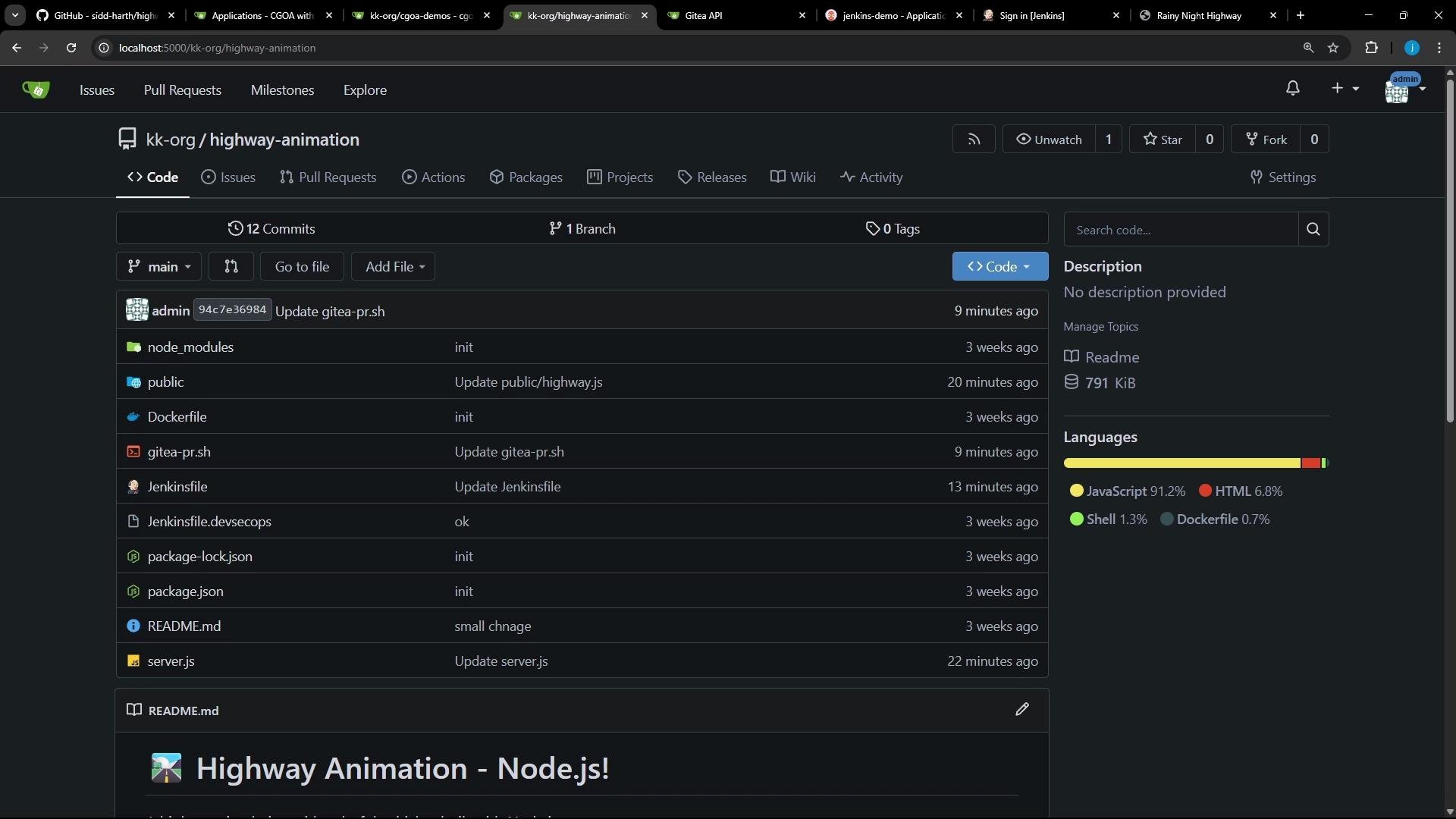
The image shows a GitHub repository page for a project named "highway-animation," featuring a list of files and directories along with their commit messages and timestamps. The repository predominantly uses JavaScript, with smaller portions of HTML, Shell, and Dockerfile code.
Pipeline filename mismatch issue
  • The pipeline previously failed because some stages referenced deployment.yaml while the repository file is named deployment.yml. That made the sed / cat commands error out.
  • Always verify file names and paths in the workspace before running commands that assume a file exists.
Always validate filenames and paths in the pipeline workspace (for example deployment.yml vs deployment.yaml) before using sed or cat to avoid stage failures.
Repository layout reminder — in this demo the Kubernetes manifests live under cgoa-demos/jenkins-demo and the manifest file is deployment.yml (note the single-letter extension):
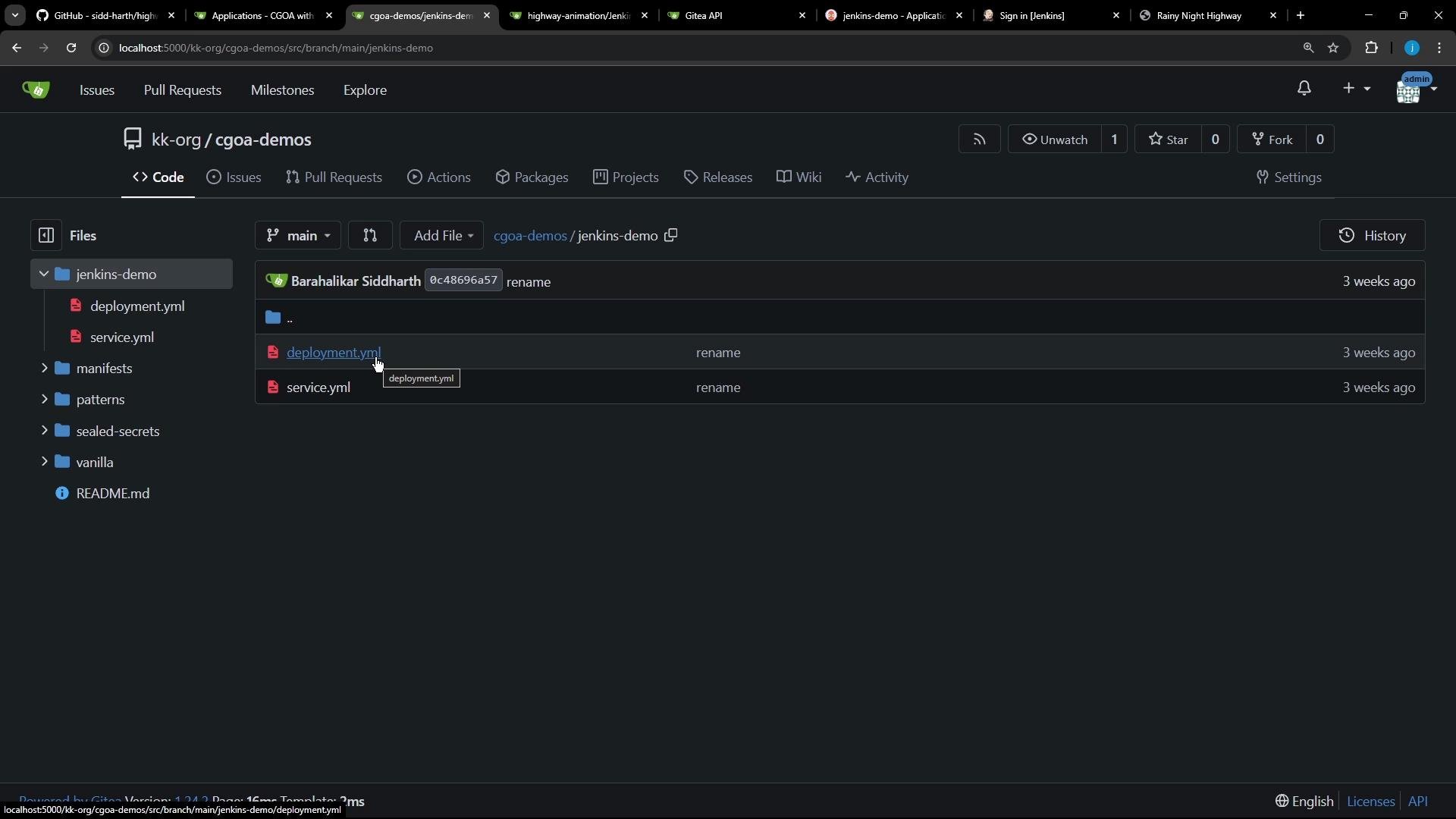
The image shows a Gitea repository interface displaying a folder structure for "jenkins-demo" with files named "deployment.yml" and "service.yml." The interface includes options for issues, pull requests, actions, and more.
Corrected declarative Jenkinsfile Below is a consolidated and corrected declarative Jenkinsfile for this CI flow. It:
  • Builds and tags the Docker image using a deterministic VERSION (combining BUILD_ID and GIT_COMMIT),
  • Pushes the image to Docker Hub using stored credentials,
  • Clones or pulls the cgoa-demos repo, updates deployment.yml to the new image tag, commits, pushes and creates a PR.
pipeline {
    agent any

    environment {
        NAME = "highway-animation-jenkins"
        VERSION = "${env.BUILD_ID}-${env.GIT_COMMIT}"
        IMAGE_REPO = 'siddharth67'
        GITEA_TOKEN = credentials('gitea-token')       // secret/token stored in Jenkins
    }

    stages {
        stage('Unit Tests') {
            steps {
                echo 'Implement unit tests if applicable.'
            }
        }

        stage('Build Image') {
            steps {
                sh "docker build -t ${NAME}:latest ."
                sh "docker tag ${NAME}:latest ${IMAGE_REPO}/${NAME}:${VERSION}"
            }
        }

        stage('Push Image') {
            steps {
                // Uses Docker Pipeline plugin credentials to authenticate to Docker Hub
                withDockerRegistry([credentialsId: 'docker-hub-credentials', url: ""]) {
                    sh "docker push ${IMAGE_REPO}/${NAME}:${VERSION}"
                }
            }
        }

        stage('Clone/Pull Repo') {
            steps {
                script {
                    if (fileExists('cgoa-demos')) {
                        echo 'Cloned repo already exists - Pulling latest changes'
                        dir('cgoa-demos') {
                            sh 'git pull'
                        }
                    } else {
                        echo 'Repo does not exist - Cloning the repo'
                        sh 'git clone -b feature-gitea http://localhost:5000/kk-org/cgoa-demos'
                    }
                }
            }
        }

        stage('Update Manifest') {
            steps {
                dir('cgoa-demos/jenkins-demo') {
                    // Replace the image line in deployment.yml with the new image:tag
                    sh "sed -i \"s#image:.*#image: ${IMAGE_REPO}/${NAME}:${VERSION}#g\" deployment.yml"
                    sh "cat deployment.yml"
                }
            }
        }

        stage('Commit & Push') {
            steps {
                dir('cgoa-demos/jenkins-demo') {
                    // Configure git user and push back to feature branch using a token in the remote URL
                    sh "git config --global user.email 'jenkins@ci.com'"
                    sh "git remote set-url origin http://${GITEA_TOKEN}@localhost:5000/kk-org/cgoa-demos"
                    sh "git checkout feature-gitea"
                    sh "git add -A"
                    // commit may return non-zero if there are no changes; allow that without failing the build
                    sh "git commit -m \"Updated image version for Build - ${VERSION}\" || true"
                    sh "git push origin feature-gitea"
                }
            }
        }

        stage('Create PR') {
            steps {
                dir('cgoa-demos/jenkins-demo') {
                    // Example script to create a PR using Gitea REST API (gitea-pr.sh should exist and be executable)
                    sh "./gitea-pr.sh || true"
                }
            }
        }
    }
}
Create the Jenkins pipeline job
  • Create a new Jenkins job of type “Pipeline” that points to this Jenkinsfile in your source repository and run it.
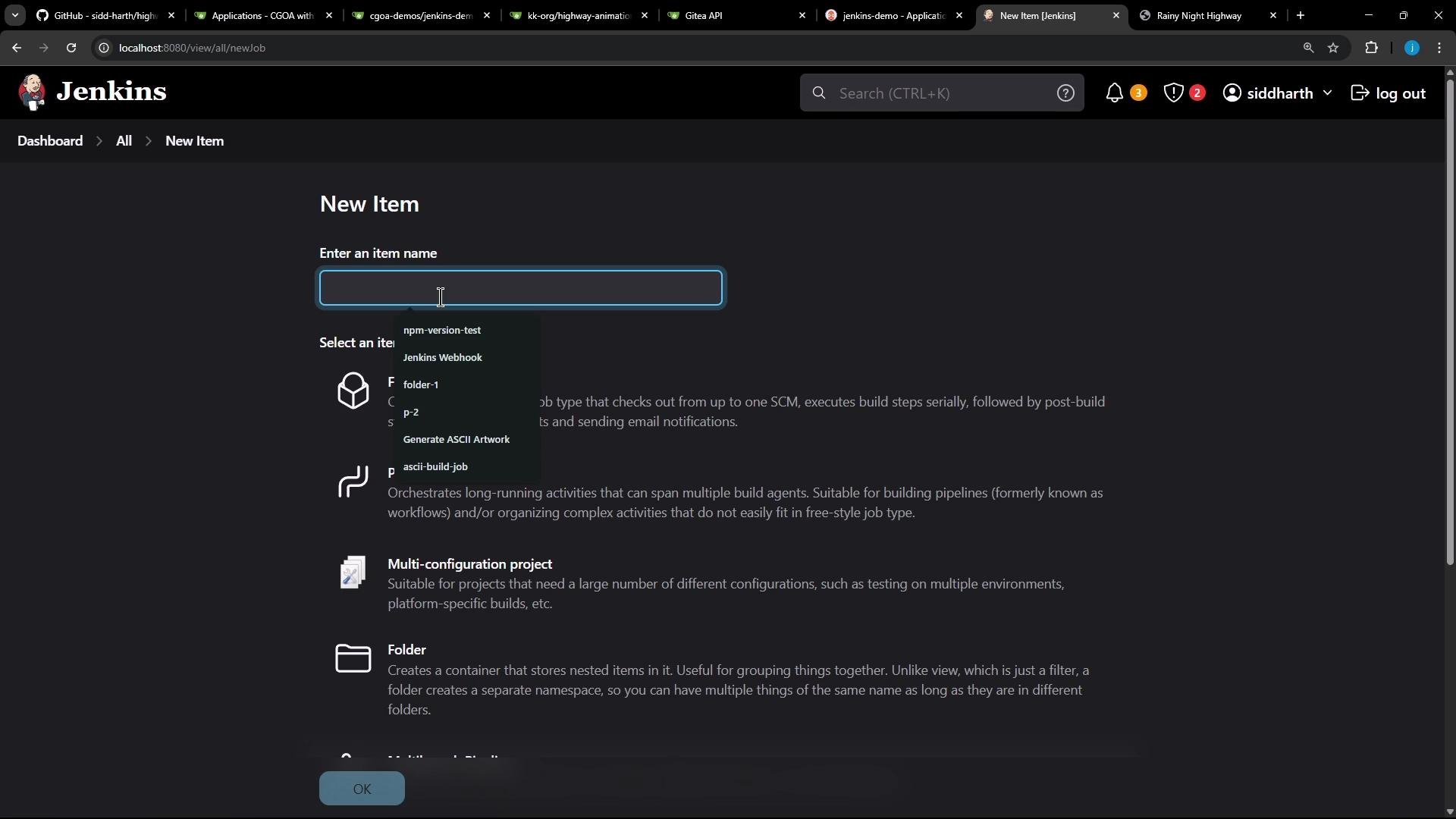
The image shows a Jenkins interface where a user can create a new item by entering a name and selecting a job type from the options provided.
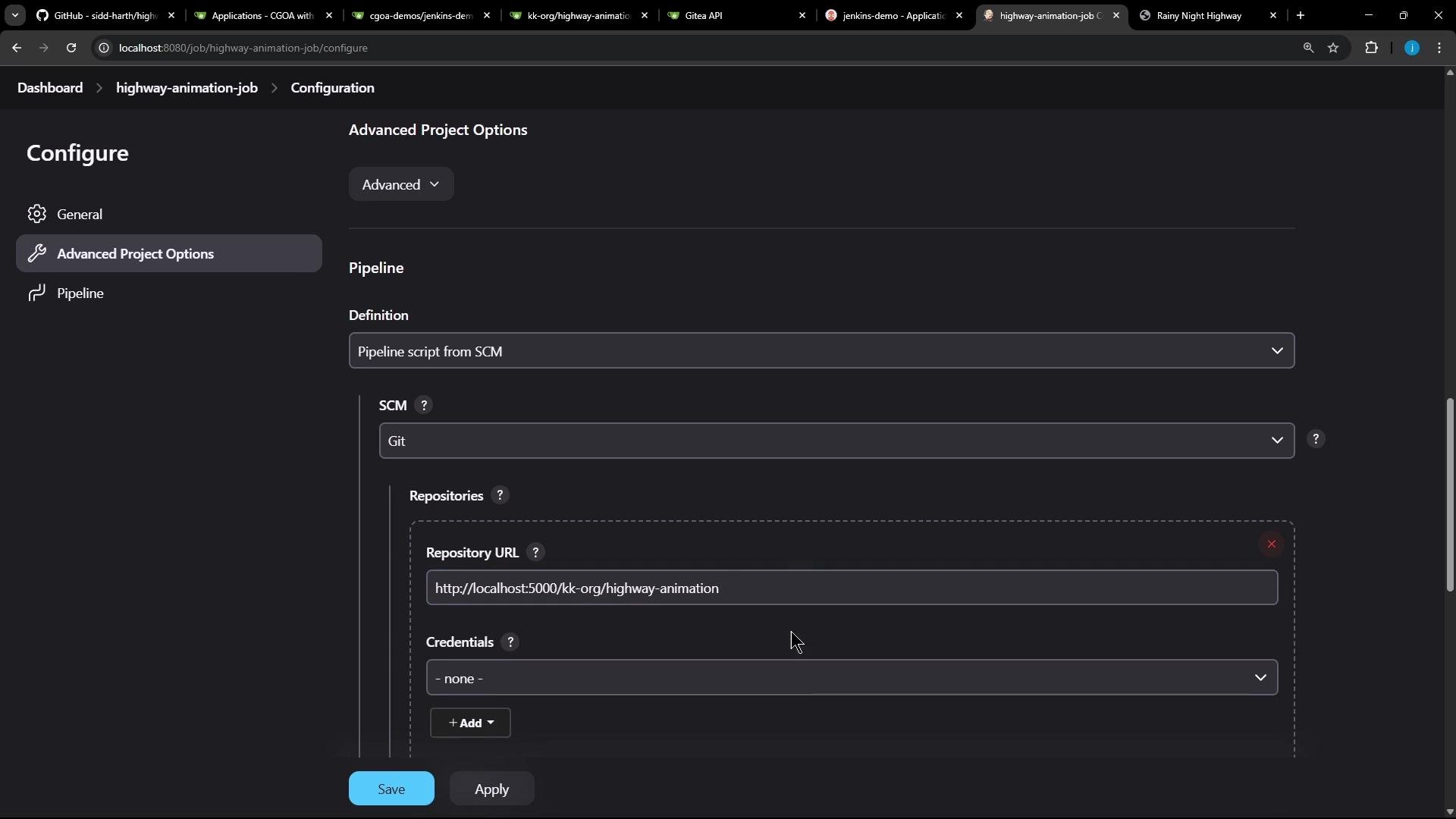
In the job configuration select “Pipeline script from SCM”, provide the Git repository URL and branch (for example main), then save:
The image shows a configuration page for a Jenkins job, specifically for setting up a pipeline script from a source control management system using Git, with repository details filled in.
Example build steps observed during execution
  • The pipeline will run stages for build, tag and push. Example shell output from the Build / Push stages:
docker build -t highway-animation-jenkins:latest .
docker tag highway-animation-jenkins:latest siddharth67/highway-animation-jenkins:2-508f3ed33b6b6876749a0f1140204afa72766719
docker push siddharth67/highway-animation-jenkins:2-508f3ed33b6b6876749a0f1140204afa72766719
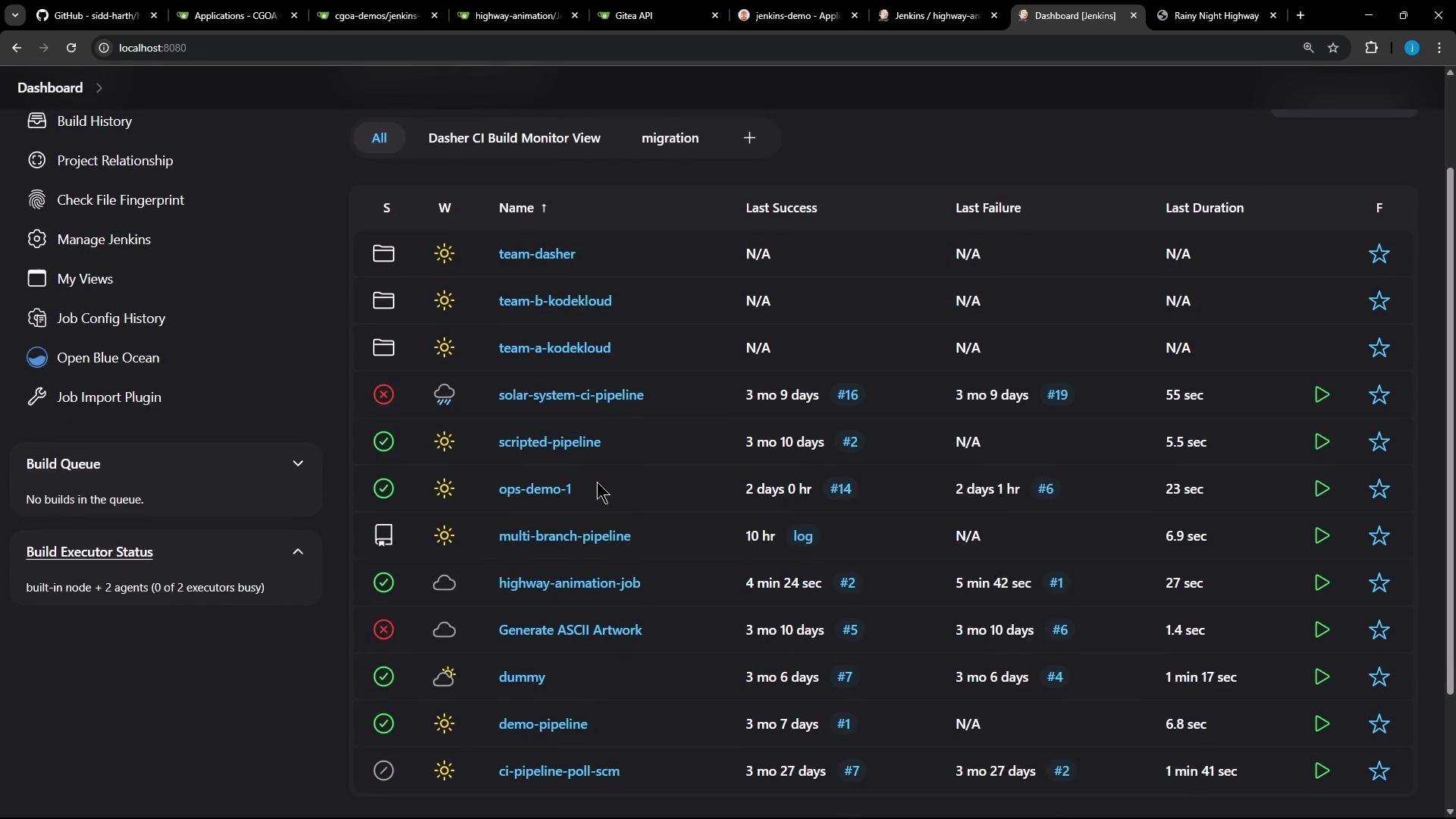
A successful pipeline run appears like other Jenkins jobs in the dashboard:
The image shows a Jenkins dashboard displaying various build pipelines with their status, last success, last failure, and duration. The interface includes options for build history, project relationship, and job configuration.
Credentials and secure tokens
  • Ensure Jenkins has Docker Hub credentials configured in “Manage Jenkins” → “Credentials” and referenced by the pipeline (this example uses docker-hub-credentials).
  • Also store the Gitea token as a Jenkins credential (here referenced as gitea-token) so scripts can push and create PRs securely.
Store registry credentials and Git/Gitea tokens in Jenkins credentials (not inline in the pipeline). Avoid exposing tokens in console output and remote URLs without proper masking.
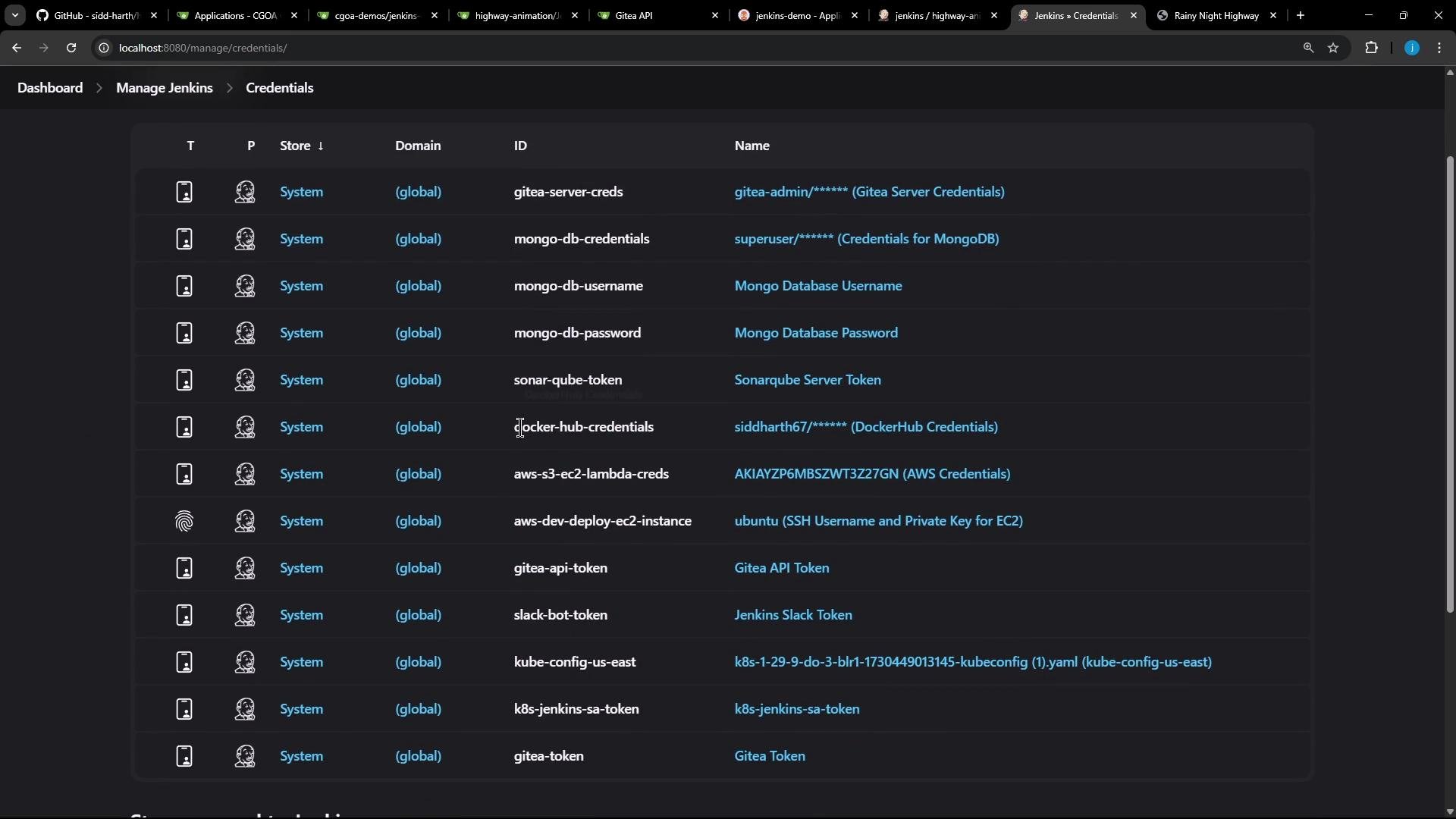
The image shows a Jenkins dashboard displaying a list of stored credentials, including IDs, domains, and names for various systems such as MongoDB, DockerHub, AWS, and Gitea.
Pull request creation
  • After pushing the commit, the pipeline runs a helper script (for example gitea-pr.sh) that calls the Gitea REST API to create a PR. Example response printed by such a script:
{"id":1,"login":"admin","login_name":"source","full_name":"","email":"admin@admin.com","avatar_url":"http://localhost:5000/avatars/...","html_url":"http://localhost:5000/kk-org/cgoa-demos/pulls/1", ...}
Success
Updated manifest in Git
  • Once the PR is merged to main, Argo CD will observe the updated deployment.yml with the new image tag — for example:
apiVersion: apps/v1
kind: Deployment
metadata:
  name: highway-animation
  namespace: jenkins-demo
spec:
  replicas: 10
  selector:
    matchLabels:
      app: highway-animation
  template:
    metadata:
      labels:
        app: highway-animation
    spec:
      containers:
        - name: highway-animation
          image: siddharth67/highway-animation-jenkins:2-508f3ed33b6b6876749a0f1140204afa72766719
          ports:
            - containerPort: 3000
          env:
            - name: POD_COUNT
              value: "10"
Argo CD reconciliation
  • When Argo CD detects the desired state in Git differs from cluster state it marks the application OutOfSync. You can then click Sync to roll out the new image.
  • The Argo CD UI reports application health and sync status:
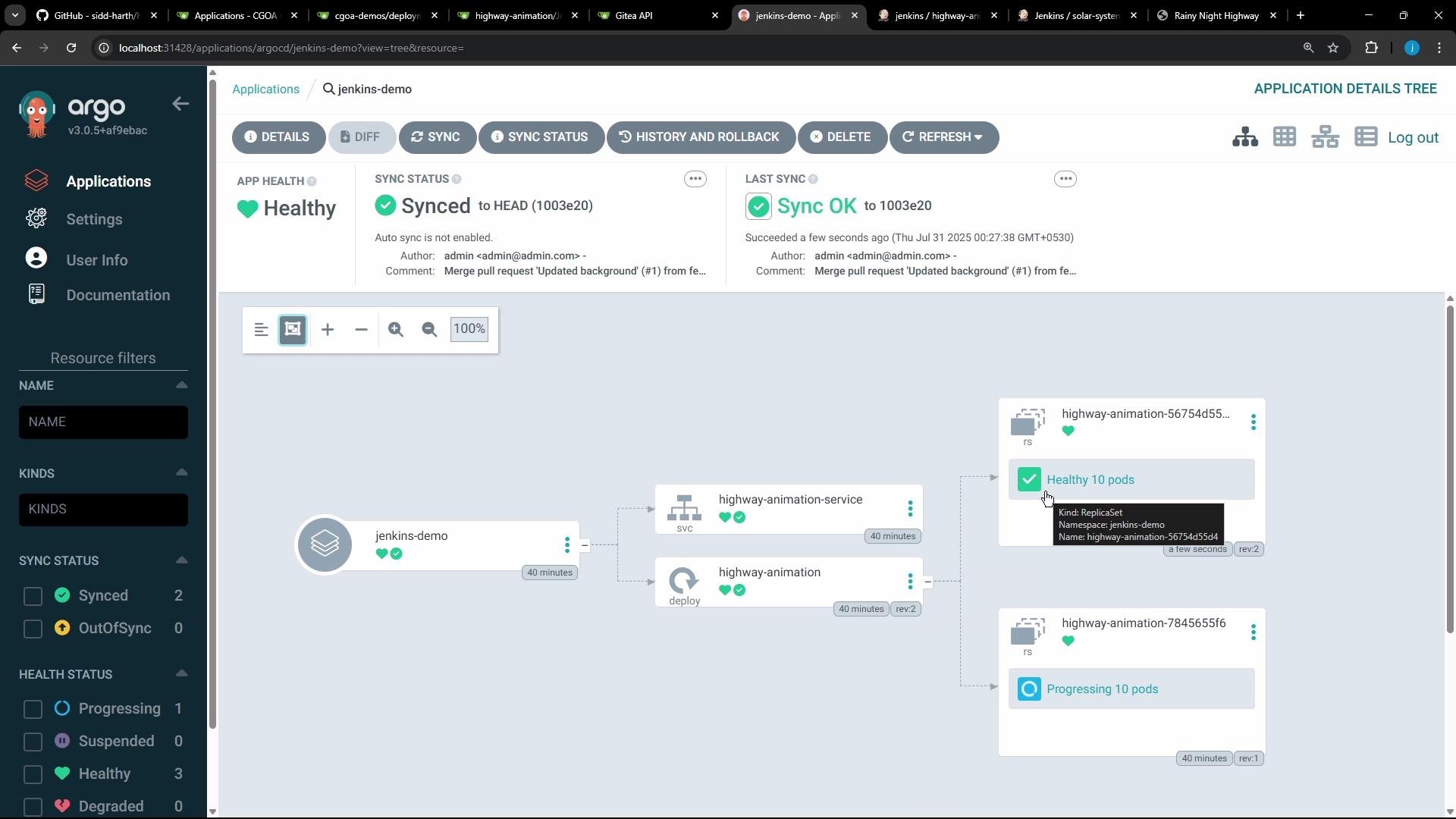
The image shows a dashboard from Argo CD displaying the health and sync status of a "jenkins-demo" application, including details of its services and deployments with a healthy status for pods.
Rollback and remediation
  • If the release introduces a bug (for example UI regressions), Argo CD allows you to roll back to a previous revision in the cluster. Note: rollback reverts the live cluster state to a previous ReplicaSet but does not change the Git repository. After rollback you should:
    1. Fix the root cause in source control,
    2. Build and test a new image,
    3. Update manifests, push and merge the PR,
    4. Let Argo CD reconcile the corrected state.
Pipeline stage summary
StagePurposeExample action
Build ImageBuild & tag the imagedocker build -t ${NAME}:latest .
Push ImageAuthenticate and push to registrydocker push ${IMAGE_REPO}/${NAME}:${VERSION}
Clone/Pull RepoEnsure local copy of manifestsgit clone -b feature-gitea http://.../cgoa-demos
Update ManifestReplace image tag in deployment.ymlsed -i "s#image:.*#image: ${IMAGE_REPO}/${NAME}:${VERSION}#g" deployment.yml
Commit & PushPush changes to feature branchgit push origin feature-gitea
Create PRCreate a pull request (Gitea API)./gitea-pr.sh
DevSecOps considerations
  • Add dependency scanning (e.g., npm audit, Snyk) before building images.
  • Scan images (e.g., trivy image) before pushing to the registry; fail builds on critical vulnerabilities.
  • Perform static analysis (SonarQube) and dynamic testing as appropriate.
Example Trivy usage (after image build, before push):
trivy image siddharth67/highway-animation-jenkins:${GIT_COMMIT} --severity HIGH,CRITICAL --exit-code 1 --quiet --format json -o trivy-image-results.json
trivy convert --format template --template "@/usr/local/share/trivy/templates/html.tpl" --output trivy-image-results.html trivy-image-results.json
Wrap-up This lesson demonstrated a common CI pipeline pattern that:
  • Builds and tags an image,
  • Pushes it to Docker Hub,
  • Updates Kubernetes manifests in Git,
  • Opens a PR so a GitOps operator (Argo CD) can pick up and deploy the change.
When the PR is merged Argo CD detects the change and applies the new manifest. If problems occur in production you can roll back via Argo CD and iterate fixes through the CI pipeline. Further reading and references That’s all for this lesson.

Watch Video

Practice Lab