

Understanding Methods in Rust
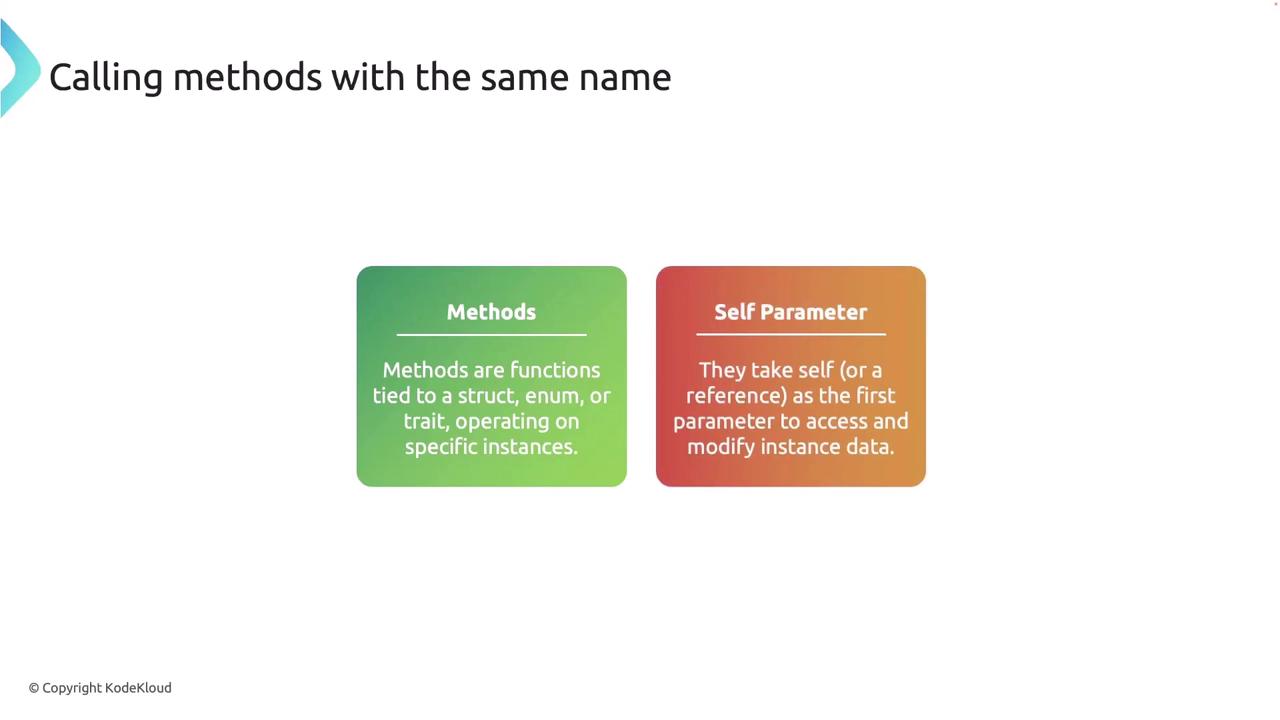
Methods in Rust are functions defined within the context of a struct, enum, or trait. They are associated with a particular instance of a type and typically takeself (or a reference to it) as their first parameter, allowing the method to access or modify instance data.
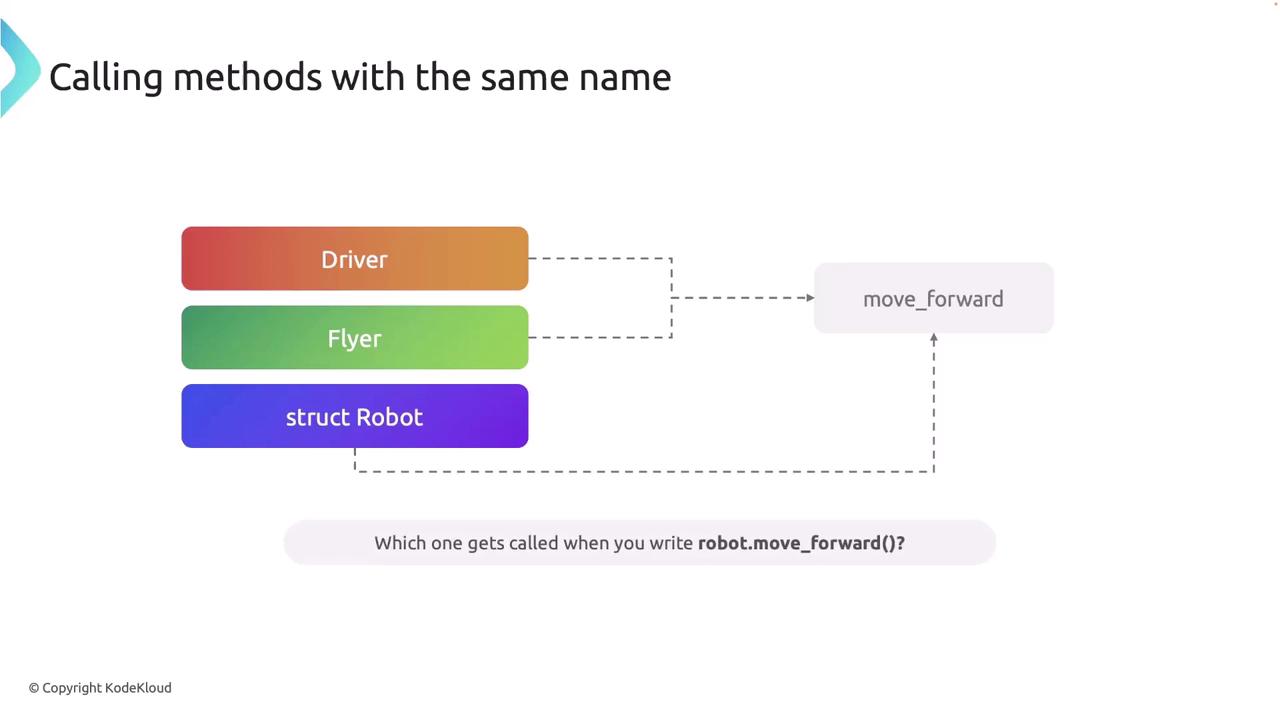
move_forward, it becomes necessary to clarify which version of move_forward should be executed.
Fully-qualified syntax is essential in Rust to ensure that the correct method is called, preventing ambiguity when multiple implementations exist.
A Practical Example with Methods
Consider a scenario where we have two traits,Driver and Flyer, each defining a move_forward method. Additionally, the Robot struct provides its own implementation of move_forward. Here is how the implementations are structured:
move_forward directly on a Robot instance like this:
Robot struct, and thus prints:
move_forward methods from the Driver or Flyer traits, you must use fully-qualified syntax. Here’s how:
::), fully-qualified syntax ensures that Rust calls the intended version of the method.
Fully-qualified Syntax with Associated Functions
Fully-qualified syntax is equally important for associated functions—those functions that do not require aself parameter. Consider the following scenario where we want to assign different names to a Robot based on its capabilities. We define a trait named GroundRobot with an associated function robot_name, and we also implement a function with the same name directly on the Robot struct.
Robot struct like this:
Robot struct, producing the following output:
robot_name function from the GroundRobot trait, you must use fully-qualified syntax as shown below:
self, you include the instance as an argument. For associated functions, simply supply the necessary parameters after the function name.
Be cautious when using the same function name across multiple traits and structs. Without fully-qualified syntax, Rust may not know which function version to execute, leading to bugs or unexpected behavior.