

Result and Option types. The Result type is used for operations that can either succeed (returning an Ok variant) or fail (returning an Err variant). The Option type is useful when a value may be absent, represented by either Some (indicating a valid value) or None.
This powerful type system helps prevent common bugs by forcing developers to handle potential errors explicitly.
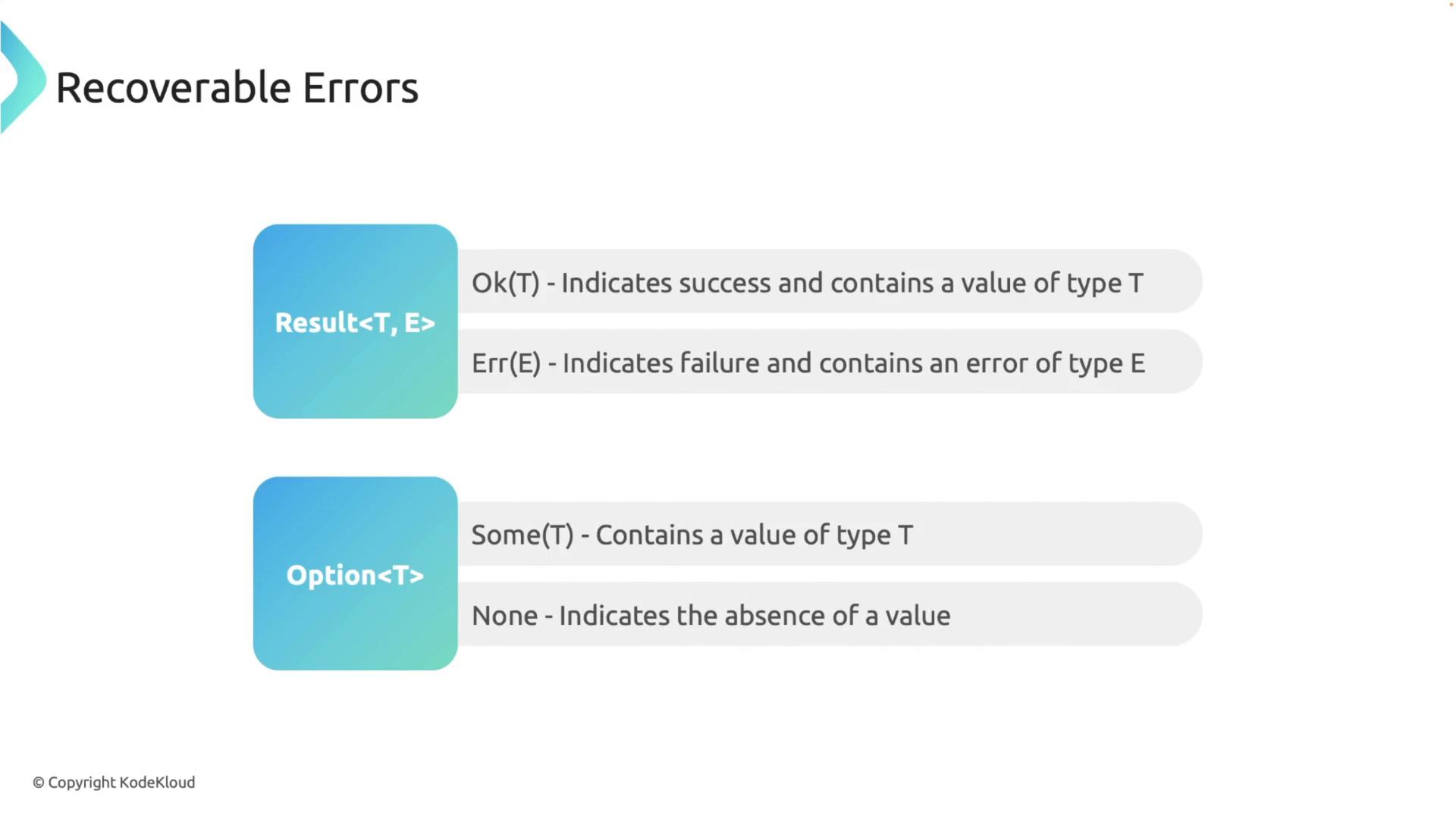
The Result Type in Detail
TheResult type is the primary tool for managing recoverable errors in Rust. Consider the following example where the divide function divides two numbers. If the denominator is zero, the function returns an error with an appropriate message; otherwise, it wraps the result in an Ok.
Propagating Errors with the Question Mark Operator
The question mark operator (?) simplifies error handling in functions that return a Result or Option. When used, it checks the value: if it is Ok or Some, it unwraps and returns the inner value; if it is an Err or None, it returns early from the function with that error value.
Consider the refactored example below using the question mark operator:
divide function returns an error, the ? operator causes an immediate return from the calculate function, skipping any remaining lines.
You can chain multiple operations with the ? operator. For example, consider a scenario where you first read a username and then validate it:
read_username or validate_username fails, the error is immediately returned from the main function.
Handling Errors with unwrap_or_else
Theunwrap_or_else method offers fallback behavior when dealing with Result or Option types that encounter an error or an absence of a value. This method is ideal for logging errors, returning default values, or computing a fallback value based on the error.
Example with Option
In this example, theOption value is None, so the closure passed to unwrap_or_else executes and returns a default value:
Example with Result
For aResult, the closure receives the error as an argument. In this scenario, the operation fails, and the closure provides a fallback value:
Best Practices for Handling Recoverable Errors
When working with recoverable errors in Rust, keep these best practices in mind:- Use
Resultfor operations that might fail. - Leverage the question mark operator (
?) to streamline error propagation. - Provide clear, meaningful error messages.
- Utilize combinators like
map,and_then, andunwrap_or_elseto handle errors gracefully. - Handle errors at appropriate points in your code to avoid excessive error propagation.
For a quick reference on Rust error handling, consult the Rust Error Handling Guide.
Result and Option along with the unwrap_or_else method:
By following these techniques, you ensure your Rust applications can handle errors robustly, allowing them to continue operating smoothly even under unexpected conditions.