

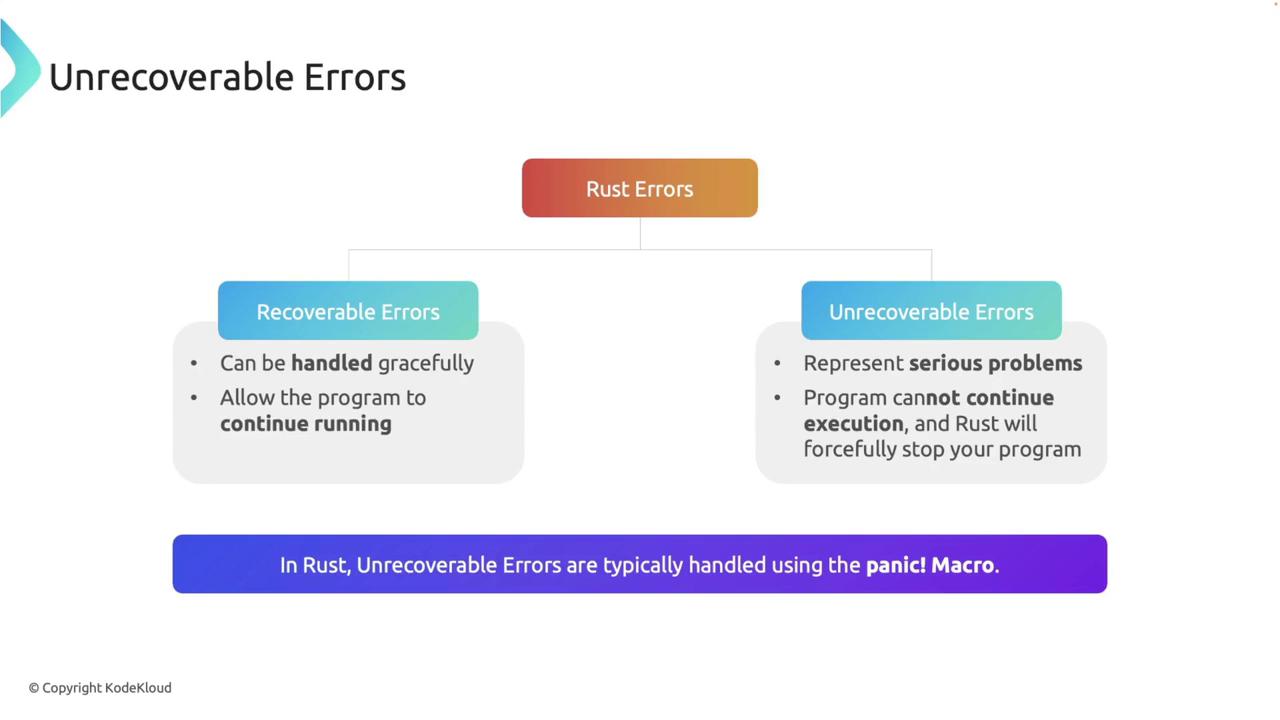
- Recoverable Errors: These are conditions that can be handled gracefully, such as a file not being found, allowing your program to continue running.
- Unrecoverable Errors: These represent critical issues (for example, accessing an array out of bounds or unwrapping a None value) that force the program to stop immediately. Such errors usually indicate bugs in your code and are handled in Rust using the
panic!macro.
panic! macro is invoked, Rust stops execution immediately, unwinds the stack, and cleans up allocated resources before aborting the program. Below is an example that demonstrates this behavior with a vector of three elements:
v[2] is valid since it is within the vector’s bounds. However, trying to access v[3] results in a panic with a message similar to:
How the panic! Macro Works
Thepanic! macro can either unwind the stack or abort the program immediately, depending on your configuration. Understanding these behaviors is important for deciding how to handle errors in specific scenarios.
-
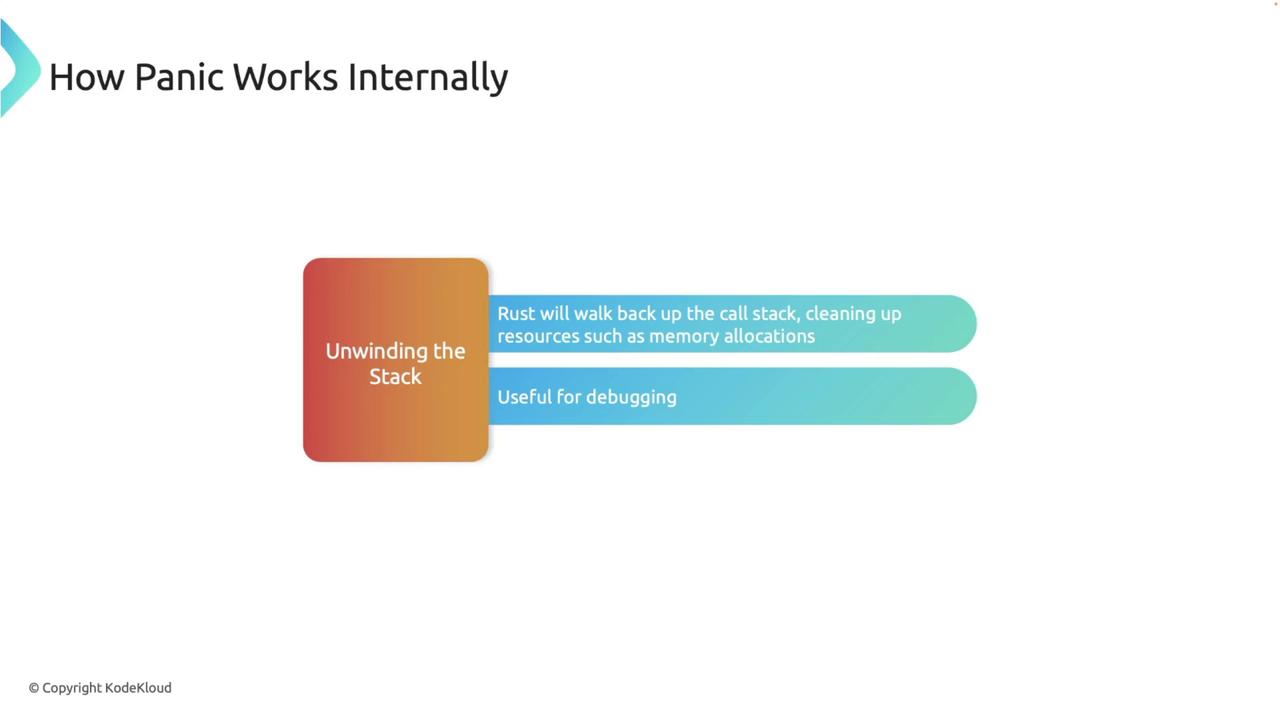
Unwinding the Stack:
Rust cleans up the call stack by freeing resources (like memory allocations) as it goes. This approach helps in debugging by revealing the sequence of function calls that led to the error. However, it might have a performance impact in critical applications. -
Aborting the Program:
For performance-critical applications, you might prefer the program to terminate immediately rather than unwind the stack. You can set this behavior by configuring your Cargo.toml as follows:When set to'abort', the program stops execution immediately, which is faster but offers less diagnostic information in the event of an error.
The
panic! macro should be used sparingly, only when encountering situations where the program is irrecoverably compromised.When to Use panic!
Some typical scenarios for employing thepanic! macro include:
- Invalid Assumptions: When your code relies on a critical assumption that must always be true. A breach of this assumption indicates a bug.
- Prototyping: During early development stages,
panic!may serve as a placeholder for functionality that has yet to be implemented. - Boundary Checks: When interacting with external inputs or APIs, using
panic!can enforce strict data boundaries to prevent processing invalid data.
panic! for invalid assumptions:
Result or Option types for scenarios where an error can be anticipated. The example below refactors the division function to return a Result instead of panicking:
b is zero, the function returns an error message rather than panicking. The caller can then handle the error gracefully using a match statement, allowing the program to continue running.
Best Practices for Handling Errors in Rust
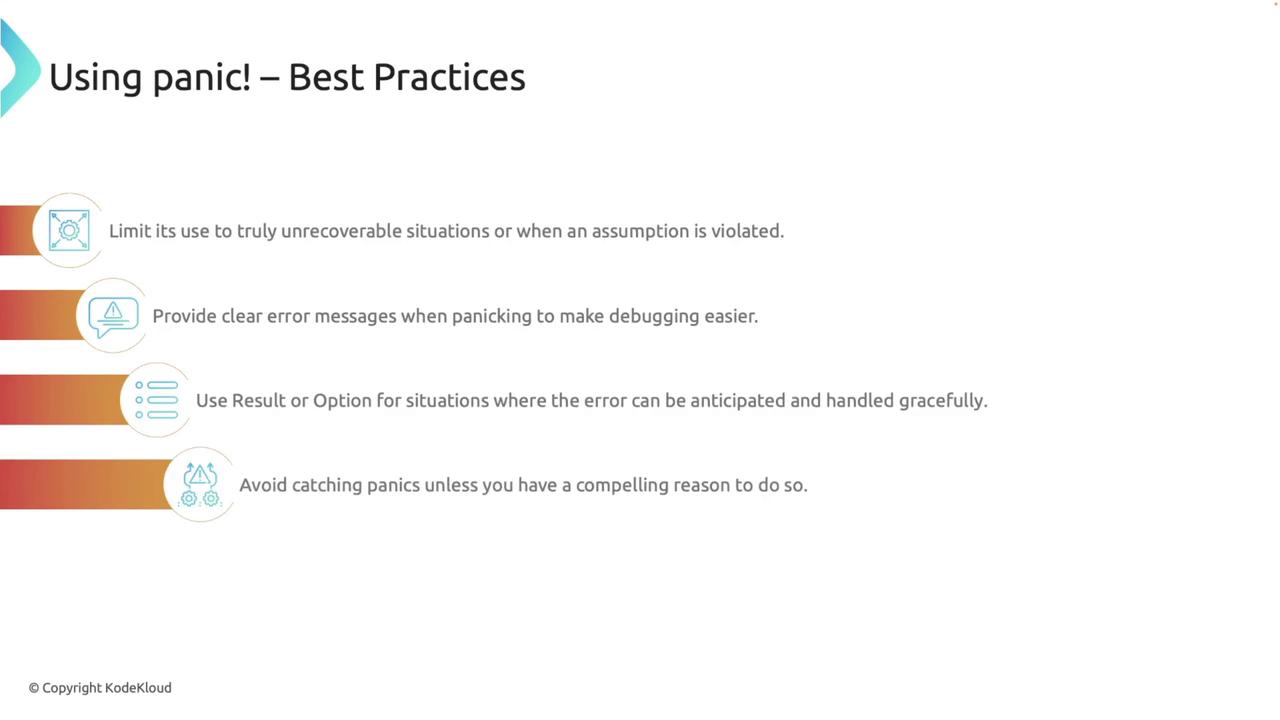
- Limit the Use of panic!: Reserve
panic!for truly unrecoverable situations or when vital assumptions are violated. - Provide Descriptive Messages: Ensure error messages are clear and informative to aid in debugging.
- Favor Graceful Error Handling: Utilize
ResultorOptionfor errors that can be anticipated and handled without terminating the program. - Avoid Catching Panics: Let Rust’s natural error handling mechanism work as intended unless there is an exceptional reason to catch panics.
panic! macro works, you can write more robust and reliable Rust applications that handle errors effectively while maintaining performance.
For further reading, check out Rust’s official documentation and Error Handling in Rust.