Understanding the Send Trait
The Send trait permits ownership of a value to be transferred across threads. When a type implements Send, it indicates that moving its ownership into another thread is safe. The Rust compiler auto-implements Send for types that are thread-safe to transfer.
move keyword:
v is moved into a new thread because Vec<T> implements Send. If it didn’t, the compiler would prevent the transfer to ensure safety.
Use the Send trait to safely pass data between threads, enabling concurrent operations without risking data corruption.
Understanding the Sync Trait
The Sync trait indicates that a type can be safely referenced from multiple threads concurrently. When a type implements Sync, immutable references to it can be shared across threads without concerns for data races. Primitive types are typically Sync, whereas types likeRefCell<T>, which allow interior mutability, are not.
Here’s an example employing Arc (Atomic Reference Counting) to share a vector safely between threads:
Arc provides thread-safe shared ownership. If Arc were not Sync, the Rust compiler would prevent such shared access, thereby averting potential data races.
Most types in Rust automatically implement both Send and Sync. This seamless implementation is part of what makes Rust a powerful language for concurrent programming.
Manual Implementation of Send and Sync
Generally, Rust’s compiler handles trait implementations automatically. However, there are rare cases where manual implementation becomes necessary, particularly for custom types comprising non-primitive data or raw pointers. Manual implementation must be approached with caution, as it bypasses safety checks. For instance, consider a custom type containing a raw pointer:unsafe impl Send declaration must be used only when you are completely certain that transferring the type across threads is secure.
Manual implementations of Send and Sync should be used sparingly. Always ensure a thorough understanding of concurrency implications before overriding the compiler’s safety guarantees.
Ownership Transfer and Channels
When creating new threads in Rust, data transfer is commonly performed using themove keyword. This approach ensures that data ownership is safely handed over to another thread as long as the type implements Send.
Channels facilitate thread communication by allowing data to be sent between threads. The data traversing these channels must implement Send, ensuring safe data transfer among threads.
Consider the following example where a vector is sent from one thread to another via a channel:
Vec<T> adheres to the Send trait. This design ensures thread safety and leverages Rust’s robust concurrency model.
Summary
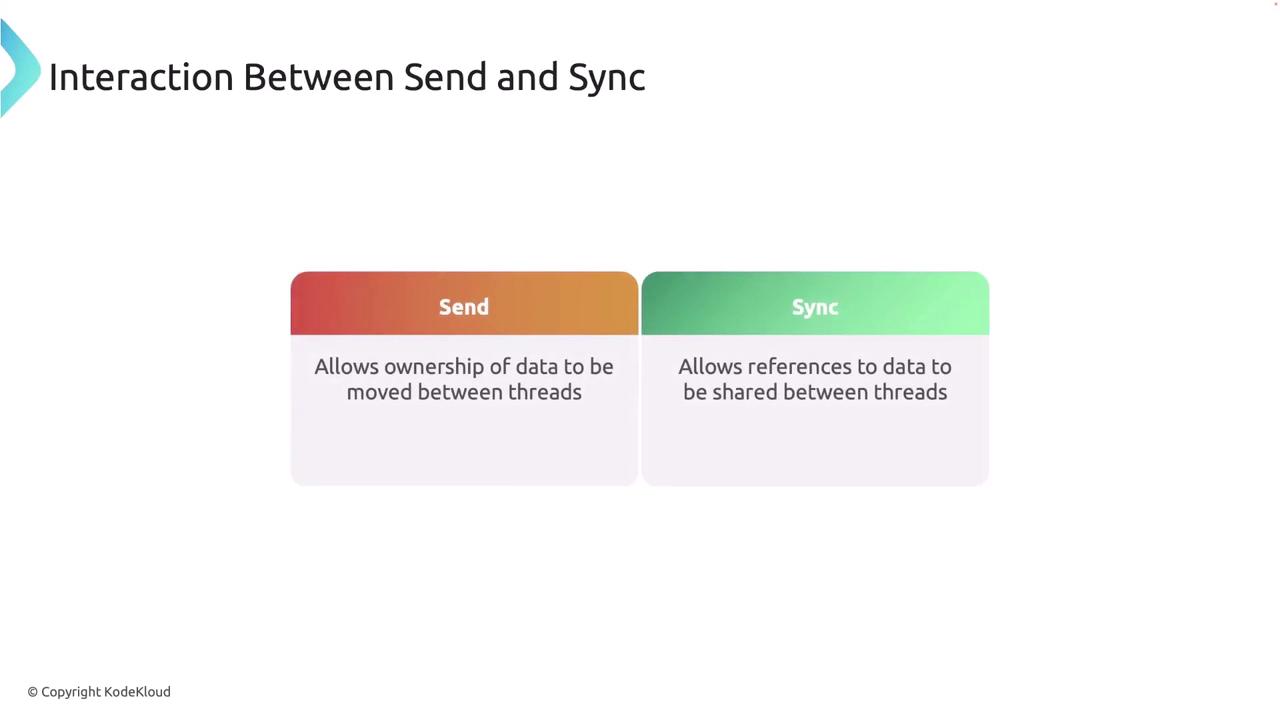
The Send and Sync traits are essential to Rust’s approach to concurrency. The Send trait ensures that data ownership can be moved between threads, while the Sync trait allows multiple threads to share immutable references safely. Together, these traits provide a solid foundation for building reliable and concurrent Rust applications.