

- Memory Safety: Rust eliminates errors such as null pointer dereferencing and buffer overflows at compile time.
- Performance: Using zero-cost abstractions, Rust offers system-level control comparable to C and C++.
- Concurrency: The language prevents data races, enabling safe and efficient concurrent programming.
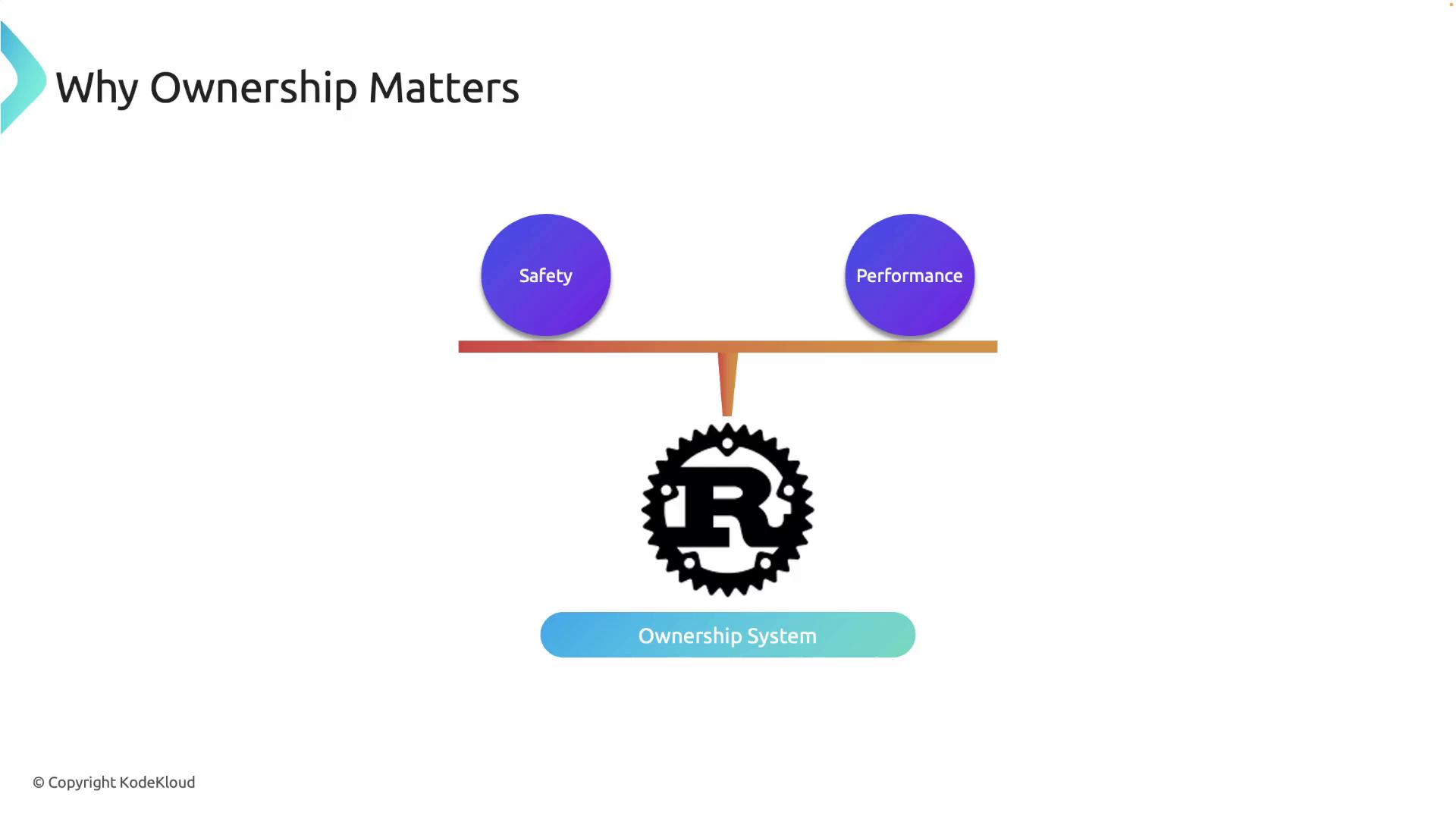
- No Garbage Collection: Rust’s ownership system ensures predictable performance by managing memory without garbage collection.
Rust’s ownership system enforces strict compile-time rules that guarantee memory safety and reliability, making it a compelling alternative to manual memory management or garbage collection.
What Is Ownership?
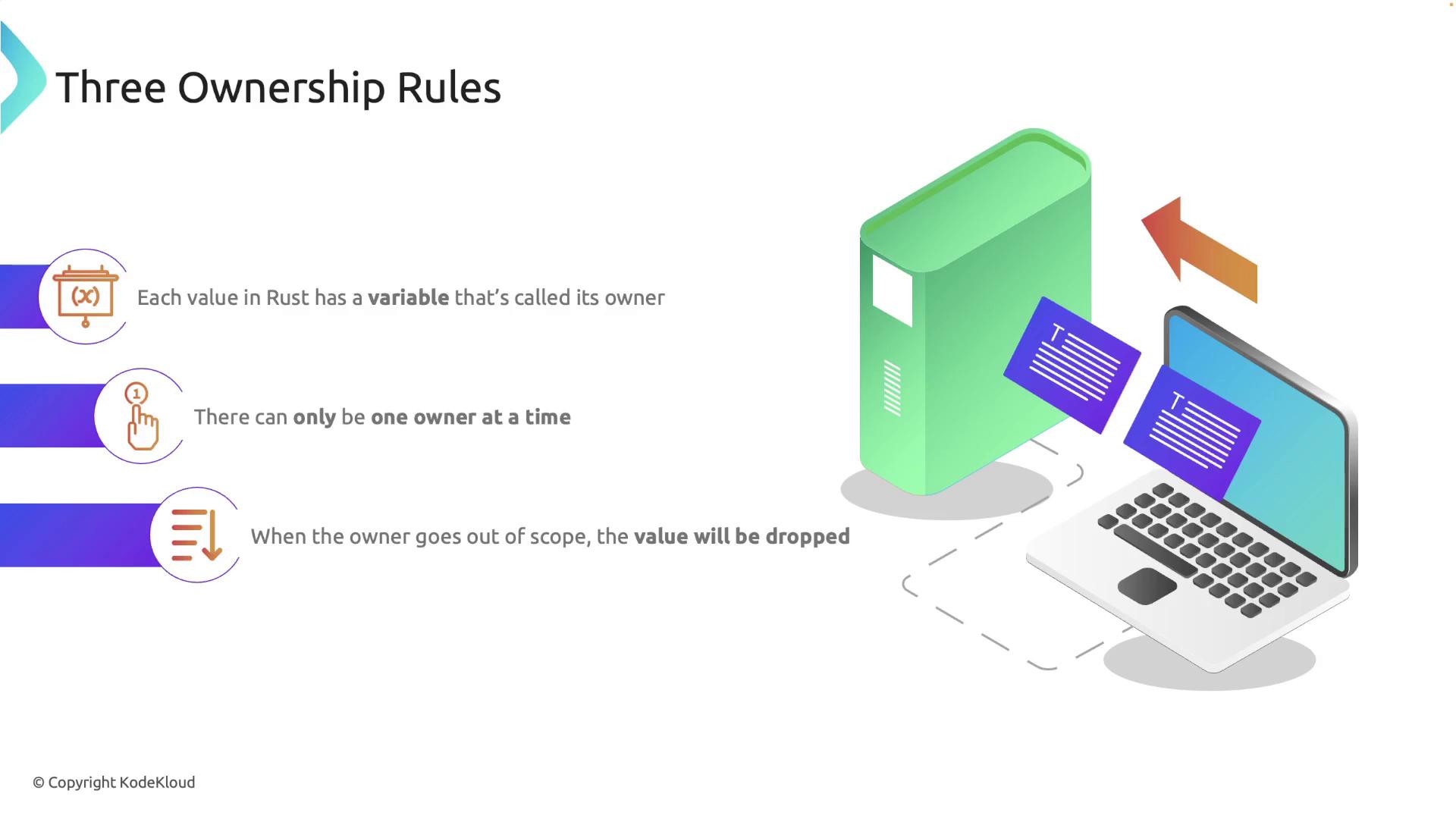
Ownership in Rust defines the rules for how memory is managed. Although the rules are straightforward, they have a profound effect on program behavior. Here are the key ownership rules:- Each value has a single owner: Every value in Rust is associated with a variable.
- Exclusive ownership: A value can have only one owner at a time.
- Automatic deallocation: When the owning variable goes out of scope, the value is dropped and its memory is deallocated.
An Example of Ownership
Consider the following Rust example. It demonstrates how a string, allocated on the heap, is owned by the variables:
s. Once s goes out of scope at the end of the main function, Rust automatically deallocates the memory used by the string. This process—where the value is dropped when its owner goes out of scope—is integral to Rust’s memory management.
In Rust, understanding when and how memory is allocated and deallocated is crucial for writing efficient and safe code. The ownership rules ensure that memory is managed predictably and safely.