HashMap::new() function or by collecting key-value pairs from an iterator. Below is an example demonstrating how to create an empty Hashmap and insert data into it:
insert() method, and the complete map is printed to the console.
Creating a HashMap from an Iterator
You can also build a HashMap directly from an iterator. In the example below, we define two vectors—one for student names and one for their respective grades. The vectors are converted into iterators using theinto_iter() method, paired using zip(), and finally collected into a Hashmap with collect().
Inserting and Updating Elements
Elements can be added to a HashMap using theinsert() method. If the key already exists, the new value will overwrite the existing one. Consider the following example that updates Alice’s grade:
entry() method, which inserts a value only if the key is not already present:
Accessing Values
There are two common methods to access values in a HashMap: using theget() method or indexing.
Using the get() Method
Theget() method returns an Option (either Some(value) if the key exists or None if it does not). This allows you to handle both cases using pattern matching:
Using Indexing
Indexing provides a more concise way to access values, but it will panic if the key does not exist. Ensure that the key is present before using this method:Updating Values with Ownership Considerations
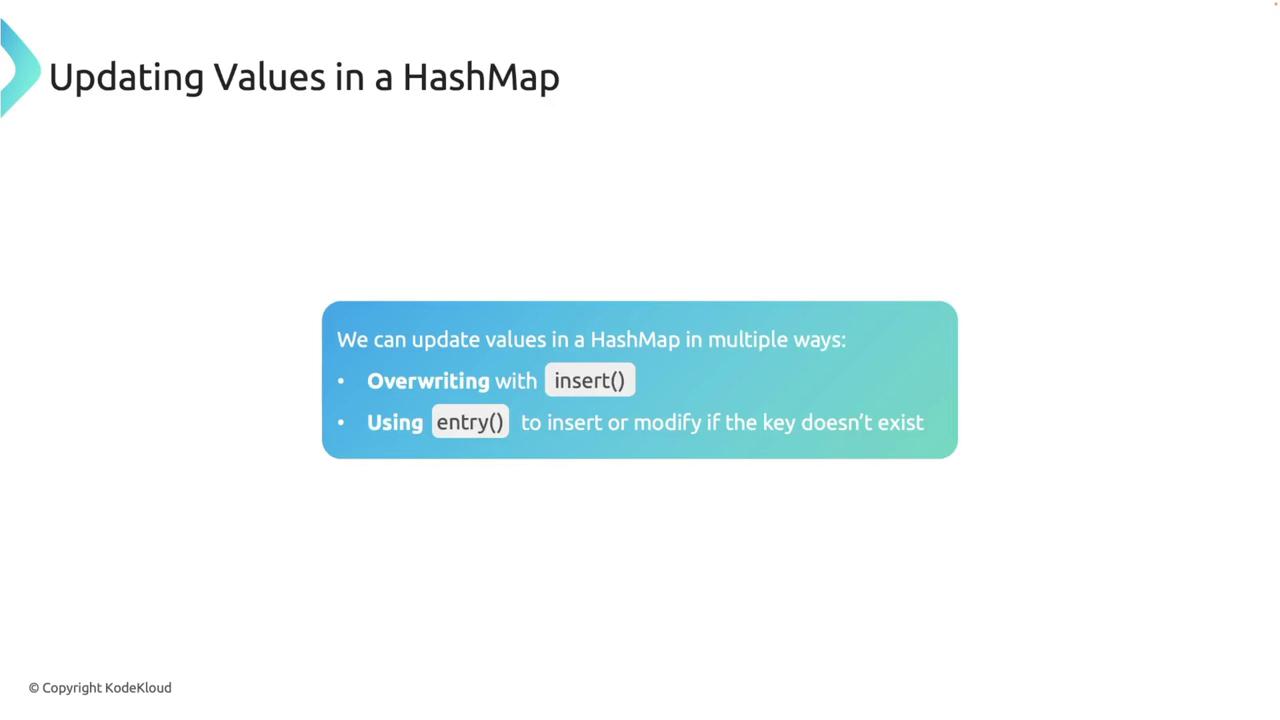
Overwriting with insert()
When you insert a key that already exists, its associated value is replaced by the new one:Using entry()
Theentry() method checks if the key exists. It inserts the provided value only if the key is missing; otherwise, the existing value remains unchanged:
Removing Elements and Iterating
To remove an element from a HashMap, use theremove() method with the key as its argument:
Common HashMap Methods
Several methods are frequently used with Hashmaps:len()– Returns the number of elements.is_empty()– Checks if the map is empty.remove()– Removes a key-value pair.contains_key()– Checks if a specific key exists.
Ownership and Borrowing with HashMaps
Moving Ownership
HashMaps in Rust do not implement theCopy trait, so moving a HashMap transfers ownership. In the following example, ownership of student_grades is transferred to new_student_grades, making the original variable inaccessible:
student_grades after this move results in a compile-time error.
Borrowing an Immutable Reference
You can borrow an immutable reference to a HashMap, allowing data access without transferring ownership. Both the original variable and its borrowed reference can be used concurrently:While borrowing immutably, the HashMap cannot be modified. Any attempt to mutate it through an immutable reference will trigger a compile-time error.
Borrowing a Mutable Reference
To modify a HashMap while referencing it, borrow a mutable reference. The following example demonstrates how to insert a new element through a mutable reference:Performance Considerations
Hashmaps are generally efficient, but several factors can affect their performance:- Hash Collisions: Multiple keys may hash to the same value, causing collisions. Rust uses a collision resolution strategy to manage these scenarios.
- Rehashing: When a HashMap becomes overly full, it may rehash its entries into a larger array. Although rehashing is computationally expensive, Rust handles it automatically.
- Hash Function: Rust’s default HashMap employs a cryptographically secure hashing algorithm. While this enhances security, it might be slower compared to non-secure alternatives. In performance-critical applications where security is less of a concern, you can opt for a different hashing function.