

Request Lifecycle in Kubernetes
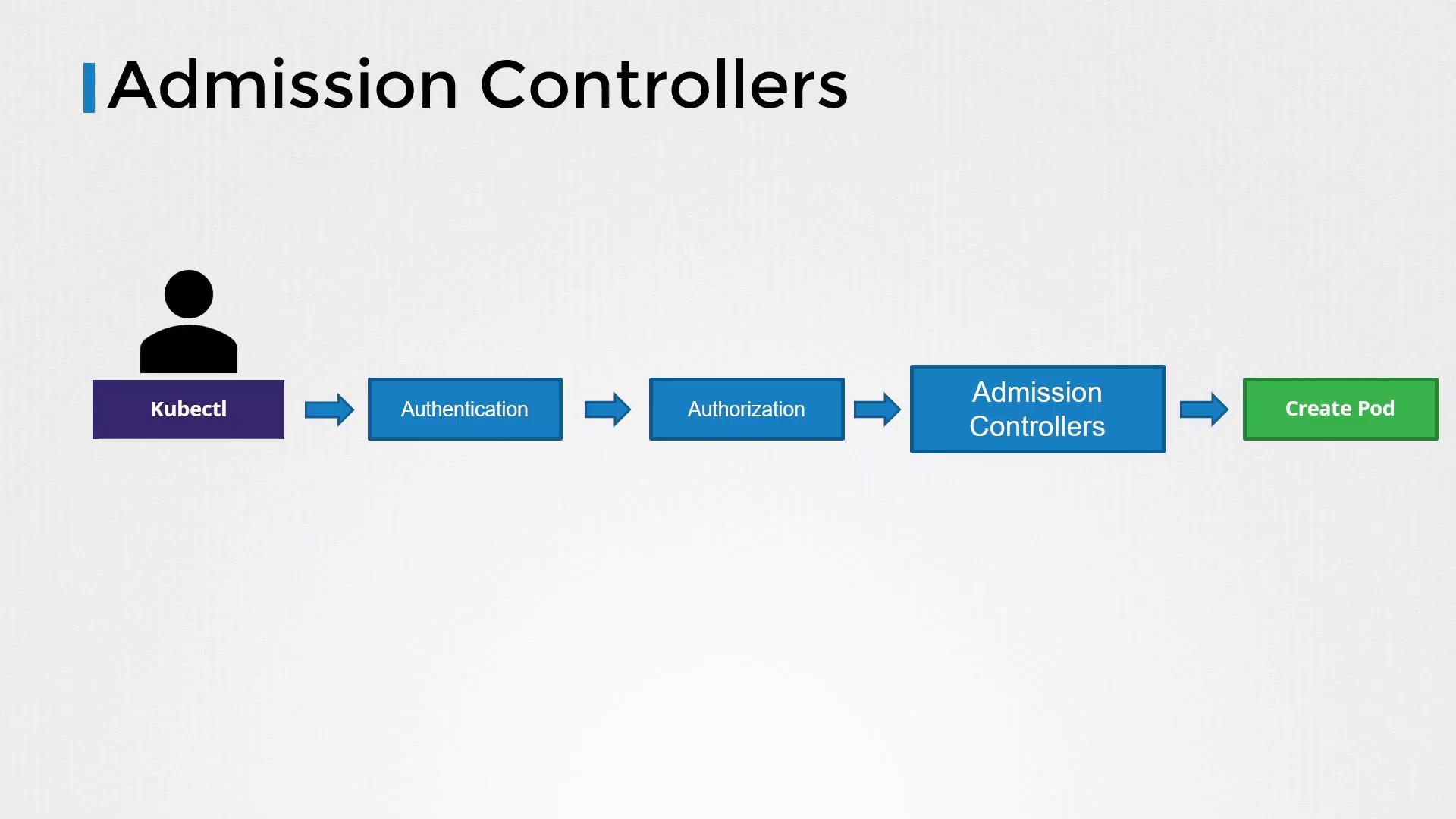
When a request is sent to the API server, it undergoes several critical steps:-
Authentication:
The API server authenticates the request. For instance, when using kubectl, the KubeConfig file supplies the necessary certificates. You can view a snippet from the KubeConfig file using:
Only a portion of the base64-encoded certificate data is shown for brevity.
-
Authorization:
After authentication, the request is authorized. Kubernetes uses role-based access control (RBAC) to determine if the user has permission to perform the requested operation. For example, a role allowing the manipulation of pods might be defined as:More granular permissions can also be established. For instance, the following role permits a developer to create only specific pods:In this case, the developer is restricted to creating pods named either “blue” or “orange.”
The Role of Admission Controllers
Beyond basic authentication and authorization, there are scenarios that require additional validations or modifications to incoming requests. Consider a pod creation request, where you might want to:- Ensure that images are only pulled from an approved internal registry.
- Enforce that the image tag is not set to “latest.”
- Reject requests if the container runs as the root user.
- Modify the container’s security context or enforce specific metadata labels.
Built-In Admission Controllers
Kubernetes includes several pre-built admission controllers, such as:- Always Pull Images: Ensures that images are pulled on each pod creation.
- Default Storage Class: Automatically assigns a default storage class to persistent volume claims if none is specified.
- Event Rate Limit: Restricts the number of requests processed by the API server concurrently.
- Namespace Exists: Verifies that the specified namespace exists, rejecting requests for non-existent namespaces.
Namespace-Related Admission Controllers
Namespace Exists Admission Controller
If you attempt to create a pod in a non-existent namespace, the namespace exists admission controller will reject the request. For example:- The API server authenticates and authorizes the request.
- The namespace exists admission controller verifies if the “blue” namespace is available.
- Since the namespace does not exist, the request is rejected.
Namespace Auto-Provision Admission Controller
An alternate admission controller, the namespace auto-provision admission controller, can automatically create a namespace if it does not exist. Note that this controller is not enabled by default. Without auto-provisioning, running the command:Using these commands helps ensure that you’re aware of all the active admission controllers in your cluster.
Configuring Admission Controllers
Enabling Admission Controllers
To enable additional admission controllers, update the--enable-admission-plugins flag on the kube-apiserver. In a kubeadm-based setup, this update is performed in the kube-apiserver manifest file. For example, you might configure the API server service as follows:
--disable-admission-plugins flag in a similar way.