Welcome to the final module in the course: Bringing It All Together. This lesson folds the fundamentals you’ve learned into practical guidance for starting and growing as a Site Reliability Engineer (SRE). The goal is to help new and entry-level practitioners prioritize what to learn, where to gain experience, and how to begin applying reliability fundamentals in real environments. We’ll cover:
  • What SRE looks like today and why it matters
  • Typical entry-level responsibilities and how to approach them
  • Paths into SRE (operations, development, or new-to-tech)
  • Practical ways to gain experience (on the job, side projects, open source)
  • Essential technical and soft skills to focus on
SRE is a rapidly expanding field. Organizations increasingly treat reliability as a business differentiator: reliable services build user trust, which fuels growth. As AI becomes central to many products, the operational challenges—safe deployment, observability, testing, and cross-team coordination—will increase demand for experienced SREs. While AI can generate code, safe system-wide changes, secure releases, and incident management still require human operational expertise.
AI amplifies the scale and complexity of production systems. Expect more opportunities to shape how AI-powered services are operated, observed, and safely released—making SRE skills more valuable, not less.

Entry-level reality: what to expect day one

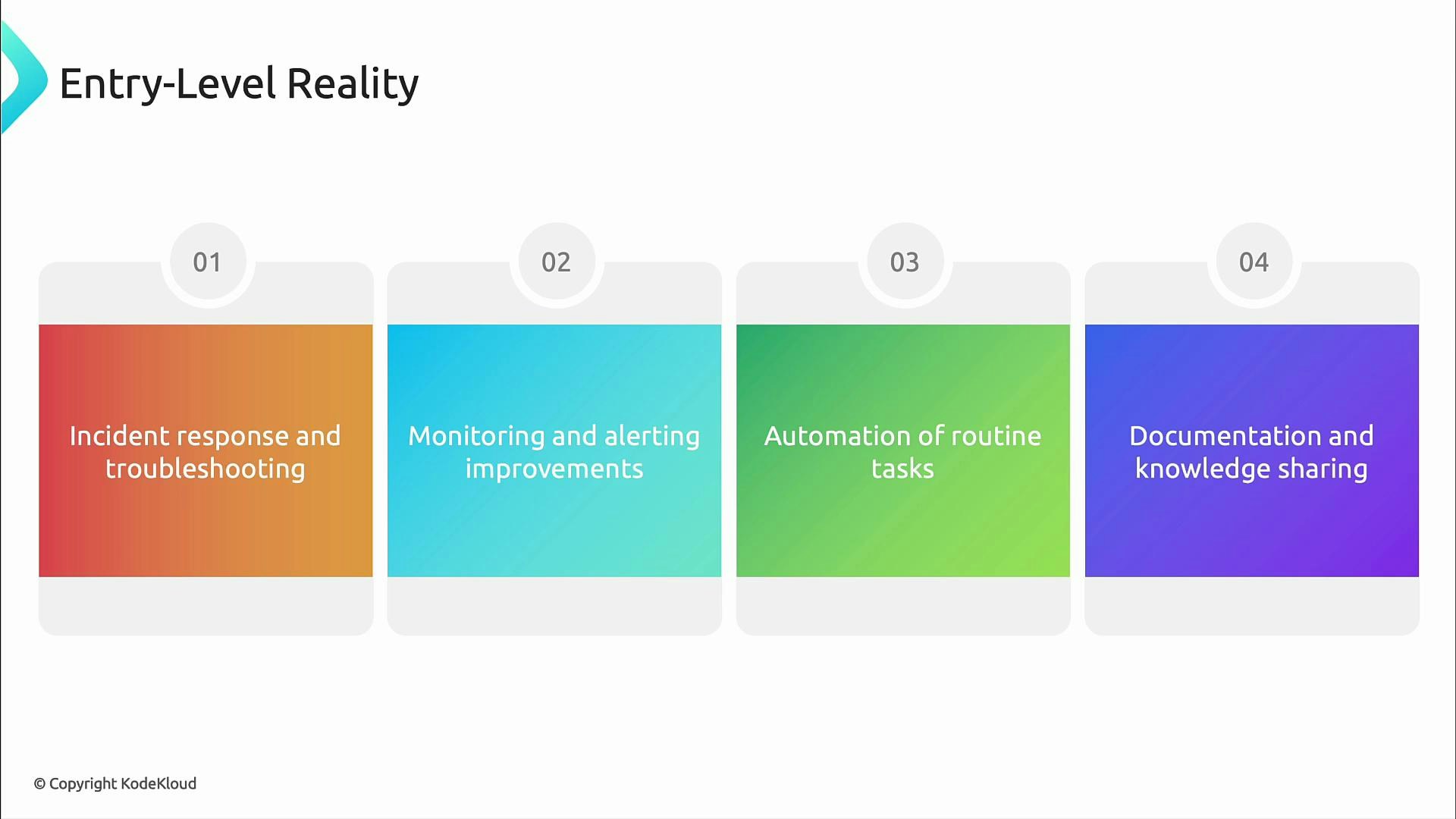
At the entry level you’ll often be thrown straight into operational work. Common responsibilities include:
  • Incident response and troubleshooting
  • Tuning monitoring and alerting
  • Automating repetitive tasks to reduce toil
  • Writing and improving documentation and runbooks
These tasks may seem basic, but they are the foundation of reliability. Always ask: Why is this process or alert configured this way? Which parts of the workflow are candidates for automation? Understanding the “why” helps you prioritize impactful improvements.
A slide titled "Entry-Level Reality" showing four numbered, colored panels. Each panel lists a typical responsibility: incident response and troubleshooting; monitoring and alerting improvements; automation of routine tasks; and documentation and knowledge sharing.
Don’t hesitate to update documentation or propose improvements when you spot gaps. The aim is to get up to speed quickly and begin contributing to reliability, not just by performing tasks but by learning the system design and trade-offs behind them.

Paths into SRE: choose a starting foundation

There are multiple, often non-linear paths into SRE. Each background brings strengths and gaps you can address with targeted learning. If you come from operations or infrastructure, you likely already know production systems, troubleshooting, monitoring, and on-call practices. To level up for SRE, focus on programming and automation (scripting, APIs), infrastructure-as-code, and fundamental reliability concepts like SLOs and error budgets.
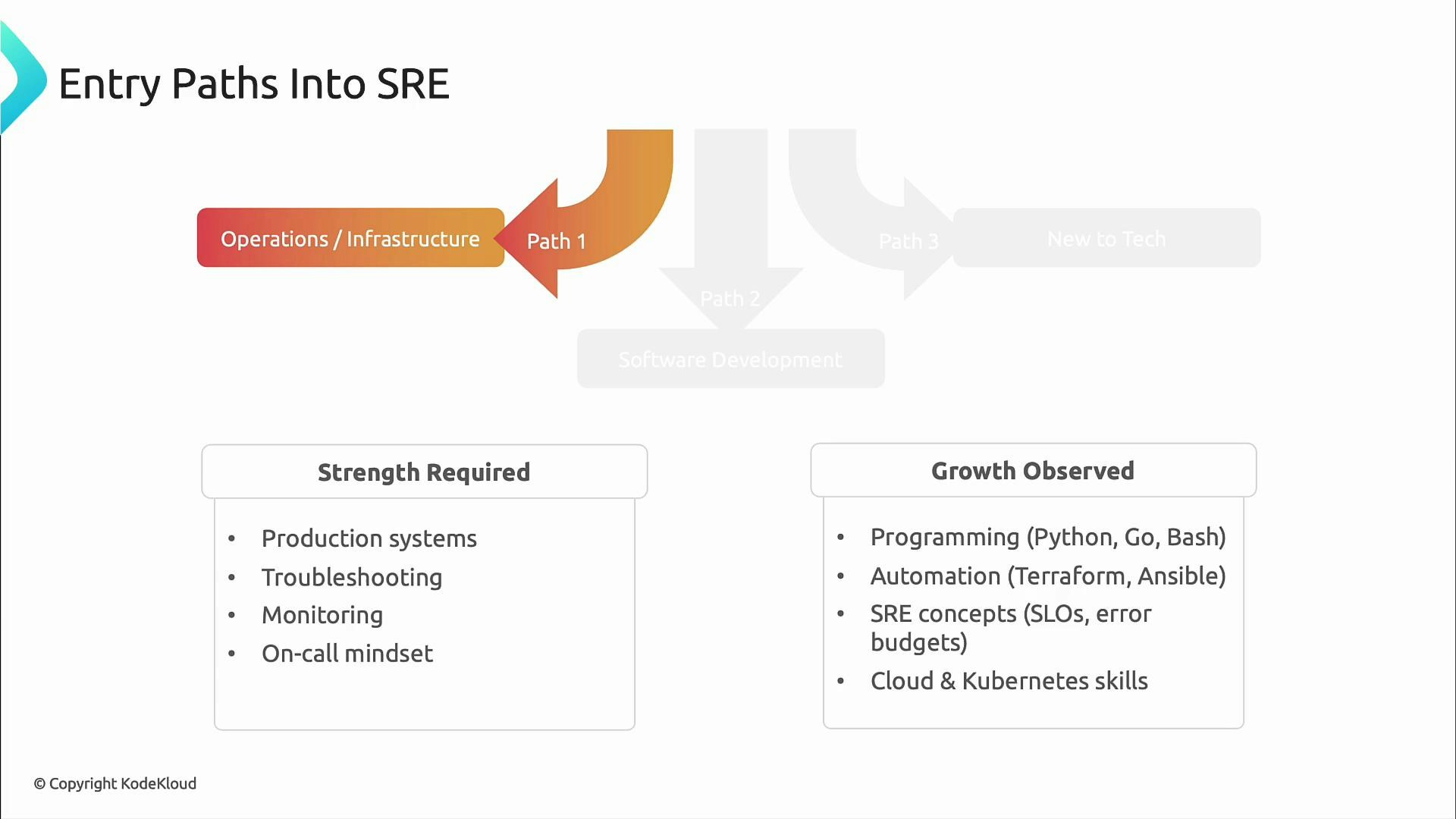
A presentation slide titled "Entry Paths Into SRE" highlighting Path 1: Operations/Infrastructure. It lists strengths required (production systems, troubleshooting, monitoring, on-call mindset) and growth observed (programming, automation, SRE concepts, cloud & Kubernetes).
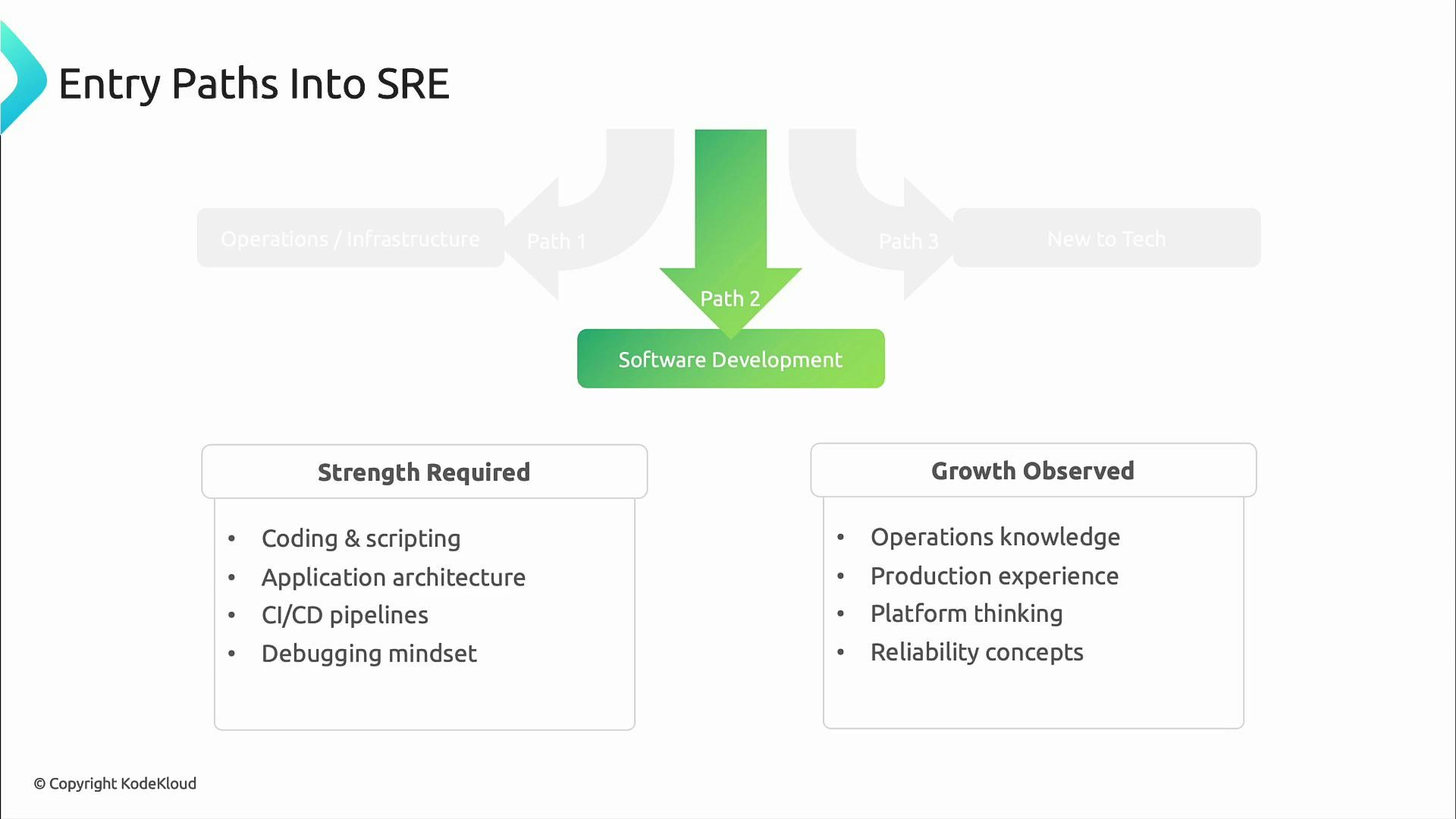
If you come from software development, you likely have strong coding, architecture, CI/CD, and debugging skills. To transition toward SRE, gain production experience: monitoring and alerting, on-call/incident response exposure, Linux and networking fundamentals, and platform thinking (scaling, capacity, recovery).
A slide titled "Entry Paths Into SRE" highlighting Path 2: Software Development with a large green arrow. It lists strengths required (coding & scripting, application architecture, CI/CD pipelines, debugging mindset) and growth observed (operations knowledge, production experience, platform thinking, reliability concepts).
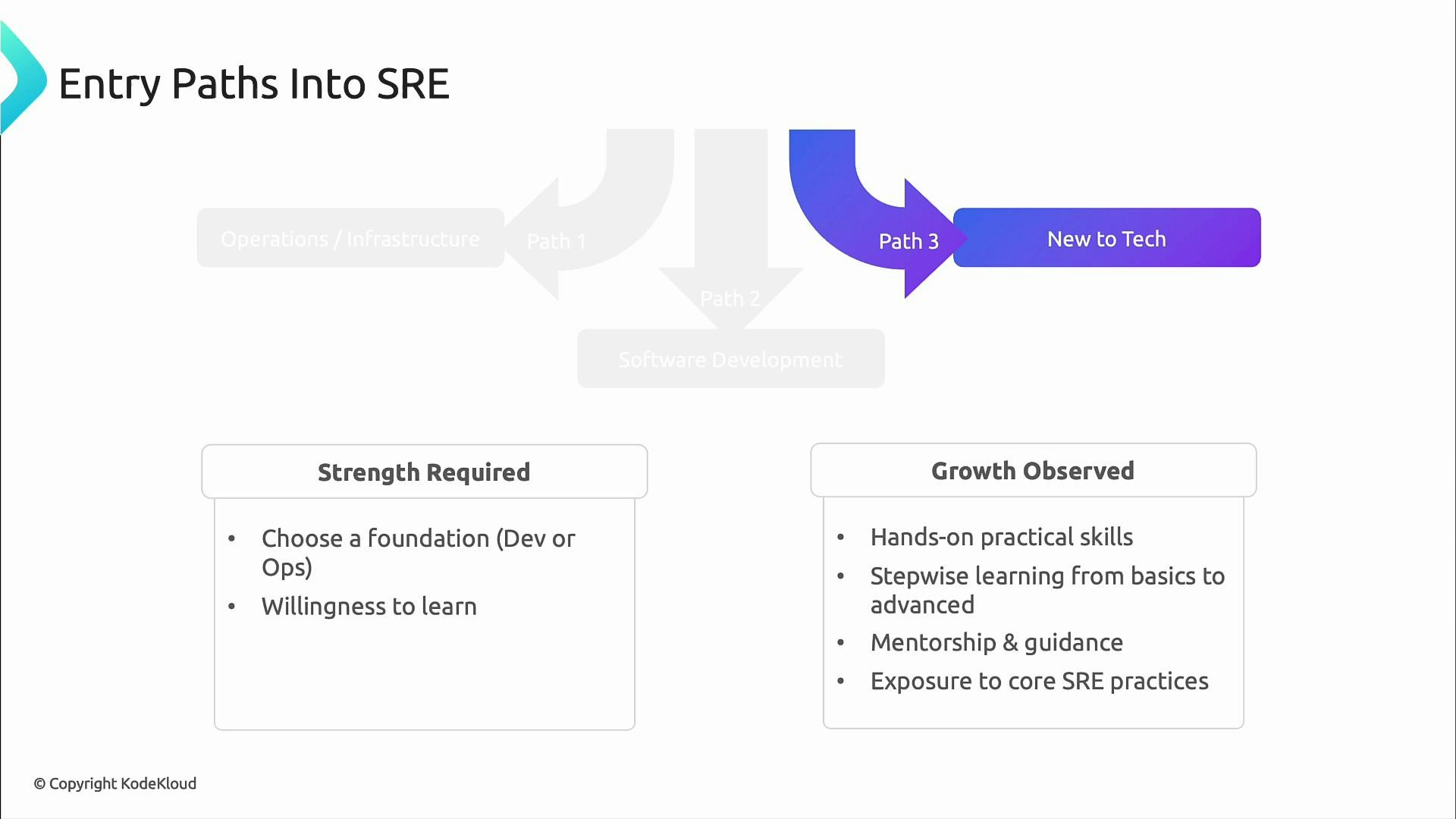
If you’re new to tech, SRE is attainable with an intentional, hands-on approach. Pick a foundation (dev or ops), practice incrementally, and seek mentorship. Real experience trumps theory—start small and build up.
A presentation slide titled "Entry Paths Into SRE" with a highlighted arrow for "Path 3: New to Tech." Below are two boxes listing "Strength Required" (choose a foundation, willingness to learn) and "Growth Observed" (hands-on skills, stepwise learning, mentorship, exposure to SRE practices).
Table: Quick comparison of entry paths
Entry PathTypical StrengthsSuggested Growth Areas
Operations / InfrastructureProduction systems, monitoring, on-callProgramming (Python, Go, Bash), automation (Terraform, Ansible), SRE concepts, cloud & Kubernetes
Software DevelopmentCoding, CI/CD, architectureProduction experience (alerts, incidents), Linux & networking, platform thinking
New to TechWillingness to learn; choose foundationHands-on labs, mentorship, incremental learning, SRE workflows
Useful learning resources:

Core technical skill areas for SREs

To succeed, focus on three broad technical domains:
Skill AreaWhat to learnExample topics
Programming & AutomationReduce toil with scripts and toolingScripting, API integration, data analysis, CI/CD automation
Infrastructure & PlatformUnderstand how services run at scaleCloud fundamentals, containers, Kubernetes, IaC (Terraform, Ansible)
Monitoring & ObservabilityMeasure and improve reliabilityDashboards, alerting, SLOs/SLA, telemetry, tracing & logging
These areas combine to help you keep systems reliable and scalable.
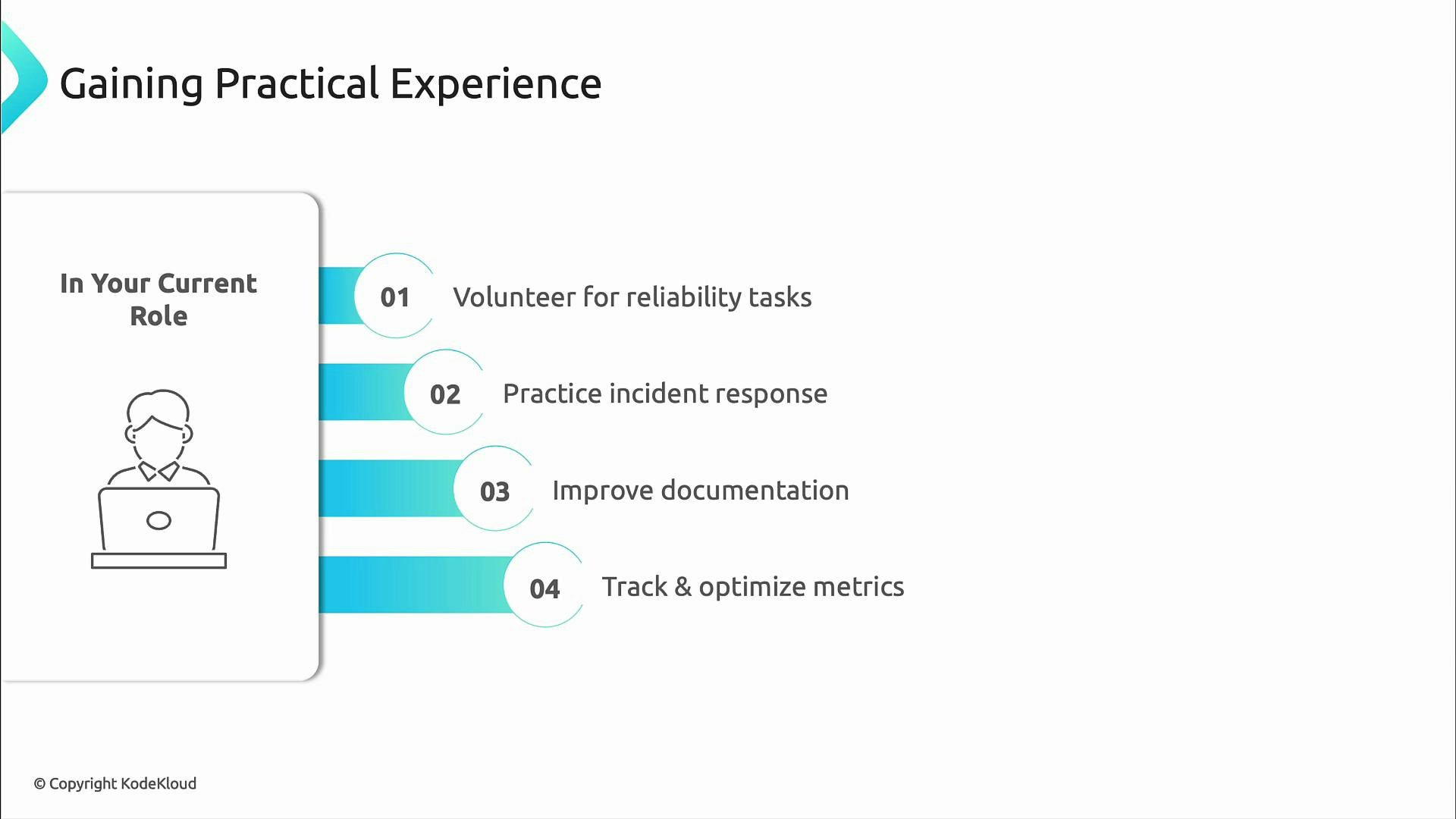
A presentation slide titled "Gaining Practical Experience" listing four tips: 01 volunteer for reliability tasks, 02 practice incident response, 03 improve documentation, and 04 track & optimize metrics. On the left is a panel labeled "In Your Current Role" with an icon of a person at a laptop and a small "© Copyright KodeKloud" notice.

Gain experience where you are

You don’t need the SRE title to build SRE expertise. In your current role, look for opportunities to:
  • Volunteer for reliability work (alerts, runbooks, incident drills)
  • Automate repetitive tasks to free team bandwidth
  • Join post-incident reviews and start contributing to remediation
  • Track metrics that show impact (MTTR, alert noise reduction, error rates)
Small, measurable improvements build credibility and a portfolio you can present to hiring managers.
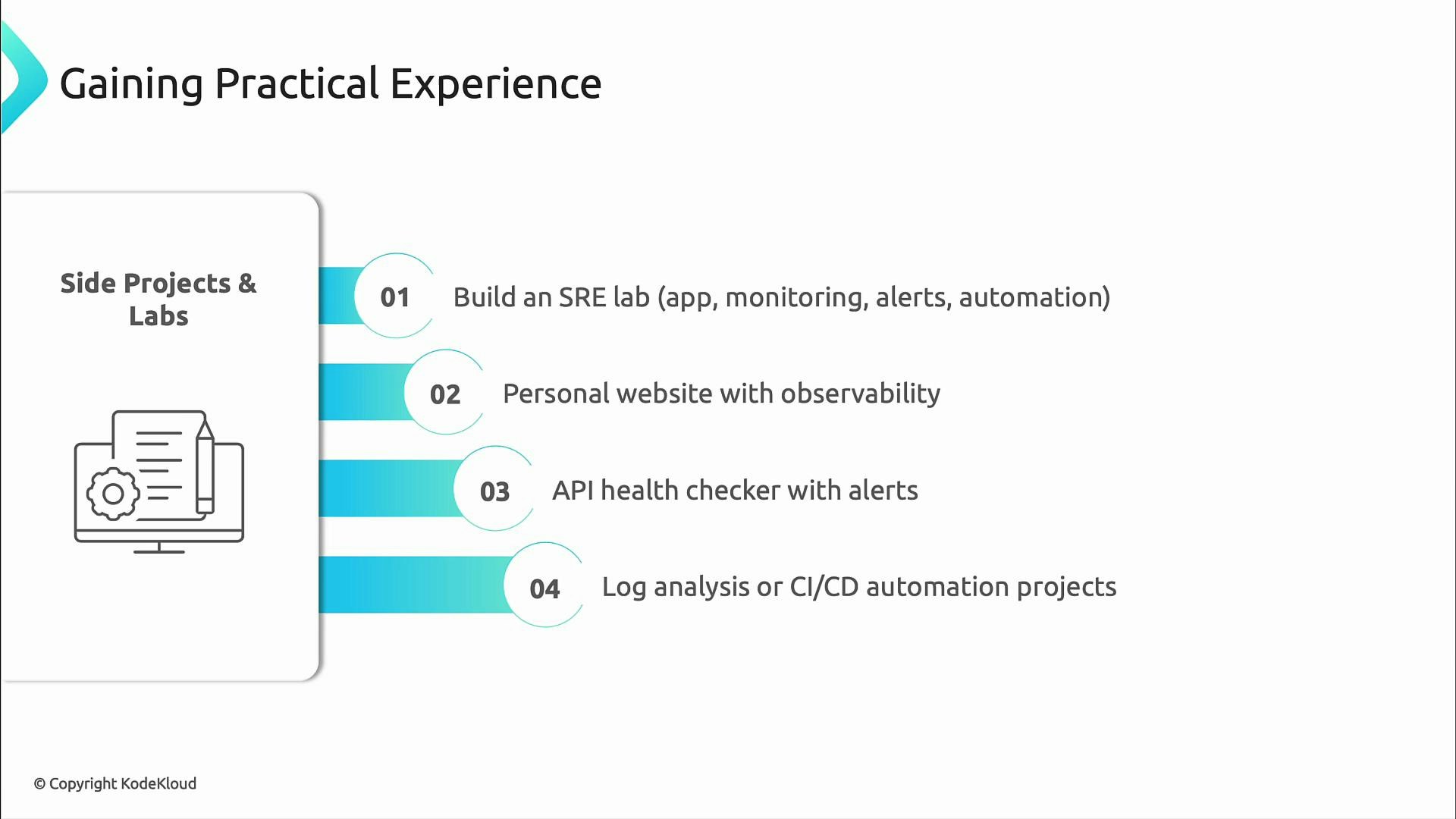
A presentation slide titled "Gaining Practical Experience" showing "Side Projects & Labs" with four numbered suggestions: build an SRE lab, create a personal website with observability, make an API health checker with alerts, and do log analysis or CI/CD automation projects. The left side has an icon of a monitor, document and gear.
Side projects are an excellent way to practice core SRE workflows. Ideas:
  • Build a personal SRE lab: deploy a small app, add metrics and alerts, and automate deployments.
  • Add observability to a website: metrics, logs, and tracing.
  • Create an API health checker that triggers alerts and dashboards.
  • Automate CI/CD pipelines and practice rolling updates and canary releases.
When experimenting, avoid making risky changes in production. Use local labs, staging environments, or small canary deployments to validate automation and monitoring before wide rollout.
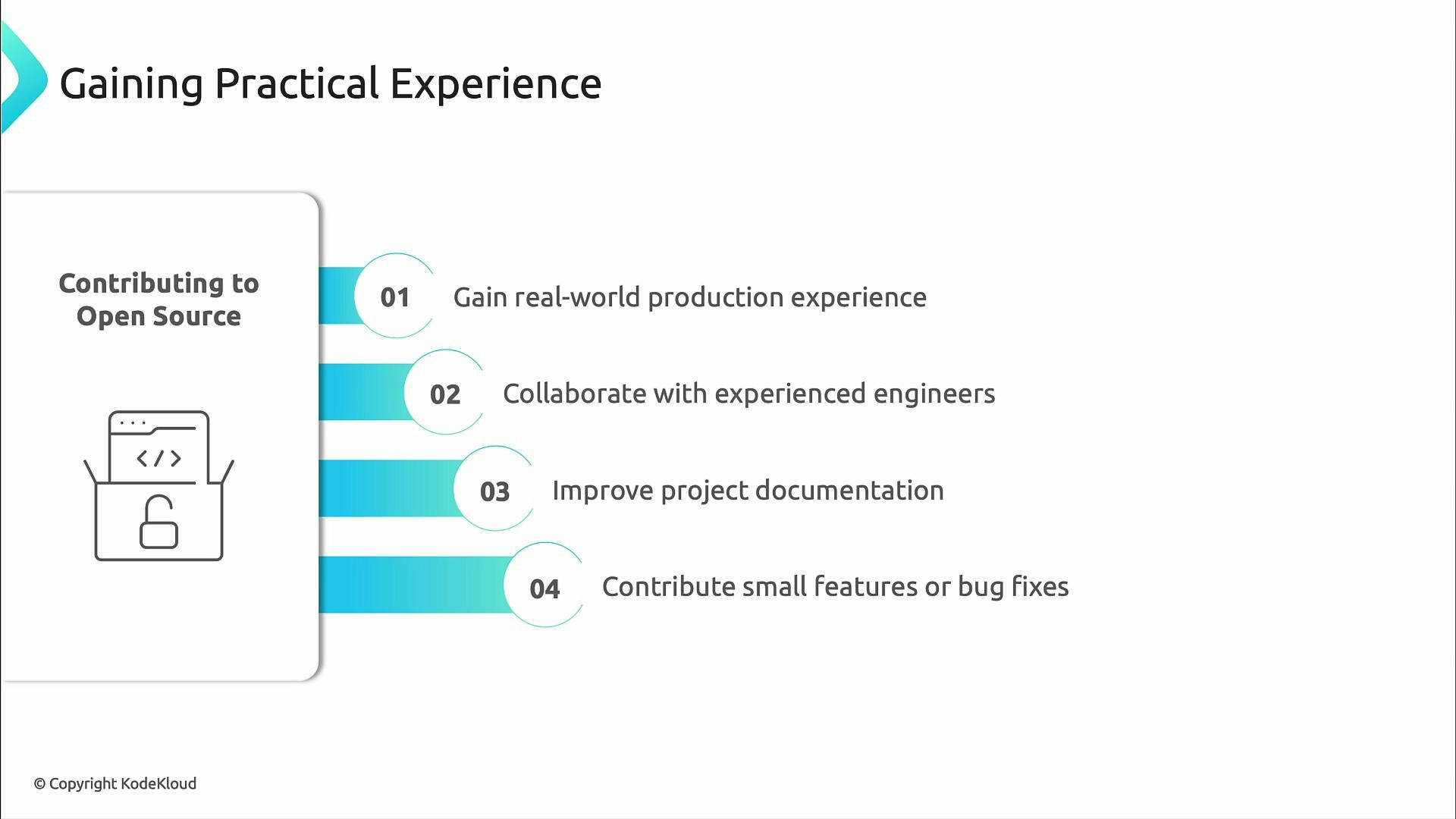
A presentation slide titled "Gaining Practical Experience" that encourages contributing to open source, shown with a code-in-a-box icon. It lists four points: gain real-world production experience, collaborate with experienced engineers, improve documentation, and contribute small features or bug fixes.
Contributing to open source is another high-leverage path: it exposes you to real systems, collaborative workflows, and code reviews. Start with documentation fixes or small bug fixes and progress to larger contributions.

Soft skills: communication and teamwork

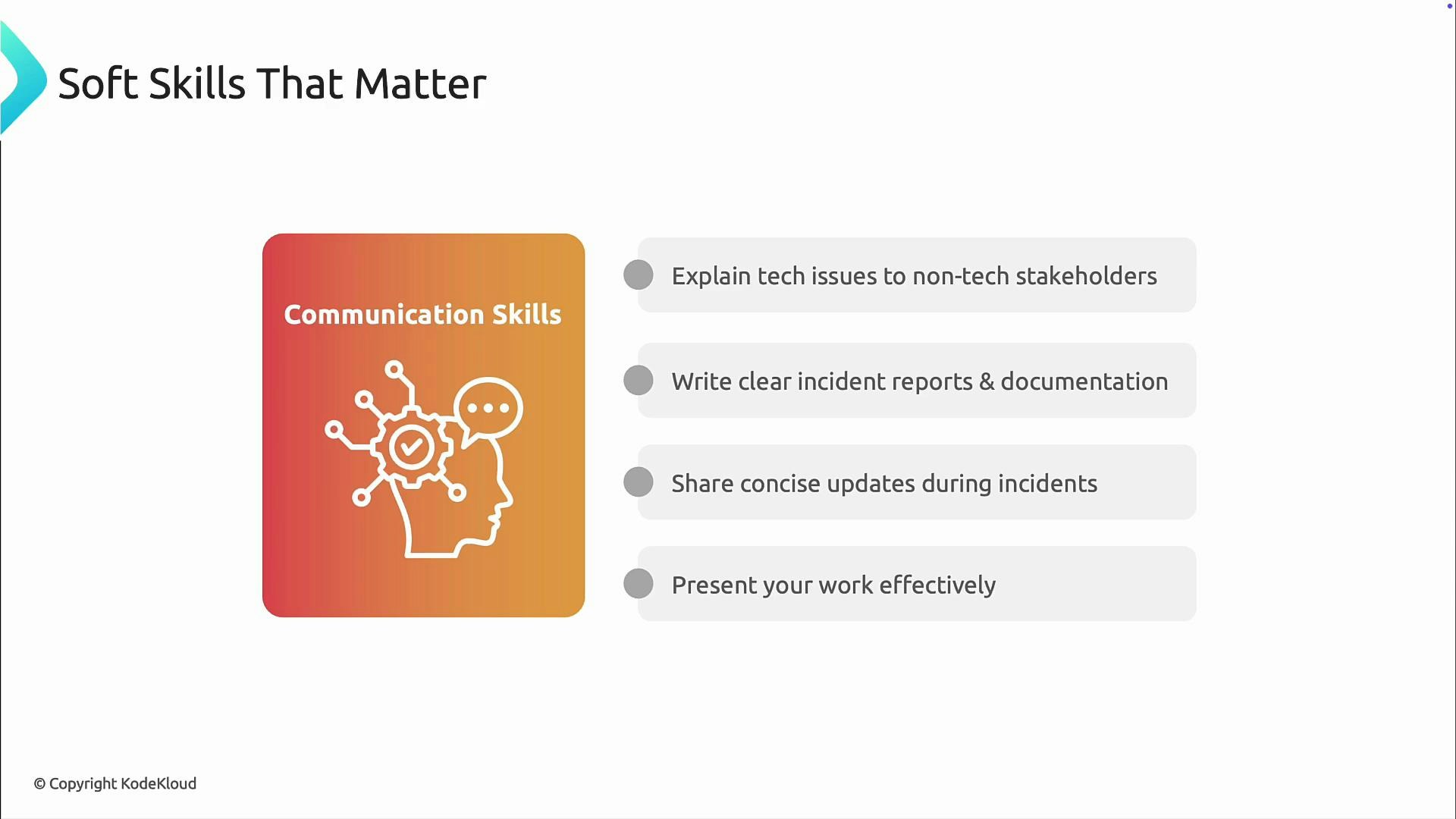
SRE is not purely technical. Clear communication and collaboration are essential:
  • Explain technical issues to non-technical stakeholders
  • Write concise incident reports and postmortems
  • Provide succinct updates during incidents
  • Present reliability work and trade-offs to product and leadership
Teamwork matters: respect established processes, improve them incrementally, and be a bridge between development and operations.
A slide titled "Soft Skills That Matter" focusing on Communication Skills, shown with an icon of a head and gear. Four bullet points list explaining tech issues to non‑tech stakeholders, writing clear incident reports and documentation, sharing concise updates during incidents, and presenting your work effectively.

Practice continuously and reflect

SRE is a craft that improves with repetition and reflection. Tactics to accelerate learning:
  • Write technical notes or blog posts to clarify your understanding
  • Participate in communities, forums, and meetups
  • Study incident postmortems—real incidents teach operational reality faster than theory
  • Run test types (load, stress, soak, spike) to see how systems behave under different pressures
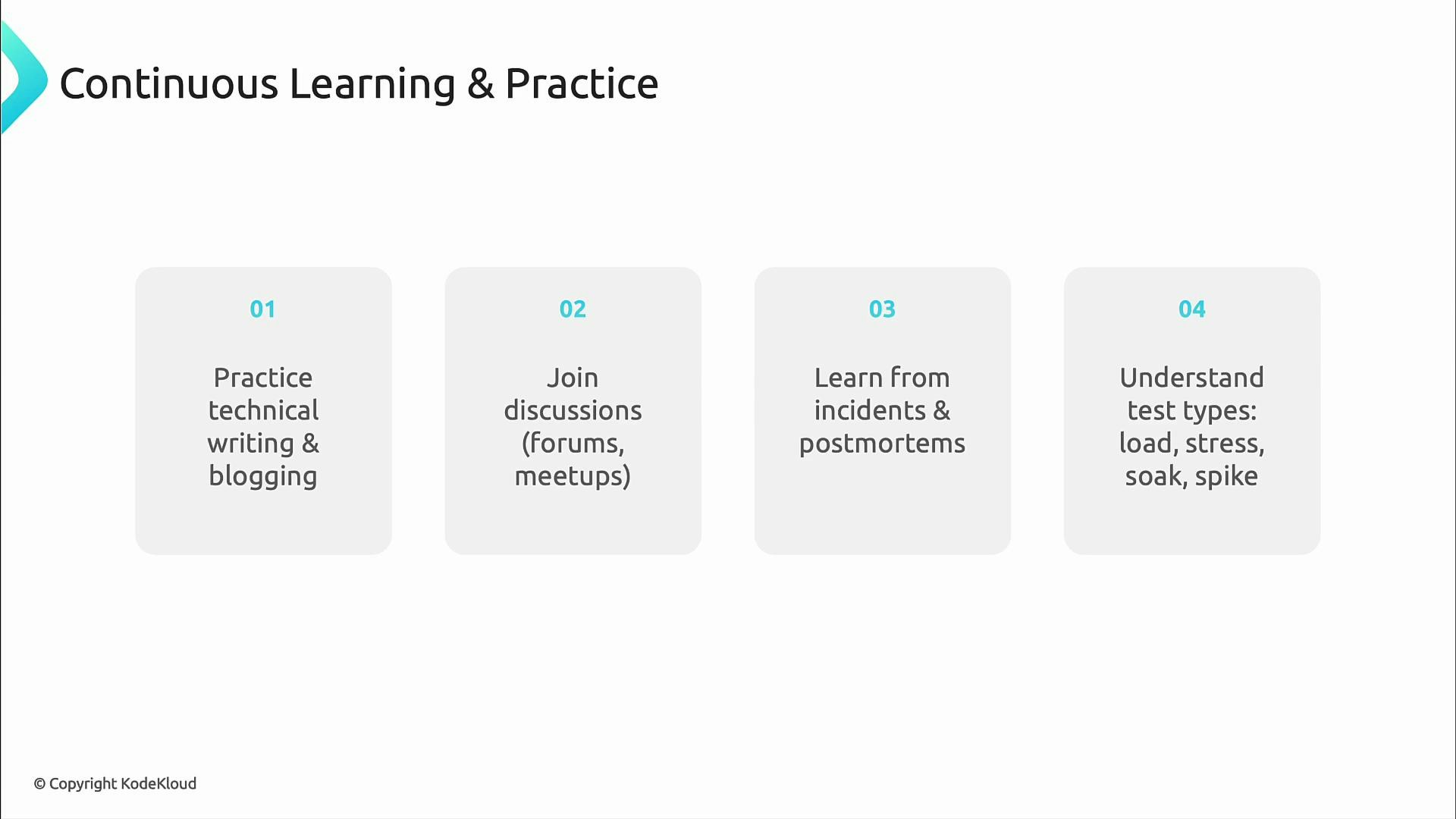
A presentation slide titled "Continuous Learning & Practice" showing four numbered tips: practice technical writing & blogging; join discussions (forums, meetups); learn from incidents & postmortems; and understand test types (load, stress, soak, spike). The slide has a KodeKloud copyright at the bottom.

Wrapping up: build habits, not just skills

This lesson covered how to build your SRE foundation—what to learn, how to gain practical experience, and the mindset that sets strong practitioners apart. Prioritize consistent, measurable improvements: reduce alert noise, ship small automations, and document runbooks. Over time, these habits compound into credibility and career momentum. Further reading and references: Good luck—start small, practice often, and keep iterating on how you measure and improve reliability.