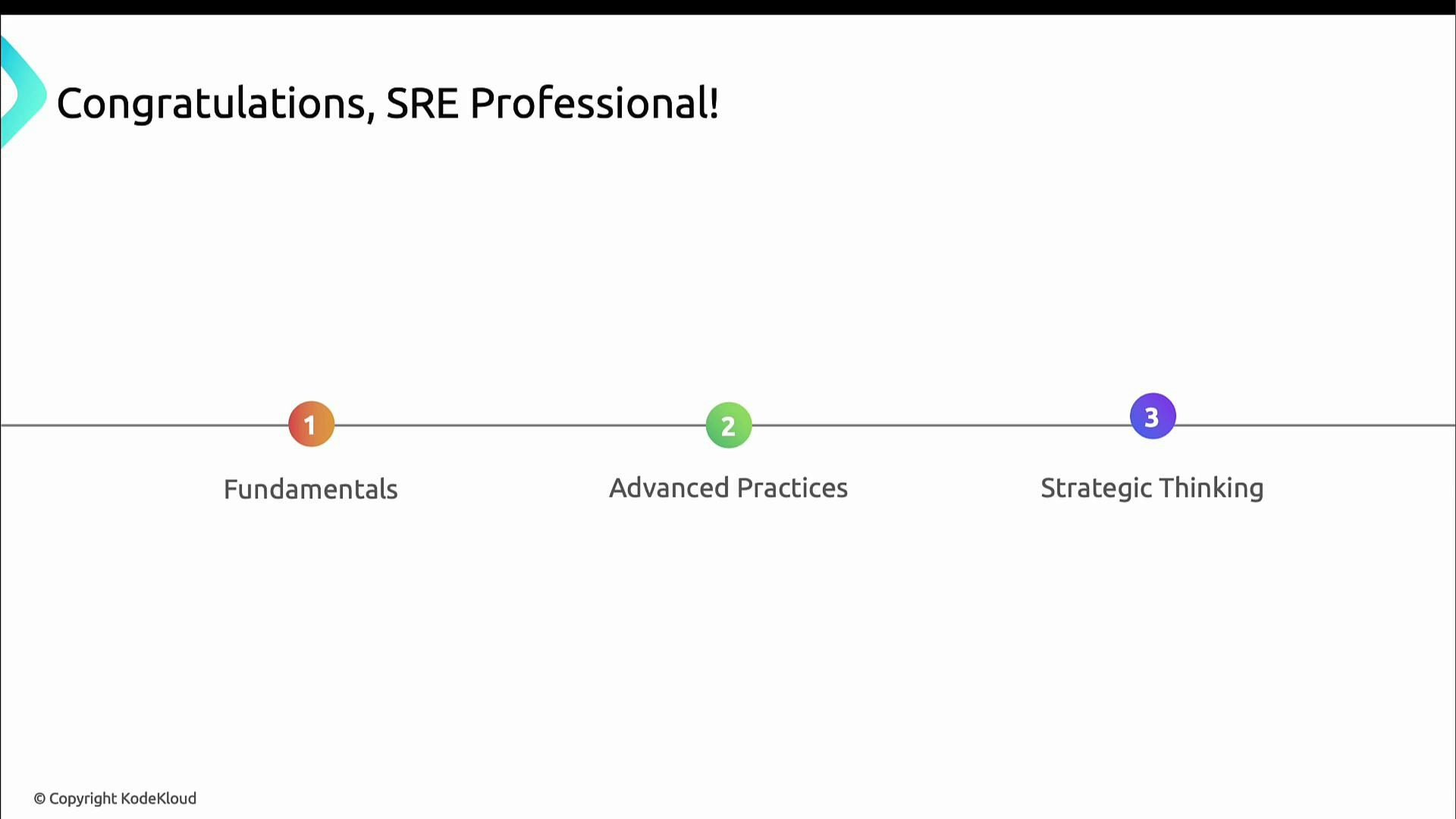
You’ve completed a full course on Site Reliability Engineering — from core principles to advanced practices and strategic thinking. This lesson steps back to map the path ahead: how to build on what you’ve learned, what to focus on as your responsibilities grow, and where to find the communities and resources that accelerate your progress. Early in your SRE career, focus on fundamentals: keeping systems stable, available, and observable. As you advance, emphasize automation, robust observability, and scaling practices. Later, broaden into strategic thinking: balancing reliability with business outcomes, influencing roadmaps, and shaping organizational processes.
A slide titled "Congratulations, SRE Professional!" showing a horizontal three-step timeline. The steps are numbered and labeled: Fundamentals, Advanced Practices, and Strategic Thinking.

What you can demonstrate now

You’ve shipped concrete, demonstrable skills that matter in interviews, team reviews, and production work. Use these capabilities as proof points in your resume and portfolio:
  • Designing SLOs and managing error budgets
  • Leading incident response and running blameless postmortems
  • Instrumenting systems for observability and telemetry-driven debugging
  • Reducing toil via automation and repeatable runbooks
  • Balancing reliability with measurable business goals
  • Managing complexity at scale and delivering a capstone project
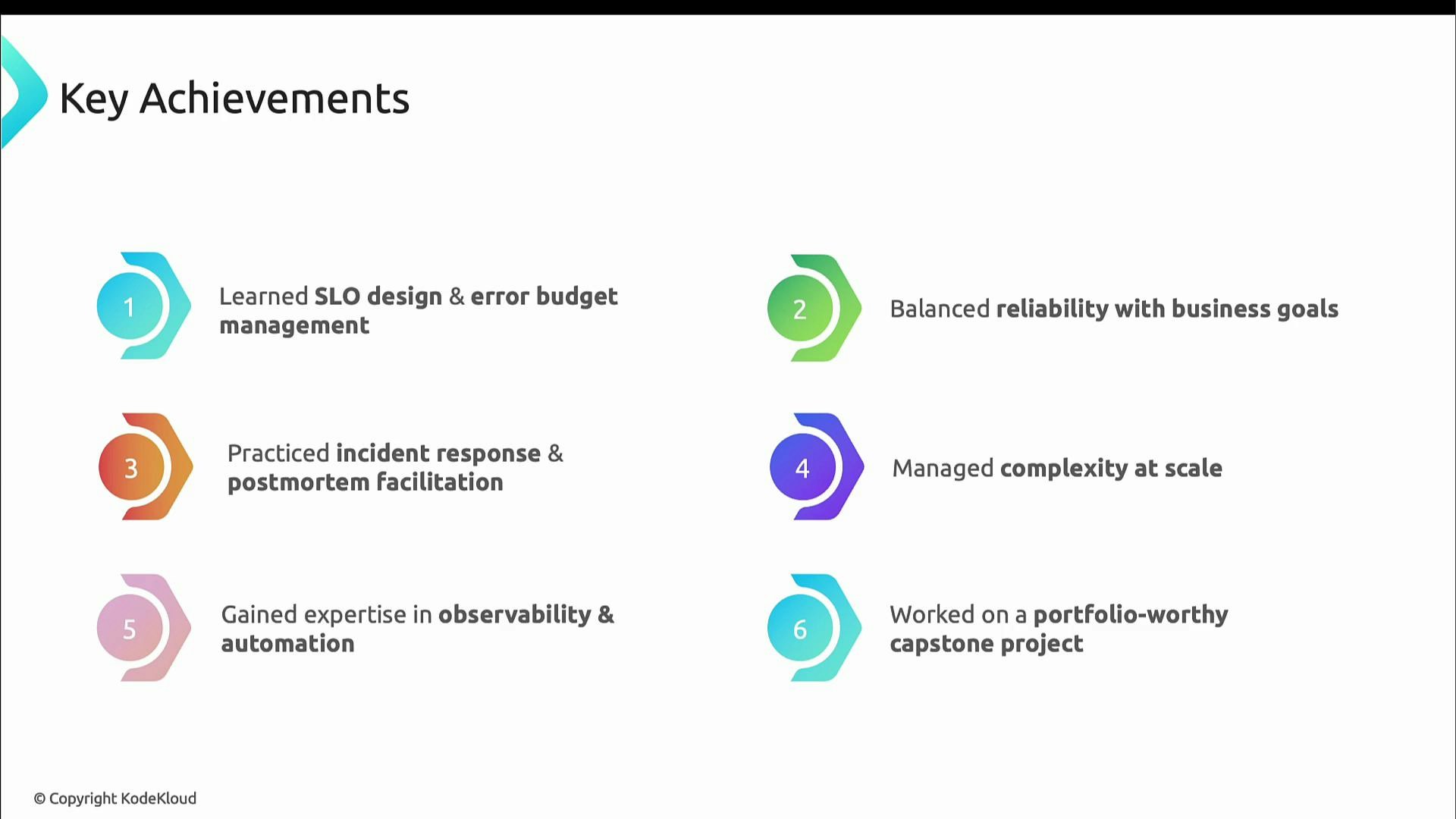
A presentation slide titled "Key Achievements" showing six numbered items. It lists accomplishments like SLO design and error-budget management, incident response and postmortems, observability and automation, balancing reliability with business goals, managing complexity at scale, and completing a portfolio-worthy capstone project.

Key achievements (summary table)

AchievementWhat it provesHow to show it
SLO design & error budgetsUnderstanding of measurable reliabilityInclude SLOs and error-budget policy in portfolio
Incident response & postmortemsOperational maturity and blameless cultureShare an anonymized postmortem and runbook
ObservabilityAbility to debug production systemsLink dashboards, tracing examples, alerting rules
AutomationReduced toil, consistent opsShow CI/CD pipelines, scripts, or operators you built
Reliability vs business goalsStrategic alignmentPresent trade-offs and outcomes from decisions
Capstone projectEnd-to-end demonstrationHost the project repo and a short demo video

Three complementary growth areas

To keep progressing, concentrate on these parallel tracks:
  1. Deepen technical knowledge
    • Study distributed systems, databases, performance tuning, and chaos engineering.
    • Learn patterns for scaling, capacity planning, and fault-tolerant designs.
  2. Broaden leadership & organizational skills
    • Learn to influence roadmaps, measure team impact, and improve delivery processes.
    • Practice stakeholder communication and cross-team incident coordination.
  3. Join the SRE community
    • Share lessons learned, attend conferences, subscribe to newsletters, and join online forums to gain diverse perspectives and practical tips.
Recommended reading and learning paths: start with the Google SRE books to ground yourself in core principles. Then specialize with titles on database reliability, chaos engineering, observability, and operational leadership. Explore publishers like O’Reilly and Packt. For organizational and leadership insight, consider books such as Accelerate and The Manager’s Path.

Communities, conferences, and ongoing learning

Make participation a habit. These venues and resources help you stay current and form peer networks:
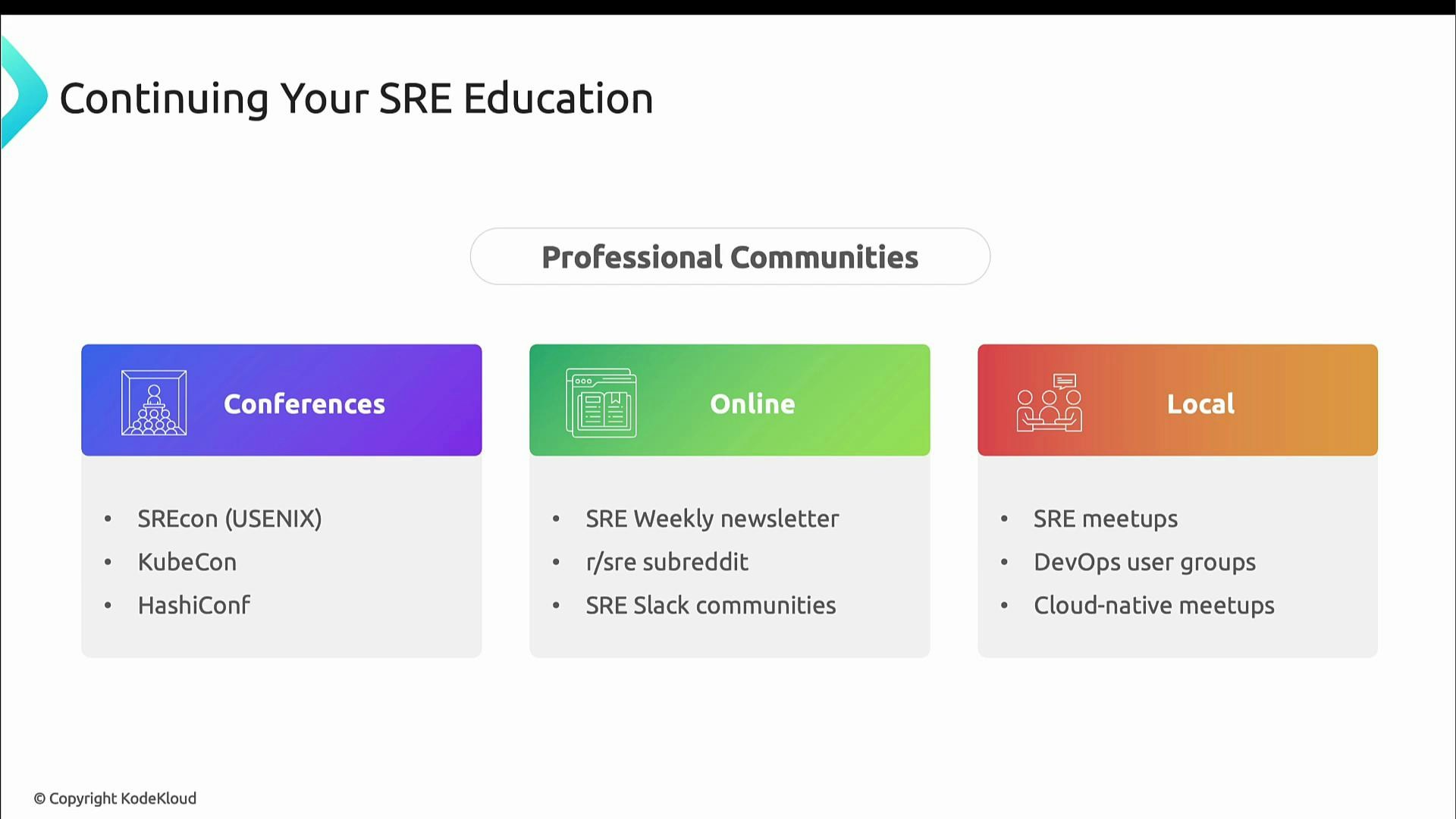
  • Conferences: SREcon, KubeCon, HashiConf
  • Newsletters & sites: SRE Weekly, vendor blogs, engineering blogs
  • Communities: r/sre (Reddit), Slack channels, local meetups
Use conferences and meetups not just to learn, but to present case studies and get feedback on operational practices. Also consider subscribing to or exploring:
A presentation slide titled "Continuing Your SRE Education" that highlights three professional-community categories: Conferences, Online, and Local. Each category lists example resources (e.g., SREcon, KubeCon, SRE newsletter, r/sre, Slack communities, and local meetups).

Practical next steps (30/60/90 plan)

  • 0–30 days: Document and publish 1–2 SLOs for a service, add observability examples to your portfolio.
  • 30–60 days: Automate a repetitive toil task, and present a postmortem to peers.
  • 60–90 days: Contribute a talk, blog post, or small workshop to a community channel; expand your capstone with metrics and outcomes.

How to present your capstone and achievements

  • Create a concise README that explains the problem, approach, architecture diagram, and outcomes (metrics and lessons).
  • Include anonymized telemetry screenshots, a short demo video, and links to key artifacts (runbooks, CI config, tests).
  • Frame your role clearly: what you owned, what you automated, and what measurable improvements followed.

Final thoughts

Thank you for completing this SRE course. Treat reliability as a continuous practice: experiment, measure outcomes, learn from failures, and share those lessons. Your career in SRE is built on steady technical depth, increasing strategic influence, and active participation in a broader community. Best of luck as you apply these ideas in production and grow your impact.