In this lesson we define and demonstrate how to build a blameless postmortem culture for incident response and Site Reliability Engineering (SRE). The goal is clear: treat outages as learning opportunities, not witch hunts. Instead of asking “who broke it?”, we ask “how did the system allow this failure?” and “what can we change to prevent it?” Why this matters: teams that practice blameless postmortems learn faster, improve system resilience, and preserve psychological safety — which in turn encourages openness, faster remediation, and continuous improvement.

The problem with blame

Imagine two teams facing the same outage:
  • Team A points fingers, engineers become defensive, details are hidden, and trust erodes.
  • Team B assumes everyone acted with the best knowledge available, focuses on systems and processes, documents what happened, and improves.
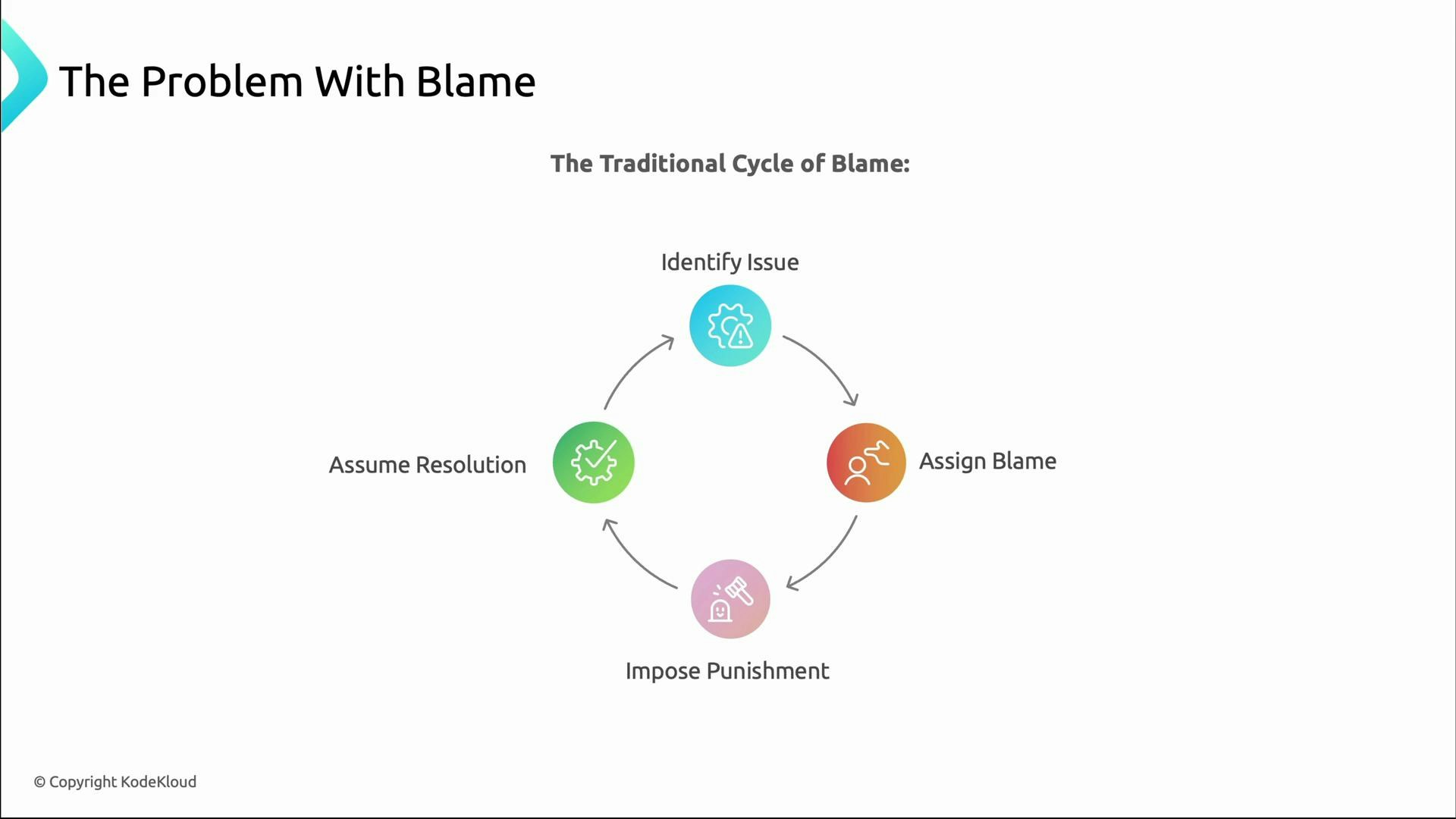
Team B is what a blameless culture enables. Traditional incident analysis often falls into a cycle of blame: identify issue → assign blame → punish → assume resolved. That cycle kills learning. When people fear blame, they hide information or avoid reporting problems, making incidents harder to investigate and more likely to repeat.
A slide titled "The Problem With Blame" showing a circular diagram called "The Traditional Cycle of Blame" with four steps: Identify Issue, Assign Blame, Impose Punishment, and Assume Resolution. Each step is shown as a colored icon connected by arrows.
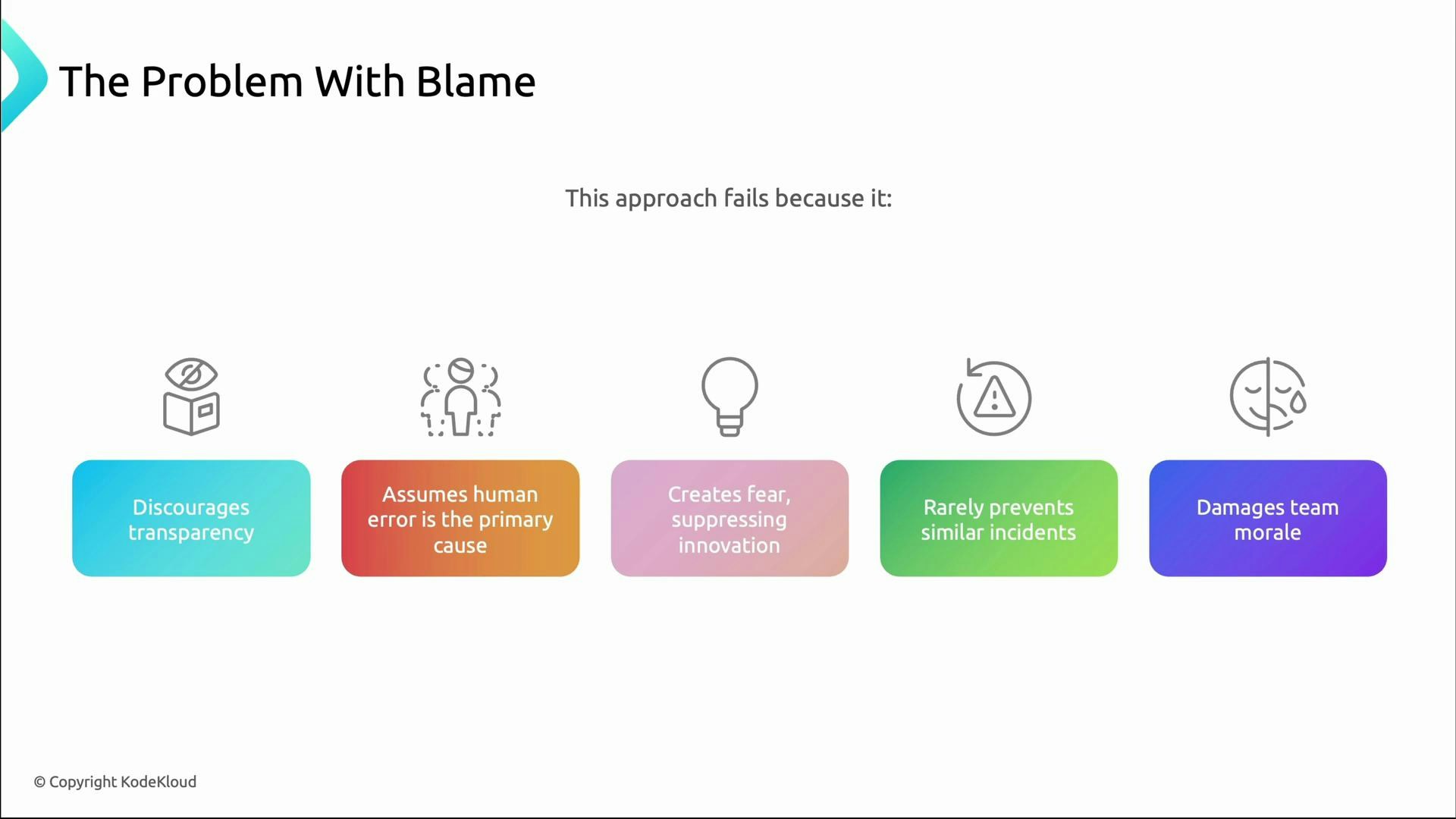
This blame-driven approach fails for multiple reasons: it discourages transparency, treats human error as the root cause while missing systemic contributors, suppresses innovation through fear, and rarely prevents recurrence. The worst consequence is damaged morale and reduced psychological safety.
A presentation slide titled "The Problem With Blame" showing five colored points that explain why blame fails: it discourages transparency, assumes human error is the primary cause, creates fear that suppresses innovation, rarely prevents similar incidents, and damages team morale. The slide also includes simple icons above each point.
Blame hides problems. Blameless postmortems expose them and make them fixable.

Psychological safety: the foundation of blamelessness

Blamelessness depends on psychological safety: people must feel safe to speak up, share questions, and admit mistakes without fear of retribution. High-safety teams:
  • Encourage open discussion and diverse viewpoints
  • Welcome questions and constructive challenge
  • Value learning and accept risk-taking
  • Offer help freely and normalize admitting mistakes
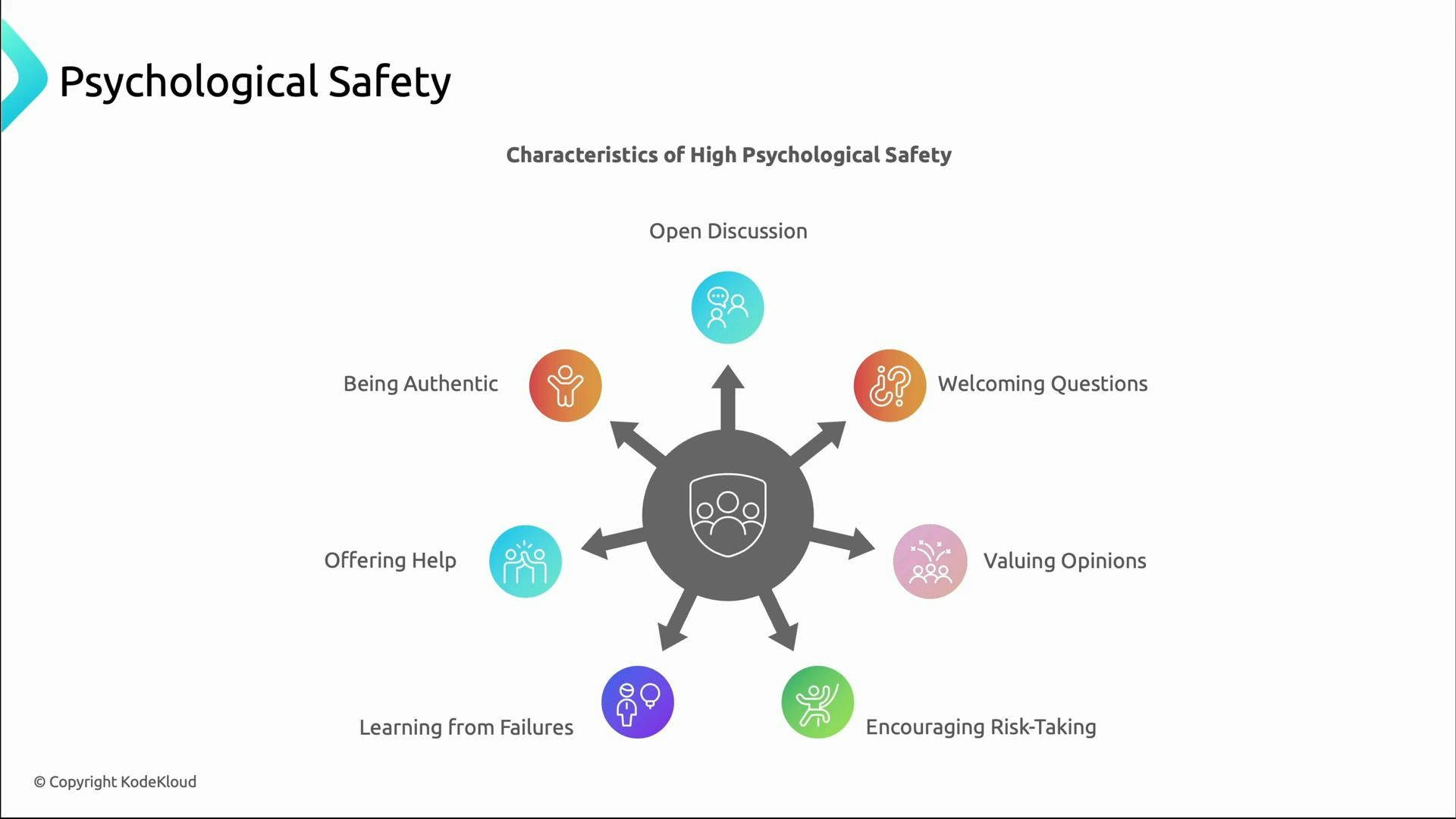
When psychological safety exists, postmortems become honest reviews that drive improvement rather than blame sessions.
An infographic titled "Psychological Safety" with a central team icon and arrows pointing outward to seven characteristics of high psychological safety. These characteristics are: Open Discussion, Welcoming Questions, Valuing Opinions, Encouraging Risk-Taking, Learning from Failures, Offering Help, and Being Authentic.
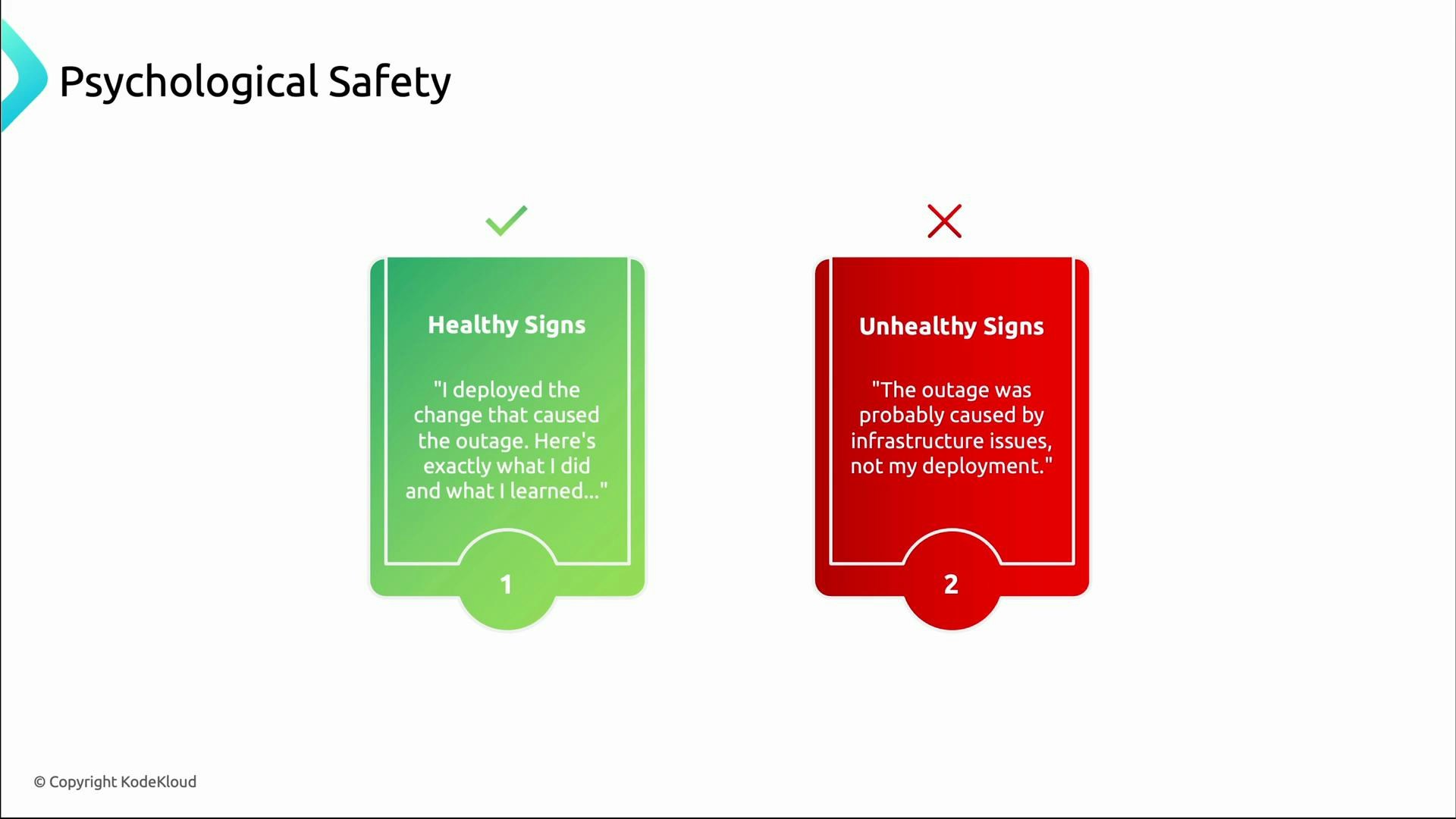
Concrete signs of psychological safety show up in how people talk about incidents. Ownership and transparent admission of mistakes are healthy; deflection and finger-pointing are not.
A slide titled "Psychological Safety" showing two cards: a green "Healthy Signs" card with a quote admitting "I deployed the change that caused the outage..." and a red "Unhealthy Signs" card with a quote blaming infrastructure instead of the deployment. The slide contrasts owning mistakes versus deflecting blame.
A single honest statement like “I deployed the change that caused the outage — here’s exactly what I did and what I learned” enables fast, factual analysis and remediation.

What is a postmortem (retrospective)?

A postmortem is a structured review held after an incident. Its purpose is to:
  • Document what happened with an objective timeline
  • Understand why the incident occurred through root cause analysis
  • Produce concrete, actionable improvements to reduce recurrence
  • Spread knowledge across the organization and institutionalize learning
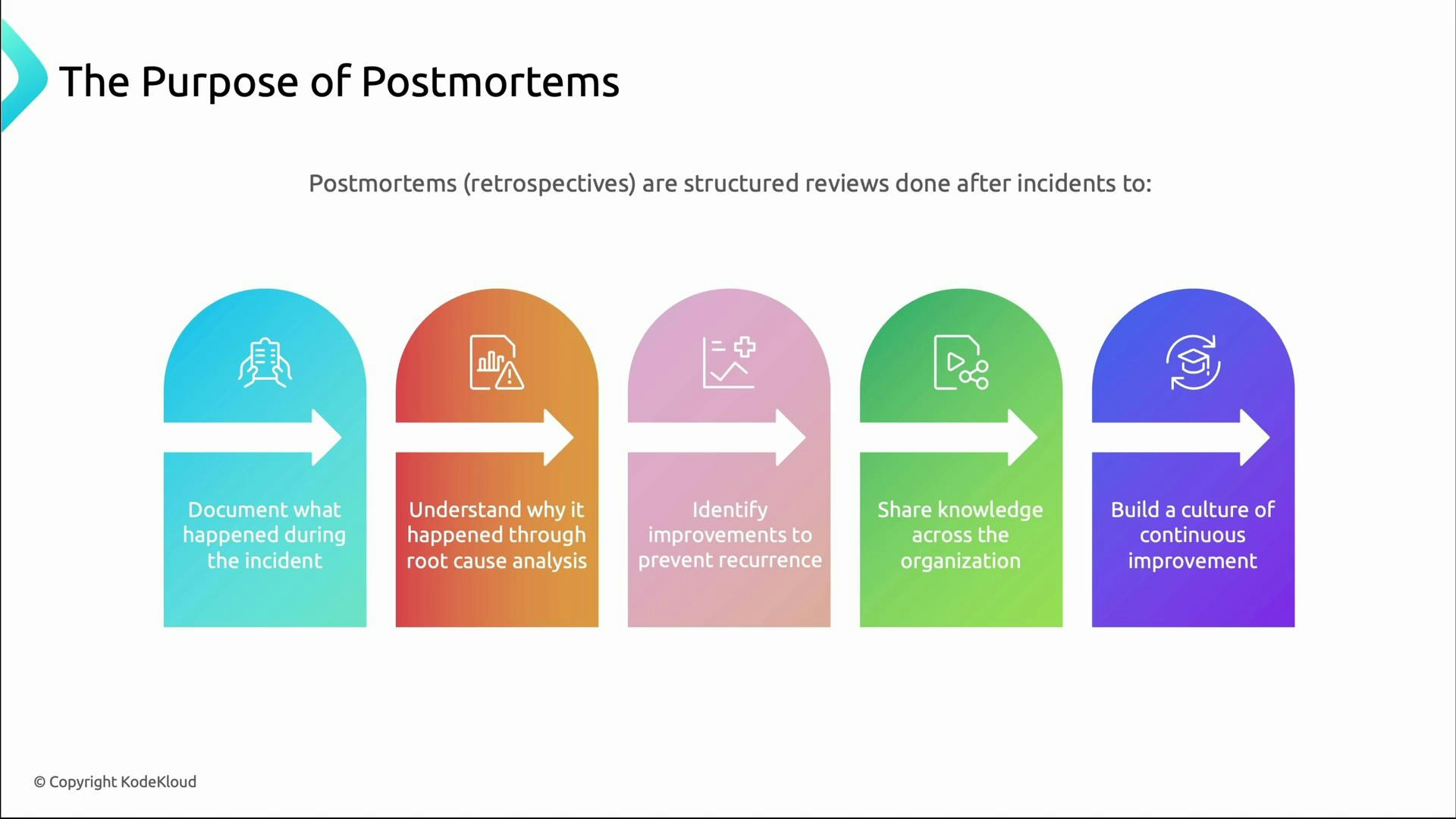
When run correctly, postmortems convert painful incidents into organizational gains.
A presentation slide titled "The Purpose of Postmortems" showing five colorful rounded panels with right-pointing arrows. Each panel lists a goal: document what happened, understand root causes, identify improvements to prevent recurrence, share knowledge across the organization, and build a culture of continuous improvement.
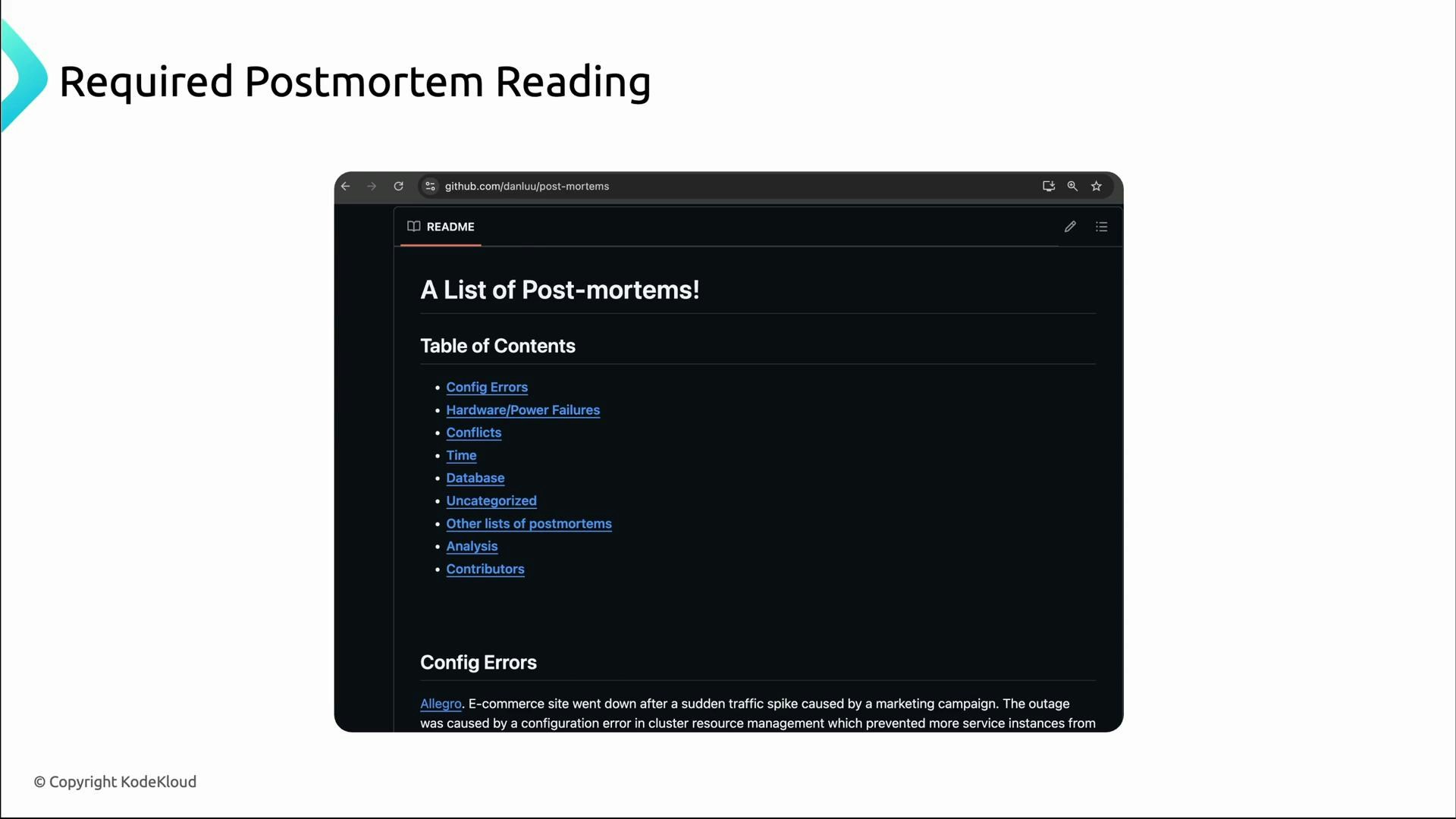
Many organizations publish postmortems publicly. Reading those examples — across config errors, database incidents, time-related issues, etc. — accelerates learning and sharpens incident response skills.
A presentation slide titled "Required Postmortem Reading" showing a screenshot of a GitHub README called "A List of Post-mortems!" with a table of contents linking categories like Config Errors, Hardware/Power Failures, Conflicts, Time, Database, and Analysis. The slide also shows a small copyright notice "KodeKloud" in the bottom left.

How to run effective postmortems

A reliable postmortem process reduces blame and increases engineering effectiveness. A typical four-step workflow:
  1. Preparation
    • Schedule the review soon after the incident (once immediate remediation is done).
    • Collect logs, alerts, timelines, runbooks, graphs, and any related artifacts.
    • Invite operators, developers, and stakeholders who can contribute facts and context.
  2. Meeting structure
    • Walk through an objective timeline (who did what and when).
    • Identify contributing factors and failure modes.
    • Brainstorm concrete improvements and prioritize them.
  3. Documentation
    • Create a neutral, fact-based writeup: summary, timeline, impact, root cause analysis, action items, and lessons learned.
    • Avoid accusatory language; focus on systems, processes, and gaps.
  4. Follow-up
    • Track action items to completion with owners and deadlines.
    • Share the postmortem and any remediation progress broadly.
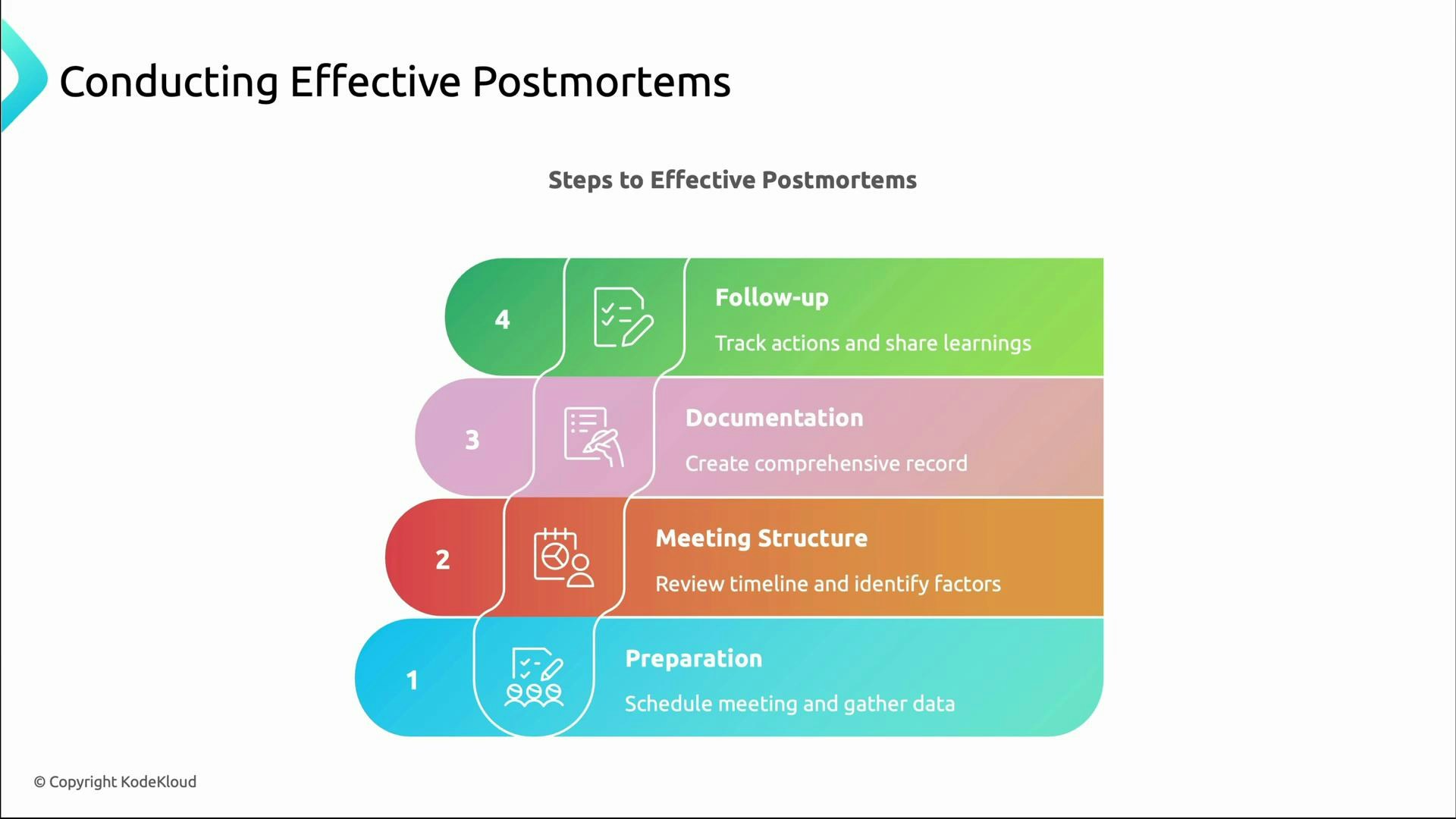
A slide titled "Conducting Effective Postmortems" showing a four-step process: 1) Preparation (schedule meeting and gather data), 2) Meeting Structure (review timeline and identify factors), 3) Documentation (create comprehensive record), and 4) Follow-up (track actions and share learnings). The steps are displayed as colored, rounded horizontal blocks with icons.
Follow-up is essential. Without tracking and completing action items, a postmortem becomes a historical record instead of a mechanism for change.
An effective postmortem clearly answers five questions:
  • What happened? — An objective, time-ordered narrative.
  • Why did it happen? — Contributing factors and causal chains.
  • How did we respond? — What mitigations were used and how effective they were.
  • What did we learn? — Technical and process observations.
  • What will we change? — Specific, owned action items to reduce recurrence.
Use templates from SRE practitioners to keep postmortems consistent. Below is a concise template and purpose for each section.
Template sectionPurpose
SummaryShort, non-technical incident overview and business impact
TimelineObjective chronological events (timestamps, actions, alerts)
Impact assessmentScope and severity: affected services, customers, SLAs
Root cause analysisCausal factors and why safeguards failed
What went wellPositive actions and mitigations that helped
What went poorlyGaps in detection, automation, or runbooks
Action itemsConcrete fixes with owners and due dates
Lessons learnedGeneralizable insights for the org
You can adapt this structure to your tooling (GitHub, Confluence, Google Docs, or a ticketing system) and your incident severity levels.
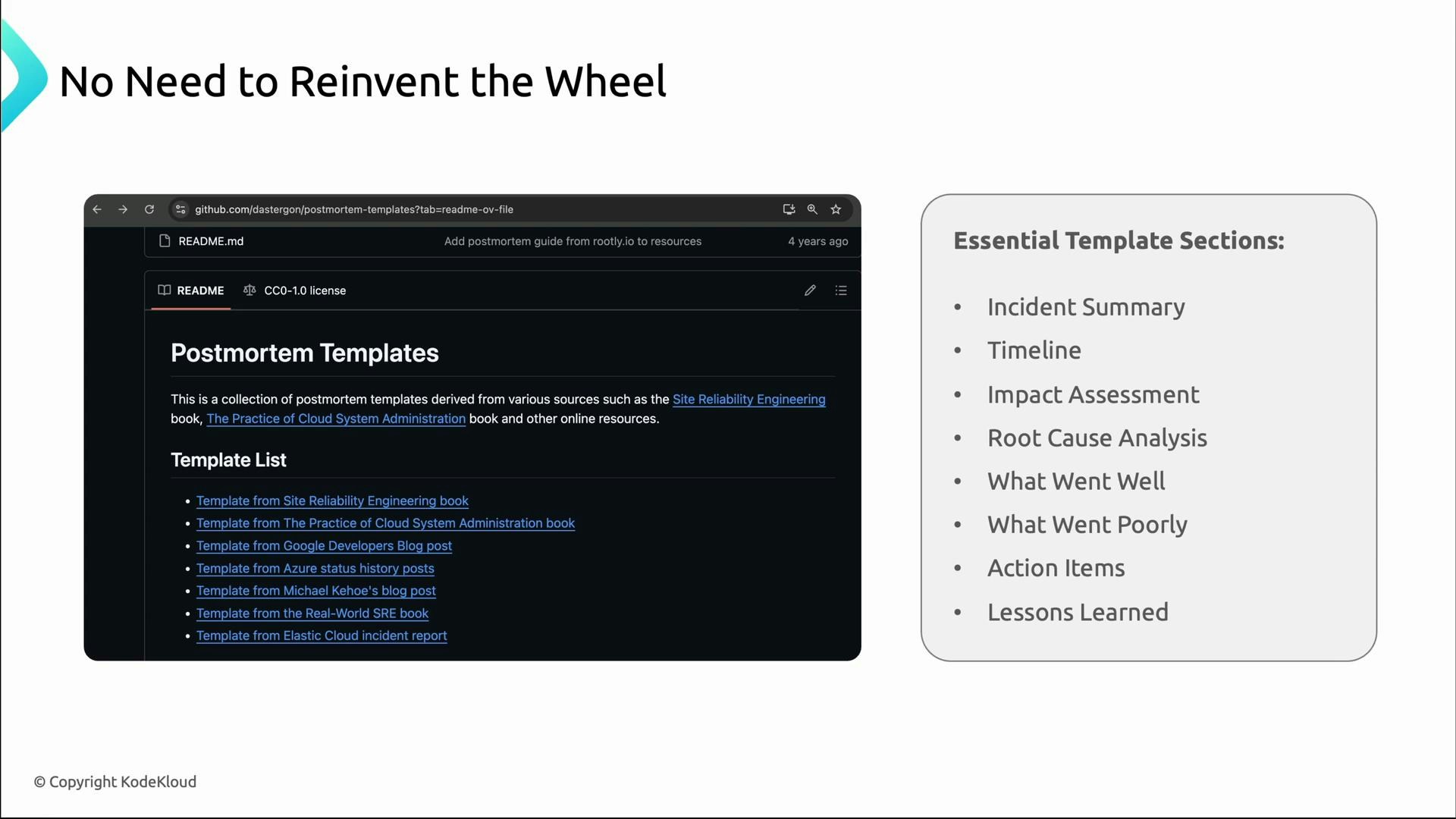
A presentation slide showing a GitHub README titled "Postmortem Templates" on the left and a boxed list of "Essential Template Sections" on the right. The sections listed include Incident Summary, Timeline, Impact Assessment, Root Cause Analysis, What Went Well, What Went Poorly, Action Items, and Lessons Learned.

Root cause analysis (RCA)

Root cause analysis should dig beyond human error to identify systemic contributors: tooling gaps, ambiguous runbooks, insufficient automation, missing tests, or unclear ownership. Techniques to improve RCA include:
  • Five Whys (iterate “why” until you find systemic causes)
  • Fishbone/Ishikawa diagrams (categorize contributing factors)
  • Timeline correlation (relate metrics, logs, and human actions)
  • Fault tree analysis (map dependencies and failure paths)
Good RCAs enable targeted remediation and meaningful reliability improvements.

Share, track, and improve

Postmortems are only useful if action items are tracked and learnings spread. Make postmortems accessible (with appropriate privacy controls), incorporate recurring findings into onboarding and runbooks, and regularly review outstanding action items in team rituals.

Further reading and references

Adopting a blameless postmortem culture improves reliability, accelerates learning, preserves team trust, and turns incidents into opportunities for lasting improvement.