Welcome to the lesson on developing service-level objectives (SLOs) and the strategies that make them practical tools for reliability engineering. By the end of this lesson you’ll understand how SLOs link user expectations to engineering reality, and why they are the foundation of measurable reliability. Why can’t we promise 100% uptime? And why do SLOs matter?
At real-world scale, 100% uptime is infeasible. Trying to guarantee it leads to unsustainable costs, brittle systems, and slow innovation. SLOs help teams balance reliability, cost, and speed by defining realistic, measurable targets.
SLOs are far more than just target numbers. Well-crafted SLOs:
  • Quantify acceptable unreliability (error budgets).
  • Create a shared language across engineering and business stakeholders.
  • Prioritize engineering effort and operational investment according to business risk.
  • Surface the incidents that matter most to users.
  • Make reliability visible, measurable, and actionable across the organization.
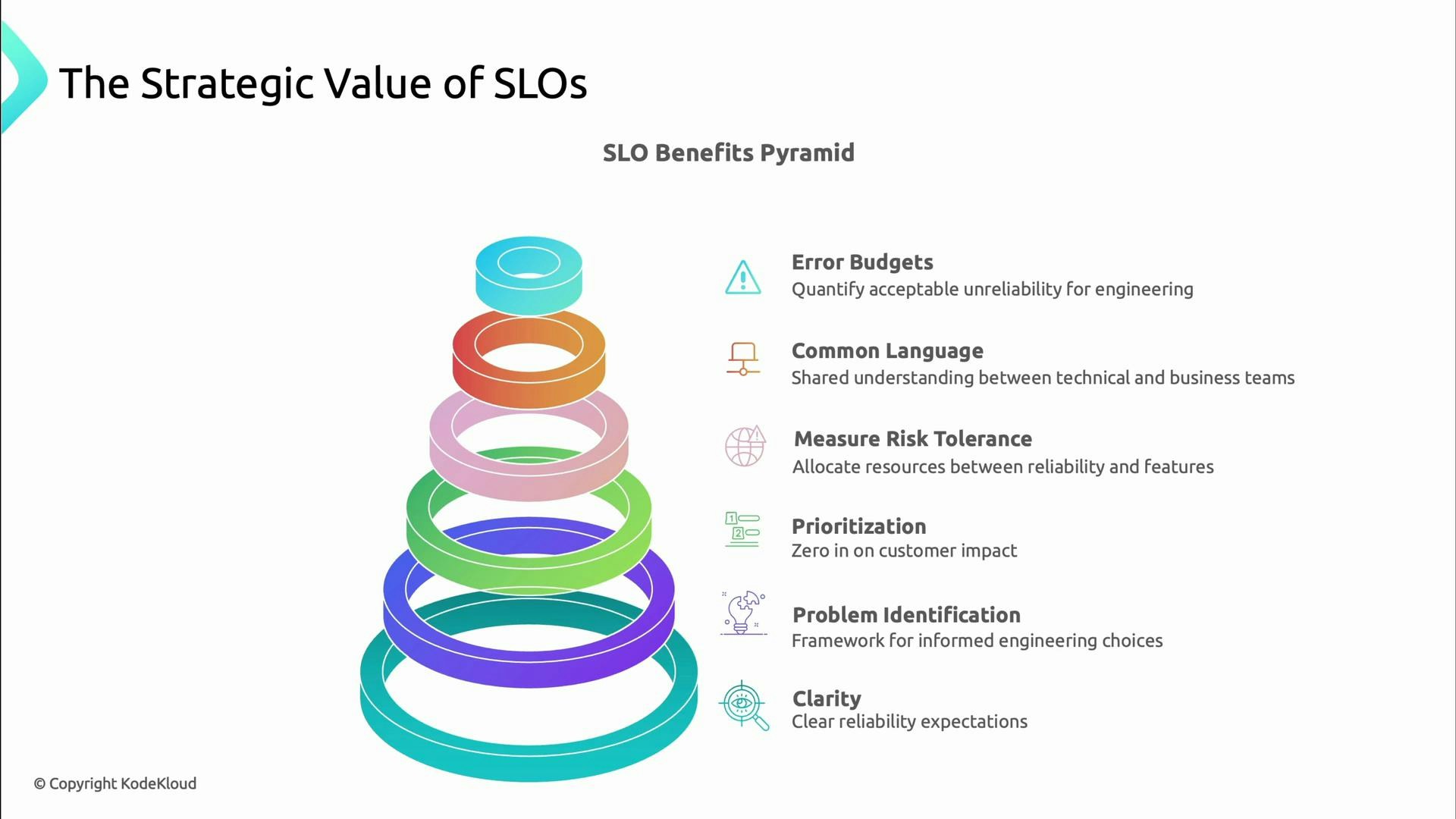
An infographic titled "The Strategic Value of SLOs" showing a colorful stacked-ring "SLO Benefits Pyramid" on the left and a labeled list on the right. The list outlines benefits like Error Budgets, Common Language, Measure Risk Tolerance, Prioritization, Problem Identification, and Clarity.
Start with the customer: what do users actually care about? Map critical user journeys, convert the steps into measurable service-level indicators (SLIs), and set SLO targets that meet business goals while leaving room to evolve the service. SRE and reliability teams translate customer needs into engineering priorities — and user satisfaction is the metric that determines success. When converting business goals into SLOs, ask:
  • Which user journeys are critical?
  • What does “good enough” look like for those journeys (latency, availability, correctness)?
  • What trade-offs between cost and reliability are acceptable?
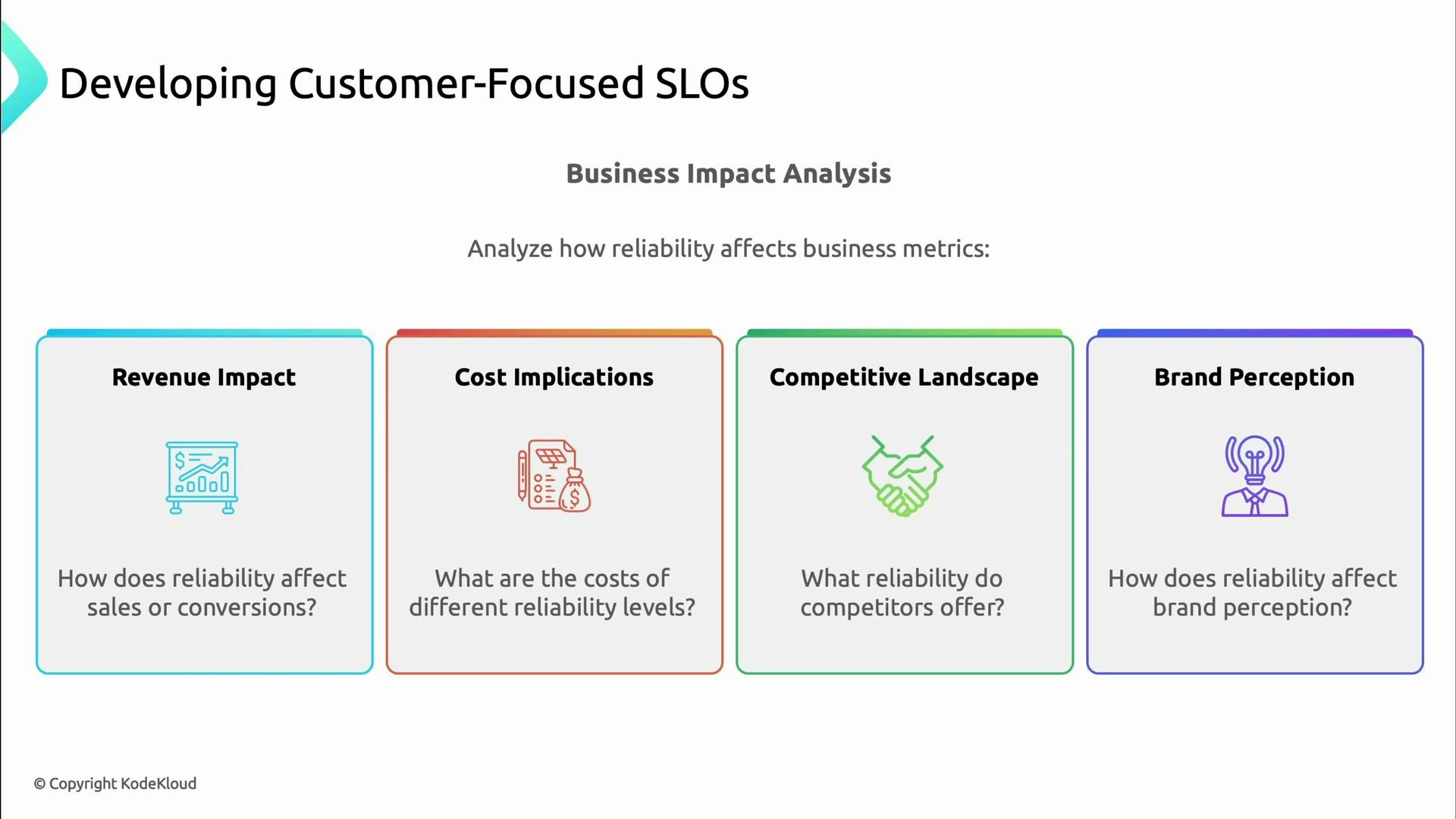
A structured business impact analysis helps justify SLO trade-offs.
A presentation slide titled "Developing Customer-Focused SLOs" showing a "Business Impact Analysis" with four colored boxes. The boxes are labeled Revenue Impact, Cost Implications, Competitive Landscape, and Brand Perception, each accompanied by an icon and a short guiding question.
Consider these business dimensions when setting SLOs:
  • Revenue: how do downtime and slow responses affect conversions and sales?
  • Costs: what operational or engineering investments are required at each reliability level?
  • Competitive position: what reliability levels do competitors promise?
  • Brand perception: how does reliability affect trust and retention?
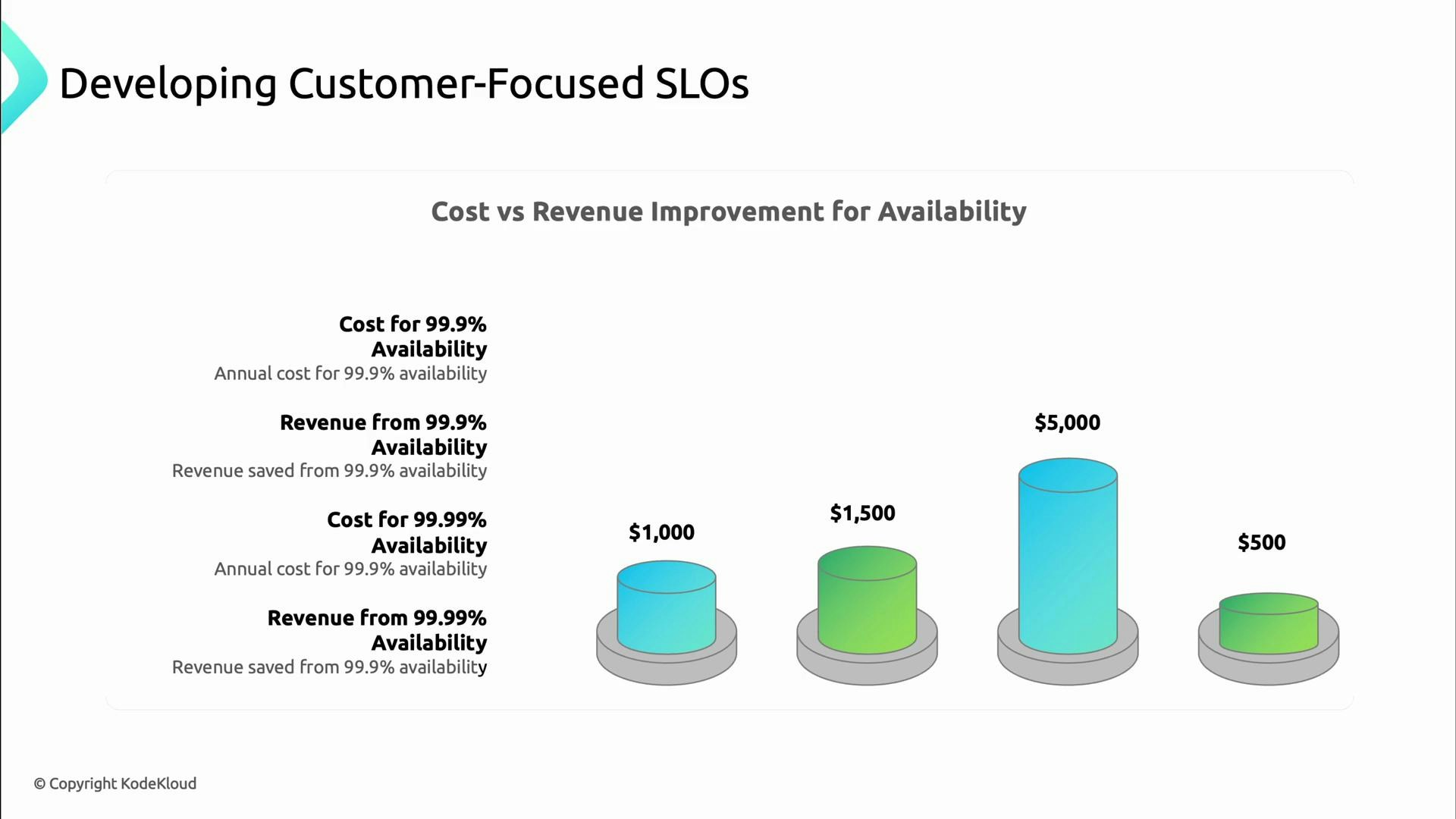
Compare cost vs. business benefit before chasing higher availability targets.
A presentation slide titled "Developing Customer-Focused SLOs" with a chart labeled "Cost vs Revenue Improvement for Availability." It shows four cylindrical bars comparing annual cost and revenue saved for 99.9% vs 99.99% availability, labeled 1,000, 1,500, 5,000 and 500.
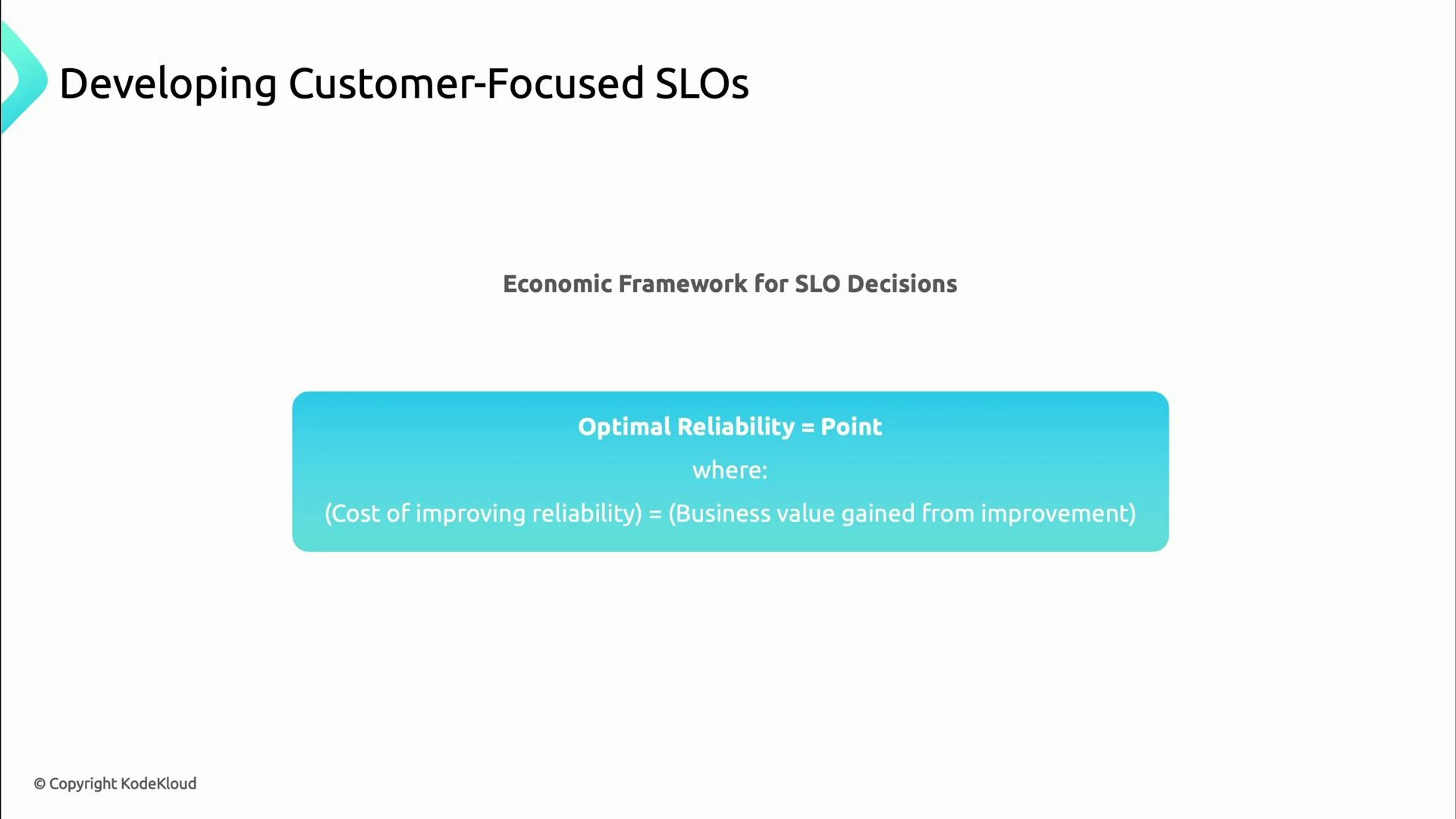
The general pattern is that each additional “nine” of availability typically costs more (often exponentially) while customer or revenue benefit increases more slowly. Your goal is the economic optimum: the point where the cost to improve reliability further equals the business value gained.
A slide titled "Developing Customer-Focused SLOs" presenting an economic framework that defines "Optimal Reliability = Point where (cost of improving reliability) = (business value gained from improvement)" in a blue callout.
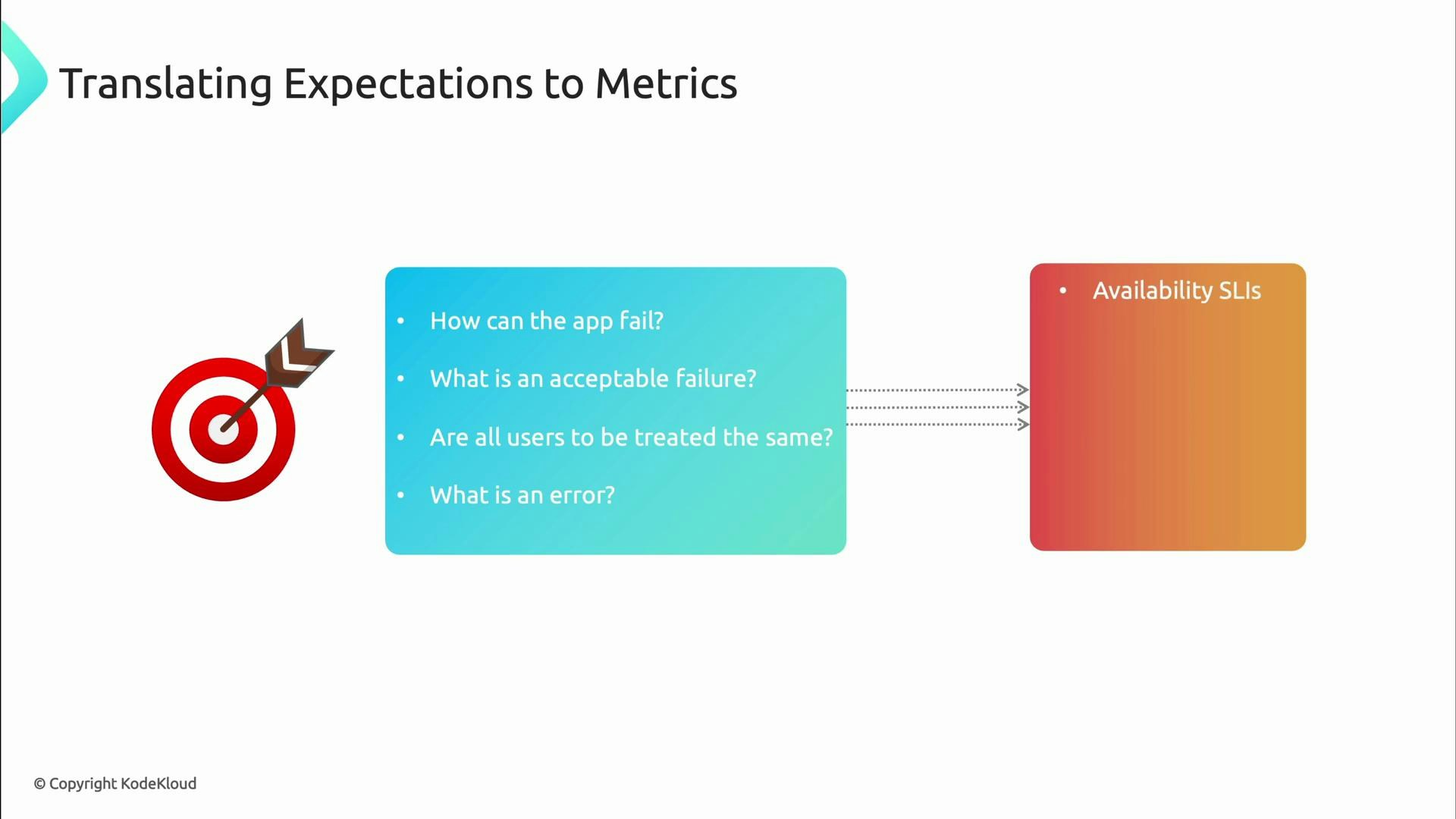
Translate user needs into technical metrics For each user journey, enumerate failure modes and acceptable outcomes:
  • How can this app fail?
  • Which failures are acceptable for the user experience?
  • Are different user segments treated differently?
  • What counts as an error?
Then choose appropriate SLI types — availability, latency, quality, throughput, durability — and define precise measurement methods.
A presentation slide titled "Translating Expectations to Metrics" showing a target icon on the left and a teal box of bullet questions about failures and errors. Dotted arrows point from that box to an orange box on the right labeled "Availability SLIs."
Common SLI types and examples
SLI TypeWhat it measuresExample
AvailabilityFraction of successful requestsprobe_success{endpoint="/health"}
LatencyResponse-time distribution95th/99th percentile of request duration
Quality / CorrectnessWhether responses are correctRate of valid responses vs errors
ThroughputRequests or transactions per secondrequests_total per minute
DurabilityData persisted without lossBackup success rate, replication lag
Map SLI measurements to SLO statements that are understandable by product and business teams. Example: KodeKloud record store (search and orders)
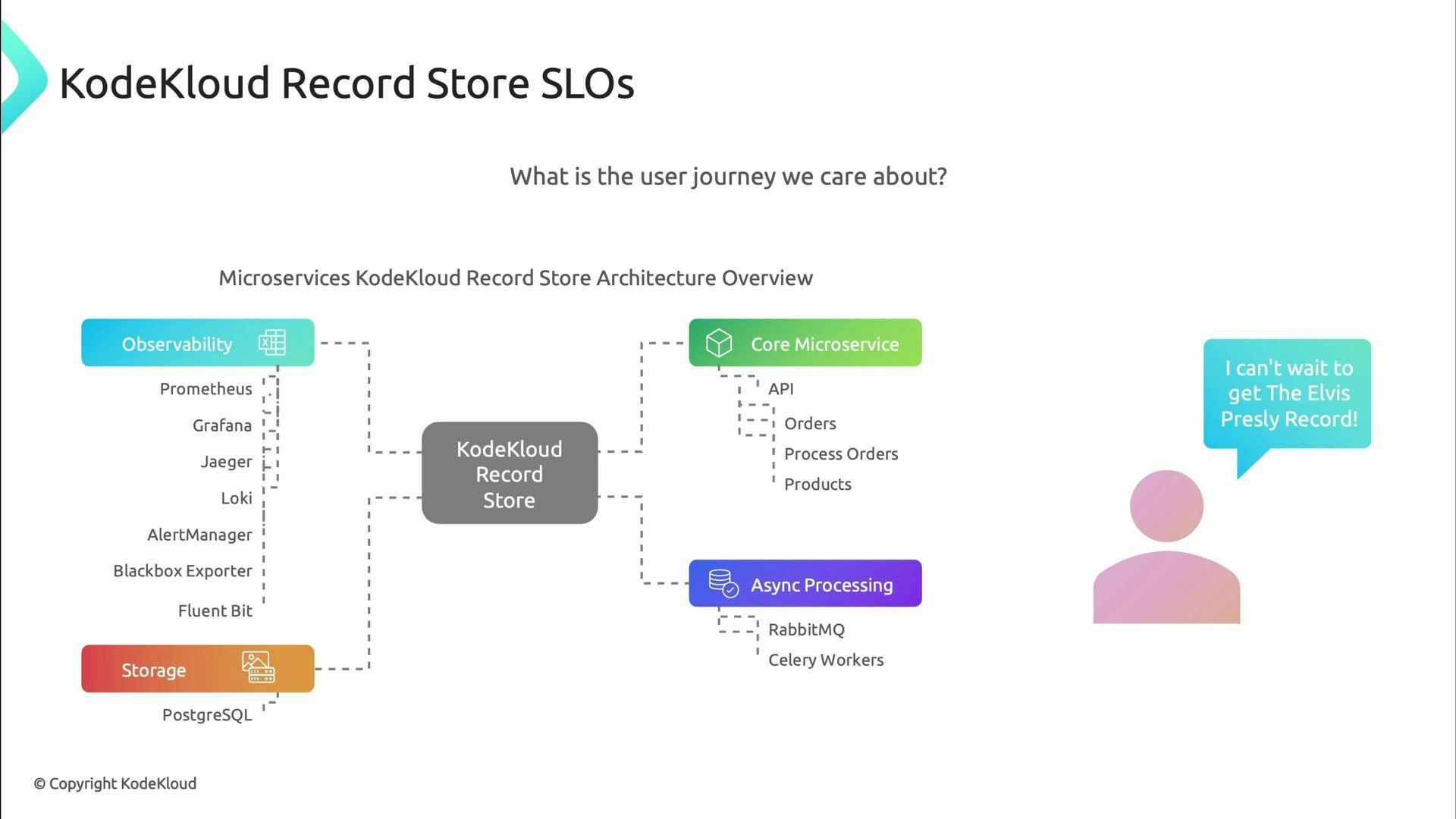
A presentation slide titled "KodeKloud Record Store SLOs" showing a microservices architecture diagram with a central KodeKloud Record Store linked to Observability (Prometheus, Grafana, Jaeger, etc.), Storage (PostgreSQL), a Core Microservice (API, Orders, Products) and Async Processing (RabbitMQ, Celery). On the right is a user icon with a speech bubble saying "I can't wait to get The Elvis Presley Record!"
Search experience: users expect quick, reliable search results. A simple Prometheus expression to measure a probe-success availability SLI over one day:
avg_over_time(probe_success{endpoint="/health"}[1d])
If that query evaluates to 0.999, it indicates 99.9% availability over the last 24 hours. Example SLOs for the search journey:
  • Availability SLO: 99.9% of API requests succeed (catalog API).
  • Latency SLO: 99% of search queries complete within 300 ms.
Why 300 ms and 99%? Research on perceived latency shows users notice delays above ~300 ms; 99% is often achievable without extreme cost while protecting the vast majority of users. Order-processing journey: placing and processing an order must be reliable and timely. A Prometheus expression to compute error rate for the orders endpoint:
sum(rate(http_requests_total{endpoint="/orders", status_code!~"2.."}[5m])) /
sum(rate(http_requests_total{endpoint="/orders"}[5m]))
This calculates the fraction of non-2xx responses over the last 5 minutes. Suggested SLIs and SLOs for orders:
  • SLIs: processing success rate, end-to-end order processing latency.
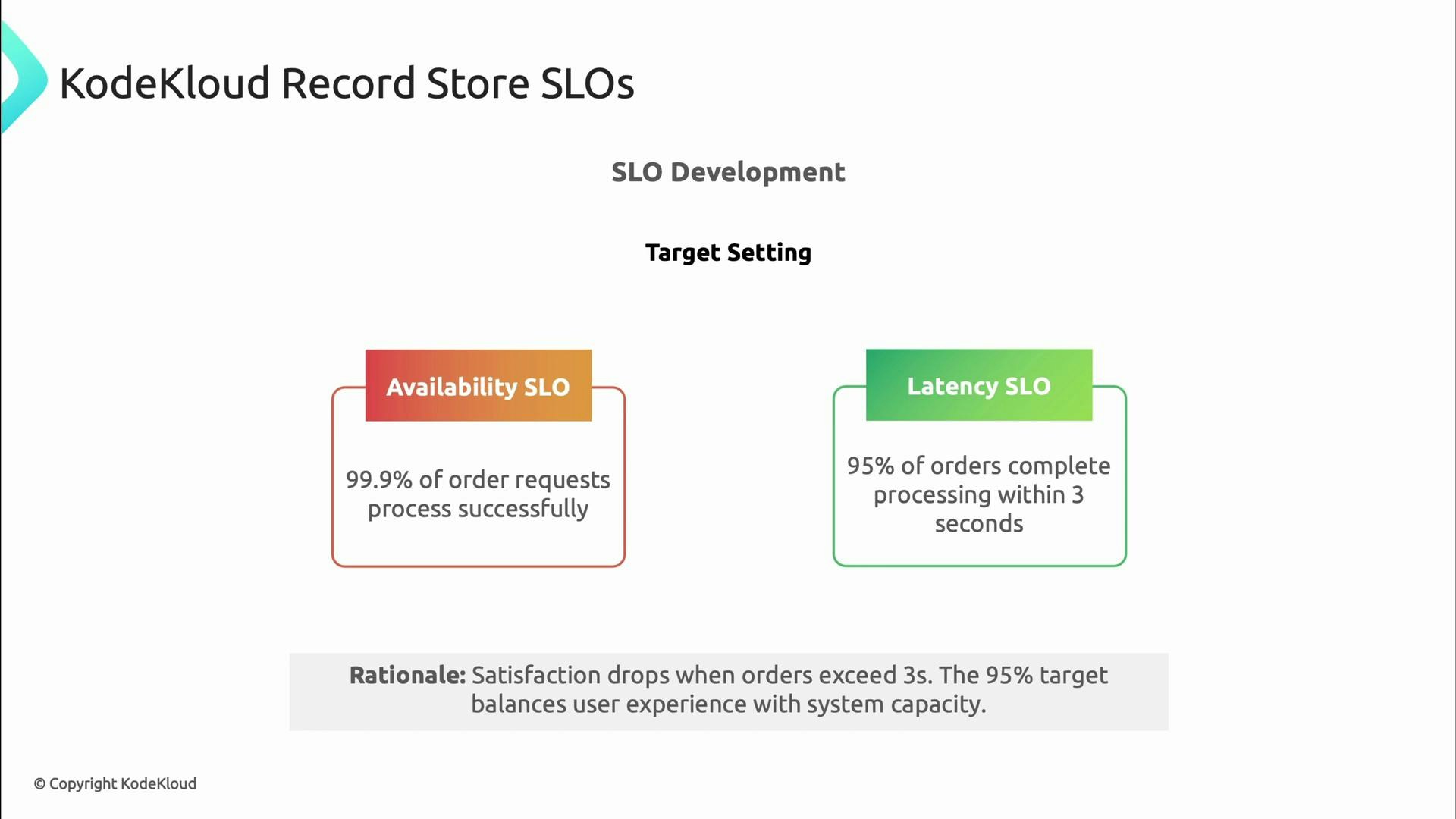
  • SLO (availability/orders): 99.9% of order requests process successfully.
  • SLO (latency/orders): 95% of orders complete processing within 3 seconds.
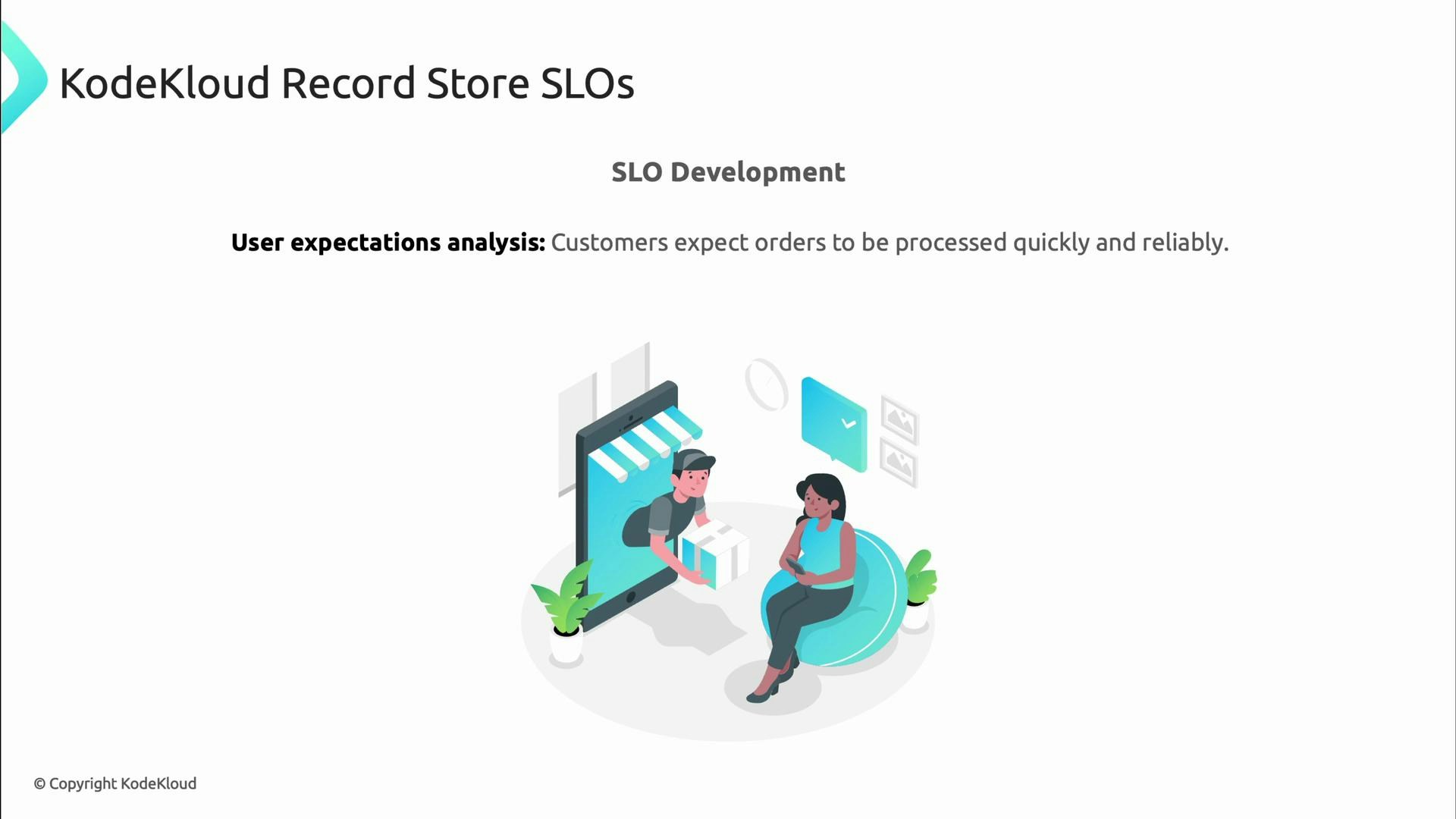
We selected the 3-second, 95th-percentile target because customer satisfaction declines sharply after that threshold and it aligns with current system capacity.
A presentation slide titled "KodeKloud Record Store SLOs" and "SLO Development" with text about customers expecting orders to be processed quickly and reliably. Below is an illustration of a delivery person emerging from a smartphone to hand a package to a seated woman.
A presentation slide titled "KodeKloud Record Store SLOs" showing target SLOs: an Availability SLO (99.9% of order requests process successfully) and a Latency SLO (95% of orders complete within 3 seconds). A brief rationale notes satisfaction drops when orders exceed 3 seconds.
Use historical data, not guesswork Wherever possible, derive SLO targets from historical telemetry. Historical SLIs give you realistic baselines and show what is achievable without major investment. Always document the rationale for each SLO: why it was chosen, the assumptions, the data used, and expected limitations.
Always record the rationale and assumptions for every SLO. This documentation enables future teams to understand why targets were chosen and how to adjust them over time.
Make SLOs a living process Establish a regular SLO review cadence and a clear escalation path:
  • Start with data-driven, educated estimates (benchmarks, architecture, stakeholder input).
  • Record assumptions and measurement methods.
  • Analyze actual performance during reviews: SLO adherence, trends, and patterns.
  • Combine quantitative metrics with qualitative feedback (customer surveys, stakeholder concerns).
  • Reassess business risk and operational cost (alert noise, toil).
  • Adjust SLOs and error-budget policies based on evidence.
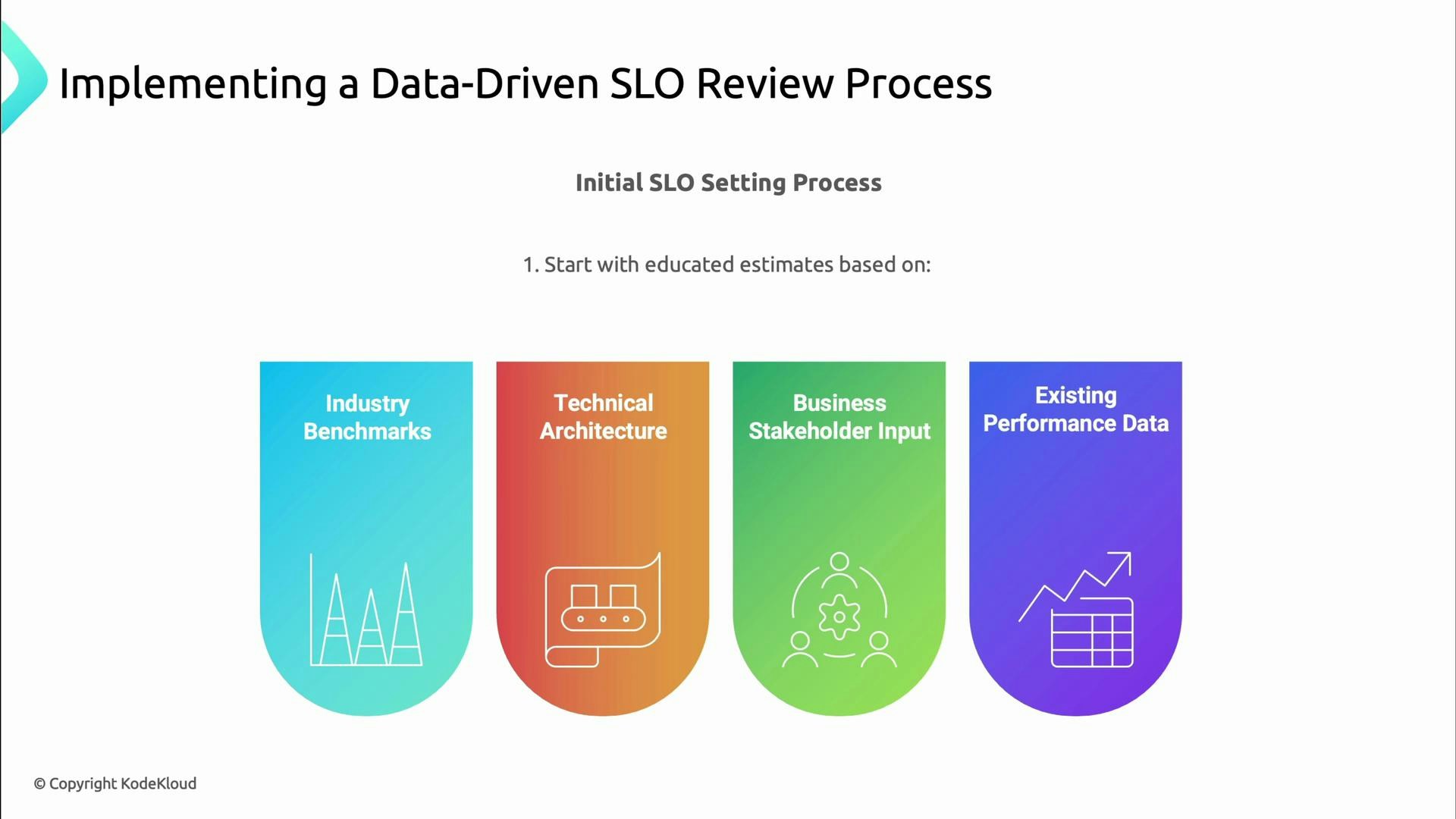
A presentation slide titled "Implementing a Data-Driven SLO Review Process" that outlines the initial SLO setting process. It shows four colored rounded panels labeled "Industry Benchmarks," "Technical Architecture," "Business Stakeholder Input," and "Existing Performance Data."
Not all services require the same SLO tightness. Align SLO strictness with business criticality:
  • Critical customer-facing systems (payments, authentication): very strict SLOs (e.g., 99.99%).
  • Content delivery and public APIs: high availability but tuned to cost-impact.
  • Internal tools and background jobs: more lenient SLOs, optimized for cost and throughput.
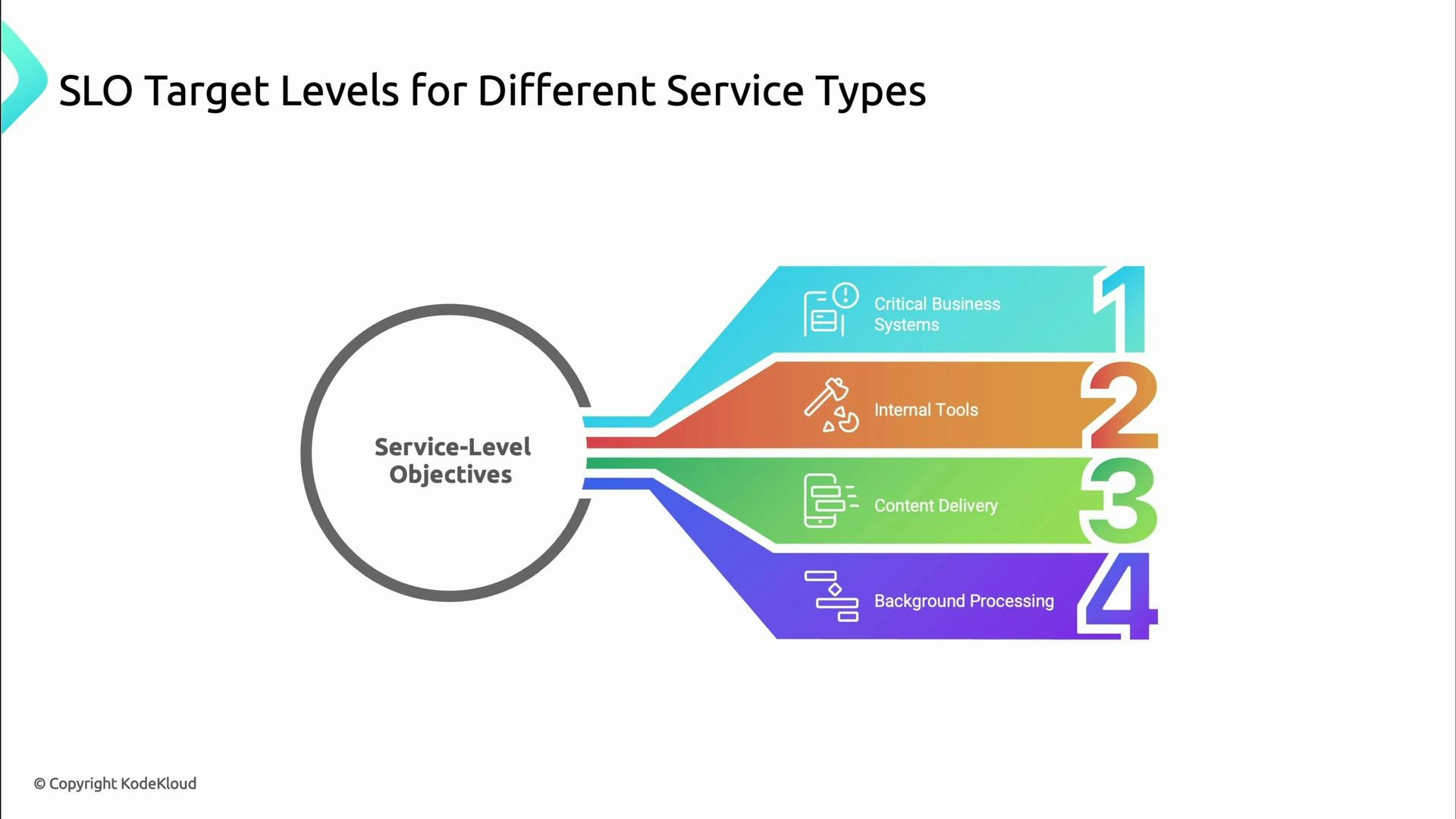
An infographic titled "SLO Target Levels for Different Service Types" showing "Service-Level Objectives" branching into four numbered, colored categories: 1) Critical Business Systems, 2) Internal Tools, 3) Content Delivery, and 4) Background Processing. Each category is represented by a colored ribbon and small icon indicating priority.
Operationalize SLOs with error budgets Error budgets translate SLOs into governance and operational policy. They enable teams to make explicit decisions about whether to prioritize feature velocity or reliability:
  • If the error budget is healthy, teams can safely ship features and experiments.
  • If the error budget is depleted, the team focuses on reliability work until the budget is replenished.
Use dashboards and automated checks to track SLO consumption, and define clear runbooks for error-budget breaches (e.g., reduce rollouts, increase QA, emergency fixes). Summary checklist for SLO development
  • Identify critical user journeys.
  • Define SLIs with precise measurement methods.
  • Set SLOs based on business impact and historical data.
  • Document rationale, assumptions, and measurement details.
  • Implement monitoring, dashboards, and alerting tied to SLOs and error budgets.
  • Review and iterate SLOs regularly with business stakeholders.
Links and references Further reading
  • How to measure latency percentiles and why p95/p99 matter for UX.
  • Error budgets: policy templates and runbooks.
  • Prometheus query examples for SLIs and SLO dashboards.