

Attack Scenario
An attacker exploits a vulnerability in your application or backend service to gain shell access inside a container. From this foothold, they move laterally to compromise other resources in the cluster.Compromised-Container Attack Tree
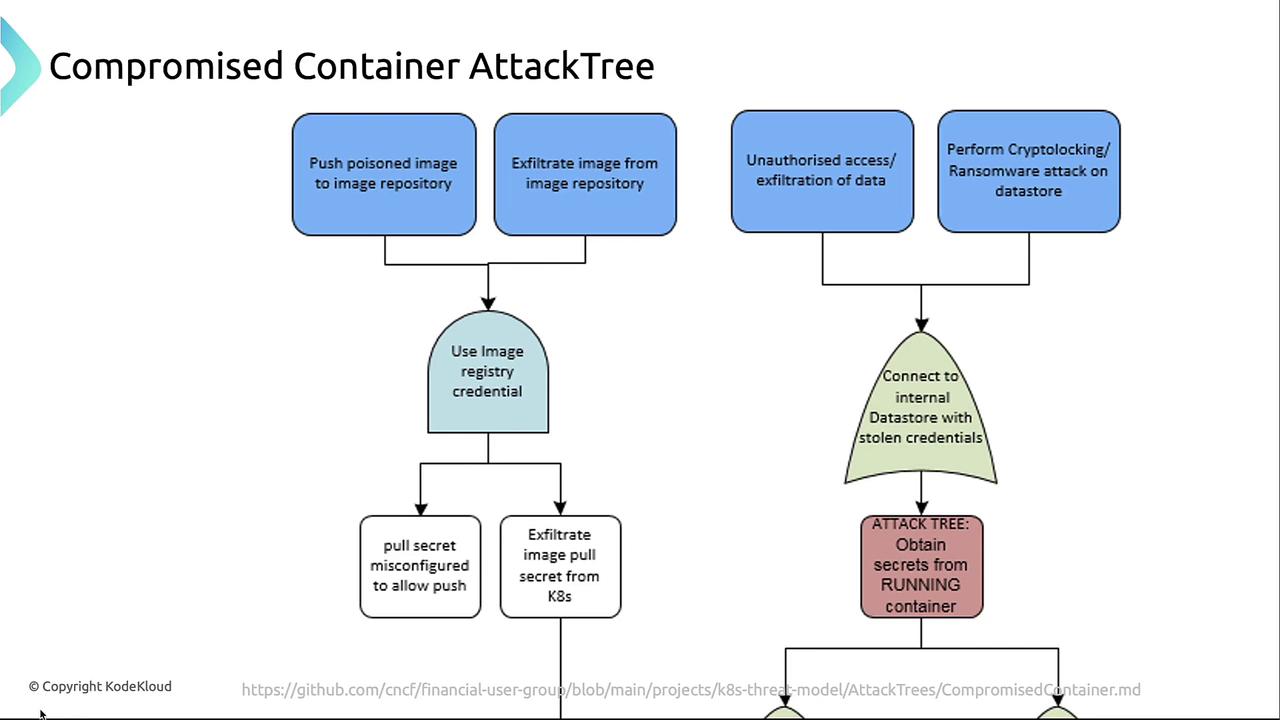
Credential and Secret Misuse
Attackers often exploit misconfigured Kubernetes secrets and image-pull credentials:- Pull-only secrets misconfigured for push
An image-pull secret accidentally granted push permissions lets attackers upload malicious images to your registry.
Misconfigured secrets can grant attackers both pull and push access to your container registry. Always follow the principle of least privilege.
-
Extracting secrets from Kubernetes
By deploying a malicious pod that mounts existing secrets, attackers gain immediate access to environment variables and service tokens. -
Attaching to a running container
If RBAC allows, an attacker can execute a shell inside a live pod and inspect its environment:This command exposes all mounted secrets and tokens visible in the container’s filesystem and env vars.
Escalation via the Kubernetes API
With a valid service account or user token in hand, attackers can abuse the Kubernetes API:- List and read Secrets
- Inspect or modify ConfigMaps, Pods, Deployments, and Services
- Create or delete resources to maintain persistence
- Potentially escalate to cluster-admin by exploiting overly permissive RBAC rules
Best Practices for Prevention
Regularly audit your cluster and registries to detect unauthorized changes. Consider tools like Kube-bench and Clair for ongoing security assessments.
Links and References
- Kubernetes Security Best Practices
- Docker Image Security
- HashiCorp Vault for centralized secret management