

This section starts with the basics of public key cryptography and certificate lifecycles. If you’re already familiar with these topics, you can skip ahead to the Kubernetes-Specific Topics further below.
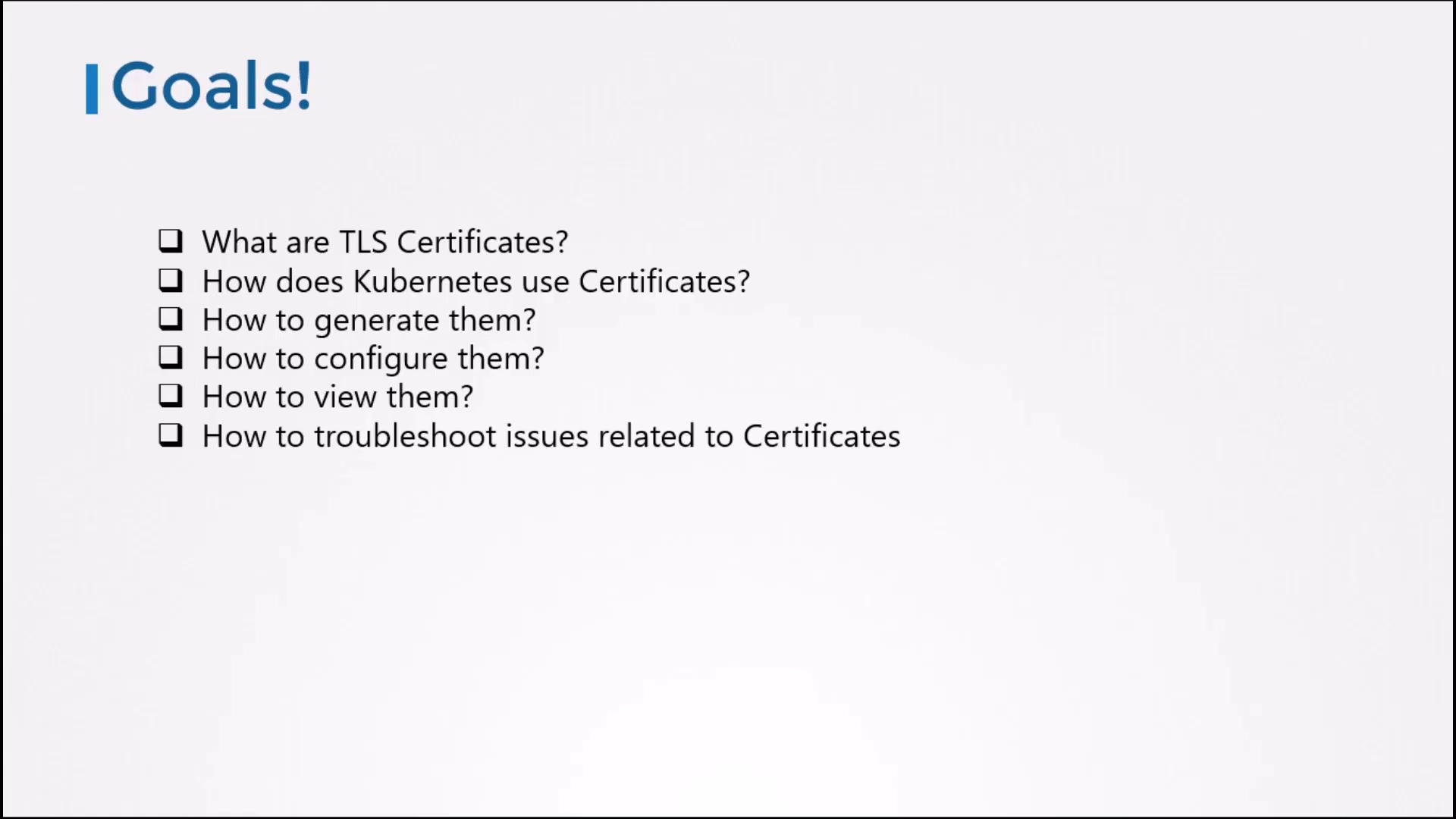
Goals for TLS Certificate Mastery
Prerequisites: Core TLS Concepts
- Public Key Cryptography: Asymmetric key pairs, digital signatures, and encryption.
- Certificate Authorities (CAs): Root vs. intermediate CAs, trust stores, and signing processes.
- Certificate Lifecycle: Creation (CSR), issuance, renewal, and revocation.
Ensure that
openssl (version 1.1 or higher) is installed on your system. Certificate operations in this course rely on OpenSSL commands.Kubernetes-Specific Topics
Once you’ve reviewed the TLS fundamentals above, the following Kubernetes-focused lectures will explore:- API Server and kubelet certificates – How Kubernetes generates and rotates its own certs.
- Mutual TLS (mTLS) – Implementing service-to-service authentication within a cluster.
- Cert-Manager integration – Automating certificate issuance and renewal.
- Troubleshooting TLS in real clusters – Common errors, log analysis, and remediation steps.