

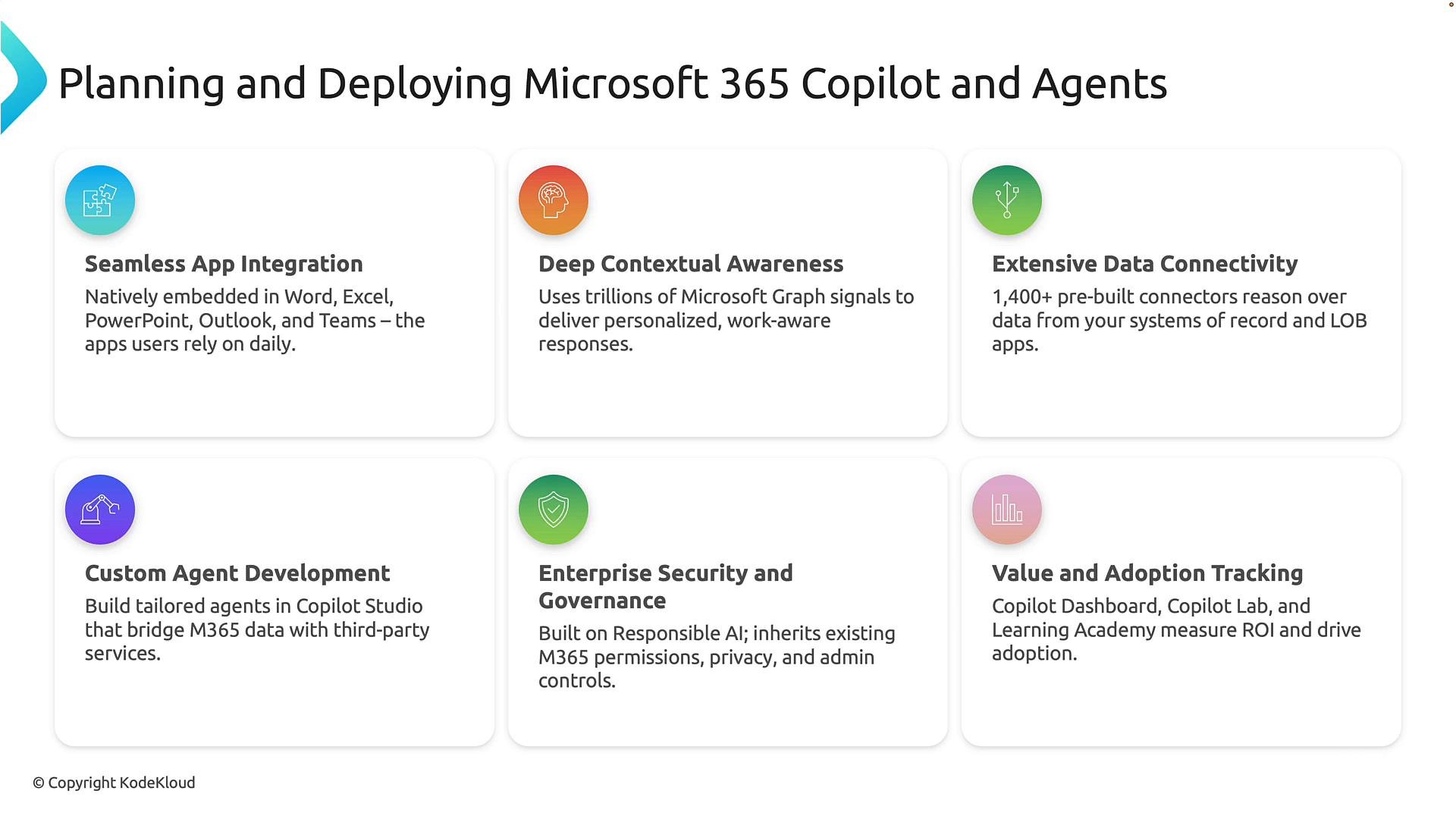
- Seamless app integration: Copilot is embedded in Word, Excel, PowerPoint, Outlook, and Teams, so users interact with AI inside familiar workflows—reducing training friction and accelerating adoption.
- Context-rich responses: Copilot uses Microsoft Graph signals from emails, meetings, chats, documents, and calendars to produce personalized, relevant output that reflects the user’s recent workplace context.
- Broad connectivity: Over 1,400 pre-built connectors let Copilot and agents access CRM, HR, ITSM, finance, and other systems so they can reason over data outside core Microsoft 365.
- Extensible automation: Copilot Studio supports building custom agents that incorporate business logic, third-party services, and multi-step workflows for process automation.
- Enterprise-grade governance: Agents inherit Microsoft 365 permissions, privacy controls, compliance policies, and admin governance so data access respects established boundaries.
- Measurable adoption and value: Administrative tools and telemetry let leadership monitor usage, identify high-value scenarios, and measure ROI.
- Copilot appears inside the apps people already use, minimizing context switches and helping teams adopt AI features more quickly. Plan training and change management material in-app (short tips, suggested prompts).
- Microsoft Graph supplies signals from emails, meetings, chats, documents, and calendars so responses are personalized and actionable. Example: when preparing for a customer meeting, Copilot can combine recent emails, meeting notes, related documents, and calendar context.
- Use pre-built connectors to bring CRM, HR, finance, and other systems into Copilot’s reasoning. This lets agents fetch authoritative data (e.g., customer records, invoice status) without copying sensitive information into chat.
- Copilot Studio enables building agents that combine Microsoft 365 context with custom actions and third-party services. Example use case: a procurement agent that accepts purchase requests, checks approval status, and retrieves supplier details from your ERP.
- Copilot and agents respect Microsoft 365 permissions, compliance policies, and admin controls so users only access data they are authorized to view.
Copilot respects existing Microsoft 365 access controls and compliance settings—agents do not circumvent permission boundaries.
- Configure admin telemetry to monitor usage, identify high-value scenarios, and measure ROI. Use adoption metrics (active users, frequency, time saved) to prioritize scaling and training.
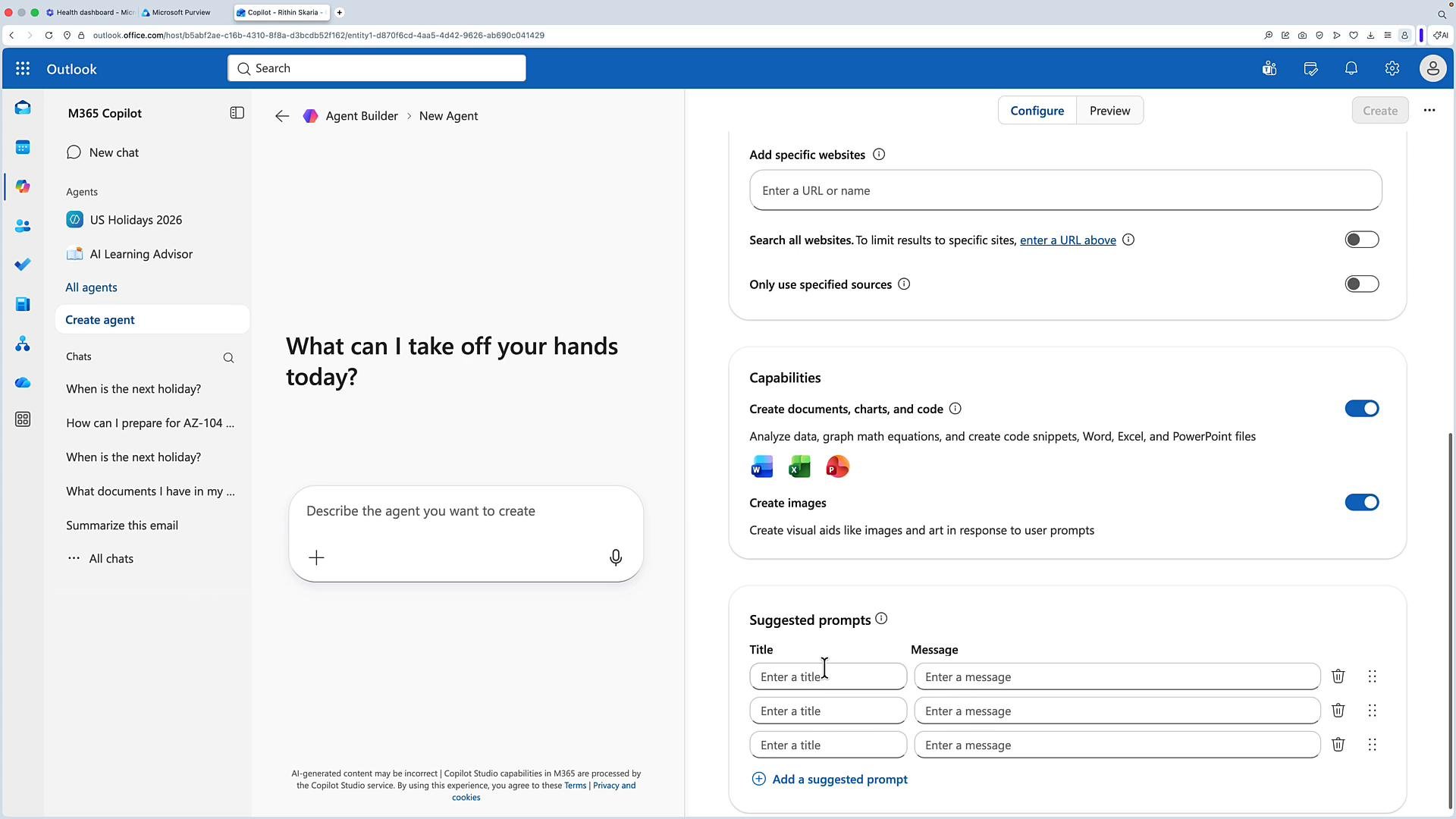
- Click Create agent and choose “Skip wizard” to go directly to configuration.
- Complete the required fields:
- Name: a concise identifier for the agent.
- Description: a short summary of the agent’s purpose and scope.
- Instructions: operational guidelines controlling tone, behavior rules, allowed actions, and guardrails (for example, require a legal question to be escalated to qualified staff).
- Add knowledge sources:
- Index public websites, internal SharePoint sites, or URLs that the agent should reference.
- Enable capabilities and integrations:
- Toggle Microsoft 365 capabilities (document creation, image generation, Excel interactions) and enable connectors to external systems as needed.
- Provide suggested prompts:
- Add starter prompts or follow-up templates so end users know how to interact with the agent and get consistent results.
- Test iteratively:
- Use preview and test tools to validate outputs, refine instructions, and confirm connectors are returning expected results.
- Multi-step workflows: chain actions, conditions, and data transforms for end-to-end automation.
- Connectors and custom actions: integrate third-party APIs or internal services for authoritative responses and transactions.
- Testing and iteration: run sandboxed tests, collect conversation traces, and refine instructions and data sources before broad deployment.
- Define pilot scope and success metrics (e.g., time saved, tickets reduced, approval process time).
- Map data sources and required connectors.
- Establish governance: RBAC, DLP, retention, and escalation procedures.
- Create training materials and suggested prompts for end users.
- Configure telemetry and dashboards for adoption and ROI tracking.
- Iterate: use pilot feedback to improve prompts, instructions, and connectors.
- Microsoft Graph documentation
- Microsoft 365 Copilot documentation
- Copilot Studio guidance (check your tenant’s documentation for availability and admin controls)